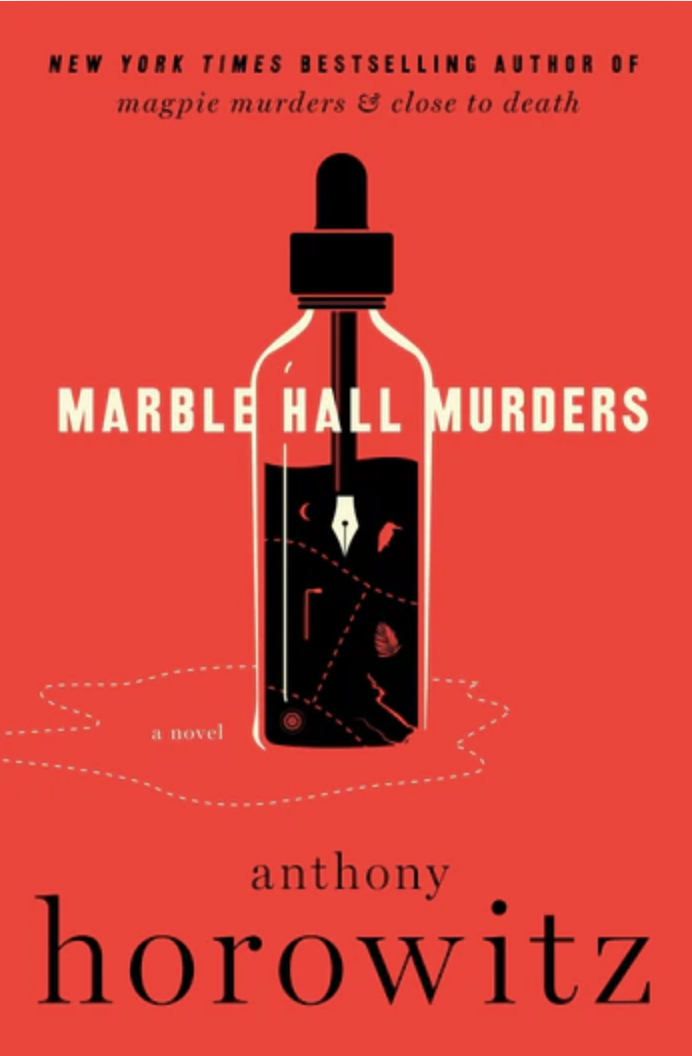
Marble Hall Murders by Anthony Horowitz (Mystery)

Number three in the Susan Ryeland series (after Magpie Murders and Moonflower Murders — both now streaming on Masterpiece). Susan was the editor of the fantastically successful Atticus Pünd detective series — from inception until disastrous events brought the series to an end. You’d think she would have had enough, but dire straights lead her to accept a job editing a continuation novel, written by Eliot Crace — a well-known loose cannon who is nevertheless blessed with a beloved children’s author as a (now deceased) grandmother.

It’s a classic story-within-a-story format — we’re reading the Crace novel as fast as he produces pages while simultaneously reading Ryeland’s story as she keeps sticking her nose into the author and the story, which continues to mirror reality to an uncomfortable extent. The two stories dovetail in weird and twisted ways and I never saw what was coming, though the clues were all there. I love Horowitz’s writing — clear and concise and bringing characters to life with minimal, essential, prose. The mystery (two in parallel really, one fictional and one not) is excellent on its own, but I also loved the meta layer exposure of the literary world — how writers write, the relationship between author and editor, and basic survival tips for the publishing industry. It’s full of anagrams, ethical discussions, and deliciously clever (albeit often evil) moves. I always appreciate a book that has no stupidity — intentional or not — in its pages!

Some facts new to me: According to the Authors, Licensing and Collecting society, the average salary earned by a novelist is a mere 7,000 pounds a year — not a lot (not even a little, really). There are around 200,000 books published in the UK every year ( and as many as 1 million in the USA) and as Horowitz writes: “How many of them do you really think are going to end up on the front table at Waterstones?.” Lastly, I had never heard of the Nazca lines in Peru — giant geoglyphs in a Peruvian desert dated between 500 BC and 500 AD that are so large they can be seen from space (for those who have read it, this reminded me of Vonnegut’s Sirens of Titan.

Easy read, completely engaging, and (IMHO) book clearly better than the Masterpiece series (which itself is very good, but the book is better)

Thank you to Harper and NetGalley for providing an advance copy of this book in exchange for my honest review. The book will be published on May 13th, 2025.

The Boxcar Librarian by Brianna Labuskes (Historical Fiction)

Writing: 4/5 Plot: 5/5 Characters: 5/5

Loved this historical fiction centered in Montana in the early 1900s. Three timelines for three characters that slowly converge: Millie Lang (1936), exiled to Missoula to “fix” the state’s contribution to the depression era American Guide Series, sponsored by the Federal Writers Project of the WPA. Alice Monroe (1924), small town Missoula librarian born to wealth, who works to get more books into more hands via rural visits. Colette Durand (1914), daughter of a Shakespeare loving union organizer for the miners employed by the Anaconda Mining Company.

An excellent cast of supporting characters, lots of action and surprising plot twists, well-researched details of the time period, and plenty of interesting locations (e.g. Glacier National Park, Wild Horse Island in Flathead Lakes, Missoula mining camps) — all vividly brought to life. Lots of literary references, both in terms of very apt quotes and individual books for an assortment of characters and the real impact they had. Really demolished the stereotype of the “lower classes” being uninteresting in learning and mind expansion. She handled themes of vengeance, injustice, and restrictions on and expectations of women adroitly with real reflection on how to know what “doing the right thing” means, and what it might cost. Loved the Boxcar library itself (apparently you can see the Lumberman’s library box car in Fort Missoula — I may take a trip!)

A great read!

Some quotes:

“Everyone had a story, and most people were just trying to get by. They didn’t deserve to become empty vessels to hold other people’s anger and insecurities.“

“So did writers. They saw the extremes in life as appealing – tear courage, fear, and strength, love and hate. They were what made humans human. But Millie didn’t think of herself as a writer. She thought of herself as a journalist. She was there to tell other people’s stories.”

Thank you to William Morrow and NetGalley for providing an advance copy of this book in exchange for my honest review. The book was published on March 4th, 2025.

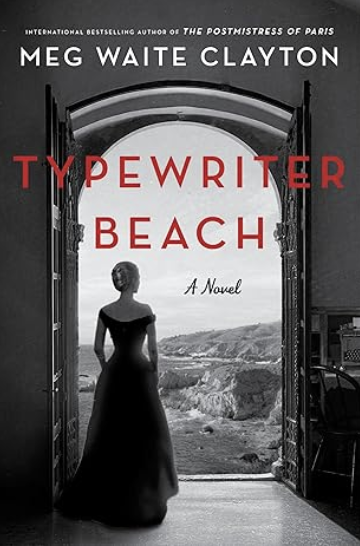
Typewriter Beach by Meg Waite Clayton (Historical Fiction)

I really warmed up to this book — it started off a little slowly and then became more and more intriguing with every chapter, ending with a lovely last line to cap it all off.

Dual timelines — an isolated set of cottages on the beach at Carmel in 1957. During the darkest times of McCarthy’s blacklists and the slow strangulation of Hollywood, a young starlet on the verge of being the next Grace Kelly is sent to wait in one of these cottages by the studio manager and all around fixer. Told to stay indoors and not be seen, she nevertheless meets her neighbor, the enigmatic Leo — a black listed scriptwriter with a haunted past. In 2018 we follow Gemma, whose beloved grandfather has just died and left her his cottage.

The story slowly unfolds, past to present, and while I often thought I knew what was happening, I was often quite wrong. The writing style is rich with thought provoking commentary and reflections. Hollywood — the deals, the norms, the restrictions, the cheats — is on display with all of the detail that I love — not just a description of events, but a description of the people living through those events and how they are changed, what they do to survive, what decisions they make (and sometimes regret, and often don’t). It’s the full experience and incredibly well-researched. I learned a lot about the different ways people dealt with the blacklist and (of course) the very different ways men and women had to deal with opportunities, threats, and restrictions.

Along with this spectacular depiction of the times and contexts is a lovely and often surprising story of love, family, parenthood, and friendship. I don’t want to give anything away, but there are multiple lovely stories of people finding love and family in a world not inclined to make it easy for them. Plenty of stories of people living in an environment not of their choosing and not in their control — and yet … finding their happiness.

Lots of intriguing details on Carmel and Hollywood — late credits for blacklisted screenwriters, a form of “me too” throughout the ages, morals clauses (for women only). I enjoyed every minute of it.

Thank you to Harper and NetGalley for providing an advance copy of this book in exchange for my honest review. The book was published on July 1st, 2025.