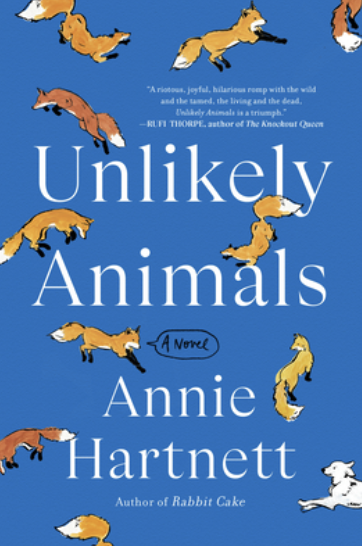
Unlikely Animals by Annie Hartnett (Literary Fiction)

Writing: 4/5 Plot: 5/5 Characters: 5/5

Wonderfully fun and engaging book — one of the most creative I’ve read in a long time.

Emma was born with “The Charm” — magic hands that could heal injuries in her small New Hampshire community. But the charm appears to have deserted her as she is called back from medical school (which she never exactly started) to “heal” her rapidly declining father. As part of his degenerative brain disease, he sees things — hordes of rabbits, stray cats, and a long-dead naturalist (Ernest Harold Baynes — the real life Dr. Doolittle!) who keeps him company. You would assume these were all hallucinations but then the narrator of the book is the collective “we” of the local grave dwellers who provide occasional opinionated commentary on events. And from here it just gets weirder and more fun. Despite tackling a number of disturbing issues: the opioid crisis, degenerative brain disease, a missing person, and drastic and unintentional life plan changes, this novel is always cheerful and always fun. A highly responsible stray dog, an expensive imported Russian fox, and some pretty adorable 5th graders join the living and the dead in the cast.

Some random fun quotes:
“That’s why we like living with animals so much; they exhibit their joy so outwardly, remind us how to be better alive.”

“Emma found that Moses had ripped open a bag of flour on the couch, another way the dog was dealing with his separation anxiety: challenging himself to make messes that were increasingly difficult to vacuum up.”

“Auggie rolled his eyes toward his skull, and Emma regretted hoping Auggie could pull his life together. In fact, she didn’t care if anything good ever happened to him.”

“It was her wedding china, but she didn’t care. Her marriage wasn’t doing her any favors lately.”

“And Clive knew he was loving, really loving, when he remembered to be.”

“Nothing to be embarrassed of. Just the imperfect human body having a hard time.”

Thank you to Ballantine Books and NetGalley for providing an advance copy of this book in exchange for my honest review. The book will be published on April 12th, 2022.

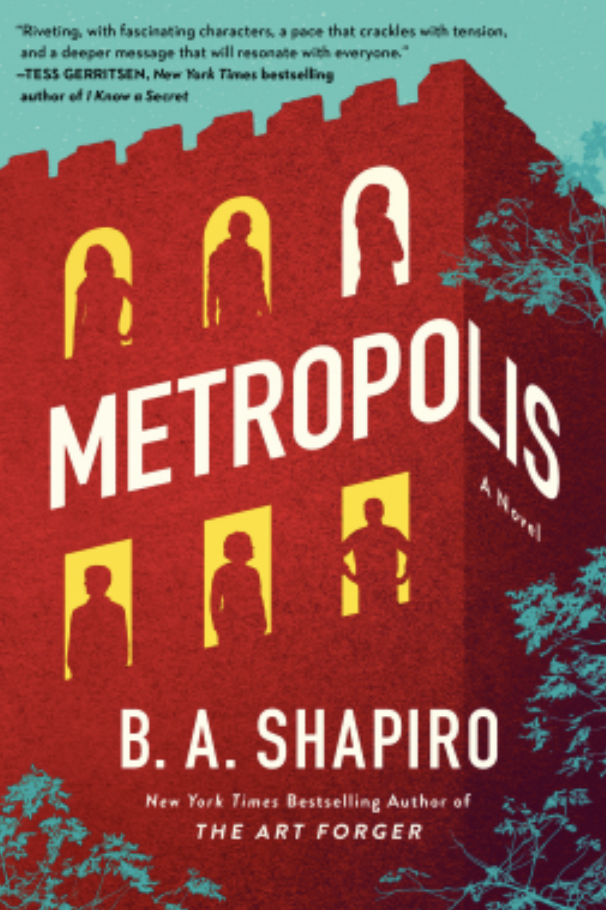
Metropolis by B. A. Shapiro (Literary Fiction)

Plot: 3.5/5 Characters: 4/5 Writing: 4/5
The Metropolis is an old fashioned self-storage unit in Boston — with variable sized units many of which have windows. The best part of this book is the peek into the lives of those who have found themselves in need of excess storage space and the way they use said space. Liddy Haines, wife of the uber wealthy (and not terribly nice) Garrett Haines, keeps her children’s things in the unit when they are shipped off to boarding school courtesy of the not-nice daddy; Jason, the black Harvard educated lawyer who found himself at odds with his corporate employer, houses his office there; Marta, a beautiful Venezuelan on the run from ICE, has moved in, feverishly focussing on her Sociology PhD thesis on how disparities at birth play out in life; and Serge, a brilliant and increasingly mentally disturbed photographer.

The unit is owned by Zach as an effort to go legit and managed by Rose who has her own set of issues. Everything is going along tickety-boo until an “incident” occurs in the unit elevator…

I love the premise of the story — who doesn’t think about all the diverse lives contained in such a collection of rooms with no other commonality? The characters were well-drawn and relatable, though I found their situations were all over-the-top and each was a little tropish. I always love her art commentary, in this case focused on Serge’s extraordinary photographs.

A fun read!

Thank you to Algonquin Books and NetGalley for providing an advance copy of this book in exchange for my honest review. The book will be published on May 17th, 2022.

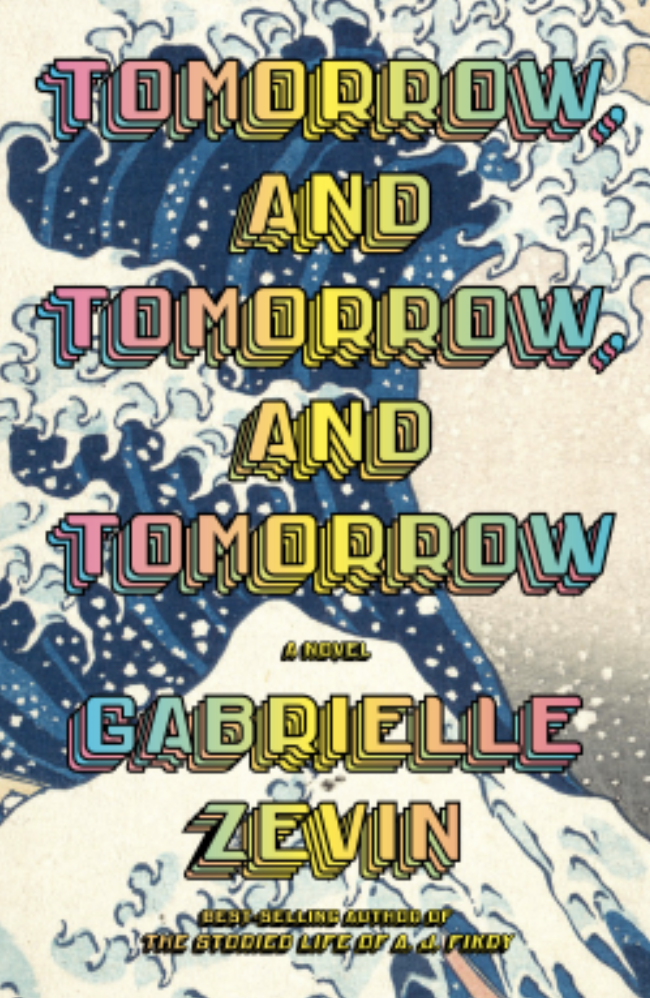
Tomorrow, and Tomorrow, and Tomorrow by Gabrielle Zevin (Fiction)

Writing: 4/5 Plot: 4.5/5 Characters: 5/5

Immersed in the Gaming world, this novel follows two childhood best friends who alternate periods of estrangement and brilliant (and wildly successful) collaborations in game design over a thirty year period. Sam and Sadie meet in a hospital when they are twelve years old — she is visiting her cancer-fighting older sister, he is recovering from a terrible car accident which has crushed his foot. She is the first person he has spoken to in the six weeks since the accident.

In the gaming world, you always have a tomorrow — you never really die — and this contrast between the imaginative worlds they create and play in and the experiences of the real world in which they dwell figures highly. Moral and ethical dilemmas, a good long story with plenty of twists and turns, and (most importantly to me) characters that you like, even when they are actively disliking each other, make this book worth reading. I’m a Zevin fan so there was no surprise in my enjoyment.

I’m not a gamer or someone who is even remotely interested in online or video games, but this did not impact my enjoyment of the book at all. At heart it’s about people and relationships, and I did enjoy the descriptions of the games and the creative process that generated them — even if I have no desire to ever play them! If you are a gamer, I would imagine it would enhance the experience.

Some fun new words (for me):
cicerone — is an old term for a guide who conducts visitors and sightseers to museums, galleries, etc. and explains matters of archaeological, antiquarian, historic or artistic interest.
torschlusspanik — gate shut panic — fear that time is running out and you’ll miss the opportunity

Some fun quotes:

“She had once read in a book about consciousness that over the years, the human brain makes an AI version of your loved ones. The brain collects data, and within your brain, you host a virtual version of that person. Upon the person’s death, your brain still believes the virtual person exists, because, in a sense, the person still does.”

“Ands what is love, in the end? Except the irrational desire to put evolutionary competitiveness aside in order to ease someone else’s journey through life?”

“Sam experienced his body as an antiquated joystick that could reliably move only in cardinal directions.”

“The way to turn an ex-lover into a friend is to never stop loving them, to know that when one phase of a relationship ends it can transform into something else. It is to acknowledge that love is both a constant and a variable at the same time.”

“The conversation was an ouroboros of inaction that they dutifully repeated every couple of months.”

“Sadie felt a swelling of love and of worry for him — what was the difference in the end? It was never worth worrying about someone you didn’t love. And it wasn’t love if you didn’t worry.”

“Sadie was, by nature, a loner, but even she found going to MIT in a female body to be an isolating experience.”

Thank you to Knopf Doubleday and NetGalley for providing an advance copy of this book in exchange for my honest review. The book will be published on July 12th, 2022.

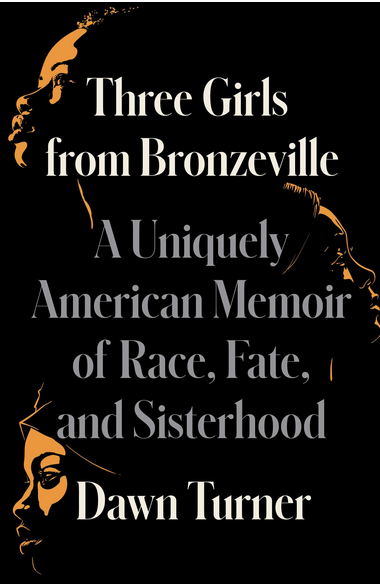
Three Girls from Bronzeville: A Uniquely American Memoir of Race, Fate, and Sisterhood by Dawn Turner (Memoir)

Incredibly well-written memoir by prize winning journalist Dawn Turner. I listened to this on audio books, and the reader — Janina Edwards — was fabulous. I’m not an audio book fan, but it’s hard for me to imagine this book without her voice.

The memoir covers Turner’s life from her earliest memories (late sixties) to the present. Her experiences shaped her lifelong passion for exploring and understanding how people manage to change their lives — a theme that pervaded her journalistic career. The titular “three girls” refers to herself, her younger sister Kim, and her childhood best friend, Deborah, who lived in the apartment literally right above her. While Turner stuck to the straight and narrow path of good behavior, education, and vocation, Kim and Deborah made a different set of life decisions leading one to an unnecessary early grave and the other to a long prison sentence. But while this could be seen as a morality tale, that is not Turner’s intention or focus. She is far more focused on who gets second chances and who is able to make the most of them. Some of the stories she tells in her columns are both inspiring and helped me have a better understanding of the different individuals who find themselves (due to whatever set of circumstances and bad choices) at rock bottom and what some manage to do about it. I was a little disappointed that the book did not address why some people make bad choices when presented with the same opportunities as those who don’t — all three of our Bronzeville girls grew up with strong and supportive families and educational opportunities — what happened? However, Turner’s focus is on the other side — once someone is far off their chosen path, what can they do to redeem themselves and get back onto a more positive track — regardless of how impossible it may seem.

This book was full of exquisitely written and deeply meaningful quotes — I wish I had been able to capture and share them, but unfortunately that is one downside of listening to, rather than, reading a good book! Not easy to highlight!

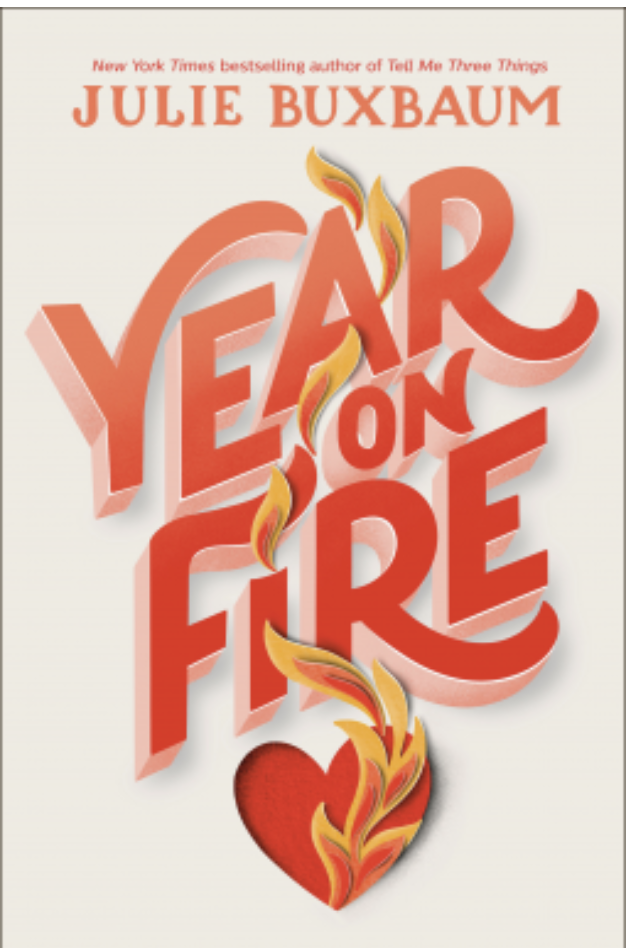
Year on Fire by Julie Buxbaum (Young Adult)

Writing: 4/5 Characters: 4/5 Plot: 4/5

A quartet of students at the elite Los Angeles Wood Valley High School — each facing their own coming-of-age difficulties. Twins Immie and Archer, so close they tend to think conjoined thoughts; Paige, the strong, fearless, and ultra-competent; and Rohan, newly arrived from London with his father as a result of some pretty serious marital discord. And around them fires always seem to be burning — one wildfire after another and even a fire within the school itself as a none-too-subtle reminder of the fires that are raging within.

The dramas that comprise the story are more-or-less typical dramas faced by teens today — some run-of-the-mill first kisses, small betrayals, secrets (all still deeply felt regardless of their commonality) as well as a good array of home situations — all problematic in their own never over-the-top but nevertheless deeply felt way. I am impressed by the way Buxbaum treats these situations and experiences directly from the perspective of the student characters — each of whom have their own personalities and coping mechanisms. We are treated to their anger, sadness, confusion and the sometimes slow realization of their own parents as individuals with their own flaws and capacity for error.

Well-written with plenty of slowly gained insight and fun dialog / text streams.

Thank you to Delacorte Press and NetGalley for providing an advance copy of this book in exchange for my honest review. The book will be published on April 12th, 2022.

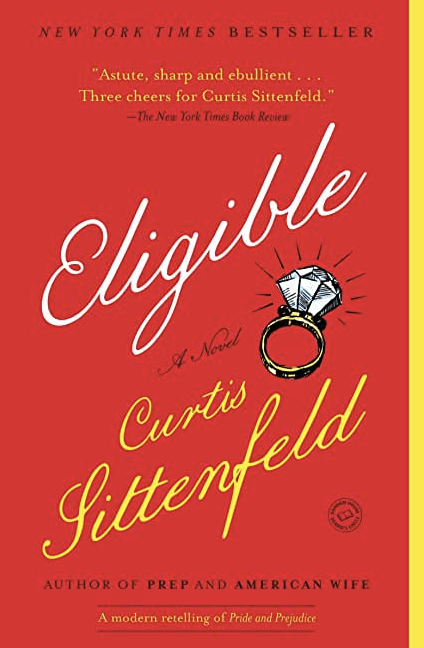
Eligible by Curtis Sittenfeld (Literary Fiction)

Writing: 5/5 Characters: 4.5/5 Plot: 4.5/5

A retelling of Austen’s popular Pride and Prejudice: Sittenfeld did a masterful job at “modernizing” the characters while keeping their essential personalities and issues intact. (As a quick recap, one could summarize P & P as about a family with five daughters that tries to marry them off, although the book is much more interesting than that). Jane, the eldest, at 40 is trying to have a baby via artificial insemination, while Liz (#2) has been dating a married man, having been led on for decades. While Jane and Liz both live in Manhattan, they are home in Cincinnati to help care for their father who is recovering from a heart attack. It is from this setup that they meet newly local doctors Chip Bingley and Fitzwilliam Darcy. What follows is hysterically funny and completely engaging, including Reality TV shows, tech millionaires, Atherton estates, and — wait for it — a trans husband. My absolutely favorite part, though, oddly enough, is Mr. Bennet with his ROFL sardonic one liners.

Sittenfeld is a seriously good writer. While this review may make this sound like a light weight beach read, it really goes much deeper than that — full of the insight, reflection, and social commentary featured in the original. I guess I’m going to have get over my prejudice against modernizations because this was hilarious, fun, and a good piece of literature. Put me in a great mood for the New Year.

Quotes:
“There’s a belief that to take care of someone else, or to let someone else take care of you — that both are inherently unfeminist. I don’t agree. There’s no shame in devoting yourself to another person, as long as he devotes himself to you in return.”

“The truth, however, was that he did not seem egomaniacal to her; he seemed principled and thoughtful, and she felt a vague embarrassment that she worked for a magazine that recommended anti-aging creams to women in their twenties and he helped people who’d experienced brain trauma.”

“At the table, Caroline was on Darcy’s other side and had spent most of the meal curled toward him in conversation like a poisonous weed.”

“Liz felt the loneliness of having confided something true in a person who didn’t care.”

“‘Fred’, the nurse said, though they had never met. ‘How are we today?’ Reading the nurse’s name tag, Mr. Bennet replied with fake enthusiasm, ‘Bernard! We’re mourning the death of manners and the rise of overly familiar discourse. How are you?’”

It occurred to Liz one day, as she waited on hold for an estimate from a yard service, that her parents’ home was like an extremely obese person who could not longer see, touch, or maintain jurisdiction over all of his body; there was simply too much of it, and he — they — had grown weary and inflexible.”

The Best Reading of 2021 (for me)

Skip to the category you favor if you don’t want to read them all! Search this site if you’d like to see the more complete review of each — I’m too lazy to put in all of the links.

NON-FICTION:
• Facing the Mountain By Daniel James Brown — The acclaimed author of The Boys in the Boat (which I loved) tackles Japanese Americans in WWII — both those interned in camps following FDRs Executive Order 9066 and those who served in the military’s 442nd Regimental Combat Team — the single Japanese American unit, which also happened the most highly decorated.
• Her Honor by LaDorris Hazzard Cordell — Well-structured and fascinating memoir of Cordell’s experiences as a Judge in Northern California.

LITERARY FICTION:
• Early Morning riser by Katherine Heiny — The biting inner commentary of a second grade Michigan school teacher following an unexpected path through her own life.
• The Human Zoo by Sabina Murray: Filipino-American writer Christina Klein (Ting) travels back to the Philippines — ostensibly to write a book about an episode in Filipino history featuring a headhunter tribe’s role in Coney Island’s “human zoo.”
• The Night Watchman by Louise Erdrich: The novel is based on the experiences of Erdrich’s grandfather, Patrick Gourneau, in his determined fight against the proposed termination of his Turtle Mountain Band of Chippewa named in House Concurrent Resolution 108 passed in August of 1953. Profound, brilliant, amazing, etc. — have been rendered meaningless through overuse. So just think about what they used to mean and apply here.
• The Sentence by Louise Erdrich: A Minneapolis bookstore is haunted by its most annoying (and recently deceased) patron. It’s not just any bookstore — it’s Birchbark Books — the very real bookstore owned by none other but the author herself who makes cameo appearances in the story. It’s a tender, multi-faceted story with characters that are so real, so nuanced, and so vibrant it made me cry to know that I would never actually be able to meet them.
• Horse by Geraldine Brooks: Rich, insightful fictionalized history of slavery, a champion racehorse, and the modern day research tools that bring the story to life.
• Dictionary of Lost Words by Pip Williams: Motherless Esme grows up in the Scriptorium (OED prime editor James Murray’s repurposed garden shed) playing under the table as her father and other lexicographers labor over entries for the decades long effort that will result in the magnificent Oxford English Dictionary.
• Vinegar Girl by Anne Tyler: a recast of Shakespeare’s Taming of the Shrew — brilliant, witty, impossible to put down and with a completely different set of messages (we like the “shrew” from the beginning).
• American Wife by Curtis Sittenfeld — Fiction loosely based on the life of Laura Bush (the names have been changed to protect the innocent!). Very, very, well-written.
• Maud’s Line by Margaret Verble — Beautifully written, eye-opening, 1926 Cherokee life for young girl who wants more out of life.
• Booth by Karen Joy Fowler: A fictionalized history of the Booth family from 1822 to 1865 when its most infamous member — John Wilkes — shot Abraham Lincoln. John Wilkes is kept as an important but minor character throughout until his action at the end tears everything apart. Great breadth of character and story.

FICTION:
• This Time Tomorrow by Emma Straub — Bizarre, upper West Side, limited time travel story with good insight and character depth.
• In the Wild Light by Jeff Zentner — coming of age story, from rural East Tennessee to elite private high school scholarship. Clashing experiences and values.
• Lessons in Chemistry by Bonnie Garmus: Elizabeth Zott — master chemist — trying to do science in a late 50s / early 60s world that treats women as incapable, inferior, and irrelevant. But don’t worry about her — she gets places and keeps us laughing the whole way. Fun!
• Bloomsbury Girls by Natalie Jenner: great story that manages to combine a fascinating bit of history and early feminism with a literary mystery, historically accurate relationships, insightful writing, in-depth characters, and some great historical characters tossed in (Peggy Guggenheim, Daphne DuMaurier, Samuel Beckett to name a few)
• Adult Assembly Required by Abbi Waxman: A light and fun novel that allows us to inhabit a happy, kooky world full of lovable characters with more intellectual curiosity than I typically expect in this genre.
• Apples Never Fall by Liane Morarity: Impossible to put down, this is a twisted, gripping, family drama / mystery that explores the violence and cruelty as well as the compassion, kindness, and personal development of ordinary people.
F&SF:
• A Spindle Splintered by Alix E. Harrow: Zinnia Gray of Ohio is the Dying Girl. Afflicted with GRM — a malady that always kills before its victims reach 22 — she has become obsessed with all things Sleeping Beauty (a girl with very similar problems). What follows is a funny and piercingly acute adventure through alternative narratives where an array of women try to alter the “crap” storylines they were given.Clever and funny with plenty of gender benders, surprise twists, and sass.

MEMOIR:
Marry Him by Lori Gottlieb — Hysterically funny and simultaneously insightful memoir on middle age dating
MYSTERY:
• A Sunlit Weapon by Jacqueline Winspear: Historical mystery at its best. Winspear’s Maisie Dobbs (a “psychologist and investigator” well connected with both the war office and the local chapter of Scotland Yard) continues to solve complex crimes while the timeline moves from early WWI (the first volume) through 1942 (WWII) in this 17th installment. The plot of A Sunlit Weapon centers around the women pilots who comprise the Air Transport Auxiliary (ATA).
WOMEN’S FICTION:
• The Heart Principle by Helen Hoang — a deeply reflective novel that masquerades (well!) as a steamy romance.
YOUNG ADULT:
• The Poet X by Elizabeth Acevedo — A novel-in-verse coming-of-age story about an Afro-Latina teenager with an intensely religious immigrant mother and a father who is absent even in his presence.

Horse by Geraldine Brooks

Writing: 5/5 Plot: 4.5/5 Characters: 5/5

A fictionalized history of the great racehorse and leading stud sire Lexington. The story is told through three alternating voices in two time periods (2019 and the 1850s): Theo, the well-mannered and highly principled mixed-race art history student, who discovers an old equestrian painting in a neighbor’s throw away pile; Jess, an Australian zoologist who finds herself articulating skeletons for the Smithsonian; and Jarret, the enslaved person who was with Lexington from birth to death as groom, trainer, and best friend.

It is a rich story full of insight into individuals and loaded with in-depth domain knowledge about a variety of professions and interests across time — the art world, the world of research, museum administration and networks, and of course the complete world of horse racing in the 1850s (which, even though I am not interested in horse racing at all, is completely fascinating).

While the primary characters were fictional, most of the others — artists, art dealers, race horses, trainers, grooms, and owners — were not. Cassius Clay (the first one, not Muhammad Ali) and Martha Jackson make significant appearances in this tale that blended so much history and showed the utter connectedness of individual stories throughout time.

It is a story suspended in racial issues and the nature of tentative friendships across racial divides. From slavery to the modern day micro-aggressions and biases that Theo experiences as an educated man of color in Washington, D.C., Brooks captures the inner thoughts of those involved including the “friendly” whites. The slavery she depicts goes farther than the traditional stories of beatings and rapes and delve into the realms of individual feelings, attitudes, and coping mechanisms. Spanning the Civil War, we see the confusion, the anger, and the value different people put on different aspects of life.

Brooks goes farther in drawing a parallel between the treatment of slaves and the treatment of the horses. Treating humans like animals is appalling, but she points out that even animals should not be treated as they were (see quote below). Jarret saw Lexington as a sentient being with talents, preferences, and fears. It is clear that Lexington would not have achieved what he did without this different kind of relationship. This is beautifully done.

My only annoyance with the book (which I’ll try to explain without spoilers) is the end of Theo’s story. Up to that point, the experiences of black characters could be said to be typical experiences of the time. Theo’s ending was very atypical and — unlike the rest of the book — was intended to shock rather than to teach. For me it didn’t fit and it didn’t add anything to the main themes of the book.

That aside — beautiful writing, meticulously researched, thoughtful treatment of difficult topics — a masterpiece of a book by Pulitzer Prize winning author Geraldine Brooks.

Quotes:

“An empathy grew in him. He began to watch people with the sensitive attention he’d only ever accorded his horses.”

“Theo shifted in his seat. He imagined she would file the exchange away as an example of how easy it was to offend a Black person. He felt irritated and suddenly exhausted.”

“He conceived, in those hard days, a renewed gratitude toward his father, who had endured hardship to rise to a measure of dignity that had extended its protective cloak over Jarret’s childhood. He learned, in those fields, what he had been spared. He felt a new understanding for the folk who bore it, and an admiration for those brave enough to risk everything to run away from such a life.”

“Because it had been his whole life, Jarret had never realized what it meant to be skilled at something that was highly valued. Now, he was merely a pair of hands, the same as any other.”

“The strong and the weak, she thought. Predator, prey. Nature’s way. God’s way. Even the Bible patriarchs had slaves. Who is Jarret to stand against it in this foolish, headstrong way, when even his own father, who is most injured in the business, accepts it? Why should she sit and shiver in the dark on his account.”

“It was impossible not to find in this picture an equivalence between the men and the horse: valued, no doubt, but living by the will of their enslaver, submitting to the whip. Obedience and docility: valued in a horse, values in an enslaved human. Both should move only at the command of their owner. Loyalty, muscle, willingness — qualities for a horse, qualities for the enslaved. And while the horse had two names, the men had only one.”

“His argument mirrored Frederick Douglass’s caustic essay arguing that no true portraits of Africans by White artists existed; that White artists couldn’t see past their own ingrained stereotypes of Blackness.”

“But Jarret thought both his father and Dr. Warfield treated horses like mechanical contraptions: do this, get that. Jarret disagreed, but had never said so. To speak of horses as beings with feelings, even souls — it might seem like foolishness, or even maybe sinful, in the eyes of the angry God of the White church Dr. Warfield attended.”

“Jess loved the interior architecture of living things. Ribs, the protective embrace of them, how they hold delicate organisms in a lifelong hug. Eye sockets: no artisan had ever made a more elegant container for a precious thing.”

Thank you to Penguin Group Viking and NetGalley for providing an advance copy of this book in exchange for my honest review. The book will be published on June 14th, 2022.
It all Comes Down to This by Therese Anne Fowler (Literary Fiction)

Writing: 4/5 Characters: 5/5 Plot: 4/5

Three grief-stricken sisters (Beck, Claire, and Sophie) wondering how to go forward without their mother, one recently released felon trying to move forward after the drastic side-swipe of events leading to his conviction, and one old house (which said dead mother insisted posthumously be sold) on a gorgeous and remote island off the coast of Maine. These are the components of Fowler’s “messy-families dramedy.” Beck — a freelance journalist with a quietly crumbling marriage; Claire — a pediatric cardiologist whose marriage crashed when her secret unrequited love was inadvertently revealed; Sophie — living an instagram life hobnobbing with wealthy art investors while house sitting because she can’t afford rent; and CJ — poster child of the poor little rich boy who wants nothing more than a peaceful place to paint after a harrowing three years in the pen.

Very good writing full of tart observations on life from a variety of perspectives. Good character insight. I found it interesting that I actually liked CJ more than I liked any of the sisters — probably because he was a little less self centered than the others having already gone through his lesson learning phase (prison will do that to you I hear) while they spend much of the book going through theirs. Some great background stories featuring Manhattan, LA, Dubai, and the wealthy world of art collectors. Also, an adorable little boy who kind of stole the show from my perspective.

Very enjoyable read.

Some good quotes:

“I needed to be humbled — I see that now. It’s the antidote for self-pity, which I admit to indulging more than a few times during the Great Undoing, when I allowed myself to think about how well everything was going for everyone else.”

“I never meant to get so caught up in all the artifice. I never thought the lifestyle would come to own me. It was a kind of addiction, I can totally see that now. … No more fueling myself with the facade of adulation from strangers who think I’m more than I am.”

“What unreasonable, illogical bastards feelings were.”

“Besides, a wealthy, liberal man with high intelligence and a sense of ethics like Sophie wanted was probably not going to look at her and see spouse material. Leaving aside her fine-tuned physical appearance, what did she have to offer? Being nimble, being wily, being conniving when that’s what was necessary to do the task at hand — this was not a compelling attribute list for a future Mrs. Liberal Billionaire.”

“Maybe because Mom was the glue. You know? Dad was … he made us like dandelion seeds, scattering us all over the city so that we could see and do everything. But then Mom held us all together, and now we’re adrift because neither of them are here.”

“CJ could not speak for every man, but in his view softer parts were just fine! Softer parts were natural! If God had meant for women to look like praying mantises, he’d have made their ability to bite men’s heads off literal.”

Thank you to St. Martin’s Press and NetGalley for providing an advance copy of this book in exchange for my honest review. The book will be published on June 7th, 2022.

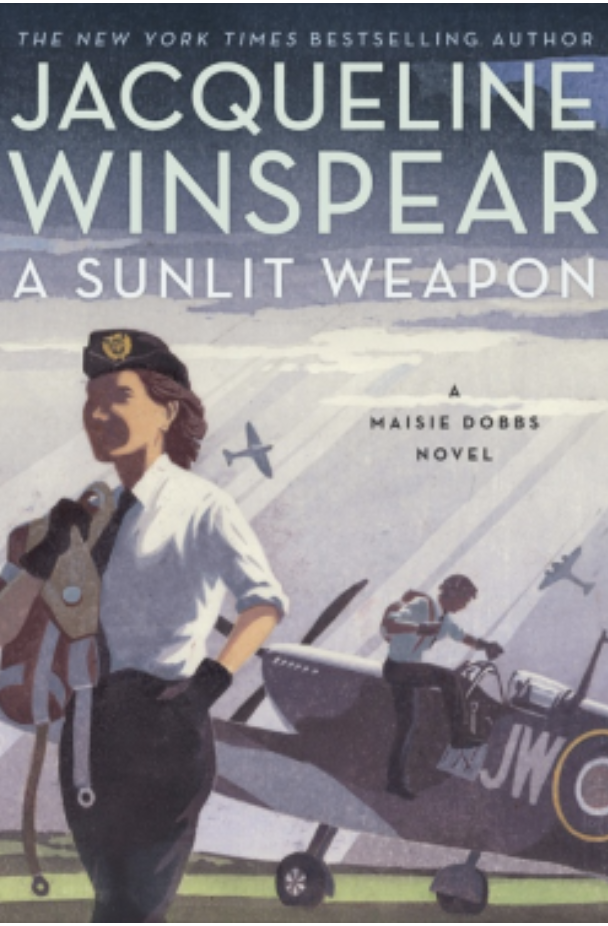
A Sunlit Weapon by Winspear

Writing: 3.5/5 Characters: 4/5 Plot: 5/5

Historical mystery at its best. Winspear’s Maisie Dobbs (a “psychologist and investigator” well connected with both the war office and the local chapter of Scotland Yard) continues to solve complex crimes while the timeline moves from early WWI (the first volume) through 1942 (WWII) in this 17th installment. Unlike many mystery series, these never get repetitive, nor are they replete with filler (as way too many are!). Each story draws from history to lay out a context in which the particular mystery takes place. The series reminds me of Foyle’s War — one of my favorite British television series — which similarly retells history via specific and accurate events.

The plot of A Sunlit Weapon centers around the women pilots who comprise the Air Transport Auxiliary (ATA). One crashes near Bromley for no apparent reason, and when a second goes to the area to investigate, she finds an American soldier — a black American soldier — left tied up in a barn with a second (white) soldier missing in action. At the same time Eleanor Roosevelt is heading to Britain, and there is real fear around trying to keep her safe, given that she likes to talk with everyone — particularly those whom others find uninteresting — the workers and the women.

Major themes of racial prejudice pervade — both with the American soldiers (who strive to maintain color segregation in Britain despite the fact that there is no such practice or policy there) and for Maisie’s adopted daughter, whose darker skin tone leads to bullying in the local school. Good writing, appealing characters whose lives also progress from one volume to the next, and a satisfyingly twisted plot. Full of real history — my favorite: the female ATA pilots were the first governmental employees to achieve pay parity with men.

I love this series — hope she keeps going!

Thank you to Harper and NetGalley for providing an advance copy of this book in exchange for my honest review. The book will be published on March 22, 2022.