Tell Me Three Things by Julie Buxbaum

Writing: 5 Plot: 4 Characters: 5

I loved every single thing about this insightful, beautifully told story about a 16 year old still counting the days since her mother died (747).  A few months before the story starts, her father moves her from her home in Chicago to a swanky area of Los Angeles to live with the “step-monster” (actually a very nice, recently widowed woman named Rachel) and her son Theo, who misses his father as much as Jessie misses her mother. Jessie is enrolled in a private school for wealthy kids and finds it very difficult to start a new life when she is still completely broken by the old.  Enter the mysterious “SN” (for Somebody-Nobody) who has anonymously contacted her via email and offers to help her navigate the difficulties of Wood Valley high school.

Friendship, bullying, sex, self-discovery – all topics deftly considered and discussed by a set of colorful and believable characters: Scarlett, the half Korean, half Jewish best friend from Chicago; Theo, the flamboyantly gay step-brother; Ethan, handsome, broken, poetry nerd who wears his batman shirt every day; Liam, lead vocalist for the band Oville and son of the bookstore owner who gives Jessie a job; and of course, “SN” who quickly becomes the person Jessie texts constantly. The plot is interesting and full of surprising, yet plausible events, but the real attraction of this novel is the excellent writing.  Page after page of insightful thoughts, conversations, and descriptions.  These characters are so real that your heart soars and breaks along with them. I’m always looking for authors who can distill and explain the essence of a character’s experience and Julie Buxbaum does this incredibly well.

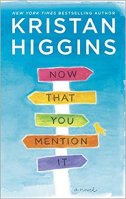
Now That You Mention It by Kristan Higgins

Frankly I’m embarrassed to admit that I read anything from Harlequin. I’m more of a Nowthatyoumentionitliterary fiction reader and I find most romance novels just stupid (sorry but that’s how I feel!). However, I make a complete exception for Kristan Higgins. Her novels are hysterically funny and well written. Yes, they definitely fit the romance genre, but the women featured are all women I would love to get to know (and to join my book club!).
Anyway, this new one is a good one. Tiny Scupper Island off the coast of Maine serves as the beautiful locale for a story with all of the traditional Higgins humor, emotions, and complex relationships. I fell in love with most of the characters – Nora, the “good” daughter, who won the town’s all expenses paid scholarship to Tufts; her sister Lily, beautiful and doomed, and Lily’s daughter Poe, tattooed, angry, living with the grandmother (a character with a real kick herself) on Scupper Island while her mother is in jail. Plus, of course, the men! A whole array of attractive, but sometimes flawed men, for our array of women to choose from! As a side note, I was very impressed with the diversity of Higgins’ characters in this book – without her focussing on the diversity as the main purpose of the novel. Everyone was treated as simply another person with individual characteristics some of which mapped to identified categories of diversity. I’d like to see more novels take this approach.

Weave a Circle Round by Kari Maaren

Writing: 4; Characters: 4; Plot: 4

I love YA books and this one was a lot of fun.  Best for the 12 – 14 year old crowd.

WeaveCircleRound14 year old Freddie knows she is “doomed to be sensitive forever”. She lives with her younger sister Mel and her step-brother Roland, a tall, hulking, deaf teenager who seems to bring both order and chaos to everything he touches. Freddie works hard to stay as invisible as possible. Enter the weird new neighbors who take the lonely house on Grosvenor Street. Cuerva LaChance is a Mrs. Whatsit like creature who is almost always cheerful and has a capital case of super ADD; Josiah is a humorless, bored 14 year old who  picks fights by simply existing. Freddie is horrified to find him in most of her classes.
The book starts slowly, appearing to be a typical coming-of-age story, but around 30% of the way in it takes off stratospherically, or rather time-ospherically, as time travel suddenly reaches in and literally yanks Freddie and Josiah off on a pinball machine like journey covering 9th century Sweden, prehistoric China,  17th century France, and 92nd century (yes, 92nd!) England.  Characters from  Norse, Polynesian, and Chinese mythology are woven in and as a bonus, we learn the identity of the “person from Porlock” – historically blamed for interrupting Coleridge as he scribbled the poem Kubla Khan.  While Josiah is blasé about the adventure, having literally lived though it before, Freddie is given every possibility to learn and grow up and help unravel a world altering mystery facing them in the current time.  What or Who exactly is Three?  And why is their “Choice” so important?

FYI, as a veteran SF reader, I was impressed with her handling of the time travel – both philosophically and mechanically.  I was also very impressed with the literary and mythological references. It’s not often you find a book that can move through such different areas so smoothly.

Manhattan Beach by Jennifer Egan

manhattanbeachWriting: 4 Characters: 4 Plot: 4

New word for me: apotropaic (supposedly having the power to avert evil influences or bad luck.)

A cross between A Tree Grows in Brooklyn and an action oriented WWII novel.

I enjoyed this book and read it quickly. It’s unusual in that it is both character and detailed action driven, by which I mean that equal emphasis was placed on the characters and their environments. The story takes place in New York City during WWII.  It revolves around three interconnected characters, each with their own narrative arc:  Anna is a quick witted and focussed young girl growing up in Brooklyn who likes accompanying her father on his “bag drops”; Dexter Styles, a polite gangster married into an upper crust family who seems to have more depth and sense of morality than many in his position; and Eddie, Anna’s father, who mysteriously disappears one day after several years working for Dexter Styles.

The settings have been given equal, if not greater, time and focus in the story.  Anna takes a job in the Navy Yard during WWII and gets a strong urge to become a diver after glimpsing a dive on her way home.  We are treated to in depth descriptions of her war work, diving equipment of the time, dive protocols and processes, and the ease with which a woman could get into that line of work (hint: no ease at all!). In another narrative stream we learn about life as a merchant marine during the war, including a detailed shipwreck survivor scenario. Lastly, details about the world of upper class banking and gangsterhood (hint: one is legal but that is about all that separates them!) abound.  For me, some of the technical descriptions went on a bit longer than I found necessary but I am good at adjusting reading speed to match my interest in the section so this was not a problem. I know others will find these action scenes / technical details more exciting than I did.

While the story revolves around the three primary characters above, there are many additional, well drawn supporting characters. Each was representative of a certain “type” in the era, but also a clear individual with their own personality, quirks, and goals. Lydia, Anna’s sister, born with an undefined wasting disease (sounded like cerebral palsy to me); her mother Agnes, the beautiful follies star who gave up working to love and care for Lydia; the Berringer family, a wealthy Episcopalian family into which Styles marries; Marle, the only negro in the dive class; Paul who thought diving might help him get into the navy and others.

Good writing, interesting characters, complex plot – a good combination of action oriented and character driven – rare in novels.  A little long winded for me in parts, though I’m guessing others would pick the opposite parts to shorten.  Definitely worth reading.

Millard Salter’s Last Day

Writing: 5 Characters: 5 Plot: 3

New word for me: Lordotic (an abnormal forward curvature of the spine in the lumbar region, resulting in a swaybacked posture)

MillardSalterMillard Salter – a Consulting Psychiatrist who “provides mental health services for the physically ill in hospitals” has decided to commit suicide on his 75th birthday. In his own terms, his is a “rational suicide”, a “curated death”.  He simply doesn’t want to end his days in the same painful, feeble, isolated way of so many others. This book is the story of this last day.

The story is told completely from his perspective – we see events, characters, and the past, solely through his eyes.  Poignant memories, surprising interactions, and a panoply of characters fill the pages.  Reading the memories of the old Jewish neighborhood in the Bronx felt like a love letter to me. We are deftly moved from childhood memories to current events to recent memories, from minor irritations at work (a baby lynx has gone missing at the hospital) to major irritations at the graveyard (his burial plot has been usurped!). This is no painful Proustian obsession – quite a bit actually happens on this day – I was surprised to reach the end and realize that only a day had passed.

The writing is excellent – clear and incisive and full of brilliant lines.  Millard says of his recently deceased wife Isabelle: “she possessed a knack for distilling people”.  I would say the same is true of the author.  Character after character, line after line, just nailed it.  Thinking about his son, Lysander, Millard finds himself “pondering whether a man who hadn’t yet amounted to a bucket of warm glue might not generate  an artistic or literary masterwork at the age of 43…”.  I really had to read that line a few times. Great use of fun words too (I’m always pleased when someone can use tatterdemalion persuasively in a sentence.

One note – the descriptive blurbs on Amazon are completely misleading.  This book has nothing in common with “A Man Called Ove” aside from the two main characters sharing initial thoughts of suicide.  Ove is a curmudgeon (a bad-tempered or surly person according to dictionary.com), but Millard is not. He is neither bad-tempered nor surly – he does have many opinions that don’t always adhere to the accepted norms of the society but I find it interesting that non conformity automatically stamps with him with curmudgeonhood!  Millard has many opinions that are clearly his own – well thought out and adhering to no particular ideology.  I found it insightful and refreshing.

I really loved this book – Millard’s voice is one I will remember for a long time.

Words in Deep Blue by Cath Crowley

Writing: 5; Plot: 4; Characters: 5

Tags:  YA; Uplifting

Beautiful, heartbreaking in places, but mostly uplifting – this is one of the best YA books I’ve read this year. Henry loves poetry, Rachel loves science, and they have been best friends for years (as per a contract made in year 3 (<- Australian school system)). They have been incommunicado for three years due to some life changes and miscommunications but now are back in the same city.  Things are different though: Henry stands to lose Howling Books, the bookstore his family has owned for years, and Rachel is in shock over her brother’s recent drowning.

In addition to Rachel and Henry, the book abounds in interesting characters – Henry’s sister George, with long blue-streaked hair and a suspicious nature; Martin, the database nerd who likes George; Lola, the devoted bandleader of the Hollow; and a cat named Ray Bradbury.  Howling Books is the used bookstore of dreams. It contains a “Letters Library” where people are encouraged to annotate, speculate on, or invite comments from others in their favorite books.  Often people leaves notes for each other in these books and we are treated to wonderful conversational vignettes encapsulated in these epistolary streams.   There are lots of fun book references, lists, summaries and discussions.  My favorite is Henry’s two-line summary of Borges “Library of Babel”  – “I decided it was about people needing the answers to the world, to the universe, and going mad trying to find them”.

Great writing, full of interesting and well-developed discussions about life, love, death, and what is really important. Funny and insightful.


What To Say Next by Julie Buxbaum

Writing: 4 Characters: 5 Plot: 4

I fell in love with these characters.

This is a young adult boy meets girl story, but the boy is David Drucker, who may or may not have Aspergers Syndrome (he probably does, he spends a fair amount of time analyzing  the DSM with respect to his personality) and the girl is Kit Lowell, still in shock from her father’s accidental death just a month before.  Kit finds David weird, but “good weird”; David has Kit on his “trust list” as detailed in the Harriet-the-spy style notebook his sister Miney helped him start to record and reference the rules of social interaction.

I won’t give away any of the plot – suffice it to say that the things that happen are interesting, plausible, surprising, and give rise to reflection and growth on the part of the characters.  The story is told in their alternating voices.

I spent some more time wondering about why stories about people on the autistic spectrum interest me so much and I think its the aspect of the syndrome whereby they don’t get nuance, don’t get the social signals, and always tell it straight.  I think the ability to lie and manipulate (even for good) is really overrated.  It’s so refreshing (and relaxing) to talk to someone (or read about someone talking to someone else) and know that what they say is actually what they mean.  I think the world would be a better place if people could actually say what they thought and other people could receive that information without excess offense and emotion. I would like to be sensitive to what other people think and feel, and to be aware that they don’t necessarily share my background, experiences, or opinions; but if I have to modify what I say in order to please or calm them, then we aren’t really having an honest conversation.  Minority opinion, I know!

The Bedlam Stacks by Natasha Pulley

Writing: 5 Plot: 4 Characters: 4

The spellbinding adventure story of a British expedition to Peru in 1860 to steal Cinchona trees for their desperately needed Quinine production capabilities. Merrick Tremayne is a badly injured ex-East India Company employee.  Master gardener, one-time opium smuggler and tea plantation manager, he is now living off the “benevolence” of an angry brother in a crumbling estate in Cornwall. Enter Sir Clement Markham – a bit of a swashbuckler with a title – and the backing of the East India Company, and off they go.

The story gets odder and odder as it progresses.  Not a typical adventure story, we meet quinine barons anxious to keep a monopoly, travel to a village in the mountains with very strange and ancient Incan technology, and encounter stone statues that behave oddly.  Most importantly, Merrick is befriended by a large Indian fluent in Quechuan, Spanish, and a kind of archaic English and it is this friendship that slowly takes priority in the story.

I was completely pulled in bit by bit and I don’t think I once figured out where the story was going next.  Pulley’s prose is mesmerizing – I had to slow myself down so I could read every word.  I’ve ordered her previous novel (The Watchmaker on Filigree Street) and hope it is every bit as good!

Ginny Moon by Benjamin Ludwig

Writing: 4; Characters: 4; Plot: 4

Tags: Fiction, first-person narration, good for book clubs

Ginny Moon is an autistic teen living with her “Forever” pareGinnymoonnts.  She calls them “Forever Mom” and Forever Dad”.  Soon, she will have a “Forever Sister”. But Ginny has an obsession with the Baby Doll she had 5 years ago in her original home before she was taken away for abuse and neglect. With single minded determination she works hard to fulfill the responsibility she feels towards her Baby Doll with some pretty surprising results.

I’m fascinated by Autism for some reason – I find brains that work differently to be intriguing and there is something very appealing about the direct, lie avoidant, non conformist, approach that autistic brains seem to take.  I’ve always liked this line from a poster written by someone with autism about neurotypicals (the rest of us): “Neurotypical syndrome is a neurobiological disorder characterized by preoccupation with social concerns, delusions of superiority, and obsession with conformity.”

In any case, Ginny Moon is a delightful book.  Ludwig appears to do a good job of presenting the story from Ginny’s perspective, but of course we are all listening to the story with our neurotypical responses so reading the story often gave me brain confusion as I struggled to rectify the two – it was fun to experience! Benjamin Ludwig and his wife adopted a teenager with autism so I’m guessing this book is written with some real experience.

Glass Houses by Louise Penny

Writing: 2  Characters: 2  Plot: 2 (on scale from 1-5)

Tags: Mystery

GlassHousesIn this installment of the Inspector Gamache series, he tackles the drug cartels and the fentanyl crisis (which we are reminded frequently kills 50 people for every kilo sold) all out of the seemingly peaceful sanctity of Three Pines. Meanwhile, a disturbing, hooded figure takes up residence on the Village Green and silently stares, bringing a sense of forboding to the sleepy town. Modeled after a Cobrador, or Conscience with a capital C, everyone in the Village feels certain it has come for them.

This is a hard review to write.  I’m a huge Louise Penny fan – I loved the first 11 books in the Inspector Gamache series and eagerly preordered the 12th, pouncing on it as soon as it arrived.  Perhaps those high expectations are part of why I found this book so absolutely dreadful.  Had it been any other author I would have stopped reading after the first couple of chapters.  The writing is simply bad.  It reads like a first draft. Characters that I loved, that had wonderful depth in previous books, have become caricatures of themselves. I literally do not like these people any more.

The structure is a big part of the problem.  The book opens at the murder trial with Gamache on the witness stand.  We don’t find out who was actually murdered until 50% of the way through the book.  It is 75% of the way through the book before we find out who the accused murderer is.  There is very little action (until the very end) and the dramatic tension is maintained not by what is happening but by what we as readers aren’t told.  Multiple chapters end with Gamache and Beauvoir looking at a new piece of startling information and exchanging serious looks – but the reader isn’t let in on the secret.  About 60% of the book alternates between repetitious hand-wringing (about the drug crisis, the scary guy on the green, or Gamache’s approach (or apparent lack of approach) to solving the problem) and bland filler about food and drink (and by the way, for a novel focussed on how terrible the drug crisis is, our heroes drink A LOT!).  That is just sloppy writing!

The last chapters in the book, where the action finally comes to a head, reminds me of the old Louise Penny.  I enjoyed reading that, but it in no way made up for the hours I spent slogging through the rest.  I know that Ms Penny’s husband died, and I know that writing was her escape during a very, very, difficult time and I feel bad giving it a bad review, but I can’t pretend something is good when it is really very, very bad!  I wish she had gone back and and done some editing before releasing.  I will certainly give her the benefit of the doubt and give the next book (if there is a next book) a try, but this book was truly awful.