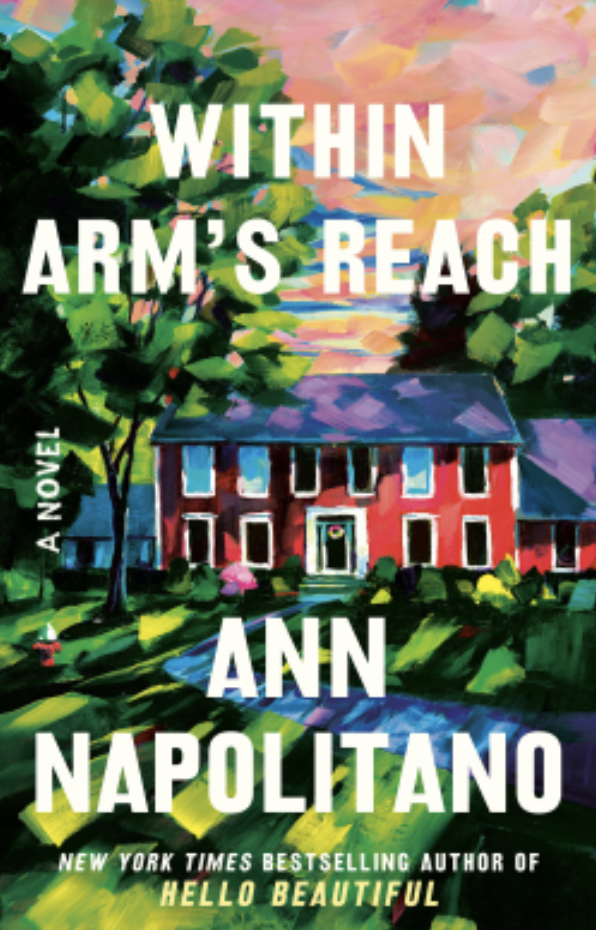
Within Arm’s Reach by Ann Napolitano (Literary Fiction)

I can’t fault the writing of this book and I’m guessing that it will be very popular because people today seem to like melodramas about unhappy people and this book has that in spades. It’s a giant soap opera about the generally dysfunctional relationships within a large, ethnically Irish, Catholic family and all the ways the individuals seem bent on making themselves and their loved ones even more miserable. It is told from six viewpoints — Catherine, the matriarch; her eldest daughter Kelly; Kelly’s husband Louis; their two children Gracie and Lila; and the nurse who attends Catherine after a fall (who has other unexpected connections to the family). I was hoping the end would either be uplifting or teach me something but I got … nada. There was also a pattern of emotional women being “saved” by decent, well-grounded, men. While there is honestly nothing wrong with that, it doesn’t seem like something to aim for.

I really loved Napolitano’s “Hello Beautiful”, and heard wonderful things about “Dear Edward” (I could not bring myself to read that book because it sounded so depressing), but while the writing was good and the characters well-drawn, the only characters I liked at all were the ones that had tied themselves voluntarily to this troubled family and I honestly couldn’t figure out why they ever would have done that…

Some quotes that I think illustrate my point:

“… there’s little point in drawing all of my brothers and sisters and their families together. What you get when we are all in the same room is not love. It is a potent combination of our childhood, my father‘s anger, and my mother’s deliberate silence and pointless, barbed comments. It is the long, thin, thorny end of the rose.”

“Why would I be working hard? And for what? For Gram? That isn’t enough of a reason. Life isn’t supposed to be hard. F*** that. Gram is wrong. I’ll end up like uncle Pat, sitting like a popsicle on the edge of a folding chair, feeling nothing. And Gram wouldn’t want that. I picture Weber’s face, bright with happiness.”

“She has the ability to make a decision and then inflate her emotions like a bicycle tire until they back up the decision with no wiggle room.”

Thank you to Dial Press Trade Paperback and NetGalley for providing an advance copy of this book in exchange for my honest review. The book will be published on April 30th, 2024.

How to Read a Book by Monica Wood (Literary Fiction)

Writing: 4/5 Plot: 4.5 / 5 Characters: 5+/5

Violet, a young woman released from jail after serving 22 months for manslaughter for driving while intoxicated and killing an elementary school teacher; Harriet, a retired librarian who runs the best book group in the world (IMHO) at the local prison where Violet has been incarcerated; and Frank, the retired tool & die guy whose wife was the one killed. A chance meeting in the local bookstore brings these three together in a pretty wonderful way.

This book was well-written, hits the sweet spot between humorous and deep, and is overall uplifting. I love uplifting! Especially when it isn’t stupid (honestly what isn’t better when it’s not stupid?). With broad themes of forgiveness and regret along with kindness (the genuine kind, not the saccharine type which is far more focused on the person being kind than the person in need of kindness), the book is full of dynamic dialog, slowly gained self-understanding, and relationships — the good, the bad, and the ugly types. Also some capital F fun-to-read sections that aren’t essential to the plot but are engrossing and plot-supporting. For example, Violet ends up with a job supporting a crazy / crotchety professor studying the higher cognitive abilities of African Parrots (based on the real life research of Dr. Irene Pepperberg (www.alexfoundation.com). Absolutely fascinating. I also LOVED every scene concerning the book club at the prison. From Harriet’s planning and selection process to the questions she asked and the way the (female) inmates responded to the emerging personality of the club itself. Some questions she asks: If you were God, would you alter the facts for these characters? Do books change, depending on when and where we read them? Why do people tell stories? Or more specifically, if Gatsby had a brother like Ethan Frome, would he have made the same mistakes?

While probably not the primary purpose of the book, it did make me consider the (always muddied) purpose of our justice system. I wish we had a better understanding of the goals of prison: Punishment? Deterrence? Rehabilitation? Safety (in case of recidivism) of the public? Sometimes sentences just don’t seem to make sense. I’ll leave you to draw your own conclusions after reading.

Lastly, though there is little in common in terms of messaging or plot, the style and tone reminded me of Lessons in Chemistry. Really enjoyed this book.

Quotes:
“From her years in the classroom, Harriet understood that any group, no matter how diverse, eventually acquired a personality; Book Club had decided they were misunderstood souls born to the wrong era, and William Butler Yeats was their proof.”

“… the days when the place feels not like a dementia unit on Mars, but like an animal shelter filled with calm dogs. I can almost see them, our Reasons, small smoky thicknesses in the air. Like guardian angels, in a way. Guarding our memory of them. They float among us, quiet and uncomplaining, and they refuse to disappear.”

“Lorraine fell for Frank the defensive lineman, but he was a team chaplain at heart. He’d given her love, patience, stability, and her only child. These gifts had turned out to be the wrong gifts.”

“But these kids, who had acres of poetry committed to memory and the mechanical skills of an aardvark, they needed him.”

“Was Baker shucking the chains of patriarchy, or emulating a pop singer? Harriet genuinely wanted to know.”

“The youngster had a cuddly laugh; if hamsters could laugh, they would sound this way.”

“She’d begun their marriage as lead, soft and pliable, elastic and forgiving, but over the years she’d transformed herself into a high-carbon steel, strong and hard and resistant to wear.”

“They remained in this magical silence for a little while, as their separate pasts floated harmlessly between them”

“Retired people were often thought to be lonely, but it wasn’t that. It was the feeling of uselessness, of being done with it all.”

Thank you to Mariner Books and NetGalley for providing an advance copy of this book in exchange for my honest review. The book will be published on May 7th, 2024.

Behind You Is the Sea by Susan Muaddi Darraj (Literary Fiction)

Writing: 5/5 Characters: 5/5 Plot: 4.5/5

This is a beautifully written novel composed of interlinking stories about characters in a Palestinian-American community in Baltimore. Most are members of three families: the Baladis, Salamehs, and Ammars. The stories move linearly forward in time, while bouncing between different individuals and their points of view. This means that the narrative slowly moves from first generation immigrants to younger family members born in the U.S. Influences from their ethnic heritage and the American culture surrounding them drift downward through the generations, melding uniquely in each individual making for nuanced, discrete characters. This creates a kind of narrative arc through the stories so that it did feel novelistic despite the clear boundaries of the stories.

I enjoyed the diversity of the characters — more akin to the everyday “diversity” of different human beings than to the diversity of skin color or ethnicity since (almost) all the characters were Christian Palestinian-Americans. Some wealthier, some poorer, some professionals, some working class, from real estate moguls to housekeepers. Many stories dealt with some aspect of being a woman within this culture, ranging from pregnancies to divorce to education — basically different ways that women might make decisions that did not align as well with family expectations as some families might expect. However, family reactions were not all the same — sometimes the father would be unhappy (to various extents), sometimes the mother (or the aunt, siblings, etc). Sometimes things escalated badly, and in others acceptance and adaptation was the name of the game. Real people — all in the same “place,” all with different stories. Topics run the gamut include generation conflicts, teenage afflictions, racism (in multiple directions), domestic abuse, cultural misrepresentation, etc. From minor issues to major. Some sweet and uplifting, and some not, but all moving towards understanding and growth.

Beautifully written, wonderful characters, little or no political statements — see some quotes below.

Quotes:
“The day he dies, Baba looks skinny and surprised. When he sucks in the last breath, his mouth opens in an O, like America has shocked him at last, and freezes there. It’s like he finally understood he was never meant to win here.”

“Americans like to talk about everything, I know. They like to share their feelings, like purging old clothing, or dumping clutter. But when you’re like us, you purge nothing. You recycle or repurpose every damn thing. Nothing is clutter.”

“Arabs are ridiculous; even if they live a dream life, they want to star in some tragedy. If there is no tragedy, they imagine one.”

”Sometimes I think that is why I like science. Science doesn’t mind when you make a mistake. Instead, science gets kind of excited.”

“No, with the baby, with Baba fading, with ever-present work stress, now is a time to lie in the weak surface of water, to trust that its fragility could nevertheless keep her afloat. It could even, despite its transparency, carry her great distances.”

“Marcus realized then that, while some people talked about growing up poor, his parents had been a whole different level of poor. Barefoot poor. Starving poor. Babies dying from diarrhea poor, like Mama’s little sister, Amal, who had died before she was a year old. Sleep on rooftops in the summer poor. Go to mass at two different times so your siblings can share the good shoes poor. Boil weeds to make tea poor.”

“Americans like to talk about everything, I know. They like to share their feelings, like purging old clothing, or dumping clutter. But when you’re like us, you purge nothing. You recycle or repurpose every damn thing. Nothing is clutter.”

“Arabs are ridiculous; even if they live a dream life, they want to star in some tragedy. If there is no tragedy, they imagine one.”

”Sometimes I think that is why I like science. Science doesn’t mind when you make a mistake. Instead, science gets kind of excited.”

“No, with the baby, with Baba fading, with ever-present work stress, now is a time to lie in the weak surface of water, to trust that its fragility could nevertheless keep her afloat. It could even, despite its transparency, carry her great distances.”

“Marcus realized then that, while some people talked about growing up poor, his parents had been a whole different level of poor. Barefoot poor. Starving poor. Babies dying from diarrhea poor, like Mama’s little sister, Amal, who had died before she was a year old. Sleep on rooftops in the summer poor. Go to mass at two different times so your siblings can share the good shoes poor. Boil weeds to make tea poor.”

Inheriting Edith by Zoe Fishman (Literary Fiction –audio book)

Writing: 4.5/5 Characters: 5/5 Plot: 4/5
Single mother Maggie — a college graduate who drifted into house cleaning — is bequeathed a beautiful house in Sag Harbor by Liza — a previously good friend with whom she had had a falling out years before. The only catch? The house comes with an inhabitant — Liza’s 82-year old crotchety mother, complete with recent Alzheimer’s diagnosis.

Maggie and her two-year old daughter, Lucy, move in, and what follows is a beautiful, slow-moving but deeply felt novel of two women coming to terms with who they are, who they were, and what kind of closure they need before moving forward. Liza was a suicide — a best selling author who did not leave a suicide note. And so part of work both Maggie and Edith have to do is to try to understand why, what they could have done, and what it means for them going forward.

Excellent dialog — full of the clear, deescalating interactions we all wish we could do on demand. Also some wonderful supporting characters: Edith’s oldest and best friend Esther — they were Broadway dancers together way back when; Sam — single dad, philosopher and now owner of a popular toy store; and two-year old Lucy who is as charming and off-the-charts annoying as any toddler could be. Lots of reflection and the gaining of self-knowledge; lots of discussion of depression, guilt, best effort, and second chances. Really nice relationships. Brought me to tears several times.

I liked the audio book reader — her “Esther” voice was my favorite. Reminded me of my grandma 🙂

Sandwich by Catherine Newman (Literary Fiction — Humor)

Writing: 5/5 Characters: 5/5 Plot: 4/5 Humor: 5++/5

Ok, this book is just flat out funny. I snorted, giggled, and guffawed my way through it with only occasional pauses. But while it gets top top grades for humor, it has plenty of depth, too. Ostensibly about a week at the beach with an extended (and all adult) family, it’s a study of functional (as opposed to dysfunctional) family dynamics. Many readers seem to want intense drama, with earth shattering impact, but I love these close looks at how real people work and learn and connect. The themes are family, love, and life with plenty of personality, philosophy, and interaction thrown in and a strong focus on parenting, pregnancy, and reproduction. Also the (new to me) phrase “anticipatory grief.” Wow — I should have learned that one a long time ago…

I loved the characters and the way they interacted. Our first person narrator is Rocky (Rachel) — a mother so full of emotion and worry and menopausal heat she is constantly threatening to (metaphorically) explode. I liked the way husband Nick — even as told through her eyes — is depicted so completely and not just a bit player in Rocky’s drama. Without giving anything away, I thought he was masterfully written. I loved the multifaceted views of all of the characters — both as themselves and also as they were in relationship with each other. I also appreciated the way Newman dealt with daughter Willa — the requisite lesbian through whom plenty of social commentary on LGBTQ+ issues was included in a nice relaxed, off key way that both made me laugh and made me think.

I also loved the dialog — it was written the way I wish people would speak — fast, humorous, and with a high signal to noise ratio. General banter and friendly family squabbling throughout but always overlaid on clear, honest, and trusting communication. I could be laughing at the (over-the-top-of the-top menopause complaints and then be tearing up at the essential humanity and love concisely tucked into an honest exchange. Kind of a combination of Nora Ephron (humor), Matthew Norman (human exchange), and Anne Lamott (parenting and reflection).

I will say that the inside of Rocky’s head is a fun, but very tiring place to be and I’m glad I don’t live there permanently.

Quotes:

“Ugh, my voice! You can actually hear the estrogen plummeting inside my larynx.”

“… I say quietly, but my veins are flooded with the lava that’s spewing our of my bad-mood volcano. If menopause were an actual substance, it would be spraying from my eyeballs, searing the word ugh across Nick’s cute face.”

“People who insist that you should be grateful instead of complaining? They maybe don’t understand how much gratitude one might feel about the opportunity to complain.”

“I’m always Sherlock Holmesing around them all with my emotional magnifying glass, trying to figure out if anybody has any actual feelings and what those might be.”

“Also he will get out the innocuous-sounding foam roller that is actually a complex pain device designed by people who hate everybody. I’ve seen enough videos of cats terrorized by cucumbers to know what my face looks like when I suddenly see the foam roller.”

“Nick’s curiosity about feelings and the people who have them is fleeting at best.”

“Forty percent of my waking thoughts were about the children dying — the other sixty about sleep. I was ashamed of this demented pie chart.”

“A conversation like this might be a wolf in clown’s clothing, and he knows it. My rage is like a pen leaking in his pocket, and before long there will be ink on his hands, his lips.”

“I mince down the spiral staircase in my memory-foam slippers, all of my joints clacking like the witch in a marionette performance of Hansel and Gretel.”

“All of the names of everything have oozed out and away from the drainage holes menopause has punched into my memory storage.”

“My ancient father actually swimming in the ocean feels like a bridge too far in terms of what I can handle fretting about.”

Thank you to Harper and NetGalley for providing an advance copy of this book in exchange for my honest review. The book will be published on June 18th, 2024.

Shred Sisters by Betsy Lerner (Literary Fiction)

Writing: 5/5 Plot: 4/5 Characters: 4/5
This novel follows the Shred sisters from childhood to middle adulthood. Our narrator is Amy, the younger, nerdy, physically diminutive, and (apparently) socially challenged sister. Her older sister, Olivia (Ollie), is beautiful, reckless, and rapidly heading for a lifetime of mental illness and instability. Written in the first person (Amy), it reads like a memoir by which I mean that things happen with a real life, rather than narrative, arc. Amy’s journey is a tough one, with the destabilizing influence of her attention-soaking, manic-depressive, more-than-a-handful, older sister on the whole family.

Lerner is an excellent writer — clear, detailed, and multi-layered. For what could be a very melodramatic story, it is told with a more dispassionate style — full of the “what” of the story without the accompanying hand wringing and / or judgement. Unfortunately for me, it doesn’t detail much of the more reflective “why” which is what interests me more. Why did Amy make so many (IMHO) bad decisions? Did she learn from them and if so, what? I can infer how her family life, her personality, and her destabilizing sister may have contributed to her life decisions, but I would have preferred to hear her own reflections. I found Amy’s life depressing, though it isn’t at all clear that she found it so (which let’s face it is the important thing!). There is a lot of human brokenness in the book, including addiction, infidelity, poor parenting, and general relationship issues — some of which I could relate to, but much I could not.

Overall it was a very good book and never became a chore to read. The characters were well-drawn but I could not understand or relate to them much of the time. I’m always trying to understand why people do what they do — in real life and in novels — and I wish the author had been more deliberate in discussing this.

Thank you to Grove Press and NetGalley for providing an advance copy of this book in exchange for my honest review. The book will be published on October 1st, 2024.

The Glassmaker by Tracy Chevalier (Historical Fiction)

Writing: 3.5/5 Plot: 4/5 Characters: 4.5/5

A chronicle of glass making in Murano (still known as the center of glass!) as told through the life of Orsola Rosso — the eldest daughter of a glass blowing family. Orsola wants to work with glass herself, but it’s 1486 and the Renaissance hasn’t quite reached the stage of promoting social changes for women. The story uses the (very) unusual contrivance of allowing Orsola and those in her immediate orbit to age slowly while time for the world at large gallops by. While the “action” starts in 1486 and ends in the present day, Orsola only ages from nine to her late sixties. While this device is explained (poetically) in the prolog, I didn’t really get it so I’m hoping that I can help you avoid bafflement by stating it here with less skill but more clarity 🙂

Orsola’s life embodies the personal (love, marriage, and children in a large extended family rife with personalities), the political (Venice shifting from commercial center to Austrian occupied territory to part of a United Italy to tourist center) , and the business (Guild control to competitive pressures to tourist-driven). She and her family go through the Plague (and later Covid!), two world wars, and the changing mores of an evolving Europe as the Renaissance gave way to the Age of Enlightenment followed by whatever our current age is destined to be called. I learned a lot about Italian history — details that I had learned in the past now integrated and brought to life in this story of artisans buffeted by the constantly shifting trends over time. The history became so much more real to me told through the lens of this particular family.

I give this a four star rating because for my taste there was a little more description than I like, though that same description may fascinate others.

Thank you to Viking and NetGalley for providing an advance copy of this book in exchange for my honest review. The book will be published on June 18th, 2024.

Family Family by Laurie Frankel (audio book – Literary Fiction)

Writing: 5/5 Characters: 5+/5 Plot: 4/5

I loved absolutely everything about this audio book — the story, the writing, the characters, and last but definitely not least, the audio book reader.

The book follows India Allwood along two intersecting timelines: from precocious and unintentionally pregnant teen to TV super star; and the weeks following a media storm raining down on India following her truthful comments about her recent movie’s position on adoption. You see, India has quite a personal relationship with adoption, having placed her baby with a family she specifically selected. On the other hand, the movie she stars in (and most of the way she sees adoption portrayed in the media) focuses only on the negatives: trauma, regret, and pain. When she admits in an interview that she doesn’t think the movie got it right — that adoption can (and usually is) a very good experience for all involved, it seems like everyone on the planet has nasty things to say about her. When her ten-year old twins see what she is going through, they decide that finding Rebecca — the baby 16-year old India delivered and placed — is the answer to all of their problems…

This book is incredibly well-written and covers all sorts of issues pertaining to families, relationships, aspirations, values, and, well, life with balanced and exceptionally articulate interactions, reflections, introspection and dialog. I cannot stress enough how happy I am with high quality dialog like the kind I found in these pages. As an aside, I found it interesting that I really did not take to 16-year old India. I found her to be a pain in the butt. But she grew on me as she grew on herself, figuring more things out, always striving to understand her own motivations and make good decisions, until by the time she was current day India I was ready to be her best friend.

I’m trying hard not to give away the many surprises that pop out along the way — suffice it to say that the pacing is excellent, the revelations are eye-opening and well-integrated in the plot, and I liked every single character in the book (and there are many). While covering adoption from many angles, the author (through the voice of India) is also very clearly pro-choice, with a great scene between India and some right-to-lifers camped out on her driveway seeking a mascot for their cause. The author also shows strong support for non-traditional family units — but again, I don’t want to give anything away… Lastly, some very in depth and illuminating commentary on the life of an actor!

Highly recommended.

The Samurai’s Garden by Gail Tsukinaya (Historical Literary Fiction)

A quiet, thoughtful, and utterly absorbing book about a young man from Hong Kong sent to a small, Japanese fishing village to recover from tuberculosis on the eve of the second Sino-Japanese war (Fall, 1937). Twenty-year old Stephen is a student and a painter. The year he spends in Tarumi is told through a set of journal entries which are equal parts descriptive and reflective. There is the distant war, with the radio intoning massive Chinese casualties along side propagandist calls for the enemy to “simply surrender to the kindness of the Japanese army, and all will be well.” There is the slow unraveling of his parent’s marriage as his father’s business interests keep him in Japan. And there is the burgeoning friendship with the older Matsu — caretaker and master gardener — and Sachi — whose life was abruptly shattered when leprosy swept the village decades before. Throughout the year, Stephen — feeling deeply but never loudly or dramatically — is slowly developing his own philosophy of living based on the lessons the world is teaching him.

The writing is exquisite — shifting between culture, character, and the natural (and unnatural) world. There is a recurring theme of beauty — sometimes found in the most unlikely places — and yet, once found, inevitable rather than surprising. Throughout all — war, destruction, disease, grief, and the ever tragic profusion of human contradictions — the focus is always on how to move forward — recognizing the fragility of life and finding your own peace and contentment within it. I liked the way the author made it clear that this was not an easy task. And I loved the fact that throughout this story teeming with essential truths, there was neither a cliche nor a saccharine sentiment to be found anywhere in the pages. Some beautiful descriptions of gardens and natural landscapes along with an artist’s way of engaging with the world as well.

Highly recommended.

Quotes:
“ It’s harder than I imagined, to be alone. I suppose I might get used to it, like an empty canvas, you slowly begin to fill.”

“All over Japan they were celebrating the dead, even as more and more Chinese were being slaughtered. There would be no one left to celebrate them. I looked around at all the smiling faces, at Matsu and Fumiko who moved slowly beside me, and wished that one of them could explain to me what was going to happen.”

“Ever since I had come to Tarumi, I’d seen more deaths than in all of my life in Hong Kong. Everything before me was changing. I knew I would never be able to step back into my comfortable past, Ahead of me lurked the violent prospect of war, perhaps bringing the deaths of people I knew and loved, along with the end of my parent’s marriage. These were the terrors I’d somehow escaped until now. And as I sat among the white deutzia blossoms, I felt a strange sensation of growing pains surge through my body, the dull ache of being pulled in other directions.”

“I’ve tried to capture this ghostly beauty on canvas, but like anything too beautiful, it becomes hard to re-create its reality. There’s something about being too perfect, that, even this, which at times appears stiff, almost boring. I finally gave up after several tries.”

“She wasn’t beautiful, not in the way that Tomoko must’ve been, nor did she have the roughness of Matsu. Her attraction wasn’t in the form of perfect features, but from the deep, wrinkles, age spots, and eyes that have seen much of what life has to offer. Fumiko had a face that had been enriched through time.”

“I was old enough to understand everything he said, but as his mouth softly formed the words, I knew the sense of integrity I had long admired in him had died, and then I was already grieving for its loss.”

“He learns how to do art with the stones in her garden: it was a strange feeling, much different from working with the fluidity of brush and paint, or water and earth. The weight of the stones pulled against each stroke and left a distinct feeling of strength and permanence.”

A Painted House by John Grisham (Historical Fiction — audio book)

Writing: 5/5 Characters: 5/5 Plot: 4/5
This book is unlike any other book Grisham has written — no courtrooms, not a lot of official justice, and not a thriller — but I found it utterly enthralling. It drew me into a world I knew nothing about and brought it to full sensory life. At least part of this was due to the audio book reader (David Lansbury) who captured the mood perfectly with his tone, pacing, and wide range of voices. Not every book (IMHO) is improved by listening to it — but this one certainly was.

The story is apparently somewhat autobiographical and takes us through one picking season on an Arkansas Delta cotton farm in 1952. Told from the perspective of seven year old Luke Chandler, the clarity of his reflections as he learns about life, morality, and people during this period is priceless. The family hires itinerant help in the form of ten Mexicans and a family of hill people. As with most farmers of the time, they are in debt from one season to the next, on the edge of ruin with every storm, flood, broken truck, or the transitory nature of picking labor. Luke is part of it all — the picking, the worrying, and the witnessing. He becomes the holder of too many secrets, and we feel the potential bursting and sickness he takes on with the keeping.

I’d forgotten how good Grisham’s writing is because I’m not that interested in legal thrillers but I was rapt throughout. His characters are such real people — each struggling in his or her own way with constant questions of both survival and morality. Making do in a rough world with little in the way of legal support — people have to figure out how to handle their own problems. Bittersweet and poignant, the narrative spans the Korean war, the movies of the day, the newness (and rareness) of television sets, flooding and tornados, farming economics, and the tension between the old ways and new possibilities.

Loved it.