Mr. Flood’s Last Resort by Jess Kidd

Thank you to Atria Books and NetGalley for an early review copy of Mr. Flood’s Last Resort Side by Jess Kidd, which will publish May 1, 2018.  All thoughts are my own.
Writing: 5 Characters: 5 Plot: 5
New words (to me):
leylandii – fast growing coniferous evergreen tree used in horticulture
hurley – stick used in game of hurling
coulter – a vertical cutting blade fixed in front of a plowshare.

A great find! One of the perils of early reviewing is that you have no idea what you’ll get. And more often than not, what you get is OK but not great. However, a book like this makes all the early reviewing worthwhile — a real gem!

Intriguing characters, a continually twisting plot, and elements that just edge beyond our assumptions of reality. It is told in the first person narrative of Maud Drennan, a home health care worker in London. She has been sent to care for Cathal Flood — a bedraggled, Irish giant, cantankerous, and a hoarder of epic proportions. Bridlemere, his four story mansion in West London, is filled to the brim with oddities — Victorian Automata, taxidermy specimens, and scientific curiosities — most of which is hidden behind “The Great Wall of National Geographics”.

With brilliant pacing and suffused with the Irish gift for storytelling, several interconnected and constantly shifting tales unfold: Cathal’s son Gabriel wants to put him in a residential home; there is a mystery surrounding the death of Cathal’s wife some twenty years ago; a missing girl from Dorset from the same time period; and elements from Maud’s own traumatic past. Other characters include a good looking geriatric whisperer, an agoraphobic transsexual with an appetite for crime novels, and a slew of Catholic Saints who appear, emote, and opine at both appropriate and inappropriate times.

I love the writing — metaphors and similes that jar and then settle into being just right and lots of Irish swearing, Shakespearean in breadth. Some great lines:

“Mr. Flood salutes me with his glass and gives me the alligator smile of a TV-advert denture wearer: jauntily fraudulent.”

“Mrs. Cabello has quite then emotional range, from furious and distraught to angry and venomous.”

“The effect is oddly charming; it has something of an ancient misanthropic squirrel about it.”

About The Great Wall of National Geographics: “Each copy has been placed carefully, with aptitude and instinct, so that the whole has the arcane strength of a dry stone wall.”

The book got better and better as it went along — kept me up all night when I made the mistake of going to bed before finishing it! By the way, marketing has compared this with “A Man Called Ove” which I also liked, but frankly I don’t see much of a similarity beyond the fact that both centered around cranky, old, men. The similarity comes to an abrupt stop there. I found this one MUCH more interesting.

A Fist Around the Heart by Heather Chisvin

Thank you to Second Story Press and NetGalley for an early review copy of A First Around the Heart Side by Heather Chisvin, which will publish April 10, 2018.  All thoughts are my own.
Writing: 3 Characters: 3 Plot: 4

Quite the grand undertaking! This historical novel follows the fortunes of two young Jewish sisters who are sent to Winnipeg, Manitoba, from a Russian shtetl in order to escape the pogroms in 1881. Anna eventually makes her way to New York where, fiercely independent and with a strong social conscience, she becomes part of the birth control movement. Esther remains in Winnipeg, marries well, and yet continues to suffer from strange episodes of altered state and a (quite natural) obsessive fear of anti-Semitism. In 1942, where the “present day” is centered, Anna receives notice that Esther has died, apparently a suicide, just as she returned to Winnipeg from her last visit. Untangling this mystery, as well as the fog around their departure from Russia, is the loose driver of the book.

The story is intricate and rich — almost too rich as the narrative veers wildly between different time periods (and locations). There is a lot of history stuffed into their lives – particularly Anna’s as she participates in so many cultural trends over the 60 years. Historical episodes include the Bolshevik revolution, the assassination of Alexander II, the stock market collapse, the Dust Bowl, the birth of Avon, early feminism, bohemians, psychiatric methods, TB sanitariums, jazz music, the birth control movement, and “If Day,” a simulation of Nazi takeover in Winnipeg designed to help raise war funds held on Feb, 19, 1942.

While I wish the editing had been a bit tighter and the characters drawn with a little more depth, I found the story quite gripping and read it through pretty quickly. The descriptions of Winnipeg in particular were completely new to me, as were several of the stories from that time period in New York.


Just Under the Clouds by Melissa Sarno

Thank you to Random House and NetGalley for an early review copy of Just Under the Clouds by Melissa Sarno, which will publish June 5, 2018.  All thoughts are my own.

#young readers (ages 8-12)
Writing: 4.5 Characters: 5 Plot: 4.5

This is one of those books that opens your eyes to a completely fresh perspective. Cora is a 12-year-old girl who is technically homeless.  Along with her mother and sister, she moves from placement to placement in South Brooklyn.  Some placements are better than others, and some almost begin to feel like home, but all are temporary and none is truly theirs.  They began this sojourn 6 years before when her father died suddenly of a too large heart.

Cora is a budding naturalist.  She carefully documents all the plants and trees she finds in each of the places they live, keeping note in her father’s field journal which she calls her “Tree Book.”  Through her observations and records, we are exposed to aspects of nature that I wouldn’t have known existed in these urban settings.  Frankly, I had never heard of the Red Hook and Gowanus sections of Brooklyn, and I was fascinated reading about them from within Cora’s story.

We also see a panoply of different people through her eyes: a new friend who lives on a houseboat and was home schooled for most of her life; an artist building a giant, slightly jagged, heart in an old warehouse; an old friend of her mother’s who lives a life of relative luxury near by; and her sister, Adare, who is “special.” Cora hates that word because “when it comes to Adare, nobody can get enough of the word special.” Adare was deprived of oxygen as a baby and is certainly different, but there is more to Adare than the label implies — she has a magical way of interacting with the world.

This is a real gem — one of the best young reader books I’ve read in a long time.  An honest and absorbing story about a young girl seeking to belong.  As a fun aside, in the acknowledgements, I found out that Sarno’s agent is none other than Rebecca Stead, one of my favorite children’s literature authors. An excellent recommendation!

School for Psychics by K.C. Archer

(pub date April 3, 2018 — Billed as General Fiction and SF / Fantasy; also suitable for YA)
Writing: 4 Plot: 4.5 Characters: 4.5

New words (to me):
Algor mortis – the second stage of death is the change in body temperature post mortem, until the ambient temperature is matched.
Liver mortis – also known as hypostasis, is the discoloration of the skin due to the pooling of blood in the dependent parts of the body following death.

A Harry Potter-style story for millennials with a menagerie of psychic powers nurtured by a blend of science, chakras, vegan diets and computer hacking in a School for Psychics. A fun book — well paced, great plot development, cool characters, and multiple layers of mystery. Also, nothing egregiously stupid which frankly tends to pepper this kind of book. I gobbled it down quickly.

Teddy Cannon is a bit of a screw-up. She is your typical, irreverent, smart-ass complete with multiple ear piercings and combat boots. She’s been banned from every casino in Las Vegas, even though they could never prove she cheated. That’s because she never did — she just has an uncanny ability to tell when someone is lying. Right as she hits rock bottom she is given an opportunity to attend the Whitfield Institute for Law Enforcement Training and Development — a School for Psychics. She is lured in when told “The world needs people like us.” She hadn’t previously felt like much of an “us”.

Strong moral themes around friendship, trust, and “choosing public service over public menace” integrate with millennial style self-discovery (at one point she wonders if this is “a school for wayward psychic millennials” which was not what she signed up for!). For San Franciscans, the action takes place on Angel Island!

Overall, a good mix of action, reflection, learning, and mystery. The action scenes are good but don’t take over the book (no ridiculously long car chase scenes, thank goodness). A strong ending. While clearly the beginning of a series, the denouement provided closure to the plot while still leaving several mysteries on the back burner for future installments. I plan to keep an eye out for book 2!

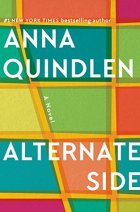
Alternate Side by Anna Quindlen

36525343(Pub date March 20th, 2018)
Writing: 4 Plot: 3 Characters: 3.5
New chat acronym (for me): ICE – I can’t even

Nora loves New York City. She is one of those people who finds “home” when they first move to the city. This is her narrative: her ongoing love story with the city; her slowly unraveling marriage with a husband who is a good man but is becoming unhappy with the life he is living; and the jolt her life receives from a violent act in her neighborhood.

Told through interactions with neighbors from her block (a special cul-de-sac with actual houses right in New York City), friends from college, and work colleagues, we are exposed to an array of opinions, obsessions, stereotypes, and prejudices that are drawn with detail and make sense for that person in that situation. The short but intense violent act brings out discussions on loyalty, racism, and morality. It brings to light a divided city, a divided neighborhood, and eventually, a divided marriage. I appreciate the fact that no character spouts a party line — the opinions are individualistic and internally consistent.

It’s kind of a smaller story than it could have been it really focuses on Nora and how she evolves as a character rather than the Bonfire-of-the-Vanities-style social commentary that it could have been. However, there is plenty of social observation and analysis: the “shadow government” run by the nannies and housekeepers on the block, how to live in the “new cleaner, safer, impossible without money New York” and the general feeling that things are going “awry” on the block. I loved the line “The slightly aberrational spouse was a status symbol too. The husband who cooked. The wife who played golf.” Another great line “The truth was that their marriages were like balloons. Some went suddenly pop, but in more of them than not the air simply headed out until it was a sad, wrinkled little thing with no lift to it anymore.”

I didn’t feel a lot of empathy for the main character, to be honest, and I enjoyed trying to figure out why. She is well written, and there is nothing wrong with her. She isn’t a bad person and in fact works hard to be a good person. It feels like she just fell into an awfully good life without having to work for it and I guess that bugs me. And she doesn’t seem to have a lot of empathy for her husband who clearly wishes a different kind of life. Or rather, she has empathy, but she is unwilling to give up anything that she wants in order to make his life better. It helps me understand my own values a little better – I like anything that makes me think!

Well written, good for fans of introspective, women’s fiction and / or tales of New York City.

Leonardo Da Vinci by Walter Isaacson

Writing: 5 Content: 5

A comprehensive biography of a fascinating man. Isaacson’s clear, lucid, prose manages to portray the man and his near-infinite number of interests without becoming tedious or repetitive. Isaacson draws on a wealth of sources, primary among them the 7,200 pages of Leonardo’s notebooks available for study — sadly estimated to be only one quarter of the original number. The notebooks — works of art themselves — were cut up and auctioned off after Leonardo’s death. As none of the pages were numbered, all original ordering has been lost (as a librarian, this causes me physical pain!). As an aside, the notebooks contained very little that was personal. As Isaacson says, “These are not St. Augustine’s confessions but rather the outward looking enthrallments of a relentlessly curious explorer.” Great line!

Leonardo’s curiosity was obsessive. Most know him for his masterpieces — the Mona Lisa and The Last Supper — but his curiosity really knew no bounds. He studied water endlessly — one notebook listed 730 conclusions about water crammed into 8 pages. When he needed to paint horses for a painting of war, he spent hours dissecting horses to understand how they moved. His dissections were not limited to animals; he also dissected up to 30 human corpses trying to understand how the sensory organs, muscles, and nerves worked together to create motion and to show emotion.

His work previewed great discoveries. He investigated the aerodynamics of flight, the transfer of motion, and the optical processing of the human eye. Often the descriptions were annotated with comments about what a spectacular treatise the work would make — probably true — and yet, Leonardo never got around to publishing! He was notorious for following his passions and not really bothering with the tedium of tying things up in neat packages and disseminating them. Similarly, he was a wonderful painter — people flocked to watch him paint and begged him to do their portraits — but the number of unfinished commissions was far larger than the number he actually completed. In some cases, he carried paintings with him for years, “perfecting” them. As an example, he kept the Mona Lisa with him for 17 years. It only left his possession at his death.

Isaacson makes two claims (clearly stated as his own opinion) with which I strongly disagree. He claims Leonardo was not a genius in the sense of Newton or Einstein, who each had brains that were different from an average person. Instead, Leonardo had intense observational skills and passionate curiosity — attributes any of us could develop. I disagree completely. While both of those attributes were key to Leonardo’s success, he also possessed a wildly active brain that drew analogies between everything and anything at a dizzying pace. That is the very hallmark of intellectual genius. Most of us do not have brains that can make those connections at all; and certainly not that quickly.

Additionally, Isaacson made continual references to Leonardo’s Freudian search for a “paternalistic, supportive, and indulgent” patron as a sop to his abandonment issues from a mostly absent father. That feels like a lot of modern sensibility applied to a very different time and place to me. What Leonardo did was search for a patron he could respect and who would understand, support, and appreciate him. After all, some of his previous patrons (think Cesare Borgia) were beyond dreadful. I was personally very gratified when he finally found that patron in Francis I, King of France, albeit at the very end of his life.

“He relished a world in flux” — my favorite Isaacson summary of Leonardo. He loved motion and was on a constant quest to identify the patterns that united the physical world with the world of man. A great biography – very readable and well organized. Easy to do deep dives into your areas of interest and skim through those that don’t grab you — although those will be fewer than you think.

Fight No More: Stories by Lydia Millet

Publication date: June 12, 2018
Writing: 4 Plot: 4 Character: 4

A set of 13 interlocking stories about individuals loosely coupled through L.A. real estate transactions. A wide variety of topics – a depressed musician in a pool, a house whose owner swears little men have moved in to do all the work, a phone sex worker who lands a gig as a nanny, surprising new loves, an old woman giving up her home – each story is a told from the perspective of a single person reflecting on some aspect of their life.

I’m not a short story fan in general, but I quickly warmed to these stories, especially as characters reappeared and were allowed to develop. I found the women to be written with more depth and perception than the men. The men are either scumbags or saints (plus one teenage boy trying to choose between the two). For me the collection got better as it went on – the first few stories were OK but by the time I got to the 4th or 5th story I was hooked and they just kept getting better and better. The last story was my favorite.

These are intimate portraits of individuals of all ages and backgrounds, and while not a novel with a clear narrative arc, characters do continually brush up against each other, sometimes with impact and sometimes not. A clear reminder that while each person is the center of their own story, those near by are busily starring in their own.

Great for fans of Ellen Gilchrist.

Pachinko by Min Jin Lee

Writing: 5 Characters: 4 Plot: 5

A sweeping, multi-generational, saga of a Korean family spanning the Japanese occupation of Korea, WWII, and beyond. Sunja is the solid, diligent, warm hearted only child of a poor widow running a boarding house in Busan (Korea). An unintended pregnancy and a chance encounter with a kind, tubercular, pastor launches her to a life in Osaka. Life is not easy in Japan for Koreans who are Christian to boot, but the writing handles this beautifully. It is a precise, detailed, unfolding of lives against a background of racism and cruelty that focuses on survival, not on the drama of injustice. After all, survival really is the ultimate human story.

EEach chapter is a strobe illuminating a slice of time and place with snippets of experience.  Each is labeled with a place and date, and focusses on the experience of one of the characters: Sunja, her husband, his brother and wife, and eventually Sunja’s two children, their spouses, girlfriends, and children. The stories take place from 1910 to 1989 and expand from Busan to Osaka, Tokyo, Yokohama, Nagano, and even New York.

The range of character, location, and time lends an incredible variety to the attitudes, perceptions, and experiences of being a Korean in Japan. The author is able to explore a number of issues and situations in depth through this panoply of voices: “passing” as Japanese, proper roles for women, homosexuality in Japan, the Yakuza, perceptions of Christians and Christianity, suicide, honor, and the wisdom distilled into departures.

The book is long but impossible to put down. It exposes a piece of history from the perspective of a variety of every day people. The diversity of viewpoints is far more revealing than the summary found in most history books.

The Intermission by Elyssa Friedland

(publication date 6/3/18)
Writing; 4+ Characters: 4 Plot: 4

An intriguing exploration of the interior spaces of a marriage. Cass and Jonathan Coyne have been married – ostensibly happily – for five years. And yet just as they are about to start a family, Cass suggests a six month “intermission” in which to step back and decide whether or not they belong together. The alternating chapters between their two voices are full of penetrating observations about themselves, their relationship, and their feelings about the other.

The writing is excellent and the characters are drawn with depth and plausibility. I found surprisingly fresh insights on most pages as each of their narratives unfolded. Both want to be good people and good partners and yet each has been holding back from the other – not “body hidden in the attic” kinds of secrets, but secrets that add a self-perceived dishonesty to the relationship. As a reader, I found my allegiance shifting between them as the story unfolded, which taught me a lot about my own morals, preferences, and perceptions. Very readable, unpredictable, and original – I enjoyed it far more than I expected from the basic description.

The Almost Sisters by Joshilyn Jackson

Writing: 5 Characters: 4 Story: 5

Quintessentially southern, humorous, and impossible to put down. Also some beautifully articulated messages on the importance of fatherhood both for the children and the fathers themselves. Top recommendation for the pure enjoyment of of the read!

38-year-old Leia Birch is a well-regarded graphic novel artist and self professed “uber-dork”. After an enjoyable comic book convention hook-up with a gorgeous black man in a come-hither Batman cowl and cape, she finds herself pregnant. In the meantime, her 90-year-old grandmother “Birchie” (as in The Last Birch Standing of Birchville, Alabama) appears to be losing her mind in very colorful and public ways. Add in Miss Wattie, Birchie’s lifelong best friend and Rachel, Leia’s “and she knows it” perfect and pretty step-sister, and you have two pairs of “almost sisters” and the potential for a wild ride!

The story is exceptionally well put together, full of real people with giant personalities, and tons of interesting plot twists (that I’m desperately trying to not give away here!). Great writing that just eases you along until you completely forget that you are reading. Tackles racial issues as a seamless part of the story, triggered both by Leia’s awareness of the biracial baby growing within her and the events unfolding in Birchville that allow her to see a different side of the South (I had stepped into the Second South and seen that my South was a luxury I did not know I had,” she observes).

A special treat is the insight into the creative process of a comic book artist. Leia is well known for her graphic novel Violence-in-Violet (V-in-V) – a cult classic that she wrote, penciled, lettered, inked, and colored herself. After many years as a successful artist working for Marvel, DC, Dark Horse, etc. she’s been offered a contract to write the prequel to V-in-V. Throughout the book we’re treated to her inspirations, ideas, backtracking, frustration, and glorious epiphanies. I’m not a big comic fan but after reading this I kind of want to turn into one. Really good descriptions of what the art can bring to the story. This is not a typical career for the heroine of a woman’s fiction book!

I enjoyed every inch of this book. It’s light and playful, but has enough meat in it to not be tossed out with the trashy epithet of a “summer read”. Highly recommended.