
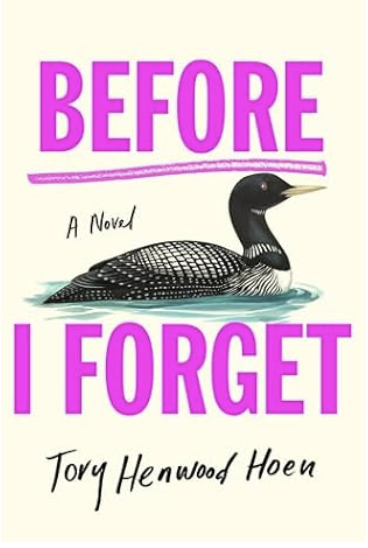
Before I Forget by Tori Henwood Hoen (Literary Fiction)

This is the long-delayed coming-of-age story of a 26-year old going home to care for her Alzheimer-ridden father. And let me immediately reassure you that there is absolutely nothing depressing in any of it. What I began reading with trepidation (I’m not looking for depressing stories!) pulled me forward with increasing amounts of humor, human insight, and beyond touching moments (so yes, I teared up frequently, but from seeing substance, not sadness).

Cricket quits her job as an underutilized gofer for an over-the-top healthcare company that peddles an infinite array of body rejuvenation at very high prices. Instead, she heads to her favorite place (their home in the Adirondacks) and her beloved father — neither of which she has seen since a decade old tragedy left her beyond bereft and thoroughly guilt-ridden. From here the story takes off in unexpected ways with engaging characters, possible connections to the spiritual world, some unexpected business opportunities, and many chances to rethink the past. Throughout all of it, Cricket moves toward self understanding, forgiveness, and a stronger connection to those about her.

The writing is very good — the prose, pacing, and plot elements all perfectly tuned to Cricket’s growth without demeaning the roles of others in her story. I loved the insight and the messaging and the way Cricket always behaved in a principled manner — even when she was confused or afraid. I loved the different out-of-the-box ways dementia was portrayed, without downplaying the difficulty and loss. I loved the way personality traits could be interpreted in opposites: was someone passive or patient? Complacent or content? Insatiable or intrepid?). And I loved the humor applied to the situations and characters — particularly the buffoonish commentary on new age health gurus and products (see some of my favorite quotes below).

One of my favorite books this year.

Some great quotes:
“I am only 26, which means I am essentially a larva. In contemporary America, childhood can last well into one’s 30s, 40s, and even 50s.”

“What if Alzheimers isn’t just a slow death? What if it’s another dimension entirely – an ascension even? Humans are so fixated on our minds that we see their loss as a tragedy. But what if it’s a gift? Maybe the erosion of memory clears space for something truer. Maybe the intellect gets in the way of the heart, until little by little, it doesn’t.”

“My mother once told me I was too passive, but I prefer to think of myself as patient. There are some problems that solve themselves if you simply wait a while.”

“I have a vague feeling that, when it comes to my life, not only am I sitting on the sidelines, but I’m playing the wrong game altogether. As I look around at the leftover mess from the weekend, I think: I’m ready to be something other than young.”

“I was impressed by her confidence and conviction – two things I was lacking. When you are full of questions, you are drawn to people who look like answers.”

“You could spend all day exfoliating, lifting, moisturizing, resurfacing, deep conditioning, buffing, harmonizing, depilating, and rejuvenating your bodily surfaces, but at the end of that day, your soul will still ache for what it really wants: freedom from the consumptive cycle of never feeling or looking quite good enough. We’ve conflated health with vanity. It’s not that I don’t believe in healing; I just don’t believe you can buy it for $78 an ounce.”

Thank you to St. Martin’s Press and NetGalley for providing an advance copy of this book in exchange for my honest review. The book will be published on December 2nd, 2025.
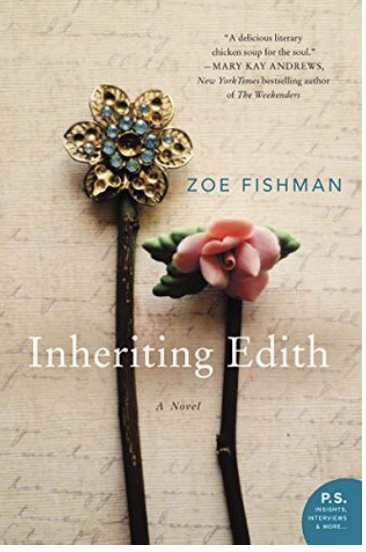
Inheriting Edith by Zoe Fishman (Literary Fiction –audio book)

Writing: 4.5/5 Characters: 5/5 Plot: 4/5
Single mother Maggie — a college graduate who drifted into house cleaning — is bequeathed a beautiful house in Sag Harbor by Liza — a previously good friend with whom she had had a falling out years before. The only catch? The house comes with an inhabitant — Liza’s 82-year old crotchety mother, complete with recent Alzheimer’s diagnosis.

Maggie and her two-year old daughter, Lucy, move in, and what follows is a beautiful, slow-moving but deeply felt novel of two women coming to terms with who they are, who they were, and what kind of closure they need before moving forward. Liza was a suicide — a best selling author who did not leave a suicide note. And so part of work both Maggie and Edith have to do is to try to understand why, what they could have done, and what it means for them going forward.

Excellent dialog — full of the clear, deescalating interactions we all wish we could do on demand. Also some wonderful supporting characters: Edith’s oldest and best friend Esther — they were Broadway dancers together way back when; Sam — single dad, philosopher and now owner of a popular toy store; and two-year old Lucy who is as charming and off-the-charts annoying as any toddler could be. Lots of reflection and the gaining of self-knowledge; lots of discussion of depression, guilt, best effort, and second chances. Really nice relationships. Brought me to tears several times.

I liked the audio book reader — her “Esther” voice was my favorite. Reminded me of my grandma 🙂

Hope and Other Punchlines by Julie Buxbaum (Young Adult)

Writing: 5 Characters: 5 Plot: 4

16-year old Abbi Weinstein is known to the world as “Baby Hope” — she was the one-year old birthday girl clutching a red balloon fleeing the towers in the arms of a day care worker in an iconic (fictional) photograph from 9/11. Noah Stern is obsessed with that photo because he holds the secret hope that one of the background figures is his father, presumed dead. Both hail from Oakdale, New Jersey, a fictional town loosely based on Middletown, New Jersey, with the dubious honor of having the largest number of 9/11 fatalities outside of New York City. Together, they slowly put together the missing pieces from that day, and the ongoing impact ripples on the people affected.

Despite the subject matter, this is an uplifting book. It’s full of humor, friendship, and love as well as a lot of heartfelt and sob inducing stories. It is a way forward from tragedy, not a hopeless and depressing fixation on it. I like YA fiction because somehow the issues are clearer — less muddied by the accreted neuroses and mental sluggishness of age — and I am able to learn more easily from it.

I think Julie Buxbaum is brilliant — I love her characters and her humorous, banter-rich, prose. Each of her books focusses on real and difficult issues — and helps the characters work on making sense of the world and their place in it. This book is easily the best of all — I read it in one sitting. The stories woven together were touching, personal, and inspiring. I sobbed through a lot of it, but finished feeling centered and hopeful.

There are so many great lines in this book — here are a few:
“I think our stories are actually what make us people. We each have a history… Stories are like the … currency of connection. And all your stories woven together might tell some larger story about the history of our country from that moment to now.”

“I was fashionably late to the existential panic party.”

“She’s the one who gave my mom her stoicism. In my mother it takes on a cheery perversion, but my grandma is all strong, clean lines, when it comes to the difficult stuff. She’s stating a fact, true words without any sentimentality.”

“My mother has always liked to outsource our difficult conversations. It was my dad, not her, who sat me down last spring and asked if I’d be interested in going on the pill.”

“Well, the good news is that awkward phases help with long-term personality development.”

“All it takes is a tiny, inexplicable tear in the fabric of the moral universe.”

Abbi’s grandmother is suffering from the beginnings of Alzheimers — this is what she tells Abbi: “You know what I think about sometimes? I think about how all the little bits of me that I’m losing will somehow find their way to you. Like they are … what’s the word … tangible. Like they are tangible things that can crawl from my bedroom to yours and so as I become less me, you will become more you, and I will continue to march on within you when I’m not me anymore. You’re going to keep growing. That’s how it’s supposed to be.”

“Life can really suck, right? So why not make it at least a little bit fun whenever we can? I mean, think about it. There are few things that a well-timed joke can’t solve.”

“Pretty much everything about being in high school is embarrassing. Not only the hours spent jerking off behind locked doors, the days cooped up in windowless classrooms — not to mention the greasiness of it all. I’m talking our very existence. We are a reminder to grown-ups of how far they’ve come and how much further they wish they could go.”

“When you have a kid, it’s like letting your heart walk around outside your body. You never get used to it.”

Goodbye, Vitamin by Rachel Khong

Writing: 4/5 Plot: 4/5 Characters: 4/5 Personal Enjoyment: 5/5

Sweet, touching, and laugh-out-loud funny — and this is a book about Alzheimers. I didn’t think that sentence was even possible!

30-year old Ruth quits her job in San Francisco to move back home (Southern California) to help with father —a prominent history professor father (Howard) who is slowly losing his mind to Alzheimers. Written in a journal style (short, dated, segments over a year), the entries slowly morph into a set of notes addressed to her father describing their days together — a mirror of the delightful notes he had addressed to her about their time together during her childhood.
Ruth, her brother, and her mother all have their own issues to deal with — breakups, infidelity, betrayal — but the focus on helping Howard helps them in unexpected ways: Ruth finds herself more forgiving, and more understanding of the frailties of the people around her. The story abounds in kindnesses, both large and small. Instead of focusing on the loss, they are able to reestablish the love and connections that bind them into a family, with this new (or old) version of their father. A beautiful, and insightful, line: “Sharing things is how things gets started, and not sharing things is how they end.”
Well-written, fun to read, full of odd factoids and observations, and really touching insights into what relationships (of any kind) are really about.
Great for fans of Weike Wang.

The Last Year of the War by Susan Meissner

Thanks to NetGalley and Berkeley Publishing Group for an advance reader copy in exchange for my honest opinion. Book to be released on March 19, 2019 .

Writing: 4 Characters: 4.5 Plot: 4

An historical novel that plunges you right into the WWII period through the eyes of Elsie Sontag — a ten-year old Iowan girl whose life is utterly upended when her father is unjustly arrested as an enemy alien under Executive Order 9066. We follow her along a tortuous path from Iowa to an internment camp in Texas to an unwilling repatriation to Germany in the last year of the war (she doesn’t even speak German). Each step provides a slap-in-the-face kind of opportunity to learn how labels change the way we perceive and treat others.

The book opens when Elise is 81. She is coming to terms with an Alzheimers diagnosis and more than anything wants to find Mariko — the friend she made in the internment camp many years prior. As an aside, I fell in love with this book because of the way Elise anthropomorphizes her disease:

“What I feel is that I’ve been saddled with a sticky-fingered houseguest who is slowly and sweetly taking everything of mine for her own. I can’t get rid of her, the doctor assured me, and I can’t outwit her. I’ve named my diagnosis Agnes after a girl at my junior high school in Davenport — Agnes Finster — who was forever taking things that didn’t belong to her out of lockers.”

Each of the four parts of the book starts with a scene from elderly Elise’s life as she gets closer to finding Mariko. The rest of the book details her journey: Davenport, Iowa after her father’s arrest (part 1), the largely Japanese internment camp (part 2), Germany during the last year of the war (part 3), and finally, her path to and life in California (part 4).

It’s an utterly gripping story — very difficult to put down. Elise’s voice is real and thoroughly human as she struggles to find her place in the world and understand why people behave the way they do. She struggles with finding a place she can call home. The narrative clearly articulates how war affects everyday people who want no part in it and yet are given little choice. I found the historic details to be largely accurate (although I did wonder about a few small details).

Surprising plot twists! Great for both adults and young adults.