
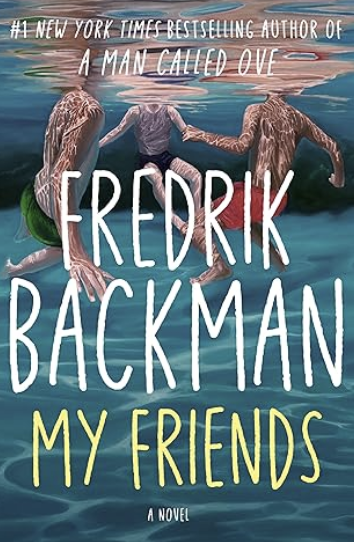
My friends by Fredrik Backman (Literary Fiction)

This book has been gushed over by all of my favorite readers — and I get it. It’s well-written, has characters that attach deeply to your heart, and tells a set of life stories of redemption through the powerful forces of friendship and art. I couldn’t stop reading, and I teared up fairly reliably in response to the truly heartfelt and exquisitely expressed insights, remembrances, and hopeful resolutions.

But — rather than finding it uplifting (as most others did), I was left feeling despondent. So many broken people, especially broken kids, populated these pages. I don’t believe the author ever specifies where this is taking place — what country, what city. We’re left to feel that this level of grief, brokenness, woe, and misery is the lot of most — the essential human experience as it were. I loved the uplift that came with the discussions on art, and the fierce loyalty struck between friendships forged in despair, but I felt more disturbed than inspired by the book as a whole.

Anxious People by Fredrik Backman (Fiction)

A sweet story of compassion and benevolence. The style starts in a tongue-in-cheek, paternalistic manner and transitions to a kindness-conquers-all happy finish. It’s a bit of a fairy tale — both in terms of the happy ending and the oversimplified set of troubles with which the story begins — but it is uplifting and poignant and brought me to tears several times with the beauty of specific human moments.

The (self-stated absolutely ridiculous) story is about a bank robber. Sort of. Said robber only asks for 6,500 kroner but makes the mistake of going to a cashless bank … and somehow escapes into an apartment viewing, inadvertently taking hostages. Lots of things tie together in a twisted but essential way as we get to know all the characters, how they evolved into the state they are in, and how they will continue to evolve (more sanely) in the aftermath.

Some very interesting twists of gender expectations which I both enjoyed and found fascinating.

I found the initial chapters depressing and was irritated with the avuncular (and often second person) style. A very clear ultra-liberal message — everybody makes mistakes, it’s OK to blame society (and especially the money-grubbing banks) for everything that is wrong in your life, and if everyone is simply kind to each other, all our problems will be solved. There is one character — an economist / senior bank official — who spouts a defense of capitalism and responsibility, but it turns out that she is suffering from a trauma that has led her to withdraw into that opinion, and she “sees the light” by the end of the book. I find that kind of annoying and oversimplified, but I admit to really enjoying the book!

Thank you to Atria Books and NetGalley for providing an advance copy of this book in exchange for my honest review. The book will be published on September 8th, 2020.