
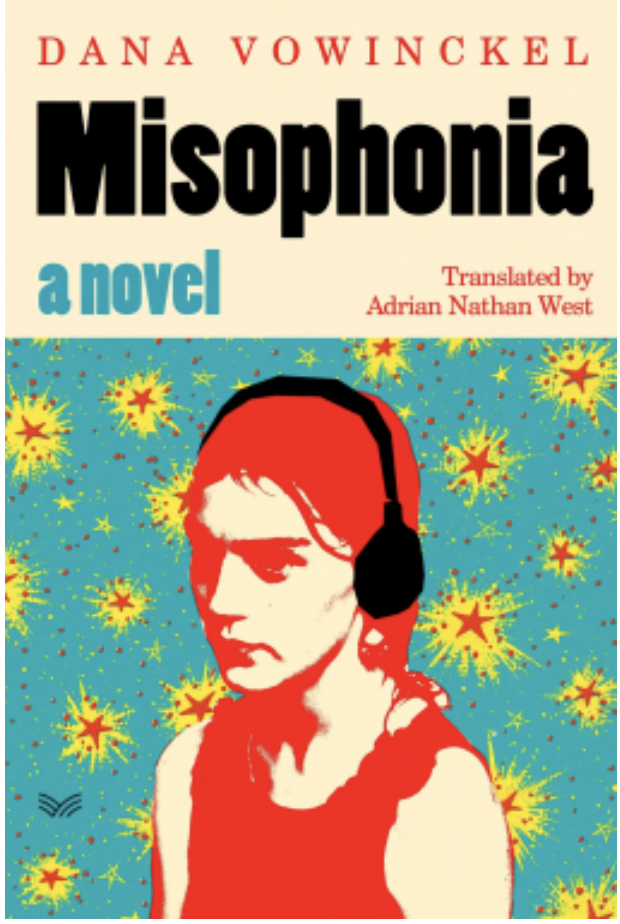
Misophonia by Dana Vowinckel (Literary Fiction)

Part coming-of-age story and part family dynamics, this is the story of an unusual family. Avi is an Israeli born and bred Cantor in Berlin living with his 15-year old daughter Margarita. Her American, linguist mother, Marsha, lives in the U.S. and has little involvement with Margarita to this point. The action takes place in Germany, Israel, and Chicago, where Margarita spends time every summer with her maternal grandparents. While there, Margarita is heavily pressured to go to Israel to stay with her mother who has a summer Fellowship to study Yiddish and Arabic as “oppressed minority languages.”

This is a translation from German, and the prose feels very German to me — methodical depictions of action, thoughts, individual insights, and development — very organized. The opposite of stream-of-consciousness and relaxing for my structured brain. What wasn’t particularly relaxing was the extreme depth of the exposure to the inner turmoil of troubled characters. Margarita’s story becomes cringeworthy in the way that only a particularly astute description of a teenaged girl’s inner struggles can be. The pressures — both internal and external — of being Jewish in multiple contexts (e.g. in Israel, Germany, or America) is thoroughly explored to the point where the reader is completely immersed in the religion from multiple viewpoints, and the impact of Jewish people dwelling within these contexts — much of which is exposed as the revelations different characters have as they develop through the story. I found all this extremely eye-opening, despite the fact that these are topics I’ve read a lot about. There are some absolutely beautiful comments about faith and ritual and Jewish Philosophy. Some very interesting thoughts about how context shapes children as much as their parents do, and how this can cause friction and non-understanding between them.

In the acknowledgements, the author explains that she worked on the novel the year before the events of Oct 2023 so the huge impact that the Hamas massacre had on Israel and the rest of the world is not a part of the story, though I noticed that you can see some hints in a few of the attitudes of some characters. I can’t say that I enjoyed reading this book — the characters are dysfunctional — not in a hopeless or upsetting way, as they are all working to figure things out and improve themselves and their lives, but in a painful way to read. However, I am very glad I read the book and feel like I gained some fresh understanding of the lives of people very different than myself (which is big part of what I look for in my reading).

Thank you to HarperVia and NetGalley for providing an advance copy of this book in exchange for my honest review. The book will be published on May 6th, 2025.
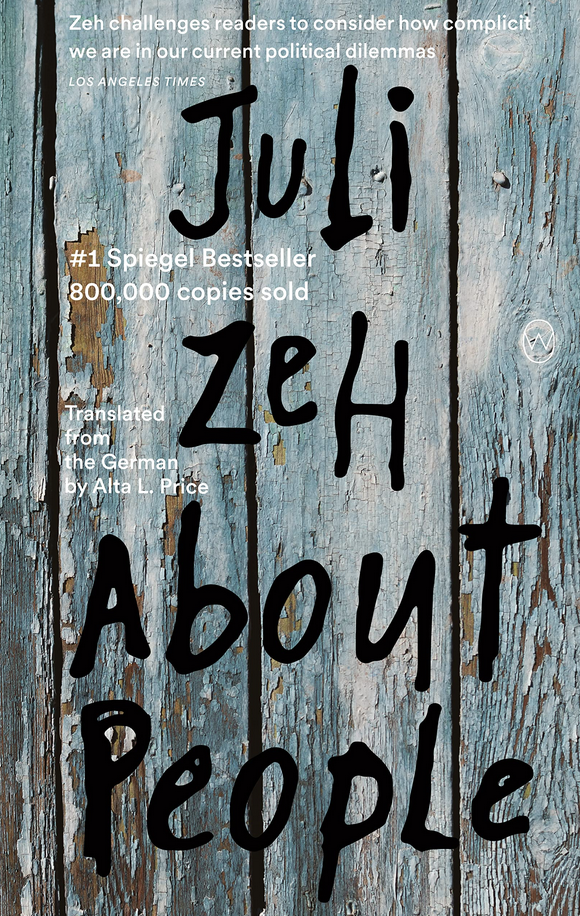
About People by Juli Zeh (Literary Fiction)

Writing: 5/5 Characters: 5/5 Plot: 4.5/5

Dora — a 36-year old advertising creative — thinks a lot. It doesn’t necessarily make her happy, but the stubborn core inside her makes her bristle at any hint of absolute truth, absolute authority, or socially enforced groupthink. Her long-term boyfriend, Robert, has become obsessed with climate change, steadily ramping up his insistence on (her) behavior modification to meet his right-thinking absolutes. When Covid hits, he retargets his laser focus on lockdown adherence and becomes unbearable in close quarters. Dora escapes to a dilapidated house in a small village for a breath of fresh air and finds herself in an AfD (right-wing German populist party) hotbed with the self-proclaimed Village Nazi as a neighbor. Thus begins an unasked for opportunity for a deeply introspective and stubbornly think-for-yourselfer to contemplate existence, humanity, and the nature of moral certitude while the world goes nuts around her.

Had I known anything about the author when I picked this book up, I wouldn’t have been as surprised as I was by how good it was — Zeh is an award winning German author and former judge. I realize that I haven’t kept up with European authors at all in the last decades. The writing / translation is excellent. Through a widely variable set of characters — her rigid climate activist boyfriend, the neo-Nazi next door, her highly confident (veering on the arrogant) neurosurgeon father, advertising colleagues, and a slew of village denizens — Zeh is able to cover a wide range of viewpoints on both specific hot topics (e.g. climate change, covid) as well as general socio-political attitudes towards life.

I loved this mildly satirical look at the way we humans cope with life — “mildly” satirical because it didn’t feel unkind to me. We all have our weaknesses, biases, rationalizations, and expectations and figuring out how to accept that ourselves and others seem like one of the more important problems to tackle. I appreciated Dora’s stubborn insistence on doing her own thinking and doing a lot of it. I loved the way explanation and depth was present in every argument, regardless of the character spouting it. It helped me to (surprisingly) be able to empathize with all of the characters, not just the ones I liked.

There were a lot of great quotes — here are a few:

“She follows the rules and regulations. But her thoughts remain free. Nobody can force her to view the beer drinkers outside the Spatis as treasonous public enemies.”

“What happened to the old certainty that there are no absolute certainties, which is why everything needs to be doubted, debated, and thought about? Dora couldn’t understand how Robert could feel so completely certain his lifestyle was so superior. She just didn’t follow.“

“The era of endless self-pity and constant complaining, JoJo will say. When everyone is always offended, afraid, and feels like they’re in the right. What a combination.”

“Take away the possibility of escape, and every refuge turns into a prison.“

“That sense of superiority is a long-acting poison that devours all humanity from the inside. “

“Then life prescribed her a neighbor. A nazi behind a wall. He was ugly and he stank. If he had been a product, he would’ve gotten only one star in the customer reviews on Amazon.”

“She’s often wondered what, exactly, lies behind this racism-triggered stiffness. Maybe a quandary. A series of impossible either-or decisions: Be a moralizer, or be a coward. Follow your convictions, or society’s expectations — or go for a third option and follow your aversion to conflict.”

“Everyone’s busy being interesting and important. And successful, of course, in both their professional and their personal lives. It’s a rat race of conformists outcompeting one another to come across as something special, someone different.”

“Of course there’s no law stating that neo-Nazis can’t appreciate hydrangeas. But it’s a jarring notion nevertheless. It poses a threat to the life-affirming yet mistaken idea that good and evil can easily be distinguished from one another.”

Thank you to World Editions and NetGalley for providing an advance copy of this book in exchange for my honest review. The book will be published on October 3rd, 2023

The Last Year of the War by Susan Meissner

Thanks to NetGalley and Berkeley Publishing Group for an advance reader copy in exchange for my honest opinion. Book to be released on March 19, 2019 .

Writing: 4 Characters: 4.5 Plot: 4

An historical novel that plunges you right into the WWII period through the eyes of Elsie Sontag — a ten-year old Iowan girl whose life is utterly upended when her father is unjustly arrested as an enemy alien under Executive Order 9066. We follow her along a tortuous path from Iowa to an internment camp in Texas to an unwilling repatriation to Germany in the last year of the war (she doesn’t even speak German). Each step provides a slap-in-the-face kind of opportunity to learn how labels change the way we perceive and treat others.

The book opens when Elise is 81. She is coming to terms with an Alzheimers diagnosis and more than anything wants to find Mariko — the friend she made in the internment camp many years prior. As an aside, I fell in love with this book because of the way Elise anthropomorphizes her disease:

“What I feel is that I’ve been saddled with a sticky-fingered houseguest who is slowly and sweetly taking everything of mine for her own. I can’t get rid of her, the doctor assured me, and I can’t outwit her. I’ve named my diagnosis Agnes after a girl at my junior high school in Davenport — Agnes Finster — who was forever taking things that didn’t belong to her out of lockers.”

Each of the four parts of the book starts with a scene from elderly Elise’s life as she gets closer to finding Mariko. The rest of the book details her journey: Davenport, Iowa after her father’s arrest (part 1), the largely Japanese internment camp (part 2), Germany during the last year of the war (part 3), and finally, her path to and life in California (part 4).

It’s an utterly gripping story — very difficult to put down. Elise’s voice is real and thoroughly human as she struggles to find her place in the world and understand why people behave the way they do. She struggles with finding a place she can call home. The narrative clearly articulates how war affects everyday people who want no part in it and yet are given little choice. I found the historic details to be largely accurate (although I did wonder about a few small details).

Surprising plot twists! Great for both adults and young adults.