
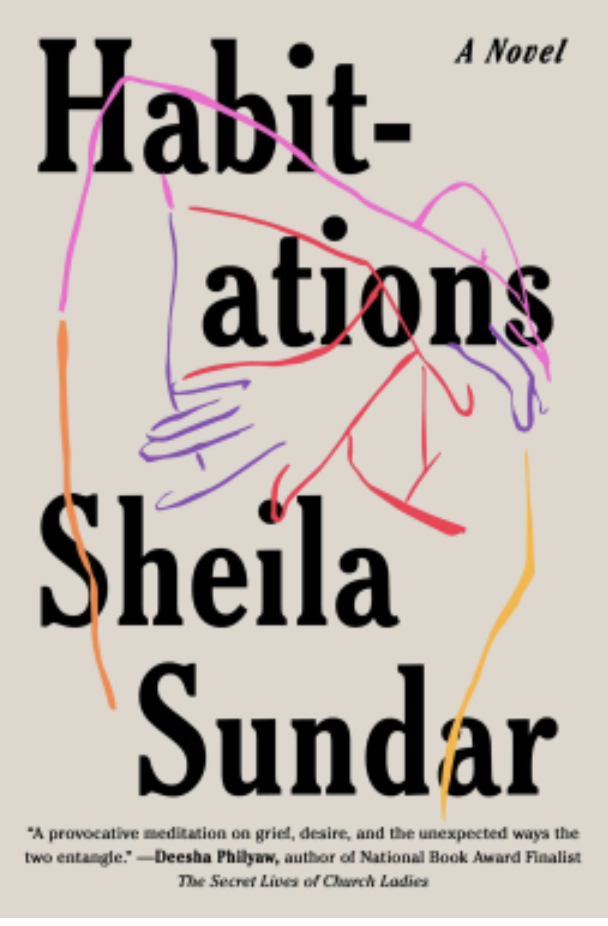
Habitations by Sheila Sundar (Literary Fiction)

Writing: 5/5 Characters: 4.5/5 Plot: 3.5/5

A deeply thoughtful book about Vega Gopalan — an Indian academic (Sociology) who immigrates to the U.S. and shares her introspective take on all her observations of life for herself and the people she meets. Pervading her experiences is the memory of her sister who died at 14 from a disease that would have been easily detectable (and treatable) had she been born in the U.S.

The writing is beautiful, with a talent for capturing complex feelings and thoughts in a few apt phrases. It read like a memoir to me — no foreshadowing, no clearly defined narrative arc — more the development of a life with the actions and events paralleled by Vega’s internal commentary and awareness of self-discovery as it occurs. It was interesting that I didn’t really like Vega — she is not the type of person I would befriend. This is not because she was in any way an unpleasant character, but because she is a deeply interior person who does not always show (or feel?) the empathy and interest in others that I personally like in friends. One of her friends says (appropriately) at one point: “… but sometimes, when we talk, I feel as though I’m interrupting your thoughts.” I usually need to really like a character to enjoy reading about her, but in this case I found myself relating to her intellectually, if not emotionally, so perhaps I would have enjoyed her friendship after all. 🙂

I was impressed by all of the topics discussed in the pages — none with heavy agendas and all with the kind of verbal interactions that show several individuals tackling a topic from multiple personal contexts rather than pulling the latest PC verbiage from a shelf. Vega spends her time in her (American) university keeping company with a wide variety of people — almost all immigrants themselves (from East Africa, Pakistan, Jamaica, etc.). There are a lot of discussions of cultures, advantages, and a realistic depiction of choices that have to be made in order to be allowed to stay or to study. All were treated as facts of life for which you needed to adopt strategies, rather than focussing on the unfairness.

Vega experiences racism at various points but doesn’t let it define her — it’s just more of the expanding context that provides the soundtrack for her developing life. I loved the fact that she was irritated by the “inclusive educational models” at her daughter’s school which featured simplistic math sheets and overly exclamation pointed reading guides, but at the same time had the awareness that if one of her colleagues had written a paper on such models she would have applauded the theories. The book referred to some fascinating academic studies about topics I couldn’t have imagined myself — opening me up to new worlds of thoughts and experiences. Also some lovely references to some of my favorite (and not that well-known) books such as Maya Angelou’s “I Know Why the Caged Bird Sings,” and Tsitsi Dangarembga’s “Nervous Conditions.”

I enjoyed reading the book, but it was one of those books that I found become more interesting the more I thought about it after I finished it. I felt exposed to the multi-faceted reality behind the academic reports, news coverage, and general stereotypes through a stream of social commentary that pertained to individuals in groups, rather than groups as a whole. And lots of stereotype smashing roles — her characters were all influenced by their cultures and backgrounds, but never defined by them. Every time I assumed it would go in a predictable direction it didn’t. Definitely worth reading.

A few good quotes:

“She has long had the sense that there were two types of men: spectacularly bad choices, and interchangeably mediocre ones. She only realized, now, how far she had come from that impression. There was such a thing as a happy marriage. Easy and generous love.”

“She found the veneer of friendship lonelier than being alone.”

“I just grew up with so many people like that. People who lived privileged lives in India, but the moment they travel abroad or talk to foreigners, they want to establish themselves as experts as poverty.”

“There was something broken in her. She knew how to desire a person, but not to care for them.”

Thank you to Simon & Schuster and NetGalley for providing an advance copy of this book in exchange for my honest review. The book will be published on April 12th, 2023.

The Sleepwalker’s Guide to Dancing by Mira Jacob (Literary Fiction)

Writing: 5/5 Plot: 5/5 Characters: 5+/5
Loved this book — 500 pages and I read it in a day and a half — I couldn’t stop!

A skillfully constructed family drama pulsing with life, love, relationships, tragedy, and personality — yet (thankfully) never crossing that line into the minefield of melodrama. Amina Eapen is a talented photojournalist who fled to the safety of weddings and quinceaneras after taking a stunning suicide photo that led to both massive acclaim and massive recrimination. A second-generation, Indian-American immigrant, this story features some of the immigrant flavor, but primarily throws stereotype aside to focus on intricately drawn individuals with so much detail I feel I know them better than I know myself. The action takes place primarily in Albuquerque and moves between the present (1998) and (well sign-posted) pieces of personal history.

I always hesitate to give anything away because the stories unfold at the perfect pace and you should get to enjoy the uncoiling. Suffice it to say that this is a book about family relationships, concomitant personal growth for all, love and loneliness, life and death. Characters: Amina’s father Thomas, the brain surgeon who prefers life in the U.S.; his wife Kamala who wants nothing more than to go back to India; brother Akhil, angry and ranting until he meets his perfect foil; and their extended families — the biological portion left in India and the even closer family created locally.

The writing is beautiful and manages to be funny and poignant at the same time. One of those books where I highlight phrases on most pages (see samples below). I thought the last line of the novel was absolutely perfect. Some comprehensive and edifying descriptions of the process of creating artistic photography which I found fascinating.

As an aside, I learned about a group of Christians that was completely new to me: Amina’s family are part of the Syrian Christians of India who trace their conversion to the 1st century AD after a visit from Thomas the apostle. This plays only a tiny role in the book but I love a good historical tidbit.

It reminded me a little bit of A Place For Us — which I also loved — probably because both are 2nd generation immigrant family dramas that do not claim to represent the category but are splendidly unique and have that amazing character insight that draws me in.

Some quotes:

“Amina nodded calmly, trying to keep her face from registering any hint of worry, but something in her chest bunched up on itself, like a cat being cornered.”

“It wasn’t that she doubted their love or intentions, but the weight of that love would be no small thing. What would they do with everyone else’s worry on top of their own? Thomas did not weather other people’s concern well. He was not going to be happy with her.”

“Cool, flabby arms squeezed her round the middle hard, more a Heimlich than an actual greeting.”

“A minute later Amina set everything on the counter between them and sat down, instantly more jittery, like there was a panic button on her ass.”

“It resembled nothing as much as a set of monster’s dentures fallen from some other world and forgotten on the dusty side of the thoroughfare”

“Her mother’s convictions that movies continue in some private offscreen world had always been as baffling as it was irrefutable. Whole plots had found themselves victims to Kamala’s reimagining, happy endings derailed, tragedies righted.”

“Like plumage that expanded to rainbow an otherwise unremarkable bird, Kamala’s ability to transform raw ingredients into sumptuous meals brought her the kind of love her personality on its own might have repelled.”

“…she would not destroy another creature’s carefully wrought world. If she were God, she’d be a little fucking kinder.”

“Why is it that fathers so often ensure the outcome they are trying to avoid? Is their need to dominate so much stronger than their instinct to protect? Did Thomas know, Amina wondered as she watched him, that he had just done the human equivalent of a lion sinking his teeth into his own cub?”

“… it was that every part of Paige, from her conscience to her politics to her grown woman’s body, was suffused by an optimism so assured that to stay with her, Akhil had to stop being such an angry dick.”

“Her cigarette had a thumb-tip-sized ash growing on it. She flicked it, stuck it between her lips like a straw, and sucked. A cat with its claws out skidded down her trachea.”

“Why bother? Once rewritten, Kamala’s history was safer than classified government documents.”

“It was one of Dimple’s favorite theories, how thousands of years of obsession with a Christian God in a subcontinent of more dynamic religions had petrified the Syrian Christian community, turning them into what she alternately called ‘the stalest community on earth’ or ‘Indian’s WASPs.’ “

“She hated seeing her own face right next to Simple’s — all beak and long chin and awnings for eyebrows, where Dimple’s was a crisp, pert heart.”

“She imagined all of it gone, undone, erased back to 1968, when the city was nothing but eighty miles of hope huddling in a dust storm. She imagined Kamala on the tarmac, walking toward a life in the desert, her body pulled forward by faith and dirty wind.”