
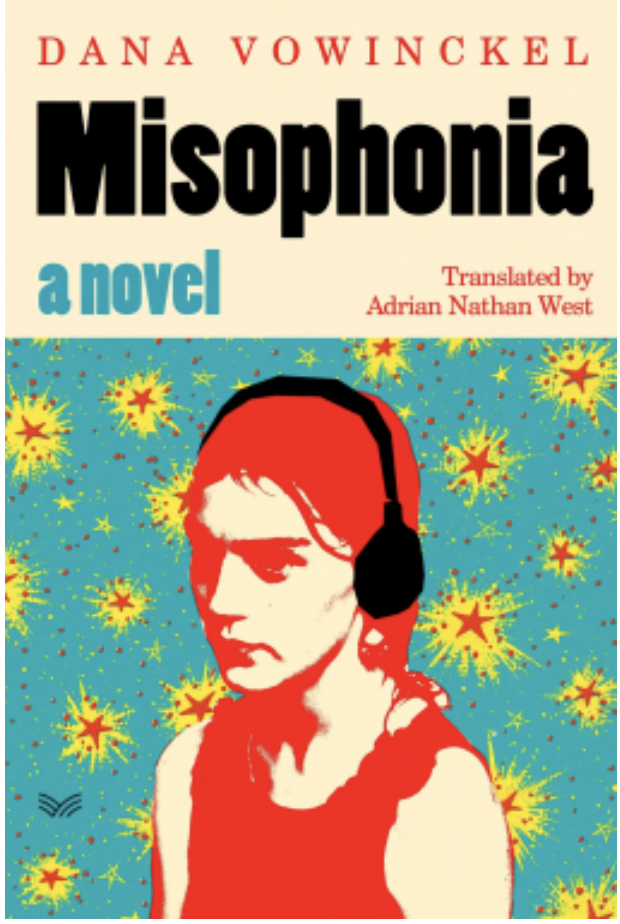
Misophonia by Dana Vowinckel (Literary Fiction)

Part coming-of-age story and part family dynamics, this is the story of an unusual family. Avi is an Israeli born and bred Cantor in Berlin living with his 15-year old daughter Margarita. Her American, linguist mother, Marsha, lives in the U.S. and has little involvement with Margarita to this point. The action takes place in Germany, Israel, and Chicago, where Margarita spends time every summer with her maternal grandparents. While there, Margarita is heavily pressured to go to Israel to stay with her mother who has a summer Fellowship to study Yiddish and Arabic as “oppressed minority languages.”

This is a translation from German, and the prose feels very German to me — methodical depictions of action, thoughts, individual insights, and development — very organized. The opposite of stream-of-consciousness and relaxing for my structured brain. What wasn’t particularly relaxing was the extreme depth of the exposure to the inner turmoil of troubled characters. Margarita’s story becomes cringeworthy in the way that only a particularly astute description of a teenaged girl’s inner struggles can be. The pressures — both internal and external — of being Jewish in multiple contexts (e.g. in Israel, Germany, or America) is thoroughly explored to the point where the reader is completely immersed in the religion from multiple viewpoints, and the impact of Jewish people dwelling within these contexts — much of which is exposed as the revelations different characters have as they develop through the story. I found all this extremely eye-opening, despite the fact that these are topics I’ve read a lot about. There are some absolutely beautiful comments about faith and ritual and Jewish Philosophy. Some very interesting thoughts about how context shapes children as much as their parents do, and how this can cause friction and non-understanding between them.

In the acknowledgements, the author explains that she worked on the novel the year before the events of Oct 2023 so the huge impact that the Hamas massacre had on Israel and the rest of the world is not a part of the story, though I noticed that you can see some hints in a few of the attitudes of some characters. I can’t say that I enjoyed reading this book — the characters are dysfunctional — not in a hopeless or upsetting way, as they are all working to figure things out and improve themselves and their lives, but in a painful way to read. However, I am very glad I read the book and feel like I gained some fresh understanding of the lives of people very different than myself (which is big part of what I look for in my reading).

Thank you to HarperVia and NetGalley for providing an advance copy of this book in exchange for my honest review. The book will be published on May 6th, 2025.

Spies of No Country by Matti Friedman

I received a complimentary copy of this book from Algonquin Books through NetGalley. Opinions expressed in this review are completely my own. The book will be published on March 5, 2019.
This is the story of Israel’s 1948 War of Independence told from the perspective of four spies from Israel’s “Arab Section” — a precursor of what would eventually become Mossad. Although the book includes a lot of background about the Middle East and the War itself, it is primarily a personal account of the experiences — both internal and external — of the spies.

The spies were Jewish men of Arab descent who wanted to be pioneers in the new, experimental (Zionist, socialist, and paradisical) country. Instead they were asked to “live like an Arab” — far from family and friends and amidst people with completely antithetical views (such as “Death to all Jews”). They were given false Arab / Muslim identities and sent out to gather intelligence and sometimes engage in sabotage. When they were finally able to come back to Israel two years later, it was to a completely different place — the reality of the country was a stark contrast to the ideal which they had held. Drawn from interviews, personal writings, and historical reports, the book did a good job of detailing the time and place as well as the attitudes and activities of the spies and those upon whom they spied.

The writing is uneven with an irregular structure resulting from the mashing together of personal accounts, historical documentation, and the author’s occasionally inserted opinions. A little more synthesis and coherence would have been very welcome. However, I did learn a great deal and appreciated the way the many details brought the time and place to life for me.

While I’ve known the rough history of Israel for a long time, I had either forgotten or never had known many of the specifics that I picked up from the book. At the time Israel declared independence in May 1948, 90% of its Jews were European — and looked down on the “black” Jews of Middle Eastern descent. The creation of Israel was a solution to a European, not Middle Eastern, problem. The declaration of Independence caused a massive influx of Jews from the surrounding Middle Eastern countries — not because they were enamored with the idea of a Jewish state but because they were fleeing a sudden and drastic increase in persecution in their home countries. As an example, according to the book Baghdad was 1/3 Jewish prior to 1948 (pretty much 0% now). So the solution to a European problem resulted in a much more widespread and amplified problem for the same target population in the broader Middle East.

Middle Eastern history is long and complicated and this book did not dissuade me from my largely pro-Israel stance. However, it certainly gave me a deeper comprehension of the experiences of the every-day people of the time on both sides of the fluid borders.