
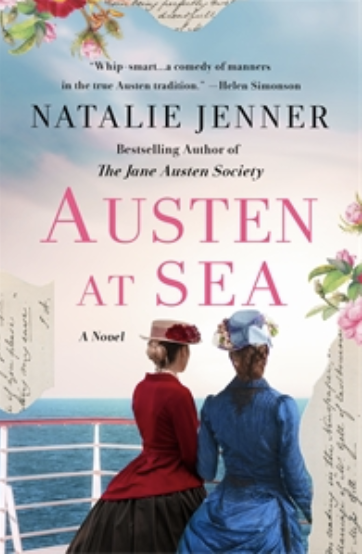
Austen at Sea by Natalie Jenner — Read by Rupert Graves (Historical Fiction)

An enthusiastic five stars for this marvelously fulfilling piece of historical fiction. The story manages to be both intellectually rich and emotionally pleasing. My perfect blend! In 1865, two daughters of the long-widowed Massachusetts Supreme Court Justice pen a daring request to the only surviving brother of their favorite author — Jane Austen. Meanwhile, two Philadelphia book collectors have similarly engaged with Admiral Austen about Austen memorabilia and editions. On the side, the Justices of the Massachusetts Supreme Court have elected to read and discuss the entire Austen oeuvre over the very summer break that sees the four correspondents heading off to England. Their discussions are completely engrossing, putting into dialog multiple well crafted opinions and surprising me with their depth. The story itself takes the reader from Boston, across to the sea to Hampshire, and concludes with a courtroom drama spectacular spanning both countries.

On the surface, this could pleasurably be read as an engaging comedy of manners a la Austen herself, with the delightful development of surprising relationships etc. But under the tip of the romantic iceberg lies the depth, thoroughness, and insight of the literary, political, legal, and economic contexts of the time period. Equality, justice, freedom — these are topics on everyone’s tongues during the post-Civil War recovery period, the still relative newness of the United States, and the current battles in both locations for various forms of women’s rights (including, but not limited to, women’s suffrage). These issues are brought out with a number of different techniques. Those discussing Austen’s works have literary discussions about her characters, their roles, purposes, desires, and life lessons. Women’s rights are addressed (and argued) through a fascinating panoply of laws, Acts, and jurisdictions — exemplified by the situations and experiences of the various characters. It’s obvious to us today (I hope!) that women should have rights equal to those of men, but to hear the completely sensical arguments and rebuttals on both sides of the issue during that time period by people who were not inherently “evil,” was deeply interesting.

I both read and listened to this book. I actually preferred the audio in this case. It slowed me down enough to actually listen to different viewpoints and consider them carefully — I usually read too fast and often miss important details. Rupert Graves is the reader — a wonderful actor with a beautiful reading voice. I learned a lot about Austen’s life and her works (despite the fact that I’ve read each multiple times) and enjoyed a wide array of references from that time period — including Louisa May Alcott who appeared in a delightful cameo role. The cast of characters at the start of the book is quite helpful.

Highly recommended.

Thank you to St. Martin’s Press, Macmillan Audio, and NetGalley for providing an advance copy of this book in exchange for my honest review. The book will be published on May 6th, 2025.
Persuasion by Jane Austen (Literary Fiction)

I reread this for a book club and am so glad I did. We’ve all seen the BBC period dramas that have brought all of Austen’s books to life, and they are all wonderfully delightful, but upon rereading I found a lot of depth that simply can’t be put easily into film.

Persuasion — the story of a woman who was once persuaded to reject the man she loved upon the recommendation of a trusted family friend — brings together all of the thoughts, manners, and considerations of a woman in the landed gentry at that time (~1815). While I am no expert in literary history, I wonder if this isn’t one of the first books to emphasize marital happiness and harmony over passionate love or a business like negotiation for status and money. Austen looks at the essential temperaments and morals of her characters and makes those considerations paramount in thoughts of marriage. And like many classics, the lessons are completely apt for today, despite their being couched in an “olde” patter. Plenty of early feminism, too, in the more open consideration of women as full beings in their own right, without application of the stereotypes of the day.

Delightful characters, thorough descriptions of the rules of society, and a real description of what is and isn’t important in considering one’s place in society, one’s duty, and one’s hope for happiness. The style is not modern — there are many long sentences with a great many commas liberally applied — but once I was back in the rhythm of the thing I had no problem.

Some good quotes:

“She felt that she could so much more depend upon the sincerity of those who sometimes looked or said a careless or a hasty thing, than of those whose presence of mind never varied, whose tongue never slipped.”

“Mr. Elliot was rational, discreet, polished, but he was not open. There was never any burst of feeling, any warmth of indignation or delight, at the evil or good of others. This, to Anne, was a decided imperfection. Her early impressions were incurable. She prized the frank, the open-hearted, the eager character beyond all others.”

“She thought it could scarcely escape him to feel that a persuadable temper might sometimes be as much in favour of happiness as a very resolute character.”

“…on more serious reflection, that, like many other great moralists and preachers, she had been eloquent on a point in which her own conduct would bear ill examination.”

“His looks shewing him not pained, but pleased with this allusion to his situation, she was emboldened to go on; and feeling in herself the right seniority of mind, she ventured to recommend a larger allowance of prose in his daily study; and on being requested to particularize, mentioned such works of our best moralists, such collections of the finest letters, such memoirs of characters of worth and suffering, as occurred to her at the moment as calculated to rouse and fortify the mind by the highest precepts, and the strongest examples of moral and religious endurances.”

“We never shall. We never can expect to prove anything upon such a point. It is a difference of opinion which does not admit of proof. We each begin, probably, with a little bias towards our own sex; and upon that bias build every circumstance in favour of it which has occurred within our own circle; many of which circumstances (perhaps those very cases which strike us the most) may be precisely such as cannot be brought forward without betraying a confidence, or in some respect saying what should not be said.”