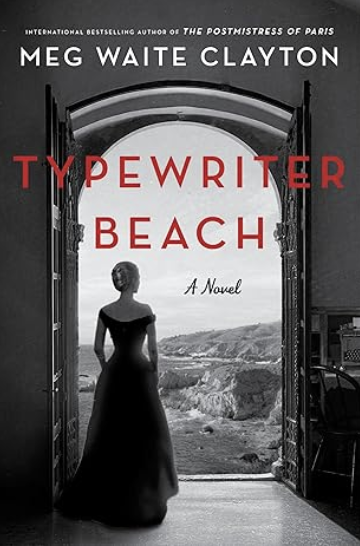
Typewriter Beach by Meg Waite Clayton (Historical Fiction)

I really warmed up to this book — it started off a little slowly and then became more and more intriguing with every chapter, ending with a lovely last line to cap it all off.

Dual timelines — an isolated set of cottages on the beach at Carmel in 1957. During the darkest times of McCarthy’s blacklists and the slow strangulation of Hollywood, a young starlet on the verge of being the next Grace Kelly is sent to wait in one of these cottages by the studio manager and all around fixer. Told to stay indoors and not be seen, she nevertheless meets her neighbor, the enigmatic Leo — a black listed scriptwriter with a haunted past. In 2018 we follow Gemma, whose beloved grandfather has just died and left her his cottage.

The story slowly unfolds, past to present, and while I often thought I knew what was happening, I was often quite wrong. The writing style is rich with thought provoking commentary and reflections. Hollywood — the deals, the norms, the restrictions, the cheats — is on display with all of the detail that I love — not just a description of events, but a description of the people living through those events and how they are changed, what they do to survive, what decisions they make (and sometimes regret, and often don’t). It’s the full experience and incredibly well-researched. I learned a lot about the different ways people dealt with the blacklist and (of course) the very different ways men and women had to deal with opportunities, threats, and restrictions.

Along with this spectacular depiction of the times and contexts is a lovely and often surprising story of love, family, parenthood, and friendship. I don’t want to give anything away, but there are multiple lovely stories of people finding love and family in a world not inclined to make it easy for them. Plenty of stories of people living in an environment not of their choosing and not in their control — and yet … finding their happiness.

Lots of intriguing details on Carmel and Hollywood — late credits for blacklisted screenwriters, a form of “me too” throughout the ages, morals clauses (for women only). I enjoyed every minute of it.

Thank you to Harper and NetGalley for providing an advance copy of this book in exchange for my honest review. The book was published on July 1st, 2025.

The Last Train to London by Meg Waite Clayton (Historical Fiction)

A beautifully written, meticulously researched, fictionalized history of the Kindertransport effort which managed to rescue 10,000 children from Nazi occupied Europe in the nine months prior to the outbreak of WWII (relocating them to England which temporarily waived immigration requirements for the effort. A similar effort in the U.S. was quickly quashed by FDR himself.)

We follow two narratives that slowly weave together: one follows Geertruida Wijsmuller or “Tante Truus,” — the Dutch woman who drives the Kindertransport effort from the politicking at home to the many, many, individual rescues in Europe. The other follows children and their families in Vienna who will eventually become part of Tante Truus’ transport.

I loved the characters — particularly the Austrian children. Clayton succeeded in making these children so bright and so real, their pain and determination nuanced and completely beyond the brief words I can find to describe them. Stephan Neuman — a 16-year old, budding playwright — and his five-year old brother Walter. Theirs is a highly cultured family, and I loved the immersion in the rich cultural world that Stephan inhabited. Stephan’s friend Žofie-Helene Perger — a mathematical prodigy whose non-Jewish mother is a journalist who speaks out against the Nazis putting herself and her family at great risk. And how can you not love Tante Truus who literally can’t bear to think about a child getting left behind if there were anything at all she could do to prevent it.

The real brilliance of Clayton’s book lies in the meticulous portrayal of the many tiny details that comprise life at that time — the underground tunnels, the linotype machines, and mouthwatering descriptions of the chocolatier’s trade. Hovering like a black cloud over these small details, the progressive hardships and changing attitudes of neighbors and friends, the slow shame that creeps up on children who are suddenly treated as different, the insidious and constant fear, disbelief, and tension that inhabits every moment. At the same time, the macroscopic details of global policies — the committees, the bureaucracy, the movements, and the fear on the part of foreign populations and governments as they slowly turn their backs on what was happening to the Jews (and other undesirables) in Europe as the Nazis plow their way through the continent. The book is utterly gripping.

For me, this is the best of the recent spate of WWII / Holocaust books: it felt incredibly real, and I was surprised to learn new things about a topic in which I’m quite well-read. I appreciated that the ultimately uplifting story was focused on survival and rescue, rather than the horrors and despair of the camps. A surprising extra: enduring the frustration (with our characters) of watching countries closing their borders to such desperate need (even though Jewish societies had offered financial support to ensure that host countries would not bear the costs) gave me a new perspective on the refugee crises facing the world today.

Thank you to HarperCollins Publishers and NetGalley for providing an advance copy of this book in exchange for my honest review. The book will be published on September 10th, 2019.