Writing: 5+/5 Characters; 5/5 Plot: 5/5
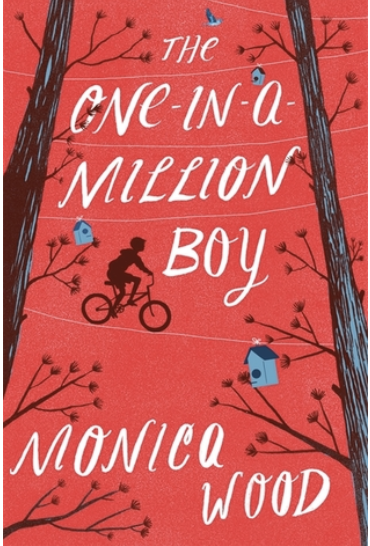
This woman can write! The eponymous “one in a million” boy is dead (at the age of eleven) before the story starts. In fact, we never even know his name — he is always “the boy.” But we learn about him extensively — his (odd) mannerisms, his fascinations, his earnestness — through the effect he has had on a number of characters: his grief-stricken mother Belle; his father Quinn, twice-divorced from his mother, and a complicated presence (or absence) in the boy’s life; and his new friend Ona, the 104-year old woman who is a service target of his boy scout troop. The boy is the only scout Ona has ever allowed to help her for long. He is different. She trusts him and he has managed to extract from her stories, thoughts, and even some fluency in the language of her birth (Lithuanian) — a language she has never knowingly spoken. Most importantly, he has elicited some enthusiasm on her part for a goal for her remaining (!) years. Well versed in the Guinness World Records and utterly enthralled with the possibilities, he believes she has a shot — with his help — at attaining more than one age-related record for the Guinness record keepers.
The book moves on — exploring the characters, their memories, their confusion, sadness, remorse, and regrets, and ultimately their ability to patch the holes in their souls and move forward. The narrative is so real — full of thoughtful characters reflecting on life intelligently with the latent understanding that comes with time; relationships that grow; and characters whose ability to have good relationships keep growing. It’s a bit of a celebration of the utter uniqueness of individual people. I just read David Brooks’ book “How to Know a Person,” but honestly I learn more about how to know a person by reading books like this. Good fiction always feels more truthful to me than the best non-fiction when it comes to people.
At the moment, Monica Wood is my (newly discovered) favorite author. So many possible quotes on this one — I’m probably including too many but I already pruned the list so much! FYI, I absolutely loved the end. I would love to include the whole section but that would just be cheating:
“To Quinn, for whom alcohol was a touchy simile, the truth was this: playing guitar was the single occasion in his slight and baffling life when he had the power to deliver exactly the thing another human being wanted.”
“They stood together in the dripping world, sizing each other up, the boy appearing to marvel at the weight of a century-plus, Ona wondering how in hell she’d unearthed two unrelated words in a tongue she couldn’t remember ever speaking.”
“He enunciated beautifully, though his diction contained barely perceptible pauses in the wrong places, as if he were a foreigner, or short of breath.”
“Normally, Scouts bored her, with their Game Boy stats and soccer scores and lazy, shortcutting ways. This one, though, brought a literal sense of second childhood: she felt as if she were speaking to a child she might have known when she herself was eleven. How easily she placed him at McGovern’s, installed at the white marble soda fountain, sipping a chocolate phosphate. She could see him amid the white-shirted boys playing stickball on Wald Street, tagging the door of Jose Preble’s black REO. There was something vaguely wrong with him that made him seem like a visitor from another time and place.”
“He reminded her that she’d once found people fascinating. That she’d lived more than one life.”
“Ona loved English from the get-go and paid strict attention, noting the cause-effect of language: her parents’ syntactical shipwrecks, the tin peddler’s casual profanity, Maud-Lucy’s pristine enunciations. Style could move listeners to pity, to reverence, to the purchase of a stewpot they didn’t need. Maud-Lucy taught Ona to compose a sentence with intention, and eventually she chose for herself a high-low hybrid that matched her ambivalence toward humankind.”
“Belle managed something like a laugh despite her sorrow, for the boy’s syntactical oddities had always pleased her. He’d read obsessively — instruction manuals, record books, novels far too old for him — picking up linguistic baubles like a crow mining a roadside.”
“I’m good at secrets,” the boy said, studying her so intently now that she began to feel stripped after all — in a good way, stripped of decrepitude and shame.”
“He did wait, observing in silence as Amy padded back and forth with an array of cleaning supplies. From their mother, the Cosgrove girls had learned to scrub their way out of despair. There was no detergent in existence for what ailed them now, but Amy heaved into the old standby nonetheless, with an alacrity bordering on violence, much sloshing and clanging coming from the adjoining rooms. He listened to these sounds — like an animal crying hard, he thought — until she appeared again, hands red and raw.”
“As she opened the menu, Ona felt momentarily unborn, as if her long life had been a warm-up for the real show, on which the curtain was about to rise. She ordered a grilled cheese and a strawberry shortcake, expecting to eat it all.”
“How could it be that Ona Vitkus after so many years alone, had been netted by the maneuverings of lovers and interlopers, tangled into their grief and envy and clumsy efforts at peace? And oh, weren’t they a show: their puzzling wants, their cross-purposes, their own mundane, ticking-down minutes.”
“She looked small and translucent, like a baby turtle from a nature documentary. He fought an impulse to pick her up and carry her to safer ground, As she stood there, fading before his eyes, he extracted the details as if through an old telegraph, dots and dashes that he gathered into a story.”
“He loved that they loved him. He loved the hollow he filled. It was the boy who’d understood this. The boy, whose lists and lists filled his own hollow, the one his father had left behind. A loosening in his chest, like sliding rocks, took him so abruptly that he doubled over, trying to hold it in.”

 Books to look forward to ...