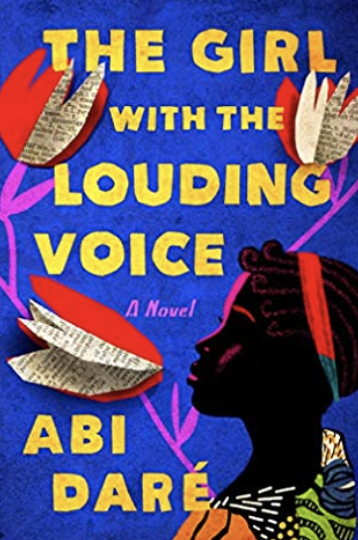
The Girl with the Louding Voice  by Abi Dare (Multicultural Fiction)

14-year old Adunni has grown up rural Nigeria with a drive to be educated that is foiled by her family’s lack of money for school fees and a father who thinks “a girl-child is a wasted waste, a thing with no voice, no dreams, no brain.” Married off at 14 as a third wife with a cruel elder wife and later sold into domestic slavery with a cruel mistress, she somehow never gives up hope — she has dreams of being a teacher and having a real voice — a Louding voice — that people will have to listen to.

The book is easy to read — the unique pidgin english (developed specifically for our fictional protagonist) wasn’t a problem, though I expected it to be. It was consistent and I found I adapted to its rhythm very quickly. There is no faulting the main message — that girls born into cultures where they are not educated, are married off at young ages into often polygamous households, or sold into domestic slavery — are still human, important, and valuable. Who wants to argue with that?

Adunni is a special character. She has real drive and an unquenchable curiosity despite the vicissitudes to which she is subjected. I loved the way she absorbed an education wherever she could find it. She read scraps of books when dusting in the library, she asked questions of everybody (despite receiving beatings for the impudence) and was constantly updating her understanding as a result. However, I did not enjoy reading it, and I’m trying to understand why.

First of all, it’s frustrating to read about such primitive conditions in the modern world with no real path to change. Although not explicitly stated, this story must take place in the Muslim Northern regions of Nigeria. While (civil marriage) polygamy is prohibited federally in Nigeria, polygamy is allowed in the twelve northern, Muslim-majority states as Islamic or customary marriages. And while the literacy rates hover between 80-90% (boys and girls) in the Southern part of Nigeria, the Northern regions show a 20% differential between boys and girls, with the boys at only 50-60% (source statista.com). So what exactly should I be doing with this information about how rural girls in Muslim Nigeria are living? I just find it depressing. The answers in this book are fictional and rely on help for one individual girl that came from a variety outsiders. One tiny drop in a giant bucket and I wasn’t left with the feeling that this kind of help would be easy to find.

Also, despite the fact that the (negative) practices and beliefs described are still in play today, it feels like the book is feeding right into Western stereotypes of Africans — uneducated, primitive, and holding beliefs anathema to our Western ideals of equality for all. And yet, Nigeria has the largest population and strongest economy in Africa, and leads the continent in literature, music, cinema and drama — surely there are other more nuanced worlds and characters who could populate a story. I much prefer the novels of Chimamanda Ngozi Adichie where each character is painted with the depth of an individual regardless of his or her identity and background.

So … well-written with an upbeat ending and some appealing characters, but I certainly didn’t feel inspired, nor did I feel like I learned anything new.
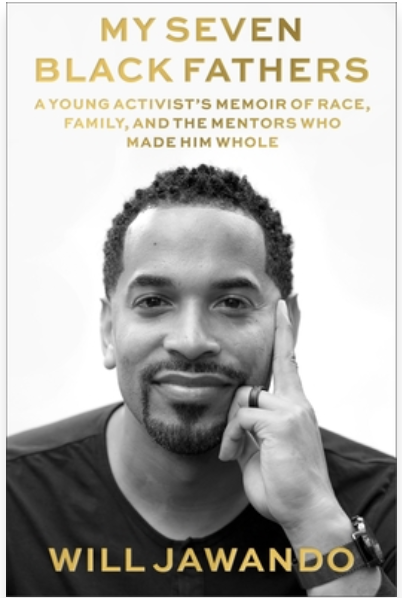
My Seven Black Fathers by Will Jawando (Memoir)

Montgomery County Councilman Will Jawando’s memoir of growing up with an absent Black Nigerian father and a white mother is well-written, measured and thoughtful, with constant fresh insights along the way. I loved the overall theme of the book — rather than considering himself a boy raised without a father, he considers himself as having seven fathers — Black men who took the time to teach him how to be a man by mentoring him, serving as role models, and generally giving him the love, attention, and advice he needed. Eventually, this even led to a loving reconciliation with his biological father.

He honestly made me see mentoring in a new light — how mentoring can literally help someone by exposing them to aspects of life that many of us take for granted. How else can a fatherless boy learn to be a man (or a motherless girl learn to be a woman, or an immigrant learn how to be a citizen of a new country, etc.)? I’ve read a number of books recently about children growing up in some of the more gang ridden areas of the country, with very few fathers present. Why wouldn’t they grow up modeling on the adult men available to them — gang members?

Jawando speaks intelligently about issues — not in slogans — and while racism is a factor in the story, it is just one factor of his experience, not the lens through which the whole story is filtered. He did occasionally make unsubstantiated generalizations based on his interpretation of personal experiences, but not very often, and more often referenced studies showing the broader sociological impact of various things he personally saw or experienced on a personal scale.

It would be hard not to immediately think of Obama’s first book — Dreams from My Father — while reading this. There are many parallels between them (both had African fathers, white mothers from Kansas, and wives named Michel(l)e and in fact, Obama is one of Jawando’s “fathers” based on the time Jawando worked on his staff.

Interesting, inspiring, accessible, and with real depth — definitely worth reading.

Thank you to Farrar, Straus and Giroux and NetGalley for providing an advance copy of this book in exchange for my honest review. The book will be published on May 3rd, 2022.

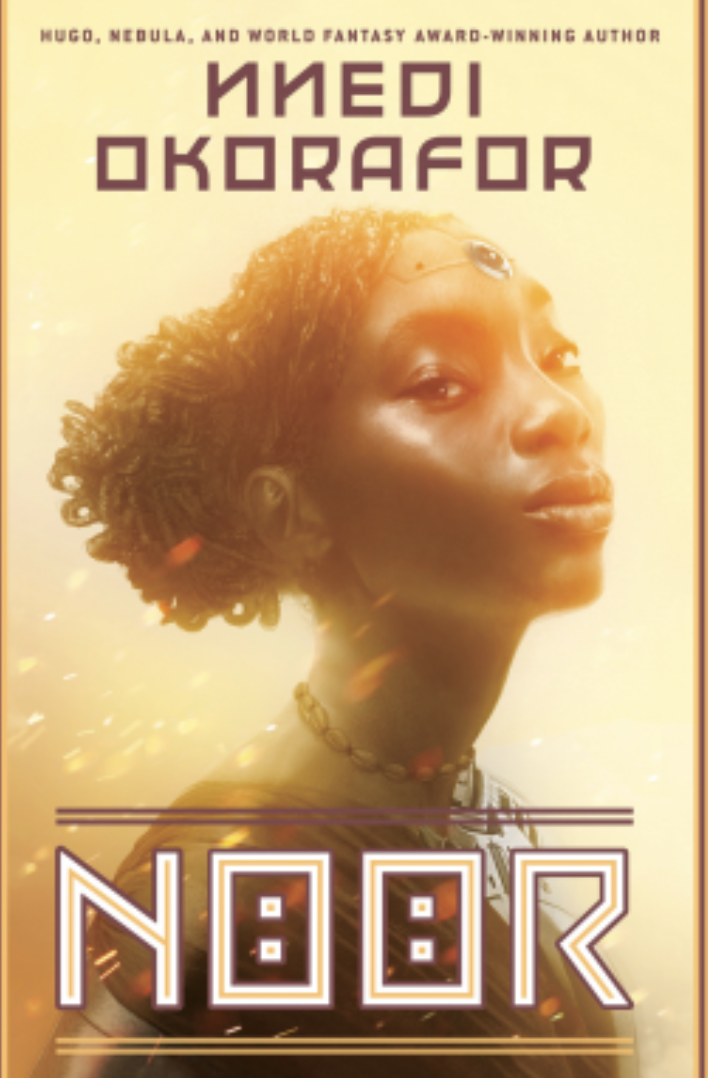
Noor by Nnedi Okorafor (SF / Multi-cultural)

AO Oju has remade herself, literally, using cybernetics and AI augmentation, but in this Africanfuturism blend of technology with deep cultural roots, she is kept an outsider by people whose constant refrain is “what kind of woman are you?” On the run from a particularly disturbing engagement in the marketplace, she meets Fulani hersdman Dangote Nuhu Adamu (DNA), and together they set off into the desert, getting closer and loser to the abomination known as the Red Eye.

Written in Okorafor’s trademark mythical language, rich with pulsing sentiment, the story is an intriguing combination of the cultural and the technical. There is plenty of injustice and unfairness and big, bad corporations at the root of it all, balanced with wonderfully inventive technical solutions. I didn’t buy the science really, but as Arthur C Clarke famously said, “any technology sufficiently advanced is indistinguishable from magic” so …

An engaging read. Works for the YA and Adult SF market.

Thank you to DAW and NetGalley for providing an advance copy of this book in exchange for my honest review. The book will be published on November 9th, 2021.