
Writing: 5/5 Characters: 4/5 Plot: 3.5/5
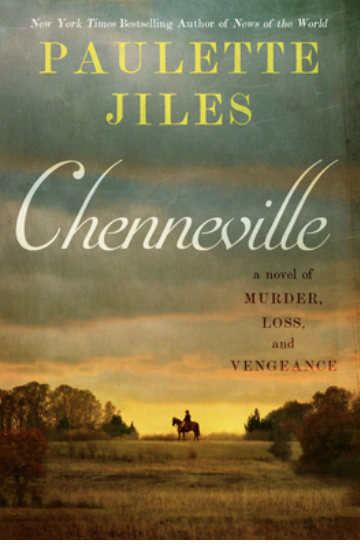
A beautifully written book that fits into the same post Civil War world as her News of the World and Simon the Fiddler. Jean-Louis Chenneville — once a successful farmer and gentleman — returns from the war a broken man having spent a year in the hospital in a semi-coma. He awakens to a dark world of ruin — Lincoln had been assassinated, Lee had surrendered, and the Gray Union army had gone home. His body and mind are slowly healing — his memory has wide gaps.
When he does finally get home, he gets worse news — news that sends him off on a long, single-minded journey to right a terrible wrong. Giles excels at bringing a place and time to life — in this case I almost wish she was a little less skilled. It is a depressing time — full of chaos, corruption, and despair. The war is over but things have not returned to any kind of normal — there is little stability in the South, with deep-seated hatreds and little consistent law enforcement.
The story is slow paced with characters — some unpleasant but many good people just trying to make things work again — introduced as part of his heroic journey. Each character had a unique backstory that highlighted all the different people who found themselves in this difficult time and place from a wide variety of starting points. My favorite part had to do with the telegraph operators that he met and the sub community they formed (with details completely and accurately belonging to the time period). There were definitely times that I wished we could have a little less atmosphere and more plot. The book was thick with description and I don’t visualize from textual description very well, which made some of the (albeit exquisitely depicted) passages tedious for me. I was happy with the ending, but until then it was a bit of a depressing read — depressing because of how hard that time really was, not because someone put a bunch of dramatic events to force readers into heavy emotions. I’m very glad I read it, but I wasn’t super cheerful during that week …
Some quotes:
“The clippers ran like teeth over the long scar. John shut his hands together with tense precision as if pain were a mathematical problem, as if he had just solved it and the solution did not include making a noise if he could help it. Sweat ran down his face.”
“The Ohio steamboat was better because the only movement was the unhinged, sliding feel of a vessel with a shallow keel as it moved across the water.”
“He tried to get a grip on himself. This was no way to live, in this messy chaos of despair.”
“People were draining south like wintertime migratory birds.”
“Every word seemed some strange phrase of dejection and unhappiness.”
Thank you to William Morrow and NetGalley for providing an advance copy of this book in exchange for my honest review. The book was published on September 12th, 2023
 Books to look forward to ...