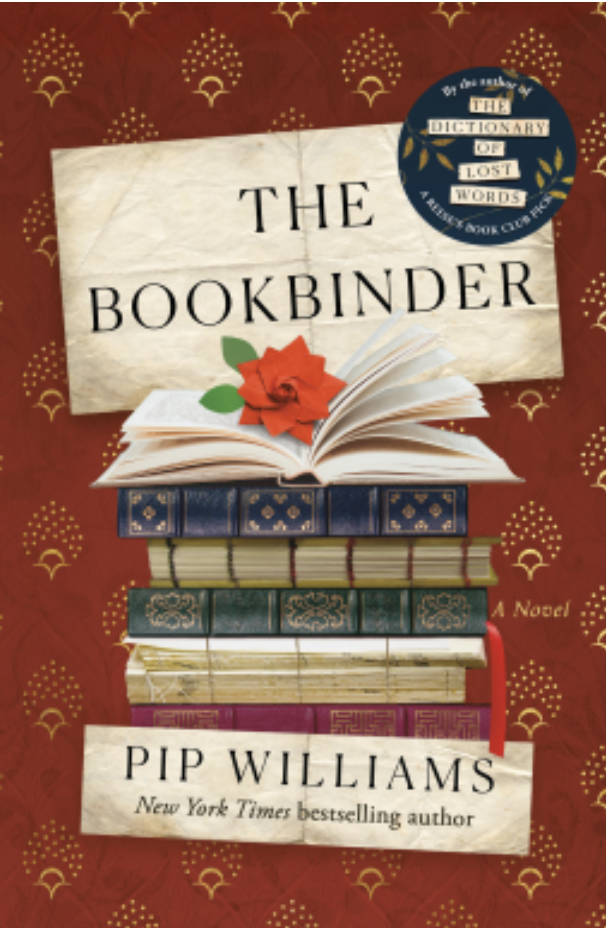
The Bookbinder by Pip Williams (Historical Fiction)

Writing: 4/5 Plot: 4/5 Characters: 5/5

Another book by Pip Williams — author of The Dictionary of Lost Words — about an element of The Oxford University Press (aka Clarendon Press) during the early 1900s. While Dictionary focused on those working to compile the OED, Bookbinder focuses on those working in the physical production of the books.

The eponymous bookbinder is Peggy Jones — a young woman who is working in the “Bindery” — the all-female component of the Press, which focussed on folding and preparing the pages of books. There is an absolutely fascinating 1925 silent video titled “Oxford University Press and the Making of a Book” which really helped me visualize Peggy’s work.

Peggy has been working at the Press with her neurodivergent (my term, not the way it is described in the book) twin sister since the age of 12 (they are now ~22). She has always wanted more — she longs for an education, longs to read and have opinions on the books she is folding — but feels that is impossible for someone of her background. She reads bits as she folds (watch the video — you’ll see how difficult that is), and the canal boat they live in is literally papered with scraps of books that did not meet quality requirements, but certainly meet hers.

The time period covered spans WWI — from 1914 to 1918 — with Peggy’s quest for “more” tied in with opportunities at the Press, the fight for women’s suffrage, and her volunteering with recuperating soldiers and Belgian refugees — all arisising from the upheaval of everyday life. Williams did an excellent job of bringing this time period to life, I was able to feel all the complex emotions of that insane time in a manner that felt very time appropriate.

I found the beginning a little muddy and confusing, but once I got into it, I very much enjoyed the story — particularly the vibrant and believable characters: the twin sister, some of the refugees, the canal community, and various suffragists, librarians, and female students. Every one was drawn deeply and was a person I would want to know. I also loved the details of how the Press was run, women’s colleges (which at the time were not allowed to confer degrees), access to libraries, and classical study. And of course, the ultimately successful effort of a woman from the “wrong side of the tracks” to attain an education and make more of herself.

Two interesting quotes:
“When we bound these books, I thought, they were identical. But I realised they couldn’t stay that way. As soon as someone cracks the spine, a book develops a character all its own. What impresses or concerns one reader is never the same as what impresses or concerns all others. So, each book, once read, will fall open at a different place.”

“The words used to describe us define our value to society and determine our capacity to contribute. They also … tell others how to feel about us, how to judge us.”

Thank you to Ballantine Books and NetGalley for providing an advance copy of this book in exchange for my honest review. The book will be published on August 1st, 2023

The Last Train to London by Meg Waite Clayton (Historical Fiction)

A beautifully written, meticulously researched, fictionalized history of the Kindertransport effort which managed to rescue 10,000 children from Nazi occupied Europe in the nine months prior to the outbreak of WWII (relocating them to England which temporarily waived immigration requirements for the effort. A similar effort in the U.S. was quickly quashed by FDR himself.)

We follow two narratives that slowly weave together: one follows Geertruida Wijsmuller or “Tante Truus,” — the Dutch woman who drives the Kindertransport effort from the politicking at home to the many, many, individual rescues in Europe. The other follows children and their families in Vienna who will eventually become part of Tante Truus’ transport.

I loved the characters — particularly the Austrian children. Clayton succeeded in making these children so bright and so real, their pain and determination nuanced and completely beyond the brief words I can find to describe them. Stephan Neuman — a 16-year old, budding playwright — and his five-year old brother Walter. Theirs is a highly cultured family, and I loved the immersion in the rich cultural world that Stephan inhabited. Stephan’s friend Žofie-Helene Perger — a mathematical prodigy whose non-Jewish mother is a journalist who speaks out against the Nazis putting herself and her family at great risk. And how can you not love Tante Truus who literally can’t bear to think about a child getting left behind if there were anything at all she could do to prevent it.

The real brilliance of Clayton’s book lies in the meticulous portrayal of the many tiny details that comprise life at that time — the underground tunnels, the linotype machines, and mouthwatering descriptions of the chocolatier’s trade. Hovering like a black cloud over these small details, the progressive hardships and changing attitudes of neighbors and friends, the slow shame that creeps up on children who are suddenly treated as different, the insidious and constant fear, disbelief, and tension that inhabits every moment. At the same time, the macroscopic details of global policies — the committees, the bureaucracy, the movements, and the fear on the part of foreign populations and governments as they slowly turn their backs on what was happening to the Jews (and other undesirables) in Europe as the Nazis plow their way through the continent. The book is utterly gripping.

For me, this is the best of the recent spate of WWII / Holocaust books: it felt incredibly real, and I was surprised to learn new things about a topic in which I’m quite well-read. I appreciated that the ultimately uplifting story was focused on survival and rescue, rather than the horrors and despair of the camps. A surprising extra: enduring the frustration (with our characters) of watching countries closing their borders to such desperate need (even though Jewish societies had offered financial support to ensure that host countries would not bear the costs) gave me a new perspective on the refugee crises facing the world today.

Thank you to HarperCollins Publishers and NetGalley for providing an advance copy of this book in exchange for my honest review. The book will be published on September 10th, 2019.

The Boy at the Back of the Class by Onjali Q Rauf (Children’s Fiction)

Writing: 4/5 Plot: 3/5 Characters: 3/5

This is a British story about the Syrian refugee crisis — focused on one small boy and given a fairy tale ending. 9-year old Alexa gets excited from the first moment she sees the new boy — Ahmet — sitting quietly at the back of the room. She and her three friends befriend him and are introduced to his plight just as the UK is moving to stop the flow of refugees completely by “closing the gates.” Alexa conceives the “MOST AMAZING PLAN” (backed up with an “Emergency Plan”) to help keep the gates open, help Ahmet find his family, and deal with the “haters” of the world (with clearly marked names such as “Mrs. Grimsby” in case you are in doubt as to who they are).

The book is sweet and does an excellent job of portraying the refugee crisis in real human terms by describing one boy’s very sad situation. I do feel that the story was oversimplified and did not like the way everyone was depicted (literally) as “good guys” and “bad guys.” While I support trying to find a real solution to refugee problems, this book was written as a very heavy handed propaganda piece. Anyone who doesn’t absolutely support unlimited refugee immigration is labeled (literally) a “bully,” a “hater,” “heartless,” “selfish,” and by implication stupid, and irrational. I don’t think that was necessary — it would have been just as effective a book if she had focussed on one young refugee’s experience, the way the kids had helped bring attention to his plight, and some positive messages about how refugees can be helped and integrated into society, without including all the nasty labels and overly simplified and often inaccurate portrayals of those with other opinions.

A child in the class — “Brendan the Bully” — is portrayed as a terrible boy with no possibility of education or redemption. And when explaining what is happening in Syria, Alexa’s mother explains: “The bad people are just much stronger than they are and like to feel big and powerful by bullying them. You see, some people think that by taking things away from other people and hurting them, it gives them more power, and the more power they have, the more they want and the greedier they get. So they go on hurting more and more people until everyone wants to run away.” Is that really an accurate description of the Syrian civil war? I don’t think so — and I think that oversimplifying problems for children by blaming and labeling whole groups of people as simply irredeemably bad is a very dangerous proposition.

Thank you to Random House Children’s and NetGalley for providing an advance copy of this book in exchange for my honest review. The book will be published on August 6th, 2019.