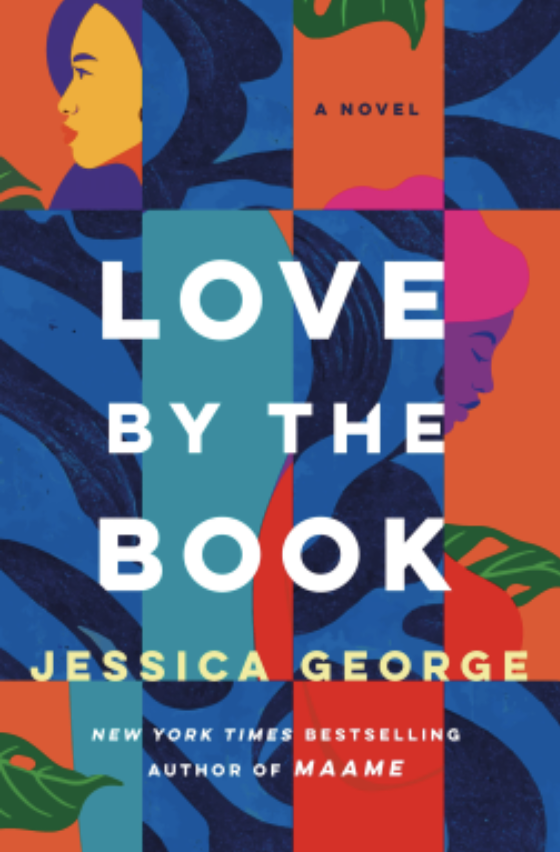
Love by the Book by Jessica George (Literary Fiction)

Writing: 5+/5 Characters: 5+/5 Story: 5

Remy is a writer struggling to produce a second book at the same time as her ten-year, very close, friendship circle is dispersing leaving her jonesing for a new friend. For her, the love she has for her close female friends is far more important than the promise of sexual relationships with men. Simone is an introvert who loves her job as a Year 1 teacher, but also loves the lifestyle provided by her second, and rather secret, job. When the two meet in a kind of platonic “meet cute,” it’s not at all clear that a friendship could be the result, but it does in fact pave the way for an incredibly rich book about female friendship. The best descriptions come straight from the book itself: “Great food, the complexities of female friendship, and the romantic nature of platonic love” and “adult friendship, and the beauty, intimacy, and unappreciated joy of platonic love are explored through the lens of the moral ethics of storytelling.”

I love that the book fully delves into so many issues of importance to women. Real issues such as whether or not have to children; how to tease apart your own moral compass from the judgment of your community; how to define selfishness and is it necessarily a bad thing; and how to manage (which is actually required) a tight friendship group. The idea of platonic love applied to friendship without attraction was a real eye-opener for me. Something I think I’ve always longer for, but honestly could never have even described. These characters are beyond rich — they are so much more interesting and complicated than the typical stereotypes and behavior groupings we get daily from fiction and the beastly news. I found the discussions of life philosophies to be penetratingly insightful (as did the characters themselves). I was able to dive into so many topics that I simply hadn’t spent much time exploring. One of my favorite lines is when one character is exposed to another’s viewpoint and says: “I’ve never really seen life that way. The idea of taking from it as opposed to merely accepting what you receive.” Think about that from the perspective of typical expectations of women!

Jessica George is a startlingly beautiful writer. A large vocabulary precisely placed into perfectly crafted phrases depicting the intricacies of human interaction and self-reflection. I enjoyed the meta-fiction circularity detailing the intricacies of Remy’s writing process while struggling to write the very book that I believe we end up reading. Masterfully done, engaging, and surprisingly unconfusing! I loved her first book — Maame — just as much (see my review here).

Thank you to St. Martin’s Press and NetGalley for providing an advance copy of this book in exchange for my honest review. The book will be published on April 7th, 2026.

The Bloodletters Daughter by Linda Lafferty (Fictionalized History)

Yuck.

This is the *worst* kind of fictionalized history. I’m not a fan of fictionalized history to begin with — combining fact with imagination without clear separation is irritating. But in this case the author went one step further — she simply threw out any real history that didn’t support her story and added in a completely false story, using with real historical characters. If she wanted to write a melodrama and place it in an historical context, why not just pick a time and some fake characters and go from there? Instead, she uses a real King (Rudolf II, the Holy Roman Emperor, King of Bohemia, and King of Hungary and Croatia from 1576 – 1612), his bastard son (Don Julius), and a rumor that the latter abused, killed, and disfigured the local barber’s daughter and turned it into a giant melodrama featuring a lunatic (Don Julius), a ravishing and determined “simple Bohemian bath girl” (the barber’s daughter), and an entire people who simultaneously lived in fear because the King was so powerful that Don Julius could do whatever he liked and yet forced the King to leave his throne at the end because they were so angry that Don Julius killed an innocent girl.

Honestly, the whole book was stupid from beginning to end. There were some poorly integrated sections referencing conflict between the Catholics, Protestants, and the Ottomans, and some others talking about Kepler, Galileo, and Brahe but they had absolutely nothing to do with the story.

Normally I would have stopped reading after the first references to the “azure eyes” and “russet hair” of the heroine — clear markers of a frivolous book — but this was a book club selection so I had to see it through to the end.

The Matchmaker’s List by Sonya Lalli

Thanks to NetGalley and Berkeley Publishing Group for an advance reader copy in exchange for my honest opinion. Book to be released on Jan. 22, 2019.

Writing: 4/5 Plot: 3.5/5 Characters: 4/5

Women’s fiction pairing romcom humor with a smart, capable, protagonist. Complex themes with authentic resolutions. Multi-cultural and sexual diversity interest.

29 year-old Raina Anand is under constant pressure from her beloved Nani to get married. Her best friend is about the tie the knot and the close knit Indian community in her Toronto suburb is all geared up to help her follow suit. However, Raina is keeping a shameful secret — she is still in love with the man she left (in another country) 2 years ago. In order to protect this secret, she allows her Nani to believe she is gay — with broad and surprising consequences.

This is not your typical romcom. There are no firemen, no Fabios flexing muscles, and no ditzy but lovable blondes prepared to make some man very happy. The story continually veers off into unexpected territory and allows the main character to experience real emotional growth while trying to find her way in the world. Opening on Raina’s 29th birthday, the narrative carries through to her 30th, interspersed with reverse-order flashbacks to previous memorable birthdays. Her family is not typical (is anyone’s?). Half Indian, half caucasian, she was raised by her grandparents and only rarely saw her mother who bore her when only 16. But even this is not exactly as it seems — there is depth and nuance in this story.

There is a strong theme of sexual orientation diversity — portrayed in an interesting way because while our first person narrative protagonist is not gay herself, this “small” white lie highlights the clash of tradition and modernism simmering beneath the surface of her small, tight-knit, community.

Fun, witty, writing. Well structured with good messages about diversity, values, and the danger of letting shame drive you into making bad decisions.

The Clockmaker’s Daughter by Kate Morton

Writing: 3.5 Plot: 3.5 Characters: 4

Richly detailed historical fiction with a convoluted plot pulled from a set of narratives scattered across time but centered on place: Birchwood Manor — a 400 year old house immersed in myth and mystery. Murder, mayhem, stolen heirlooms, and old artifacts form the center of the story, but they exist in a sea of love, loss, and a range of historical settings including Queen Elizabeth and the Catholic persecution of 1586, the (fictional) Magenta Brotherhood artist group of the mid 1800s, the establishment of a school for young women in the late 1800s, London and environs in WWII, and modern day archival work. It’s engrossing but complicated — I found that documenting a timeline as I read was extremely helpful.

The writing is good but a little long winded for my taste. On the other hand, if you love historical dramas you may enjoy the longer opportunity to immerse yourself in the 500 pages of intriguing characters and historically accurate details. Did I mention that one of the narrators is clearly a (compelling) spirit that has been bound to the house for over a century?


The Little French Bistro by Nina George

Writing: 4 Characters: 5 Plot: 4.5

A sensuous novel in the literal sense of the word. 60-year old Marianne is leading a drab, grey, existence when she slips away from the tour group in Paris (and her cold, unfeeling, husband of 41 years) with the intention of sliding into the Seine and letting it all go. Instead, her world appears to burst into color as she follows a pull towards a very different life in the small seaside village of Kerdruc in Brittany.

The book hovers on the line between literary fiction and romance: the language, character and relationship development, and the depth of details are literary; the tales of love at first sight, unrequited love lasting for decades, and makeovers that transform women into goddesses are pure romance. To be fair, the literary does outweigh the romance and I love the fact that those falling in love, rediscovering love, and staying in love for decades are of all ages.

The luscious prose delights in describing the natural world — the vistas, the sounds, the smells. The tone of the book is one of wonder — communing with nature through the senses and resonating with the beauty in the world. A magic thread keeps pulling her forward to the place that feels like home as soon as she arrives — a painted tile, a scrawny cat in the rain, a group of nuns. An added surprise — threads of Breton folklore permeate the story. Did you know the original settlers in Brittany were Celts? I did not.

This is a book of magical coincidences and love in all of its myriad forms. On the whole, I enjoyed reading it — I fell in love with the characters and it was difficult to put down — but don’t expect anything practical or even plausible. It’s just a lovely exploration of the way we wish the world could be.