
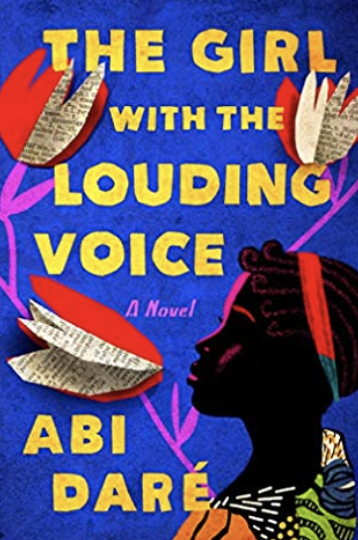
14-year old Adunni has grown up rural Nigeria with a drive to be educated that is foiled by her family’s lack of money for school fees and a father who thinks “a girl-child is a wasted waste, a thing with no voice, no dreams, no brain.” Married off at 14 as a third wife with a cruel elder wife and later sold into domestic slavery with a cruel mistress, she somehow never gives up hope — she has dreams of being a teacher and having a real voice — a Louding voice — that people will have to listen to.
The book is easy to read — the unique pidgin english (developed specifically for our fictional protagonist) wasn’t a problem, though I expected it to be. It was consistent and I found I adapted to its rhythm very quickly. There is no faulting the main message — that girls born into cultures where they are not educated, are married off at young ages into often polygamous households, or sold into domestic slavery — are still human, important, and valuable. Who wants to argue with that?
Adunni is a special character. She has real drive and an unquenchable curiosity despite the vicissitudes to which she is subjected. I loved the way she absorbed an education wherever she could find it. She read scraps of books when dusting in the library, she asked questions of everybody (despite receiving beatings for the impudence) and was constantly updating her understanding as a result. However, I did not enjoy reading it, and I’m trying to understand why.
First of all, it’s frustrating to read about such primitive conditions in the modern world with no real path to change. Although not explicitly stated, this story must take place in the Muslim Northern regions of Nigeria. While (civil marriage) polygamy is prohibited federally in Nigeria, polygamy is allowed in the twelve northern, Muslim-majority states as Islamic or customary marriages. And while the literacy rates hover between 80-90% (boys and girls) in the Southern part of Nigeria, the Northern regions show a 20% differential between boys and girls, with the boys at only 50-60% (source statista.com). So what exactly should I be doing with this information about how rural girls in Muslim Nigeria are living? I just find it depressing. The answers in this book are fictional and rely on help for one individual girl that came from a variety outsiders. One tiny drop in a giant bucket and I wasn’t left with the feeling that this kind of help would be easy to find.
Also, despite the fact that the (negative) practices and beliefs described are still in play today, it feels like the book is feeding right into Western stereotypes of Africans — uneducated, primitive, and holding beliefs anathema to our Western ideals of equality for all. And yet, Nigeria has the largest population and strongest economy in Africa, and leads the continent in literature, music, cinema and drama — surely there are other more nuanced worlds and characters who could populate a story. I much prefer the novels of Chimamanda Ngozi Adichie where each character is painted with the depth of an individual regardless of his or her identity and background.
So … well-written with an upbeat ending and some appealing characters, but I certainly didn’t feel inspired, nor did I feel like I learned anything new.
 Books to look forward to ...