
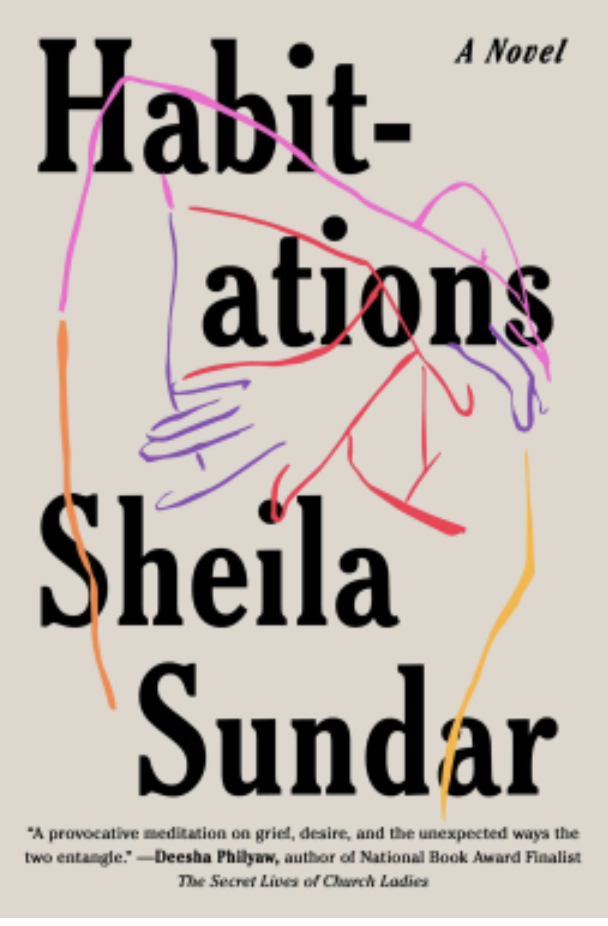
Habitations by Sheila Sundar (Literary Fiction)

Writing: 5/5 Characters: 4.5/5 Plot: 3.5/5

A deeply thoughtful book about Vega Gopalan — an Indian academic (Sociology) who immigrates to the U.S. and shares her introspective take on all her observations of life for herself and the people she meets. Pervading her experiences is the memory of her sister who died at 14 from a disease that would have been easily detectable (and treatable) had she been born in the U.S.

The writing is beautiful, with a talent for capturing complex feelings and thoughts in a few apt phrases. It read like a memoir to me — no foreshadowing, no clearly defined narrative arc — more the development of a life with the actions and events paralleled by Vega’s internal commentary and awareness of self-discovery as it occurs. It was interesting that I didn’t really like Vega — she is not the type of person I would befriend. This is not because she was in any way an unpleasant character, but because she is a deeply interior person who does not always show (or feel?) the empathy and interest in others that I personally like in friends. One of her friends says (appropriately) at one point: “… but sometimes, when we talk, I feel as though I’m interrupting your thoughts.” I usually need to really like a character to enjoy reading about her, but in this case I found myself relating to her intellectually, if not emotionally, so perhaps I would have enjoyed her friendship after all. 🙂

I was impressed by all of the topics discussed in the pages — none with heavy agendas and all with the kind of verbal interactions that show several individuals tackling a topic from multiple personal contexts rather than pulling the latest PC verbiage from a shelf. Vega spends her time in her (American) university keeping company with a wide variety of people — almost all immigrants themselves (from East Africa, Pakistan, Jamaica, etc.). There are a lot of discussions of cultures, advantages, and a realistic depiction of choices that have to be made in order to be allowed to stay or to study. All were treated as facts of life for which you needed to adopt strategies, rather than focussing on the unfairness.

Vega experiences racism at various points but doesn’t let it define her — it’s just more of the expanding context that provides the soundtrack for her developing life. I loved the fact that she was irritated by the “inclusive educational models” at her daughter’s school which featured simplistic math sheets and overly exclamation pointed reading guides, but at the same time had the awareness that if one of her colleagues had written a paper on such models she would have applauded the theories. The book referred to some fascinating academic studies about topics I couldn’t have imagined myself — opening me up to new worlds of thoughts and experiences. Also some lovely references to some of my favorite (and not that well-known) books such as Maya Angelou’s “I Know Why the Caged Bird Sings,” and Tsitsi Dangarembga’s “Nervous Conditions.”

I enjoyed reading the book, but it was one of those books that I found become more interesting the more I thought about it after I finished it. I felt exposed to the multi-faceted reality behind the academic reports, news coverage, and general stereotypes through a stream of social commentary that pertained to individuals in groups, rather than groups as a whole. And lots of stereotype smashing roles — her characters were all influenced by their cultures and backgrounds, but never defined by them. Every time I assumed it would go in a predictable direction it didn’t. Definitely worth reading.

A few good quotes:

“She has long had the sense that there were two types of men: spectacularly bad choices, and interchangeably mediocre ones. She only realized, now, how far she had come from that impression. There was such a thing as a happy marriage. Easy and generous love.”

“She found the veneer of friendship lonelier than being alone.”

“I just grew up with so many people like that. People who lived privileged lives in India, but the moment they travel abroad or talk to foreigners, they want to establish themselves as experts as poverty.”

“There was something broken in her. She knew how to desire a person, but not to care for them.”

Thank you to Simon & Schuster and NetGalley for providing an advance copy of this book in exchange for my honest review. The book will be published on April 12th, 2023.
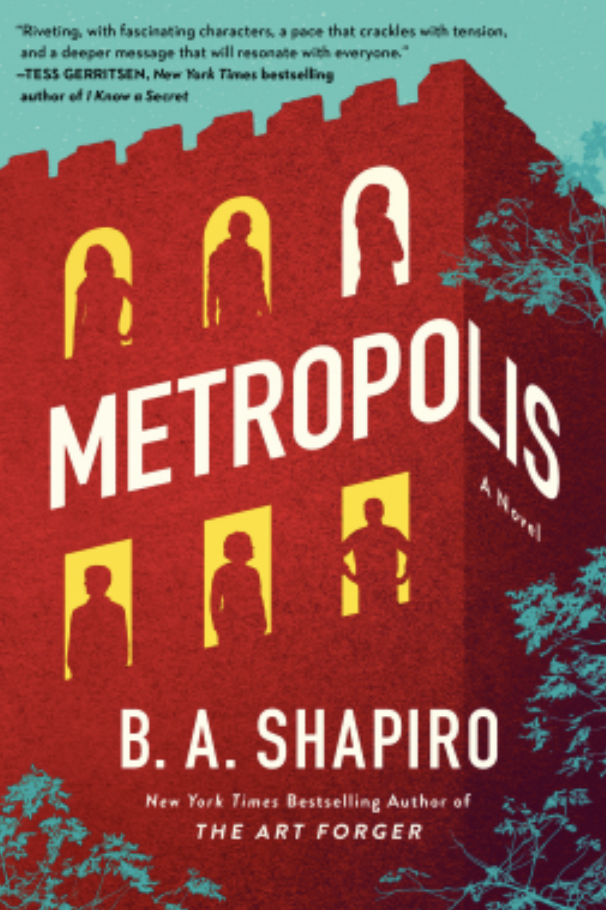
Metropolis by B. A. Shapiro (Literary Fiction)

Plot: 3.5/5 Characters: 4/5 Writing: 4/5
The Metropolis is an old fashioned self-storage unit in Boston — with variable sized units many of which have windows. The best part of this book is the peek into the lives of those who have found themselves in need of excess storage space and the way they use said space. Liddy Haines, wife of the uber wealthy (and not terribly nice) Garrett Haines, keeps her children’s things in the unit when they are shipped off to boarding school courtesy of the not-nice daddy; Jason, the black Harvard educated lawyer who found himself at odds with his corporate employer, houses his office there; Marta, a beautiful Venezuelan on the run from ICE, has moved in, feverishly focussing on her Sociology PhD thesis on how disparities at birth play out in life; and Serge, a brilliant and increasingly mentally disturbed photographer.

The unit is owned by Zach as an effort to go legit and managed by Rose who has her own set of issues. Everything is going along tickety-boo until an “incident” occurs in the unit elevator…

I love the premise of the story — who doesn’t think about all the diverse lives contained in such a collection of rooms with no other commonality? The characters were well-drawn and relatable, though I found their situations were all over-the-top and each was a little tropish. I always love her art commentary, in this case focused on Serge’s extraordinary photographs.

A fun read!

Thank you to Algonquin Books and NetGalley for providing an advance copy of this book in exchange for my honest review. The book will be published on May 17th, 2022.

Non-Binary Lives by Jos Twist, et al (Non-Fiction)

An interesting collection of essays by and about non-binary persons. From wikipedia:  Non-binary is a spectrum of gender identities that are not exclusively masculine or feminine — ‌identities that are outside the gender binary.

Most of the authors are living and working in the UK, though a few were from other countries. My impression is that most are therapists and / or gender study students or professional academics.

While a few of the essays proved to be overly jargonistic or borderline offensive (one railed against the “ableist, capitalist, patriarchal, white supremist, cisgenderist dominant society” and another kept mentioning “toxic gender binary notions”), most were well-written and explored aspects of the non-binary gender concept that were new to me. Many examined the intersectionality of being non-binary within different cultures or religions as experienced by (for example) a Vietnamese Confucianist, a Jewish feminist, a Quaker, and an Hispanic. One essay explored the effect of motherhood (via the traditional biological pathway) on someone who self-identified as non-binary.

I was naively surprised by the references to infighting between differently gendered groups. Said one author: “…the phenomenon of self-identified transsexual folk who are vehemently opposed to non-binary as a concept as they feel it undermines the realness of their own identities. The vitriol they express is nearly as bad as the right-wing opponents of ‘gender ideology’ who are freaking out about the end of gender and gender roles.” Another bemoaned the fact that as a non-binary person, they were no longer able to benefit from the many women-only groups and privileges they had been enjoying. They had been happy to be part of women’s theater companies who were “dedicated to presenting lesser-told stories” as compared to the more “mainstream” companies, “dedicated to working their way through the safe Western dramatic canon of plays by dead cishet white dudes,” and were now unhappy to be automatically lumped in with the outsiders.

I’ve been fascinated with the concept of gender and gender fluidity ever since reading Gender Mosaic by Daphna Joel and Luba Vikhanski, and I enjoyed many of the essays in this book. They forced me to examine my own perceptions and actions: Why do I care what gender a person is? Or whom they prefer as a sexual partner? And yet I notice that if I can’t tell at a glance, I spend time trying to figure it out. For some reason I feel I need to know. Does this mean I treat people differently based on gender or simply that I have a great need to keep things categorized in my head? I have no idea!

I do know that I am greatly in favor of more inclusion in society, but not at the expense of other groups. Let’s hear more stories and give more opportunities to previously unrepresented groups — but why is it necessary to exclude people simply because some perceive them to have been part of a “privileged” group? Today’s white, cishet, men should not have to suffer because in the past *some* white, cishet, men benefited at the expense of other groups. And why on Earth would we want to belittle the great works of the past simply because their creators were white men when there were others at the time who did not have the same opportunities? Shakespeare’s plays are still amazing as are the works of Mozart, Rembrandt, and Sir Isaac Newton. Let’s work on making the world a place where we can have more greatness, not less.

I hate identity politics, and I’m happy to say that most of this book was focused more on individual experiences and perceptions than on politics. Worth a read if you’re curious about the concept.

Thank you to Jessica Kingsley Publishers and NetGalley for providing an advance copy of this book in exchange for my honest review. The book will be published on April 21st, 2020.