
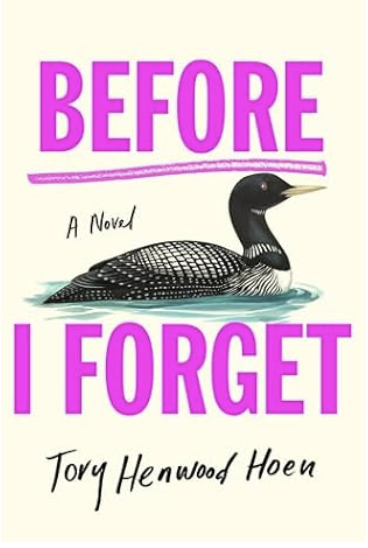
Before I Forget by Tori Henwood Hoen (Literary Fiction)

This is the long-delayed coming-of-age story of a 26-year old going home to care for her Alzheimer-ridden father. And let me immediately reassure you that there is absolutely nothing depressing in any of it. What I began reading with trepidation (I’m not looking for depressing stories!) pulled me forward with increasing amounts of humor, human insight, and beyond touching moments (so yes, I teared up frequently, but from seeing substance, not sadness).

Cricket quits her job as an underutilized gofer for an over-the-top healthcare company that peddles an infinite array of body rejuvenation at very high prices. Instead, she heads to her favorite place (their home in the Adirondacks) and her beloved father — neither of which she has seen since a decade old tragedy left her beyond bereft and thoroughly guilt-ridden. From here the story takes off in unexpected ways with engaging characters, possible connections to the spiritual world, some unexpected business opportunities, and many chances to rethink the past. Throughout all of it, Cricket moves toward self understanding, forgiveness, and a stronger connection to those about her.

The writing is very good — the prose, pacing, and plot elements all perfectly tuned to Cricket’s growth without demeaning the roles of others in her story. I loved the insight and the messaging and the way Cricket always behaved in a principled manner — even when she was confused or afraid. I loved the different out-of-the-box ways dementia was portrayed, without downplaying the difficulty and loss. I loved the way personality traits could be interpreted in opposites: was someone passive or patient? Complacent or content? Insatiable or intrepid?). And I loved the humor applied to the situations and characters — particularly the buffoonish commentary on new age health gurus and products (see some of my favorite quotes below).

One of my favorite books this year.

Some great quotes:
“I am only 26, which means I am essentially a larva. In contemporary America, childhood can last well into one’s 30s, 40s, and even 50s.”

“What if Alzheimers isn’t just a slow death? What if it’s another dimension entirely – an ascension even? Humans are so fixated on our minds that we see their loss as a tragedy. But what if it’s a gift? Maybe the erosion of memory clears space for something truer. Maybe the intellect gets in the way of the heart, until little by little, it doesn’t.”

“My mother once told me I was too passive, but I prefer to think of myself as patient. There are some problems that solve themselves if you simply wait a while.”

“I have a vague feeling that, when it comes to my life, not only am I sitting on the sidelines, but I’m playing the wrong game altogether. As I look around at the leftover mess from the weekend, I think: I’m ready to be something other than young.”

“I was impressed by her confidence and conviction – two things I was lacking. When you are full of questions, you are drawn to people who look like answers.”

“You could spend all day exfoliating, lifting, moisturizing, resurfacing, deep conditioning, buffing, harmonizing, depilating, and rejuvenating your bodily surfaces, but at the end of that day, your soul will still ache for what it really wants: freedom from the consumptive cycle of never feeling or looking quite good enough. We’ve conflated health with vanity. It’s not that I don’t believe in healing; I just don’t believe you can buy it for $78 an ounce.”

Thank you to St. Martin’s Press and NetGalley for providing an advance copy of this book in exchange for my honest review. The book will be published on December 2nd, 2025.

Clover Blue by Eldonna Edwards (Fiction)

Writing: 4 Plot: 4 Characters: 5

When 10-year old Clover Blue witnesses his first live birth in his Northern California commune, he begins to wonder which of the sister-mothers he actually came from. But there is an odd hush around that subject, in this otherwise open, loving, and caring community.

Ranging from 1974 through 1978, the book follows Blue’s quest to understand who he really is. Blue is a wonderful character and the detailed depiction of communal life and those who chose it are inspiring. The author manages to paint a full picture of real people who have consciously formed a family in a spiritual environment and yet who have also made mistakes with serious impact. I love the balanced way she has shown what might happen in such circumstances — with an objective tone which simultaneously portrays the beauty of the people, their relationships, and their way of life as well as the struggles, frailty, and hypocrisies.

I loved reading this book — particularly for the characters and the fact that it embodied all the best things I remember from that era (Blue is four years younger than I was during the time period). The commune members have their own backstories and their relationships within the commune parallel the evolution of the commune itself. The story unfolds beautifully with ongoing reflection. The commune is clothing optional and the kids are home schooled — with each of the “Elders” imparting their own wisdom. The local library serves as a fantastic resource. The essay Blue is assigned to write about people watching TV is priceless (he has to go to the local clinic to observe this as there is no television at the commune). One of the Elders sums up all of the great religions with: “Great prophets like Jesus and Mohammed and Buddha pretty much said the same thing… Be kind. Respect life. Pay attention. And focus on the here and now, not the promise of something better in the afterlife.” So simple.

The start is a little slow — I initially found the writing a little clunky and almost stopped reading — but fairly soon I was completely caught up in the characters and their surroundings and forgot I was reading at all (my measure of a good book!).

Highly recommended!

Thank you to Kensington Books and NetGalley for providing an advance copy of this book in exchange for my honest review. The book will be published on May 28th, 2019.

Professor Chandra Follows His Bliss by Rajeev Balasubramanyam

I received a complimentary copy of this book from Random House Publishing Group through NetGalley. Opinions expressed in this review are completely my own. The book will be published on March 26, 2019.
Writing: 5 Plot: 4.5 Characters: 4.5

69-year old leading Cambridge economist Professor Chandra is a shoe-in for the Nobel prize in Economics — except that he doesn’t get it. Divorced, distant from his three children, and frustrated with the new tenor of academic life, this “non event” coupled with a silent heart attack sends him off on an unintended, Siddhartha-like quest for personal enlightenment (naturally starting with a sabbatical at UC Bella Vista in Southern California).

His journey takes him to unlikely places — both physical and emotional. He is tricked into attending a weekend workshop at Esalen; he visits his ex-wife and new, annoying husband in Boulder in order to see his troubled daughter Jasmine; he searches for a way to reach his middle daughter Radha — an angry Marxist who hasn’t spoken to her conservative father in over two years; and visits his son Sunil’s highly successful Hong Kong-based “School for Mindful Business” (based on principles completely antithetical to his own). He learns that he is human and not infallible and finds himself more OK with that than he would have expected.

Excellent and insightful writing — wry and witty with deliciously pithy and often hysterical articulations of his evolving viewpoints. Lots of interesting commentary about psychology, economics, spirituality, achievement and the personal search for meaning and happiness.  I appreciate that while he learns more about himself, his priorities, and his relationships, he does not relinquish his intellectual interests or accomplishments.

Some great lines:

Brief but scathing summary of the identity politics Radha adheres to:
“‘West’ … ‘bourgeois’ … ‘capitalist’ … these words would fly from her lips like tiny swastikas, her knuckles turning white, her jaw clenched, her eyes hard as Siberian pickaxes as she sentenced most of the world to the gulag for their crimes against ideology.”

“An Indian Miss Havisham with an Emeritus Professorship and a takeaway menu.”

“… but he couldn’t help believing meditation was best suited to those with less mind to be mindful of: sociologists, for example, or geologists”

“Humans were like those snowflakes against the window, buffeted by winds no one understood.”

“Chandra accepted the phone as if he’d been handed a small but quite genuine lump of plutonium.”

“They seem to come pre-offended, forsaking any analytical content in favor of emotion and outrage.”

“But the undergraduates were even worse than in Cambridge: arrogant, unhygenic, and brazen, convinced that lazy platitudes and fallacious arguments would earn them nothing but praise if delivered with sufficient conviction.”

“King’s was Chandra’s least favorite college. It was the intellectual equivalent of a Disney princess, fluttering its eyelashes at tourists who didn’t know any better.”

“It was what Chandra loathed most about liberals — their shameless self-righteousness, as if the species’ failings were always someone else’s fault, while anything they did, murder and arson included, were heroic acts in the service of liberty and justice.”