
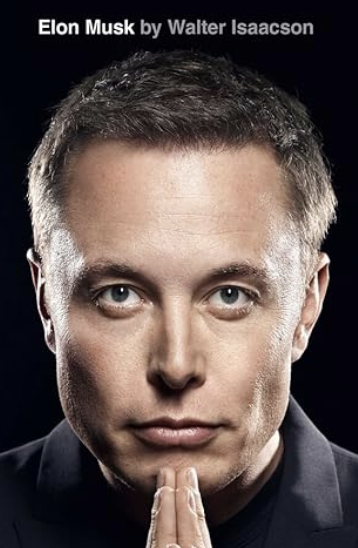
Isaacson does a great job of bringing odd, but clearly brilliant, characters to life. He did it for Steve Jobs, Benjamin Franklin, Leonardo Da Vinci, and now he does it for Elon Musk who makes a great subject for Isaacson’s style of biography — one full of relevant detail along with well-rounded, attributed commentary every step of the way. From childhood to the creation of one industry disrupting business after another (eg Tesla, SpaceX, StarLink) all the way through to the (hostile, messy, and yet full of interesting disclosures) acquisition of Twitter, we get the full story as synthesized from interviews, public records, and the occasional clearly labeled author opinions. The coverage continues through December 2022. What comes through clearly is Musk’s passion, drive, and brilliance, as well as what he is like as a human being. My overall takeaway aligns with this Bill Gates comment: “You can feel whatever you want about Elon’s behavior, but there is no one in our time who has done more to push the bounds of science and innovation than he has.” After reading the book, I am a fan, albeit a fan who has no interest in either befriending (not a likely scenario in any case!) or working for the man
I love that Musk is motivated by pushing humanity forward on the grandest scale: making humans multiplanetary; leveraging renewable energy sources to fight climate change; ensuring that human consciousness survives; and enabling freedom of information through networks and speech platforms. I like that he has the courage to stand by the need for a strict meritocracy in his companies, not subscribing to what he calls the “woke-mind virus.” (I understand that this is a contentious issue but I fall on his side, at least in terms of optimizing for competence when hiring). His “simple” test for the people he hires (or keeps) is that they are “excellent, trustworthy, and driven.” Here excellent means actually excellent as in qualitatively MUCH better than average — not the inflated excellent that is designed to make everyone feel good. Also, his version of driven is intense — he keeps things moving with a “maniacal sense of urgency.” While I’m well beyond the energy levels required to work in such an environment, how exciting would it be to be a part of actually changing the world in such a direct, uncluttered, way? Anyone who has ever worked in a (larger) tech company knows the frustration of trying to get anything done with all of the bureaucracy and frankly mediocre gatekeepers along the way. The issues surrounding Twitter are a completely different kettle of fish. Isaacson says, “He thought of it as a technology company, when in fact it was an advertising medium based on human emotions and relationships.” There is extensive coverage and I’ll let you make up your own mind about it.
The book is full of detailed engineering information (made surprisingly accessible and interesting to readers with varying degrees of background and experience) ranging from the behavior of materials to principles of process design. We’re also treated to Musk’s ongoing verbal annotations at each step as to what he was doing, why he was doing it, how he made it happen, and what he would have done differently (not much, really, but some). I found it all pretty engaging.
So was it a good book? I thought so — it was superbly organized and curated so that topics were introduced at the appropriate time. The book proceeds in date order so you get a real sense as to the number of (giant and complex) balls Musk was keeping in the air at once — each with its own urgencies, engineering issues, political aspects, funding problems, etc. He didn’t take a lot of vacations. Isaacson had access to — and extensively interviewed — almost everyone who had any large part to play in the pages. This included family, friends, colleagues, past employees (both disgruntled and appreciative), reporters, industry luminaries, and, of course, Musk himself. Isaacson’s biographies are never dry reading and his style is blessedly clear and concise (we’re still talking 700+ pages — imagine what the length would have been had it been written by a lover of tangents!).
Well worth reading.
 Books to look forward to ...