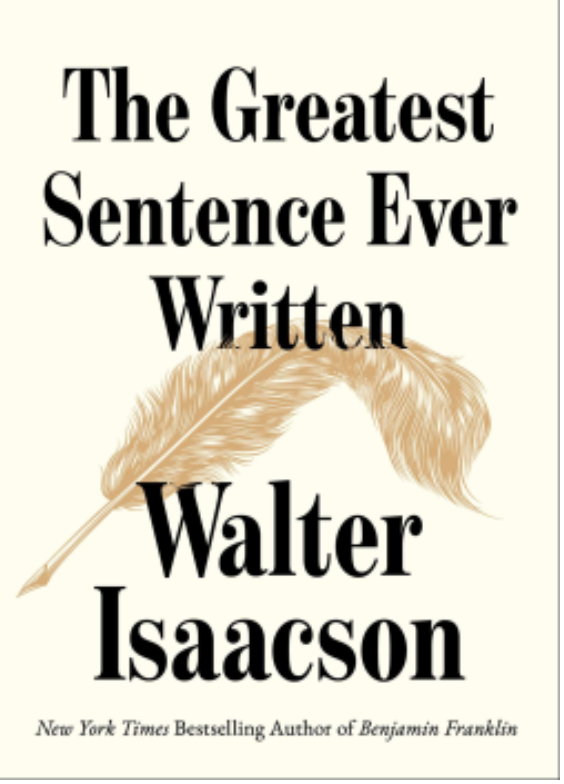
“We hold these truths to be self-evident, that all men are created equal, that they are endowed by their Creator with certain unalienable Rights, that among these are Life, Liberty and the pursuit of Happiness.” This is the sentence — the first in paragraph two of the Declaration of Independence — to which the title refers. Isaacson breaks the sentence down, elaborating on what each word or phrase meant in the context of the times. He follows this up with concluding chapters that remind us that the principles underlying the declaration were based on the need to balance personal opportunityt with the maintenance of “the common good.” He goes on to emphasize one of the main casualties of today’s lack of balance — the American Dream. He blames this near demise on the elite meritocracy that offers opportunity only to those who acquire educational credentials, leaving the other 62% resentful and foundering.
I found the book well written, full of some interesting tidbits, and thought-provoking, but I would have preferred more depth on exactly how we define “the common good,” as that seems to be a point of some contention in our current polarized democracy. I also feel that while the “elite meritocracy” may be a contributor to our economic and cultural woes, it is overly simplistic to assume it is the whole problem — there are so many contributing factors (not to mention the fact that I know quite a few successful people without college degrees and quite a few very well-educated people who find themselves unemployed with few prospects).
I love Isaacson’s biographies — I’ve read his books on Franklin, Doudna, Musk, Jobs, and Da Vinci. Those are full of the kind of intricate details on both the subject’s accomplishments, and the inspiration and drive that powered the journey. I would have been happier had the (very complex) topics in this book had a similar amount of completeness and clarity to them.
Thank you to Simon & Schuster and NetGalley for providing an advance copy of this book in exchange for my honest review. The book will be published on November 18th, 2026.
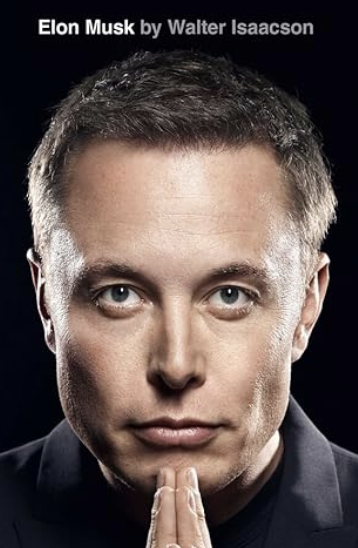
Isaacson does a great job of bringing odd, but clearly brilliant, characters to life. He did it for Steve Jobs, Benjamin Franklin, Leonardo Da Vinci, and now he does it for Elon Musk who makes a great subject for Isaacson’s style of biography — one full of relevant detail along with well-rounded, attributed commentary every step of the way. From childhood to the creation of one industry disrupting business after another (eg Tesla, SpaceX, StarLink) all the way through to the (hostile, messy, and yet full of interesting disclosures) acquisition of Twitter, we get the full story as synthesized from interviews, public records, and the occasional clearly labeled author opinions. The coverage continues through December 2022. What comes through clearly is Musk’s passion, drive, and brilliance, as well as what he is like as a human being. My overall takeaway aligns with this Bill Gates comment: “You can feel whatever you want about Elon’s behavior, but there is no one in our time who has done more to push the bounds of science and innovation than he has.” After reading the book, I am a fan, albeit a fan who has no interest in either befriending (not a likely scenario in any case!) or working for the man
I love that Musk is motivated by pushing humanity forward on the grandest scale: making humans multiplanetary; leveraging renewable energy sources to fight climate change; ensuring that human consciousness survives; and enabling freedom of information through networks and speech platforms. I like that he has the courage to stand by the need for a strict meritocracy in his companies, not subscribing to what he calls the “woke-mind virus.” (I understand that this is a contentious issue but I fall on his side, at least in terms of optimizing for competence when hiring). His “simple” test for the people he hires (or keeps) is that they are “excellent, trustworthy, and driven.” Here excellent means actually excellent as in qualitatively MUCH better than average — not the inflated excellent that is designed to make everyone feel good. Also, his version of driven is intense — he keeps things moving with a “maniacal sense of urgency.” While I’m well beyond the energy levels required to work in such an environment, how exciting would it be to be a part of actually changing the world in such a direct, uncluttered, way? Anyone who has ever worked in a (larger) tech company knows the frustration of trying to get anything done with all of the bureaucracy and frankly mediocre gatekeepers along the way. The issues surrounding Twitter are a completely different kettle of fish. Isaacson says, “He thought of it as a technology company, when in fact it was an advertising medium based on human emotions and relationships.” There is extensive coverage and I’ll let you make up your own mind about it.
The book is full of detailed engineering information (made surprisingly accessible and interesting to readers with varying degrees of background and experience) ranging from the behavior of materials to principles of process design. We’re also treated to Musk’s ongoing verbal annotations at each step as to what he was doing, why he was doing it, how he made it happen, and what he would have done differently (not much, really, but some). I found it all pretty engaging.
So was it a good book? I thought so — it was superbly organized and curated so that topics were introduced at the appropriate time. The book proceeds in date order so you get a real sense as to the number of (giant and complex) balls Musk was keeping in the air at once — each with its own urgencies, engineering issues, political aspects, funding problems, etc. He didn’t take a lot of vacations. Isaacson had access to — and extensively interviewed — almost everyone who had any large part to play in the pages. This included family, friends, colleagues, past employees (both disgruntled and appreciative), reporters, industry luminaries, and, of course, Musk himself. Isaacson’s biographies are never dry reading and his style is blessedly clear and concise (we’re still talking 700+ pages — imagine what the length would have been had it been written by a lover of tangents!).
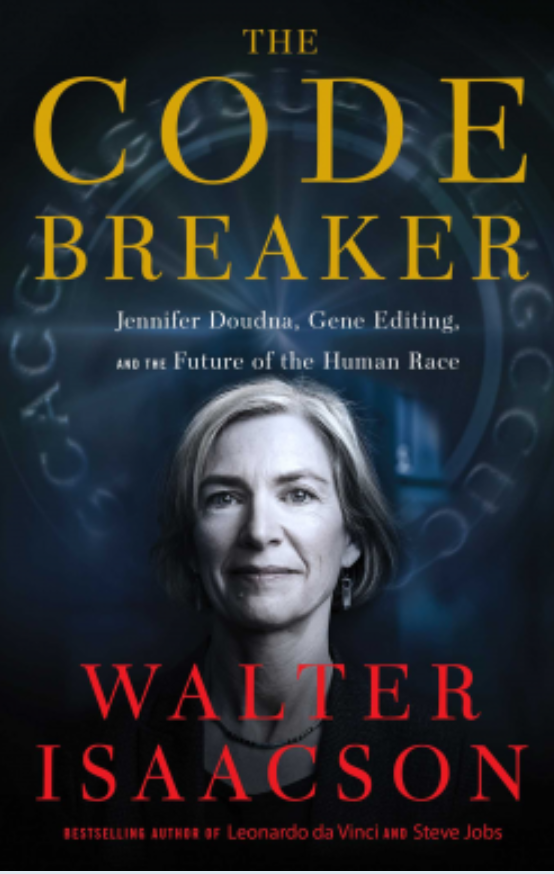
A fascinating and timely story about the life sciences revolution (specifically gene editing) and the Covid bomb that ignited a community already poised at the brink of discovery — all told through the biographical lens of recent Nobel winner Jennifer Doudna.
Isaacson is a skilled biographer and synthesizer. He has an unsurpassed ability to explain very complex concepts in accessible terms. I’ve read four of his books and have been impressed by his ability to explain well things I already know (Steve Jobs and computers) and things in which I have little background and zero aptitude (Leonardo Da Vinci and 15th century art). His descriptions of CRISPR (DNA sequences that enable the gene editing at the heart of the book) and the myriad ways it was discovered, applied, and deployed do not disappoint. What I liked best? You actually feel the zing of scientific discovery as he describes the evolution of gene editing tools and techniques and the researchers who made it happen.
Getting to know the researchers was almost as interesting as learning the science — to the point where Jennifer Doudna — while thoroughly admirable — did not have a personality that eclipsed the other players, making it feel less like a biography and more like a community portrait. Every one of the key contributors was profiled in a succinct but insightful way: James Watson of DNA discovery fame (more on him later); Harvard Medical School geneticist George Church (who felt trapped in the present when he should be in the future); Doudna’s co-Nobelist and co-discoverer of the CRISPR/Cas9 “genetic scissors” the peripatetic Emmanuelle Charpentier who likes to keep herself on edge and not get too comfy; Feng Zhang — credited (but bitterly contested) with applying CRISPR to the human genome; and the many, many additional researchers pursuing careers in the field.
In addition to the science and the scientists, Isaacson spends a fair amount of time on the aspects of commercialization including the competition between academics resulting in sometimes bitter patent battles on rights regarding various facets of the technology and its applications. In contrast, he also gives plenty of air play to the wealth of technologies born of necessity during the COVID-19 pandemic covering how the community was poised to act and the incredible bureaucracy and what strings had to be pulled to get through it (and who had the clout to pull those strings). Also included is a pretty comprehensive description of the requirements and applied innovations to virus detection, vaccination, and treatment. I actually feel much calmer about covid having read the book.
Lastly, Isaacson devoted a lot of time and discussion to the question of ethics — a topic I always enjoy. Ethical questions such as safety and unintended consequences, the tradeoff between individual needs and the needs of society, the potential widening of the privilege gap, and the potential impact on human diversity if we allow people free choice on gene selection for offspring. Isaacson inserted a lot of his own ideas into this section and I can’t say I agreed with everything he said, though he did fairly include multiple viewpoints. He appeared to conflate (as people often do) genius with debilitating problems — pointing to Van Gogh (mental illness) and Miles Davis (sickle cell anemia) as examples where a change to their genetic structure might alleviate their suffering but hamper their creative output — a loss to society as a whole. He (again, as most people do) also firmly yoked diversity to physical characteristics instead of a wide range of personality, opinion, intelligences etc. There appears to a strong fear that if left to their own devices, everyone would choose to have blonde haired, blue eyed children. Also — nobody ever seems to bring up the ethical question of parents making decisions for their as-yet-unborn children! I have more strong opinions on this chapter but I encourage you to read it yourself!
I have a few other issues with the book — Isaacson seems to insert himself into the action more often than I thought necessary and spent a little longer than I liked on a somewhat sensationalized version of the patent wars. He also loudly supported our new “cancel culture” with his full chapter treatise on James Watson’s fall from grace due to unpopular racial remarks. I’m a big believer in a free electorate who must be trusted to think for themselves and not in favor of shutting down people who have beliefs different from my own (no matter how distasteful). Controlling people’s freedom of expression is really a bad move for a free society, regardless of how much we each wish we could get the other side to shut up!
Still — small annoyances aside — this is a fully engaging book about a fascinating topic told in an accessible manner and covering one of the key turning points of human civilization — so go buy it today and read it!

 Books to look forward to ...