
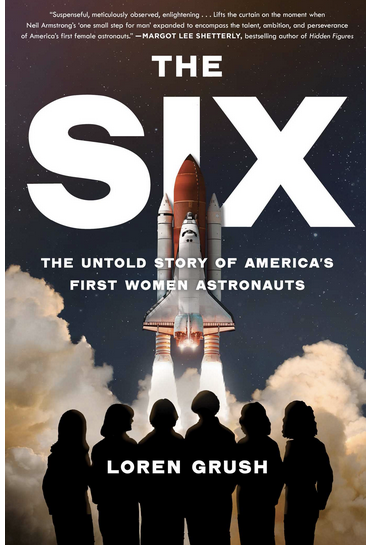
This is the story of the first six women admitted to NASA’s astronaut corps. Drawn from extensive research, interviews, personal papers, etc, it is a blended story that follows each woman from an initial interest (often as children) through to the 1986 Challenger disaster. The narrative focus moved between what it meant for women to (finally) be allowed into the profession, and what it meant to be an astronaut regardless of gender or race. I much preferred the second theme as the level of detail — the (long) training regimen, the detailed prep for each mission, the nightmarish (for some) experience of requisite PR duty, and the actual experience of being in space and on a mission was completely engaging and well documented without a lot of extraneous agenda or overwrought emotion.
The focus on the barriers the women faced and how they were treated as women was actually well done. NASA made a decision to encourage women and minorities to apply to their historic recruitment of Mission Specialists for the new space shuttle program. The focus was completely on the competency of the women under consideration, who were put to the same tests and held to the same expectations as the men. They passed with flying colors — without the need to make changes to the requirements in any way in order to accommodate women. There were a few stories about pranks, teasing, and a Playboy centerfold or two, but nobody got “offended”and everybody simply focussed on doing a great job. The media was irritatingly focussed on asking about “romance in space,” whether the women “weeped” during training, or attacking the morality of a mother for considering such a career, but the women took these questions in stride, answering calmly and rationally and letting the ridiculous questioners look like the fools (IMHO). I was annoyed by the commentary in the prolog and epilog about the need for achieving representation of women and minorities in the astronaut corps — something I disagree with completely. I’m all for equal opportunity, equal pay, and equal recognition — I see no reason for any profession to have its practitioners exactly mirror the gender and racial makeup of the population at large. Get the best! And certainly none of “the six” were turned away from their space dreams by the lack of women role models. So there!
I particularly enjoyed all the details about the space flights — the (multi-year) training routines, the detailed prep for each mission, and the individual experiences on board — both the awe and the practical details on how difficult every day tasks such as movement, eating, and yes, toileting, becomes when one is weightless. I was also intrigued by the medical experiments designed to understand the impact of weightlessness on our internal fluid systems (think blood and a pumping heart). Not something I had considered before. Overall, a clear, engaging description of what it is like to be an astronaut, with personal focus on the journeys of the first six women to take the plunge.

 Books to look forward to ...