
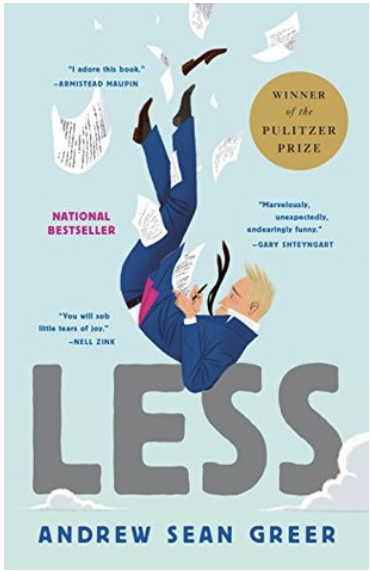
Less by Andrew Scott Greer (Literary Fiction)

Writing; 5/5 Character: 4/5 Plot: 3.5/5

Extremely clever and well-written book about Arthur Less — an aging gay writer (he is almost 50 which doesn’t sound like aging to me!) who embarks on an around-the-world trip to avoid the wedding of his ex-lover and to recover from the rejection of his latest novel. The novel is part memory and part continuous epiphany / humiliation / growth embedded in a personalized travelogue covering visits to Mexico, Italy, Germany, Paris, Morocco, and India. The writing is excellent — pointed, clever, beautiful and without resorting to stupid plot devices. The blurb says it is hilarious and I didn’t find it so at all, which was interesting. It was slow paced and I didn’t care much for the main character but it did grow on me as I continued reading and I found myself pretty happy with the ending. I enjoyed the self-referential bits — Less’ rejected novel is almost exactly what this novel is, with the exception that this novel is what Less (finally) turns his novel into. Some very interesting bits where the book discusses whether or not Less is actually a good gay writer or even a good gay man — according to those who set these rules. It’s very clever and fun to read.

Some quotes which I hope show off the beautiful writing a bit:
“Sad young Arthur Less had become sad old Arthur Less. Stories would be brought out of mothballs for ridicule; new ones would be tested, as well. The thought was unbearable; he could under no circumstances decline. Tricky, tricky, this life.”

“Next morning: the coffee maker in his hotel room is a hungry little mollusk, snapping open its jaws to devour pods and subsequently secreting coffee into a mug.”

“Too wistful. Too poignant. These walk-around-town books, these day-in-the-life stories, I know writers love them. But I think it’s hard to feel bad for this Swift fellow of yours. I mean, he has the best life of anyone I know.”

“Name a day, name an hour, in which Arthur Less was not afraid. Of ordering a cocktail, taking a taxi, teaching a class, writing a book. Afraid of these, and almost everything else in the world. Strange, though; because he’s afraid of everything, nothing is harder than anything else. Taking a trip around the world is no more terrifying than buying a stick of gum. The daily dose of courage.”

His mind, a sloth making its slow way across the forest floor of necessity, is taking in the fact that he is still in Germany.“

“It is our duty to show something beautiful from our world. The gay world. But in your books, you make the characters suffer without reward. If I didn’t know better, I think you were Republican. Kalipso was beautiful. So full of sorrow. But so incredibly self-hating. A man washes ashore on an island and has a gay affair for years. But then he leaves to go find his wife! You have to do better. For us. Inspire us, Arthur. Aim higher. I’m so sorry to talk this way, but it had to be said.“

More likable, make Swift more likable. That’s what everyone’s saying; nobody cares what this character suffers. But how do you do it? It’s like making oneself more likable. And at 50, Less muses drowsily, you’re as likable as you’re going to get.”

“But he can no more feel sorry for Swift — now become a gorgon of Caucasian, male ego, snake headed, pacing through his novel turning each sentence to stone — than Arthur Less can feel sorry for himself.”

But his mind is converging on one point of light. What if it isn’t a poignant, wistful novel at all? What if it isn’t the story of a sad, middle-aged man on a tour of his hometown, remembering the past and fearing the future; a peripateticism of humiliation and regret; the erosion of a single male soul? What if it isn’t even sad? For a moment, his entire novel reveals itself to him like those shimmering castles that appear to men crawling through deserts…“
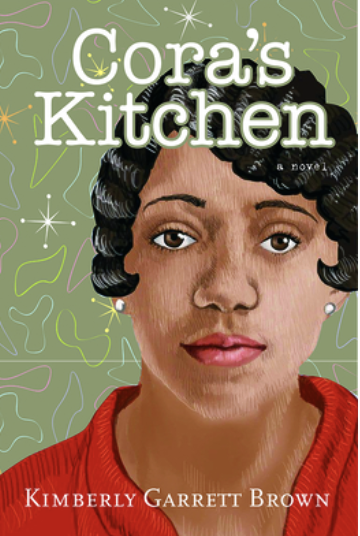
Cora’s Kitchen by Kimberly Garrett Brown (Historical / Literary / Multicultural Fiction)

Plot: 4/5 Characters: 5/5 Writing: 4/5 Enjoyment: 5/5

In 1928, Harlem librarian Cora James writes a letter to Langston Hughes whose poetry has inspired her. In ongoing correspondence, he supports her confessed desire to write and offers advice and commentary on her writing attempts.

There are more story elements including a surprising friendship with a white woman and a dangerous encounter, but for me the real story is about Cora’s awakening to the concept of having her own dreams and desires — beyond the expectations of being a wife and mother, a Black woman, and a good Christian. I absolutely loved and was startled by her own recognition of the limitations placed on her by societal and familial norms that she hadn’t even been aware of herself.

As part of the story she reads literature — Kate Chopin’s The Awakening, W.E.B Du Bois’ The Souls of Black Folk, Miss Esale Fauset’s There is Confusion, Walt Whitman’s Leaves of Grass, Nella Larsen’s Quicksand — and each informs her developing desire to express more than she knew she had in her to express. It is thoughtful, inspiring, and fascinating. Her reactions to works of literature are individual. She doesn’t like Amos and Andy or the characters in a prize winning Zora Neale Hurston story because she feels they make colored people look like fools. And she doesn’t want to write the standard colored woman story — growing up poor and oppressed in the South etc. She says, “We have been through so much as a people, but we have endured. I guess that’s why I think racism and oppression shouldn’t be our only focus. There are other stories to tell.” And in the end, when forced to choose, she makes what I found to be a surprising (and I was surprised that I was surprised by this) choice to identify more with the womanhood of her characters, rather than their Blackness). She explains it much better than I can, so I’ll let you read the story.

I loved this book and read it in a single sitting (OK — I was on a long plane flight BUT I had plenty of other books available on the kindle!).

Just a couple of quotes to let you see how Cora’s mind works:
“But most books written by colored authors are about race one way or another. And though I know it’s important to talk about, I’m tired of that being the focus all the time. There are other things in life that are just as important. Dreams. Desires. But maybe that’s too much to ask of a book.”

“But I wish Miss Larsen spent more time exploring Helga Crane’s desire for individuality and beauty, rather than her struggle as a mulatto woman trying to figure out where she belongs. Then maybe the novel would have spoken more to the workings of a colored woman’s mind.”

Thank you to Inanna Publications and NetGalley for providing an advance copy of this book in exchange for my honest review. The book will be published on September 20th, 2022.

Just the Funny Parts by Nell Scovell

Writing: 5; Importance: 4; Pleasure Factor: 5

Funny, personal, and important – all in one sparkling package!

There’s been a recent spate of celebrity memoirs written by female comedians. I’ve read (or tried to read) them all:  Tina Fey’s Bossypants, Anna Ferris’ Unqualified, Mindy Kaling’s Why Not Me?, etc.  This one is much, much, better — no doubt due to the fact that Nell Scovell is a comedy writer rather than a comedy performer and therefore can really write!

This memoir is part sitcom, part Hollywood wannabe training material, and part exposé on the difficulties of women getting fair treatment (or any treatment at all, really) in the industry. The very first line is her own paraphrase of Nietzsche: “That which doesn’t kill me … allows me to regroup and retaliate” — a great and apt opening!

I love Nell’s writing – it’s well structured and quite personal but never strident nor overly dramatic. Some great quotes, intriguing character profiles, factual depictions of the diversity (or utter lack thereof) in writer rooms, and a real sense of the frustrations in the field. The book is littered with fabulous (and funny) story ideas that went nowhere for no reason.  Her summarized job timeline in the appendix is full of “shot but unaired”, “unshot”, and “unsold” labels, with what feels like a tiny sprinkling of successes.  Such futility!  Any dreams I had of working in Hollywood (luckily I had none) have been thoroughly quashed by reading through this descriptive tour of a Hollywood writing career. At the same time, Nell’s love and passion for the work is obvious, and it is clear she wouldn’t choose to be doing anything else.

Perhaps you know her from Sabrina the Teenage Witch or perhaps from her co-authorship of Lean In with Sheryl Sandberg.  Even if you’ve never heard of her at all, you’ll enjoy this well-documented peregrination through her life as a writer of comedy. FYI I tend to find non-fiction a slog, rarely making it past the 1/3 mark, but I gobbled this book up in two days.