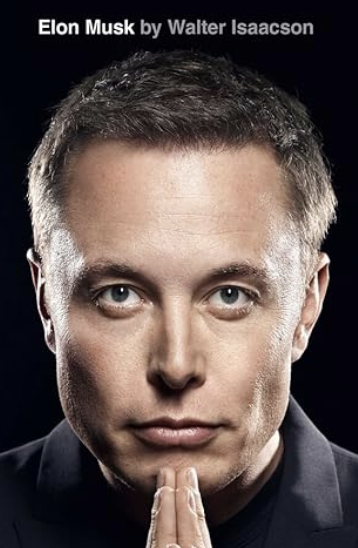
Elon Musk by Walter Isaacson (Biography)

Isaacson does a great job of bringing odd, but clearly brilliant, characters to life. He did it for Steve Jobs, Benjamin Franklin, Leonardo Da Vinci, and now he does it for Elon Musk who makes a great subject for Isaacson’s style of biography — one full of relevant detail along with well-rounded, attributed commentary every step of the way. From childhood to the creation of one industry disrupting business after another (eg Tesla, SpaceX, StarLink) all the way through to the (hostile, messy, and yet full of interesting disclosures) acquisition of Twitter, we get the full story as synthesized from interviews, public records, and the occasional clearly labeled author opinions. The coverage continues through December 2022. What comes through clearly is Musk’s passion, drive, and brilliance, as well as what he is like as a human being. My overall takeaway aligns with this Bill Gates comment: “You can feel whatever you want about Elon’s behavior, but there is no one in our time who has done more to push the bounds of science and innovation than he has.” After reading the book, I am a fan, albeit a fan who has no interest in either befriending (not a likely scenario in any case!) or working for the man

I love that Musk is motivated by pushing humanity forward on the grandest scale: making humans multiplanetary; leveraging renewable energy sources to fight climate change; ensuring that human consciousness survives; and enabling freedom of information through networks and speech platforms. I like that he has the courage to stand by the need for a strict meritocracy in his companies, not subscribing to what he calls the “woke-mind virus.” (I understand that this is a contentious issue but I fall on his side, at least in terms of optimizing for competence when hiring). His “simple” test for the people he hires (or keeps) is that they are “excellent, trustworthy, and driven.” Here excellent means actually excellent as in qualitatively MUCH better than average — not the inflated excellent that is designed to make everyone feel good. Also, his version of driven is intense — he keeps things moving with a “maniacal sense of urgency.” While I’m well beyond the energy levels required to work in such an environment, how exciting would it be to be a part of actually changing the world in such a direct, uncluttered, way? Anyone who has ever worked in a (larger) tech company knows the frustration of trying to get anything done with all of the bureaucracy and frankly mediocre gatekeepers along the way. The issues surrounding Twitter are a completely different kettle of fish. Isaacson says, “He thought of it as a technology company, when in fact it was an advertising medium based on human emotions and relationships.” There is extensive coverage and I’ll let you make up your own mind about it.

The book is full of detailed engineering information (made surprisingly accessible and interesting to readers with varying degrees of background and experience) ranging from the behavior of materials to principles of process design. We’re also treated to Musk’s ongoing verbal annotations at each step as to what he was doing, why he was doing it, how he made it happen, and what he would have done differently (not much, really, but some). I found it all pretty engaging.

So was it a good book? I thought so — it was superbly organized and curated so that topics were introduced at the appropriate time. The book proceeds in date order so you get a real sense as to the number of (giant and complex) balls Musk was keeping in the air at once — each with its own urgencies, engineering issues, political aspects, funding problems, etc. He didn’t take a lot of vacations. Isaacson had access to — and extensively interviewed — almost everyone who had any large part to play in the pages. This included family, friends, colleagues, past employees (both disgruntled and appreciative), reporters, industry luminaries, and, of course, Musk himself. Isaacson’s biographies are never dry reading and his style is blessedly clear and concise (we’re still talking 700+ pages — imagine what the length would have been had it been written by a lover of tangents!).

Well worth reading.

The Diamond Eye by Kate Quinn (Historical Fiction — audio book)

Writing: 5 /5 Characters: 5/5 Plot: 5/5
    Kate Quinn can write! This is the third book of hers that I’ve read (in this case, listened to — excellent reader.) Every one grips you completely from beginning to end. This is the story of Mila Pavlichenko — the history student who becomes Russia’s deadliest sniper when the Germans invade Ukraine in 1937. Based on the real person’s memoir, it takes us through her war: from enlistment, to finally getting a weapon, to becoming a sniper (with 309 certified kills), to her participation in the American goodwill tour (where she is befriended by Eleanor Roosevelt) designed to get the US into the war on a second front.
    The primary characters — Mila, her sniper partner Kostya, her should be ex-husband Alexei, and her lover Lionya — were incredible. Full of depth and reflection and firmly placed in the context of their time and place. I loved the depiction of relationships during wartime — the development, the tightness, and sometimes the loss — which often brought tears to my eyes. I also loved Mila’s sense of droll humor — not a characteristic much valued in the Soviet Komsomol. Perhaps this is part of why I felt connected almost instantly, even though Mila’s life was about as far as you could get from my own.
   There is plenty of action and drama in this story, but nothing is “over dramatized.” There is plenty to feel from the factual story itself without needing the embellishment of extra heartstring tugging prose. And the action — which typically bores me — is so personal that is interesting. There are strong feminist themes throughout the book. The Soviets were the only army at the time that allowed women to fight, and yet women were still subjected to expectations of sexual favors, lack of promotion, and plenty of ill will from their male comrades-in-arms. On the US goodwill tour, Mila was subjected to absurd questions such as her skin care regime and lipstick choices on the front as well as the color of her preferred underwear. Her answers were worth the entire price of admission. I particularly appreciated what felt like genuine attitudes toward the Soviet Union from the woman who lived there — there was no smacking of modern or US based sensibilities sneaking into the text.
    As always, Quinn is meticulous in documenting which parts of the novel are fiction and which are based on documented fact. I am quite impressed with both the integration of the two and the clean lines between them, making it easy to enjoy and yet distinguish between, a documentation of a real life and an electrifying story layered on top without disturbing the base.
    Highly recommended (and now I need to go read the rest of her books — my TBR pile is long past the toppling stage…)

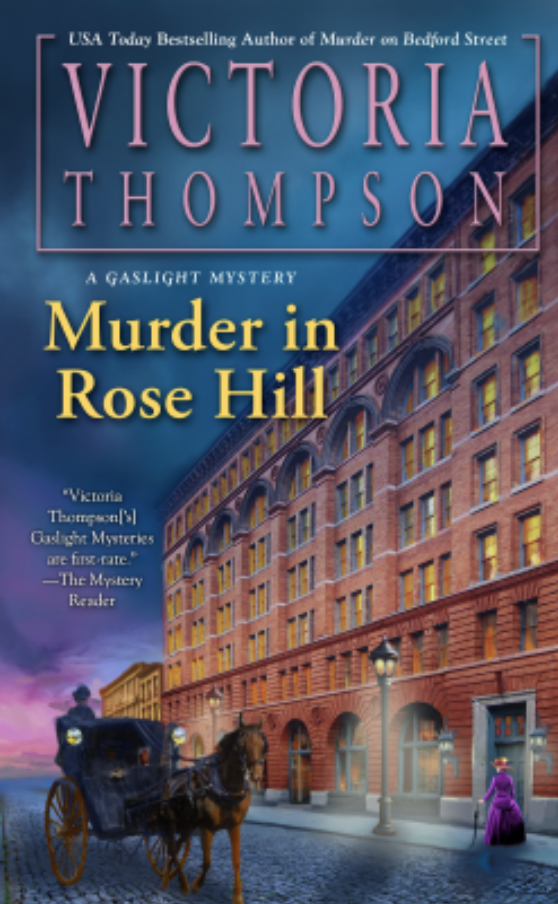
Murder in Rose Hill by Victoria Thompson (Historical Mystery)

I like this late 19th/early 20th century series by Victoria Thompson starring midwife Sarah Malloy (nee Brandt) and her private detective husband Frank. The characters have continued developing at the rate of approximately one book per year since 1999 beginning with the initial meeting of the young widow and the rare, incorruptible Sergeant Frank Malloy. Thompson does an excellent job with historical detail — inserting each story in pieces of history with deftly integrated details that do not sound like a regurgitation of Wikipedia articles.

In this installment, Louise, a young woman determined to follow in muckraker Ida Tarbell’s footsteps, is digging up information to bring down the patent medicine industry which she is sure harms more people than it could possibly help. (She is clearly correct given that most potions are mixtures of alcohol, heroin, and cocaine!) When Louisa is found dead shortly after interviewing Sarah, her father comes to the Malloys asking for help in finding her killer. The story brings in the new technology of the time (electric motors! the telephone!) along with the mechanics of the police force, the (widely varying) attitudes towards women who choose education and working lives over lives as wives and mothers, and of course, the ubiquitousness and impact of patent medicines. Did you know that the word “flashlight” comes from the fact that the originals gave out only short bursts of light because batteries were weak and bulbs primitive? Pretty fascinating stuff!

The writing is fairly simple, the characters are likable, though not terribly introspective, I never do figure out whodunnit in advance, and the history illuminates the every day details of life in a completely foreign time period.

Thank you to Berkley and NetGalley for providing an advance copy of this book in exchange for my honest review. The book will be published on April 23rd, 2024.

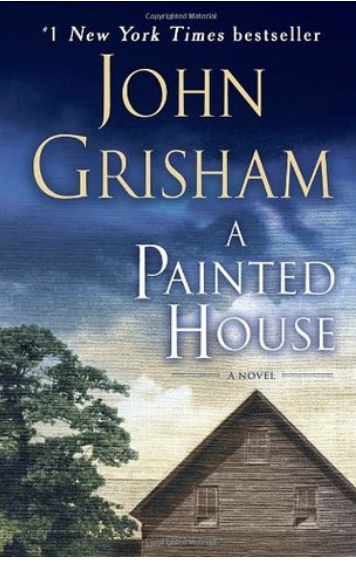
A Painted House by John Grisham (Historical Fiction — audio book)

Writing: 5/5 Characters: 5/5 Plot: 4/5
This book is unlike any other book Grisham has written — no courtrooms, not a lot of official justice, and not a thriller — but I found it utterly enthralling. It drew me into a world I knew nothing about and brought it to full sensory life. At least part of this was due to the audio book reader (David Lansbury) who captured the mood perfectly with his tone, pacing, and wide range of voices. Not every book (IMHO) is improved by listening to it — but this one certainly was.

The story is apparently somewhat autobiographical and takes us through one picking season on an Arkansas Delta cotton farm in 1952. Told from the perspective of seven year old Luke Chandler, the clarity of his reflections as he learns about life, morality, and people during this period is priceless. The family hires itinerant help in the form of ten Mexicans and a family of hill people. As with most farmers of the time, they are in debt from one season to the next, on the edge of ruin with every storm, flood, broken truck, or the transitory nature of picking labor. Luke is part of it all — the picking, the worrying, and the witnessing. He becomes the holder of too many secrets, and we feel the potential bursting and sickness he takes on with the keeping.

I’d forgotten how good Grisham’s writing is because I’m not that interested in legal thrillers but I was rapt throughout. His characters are such real people — each struggling in his or her own way with constant questions of both survival and morality. Making do in a rough world with little in the way of legal support — people have to figure out how to handle their own problems. Bittersweet and poignant, the narrative spans the Korean war, the movies of the day, the newness (and rareness) of television sets, flooding and tornados, farming economics, and the tension between the old ways and new possibilities.

Loved it.

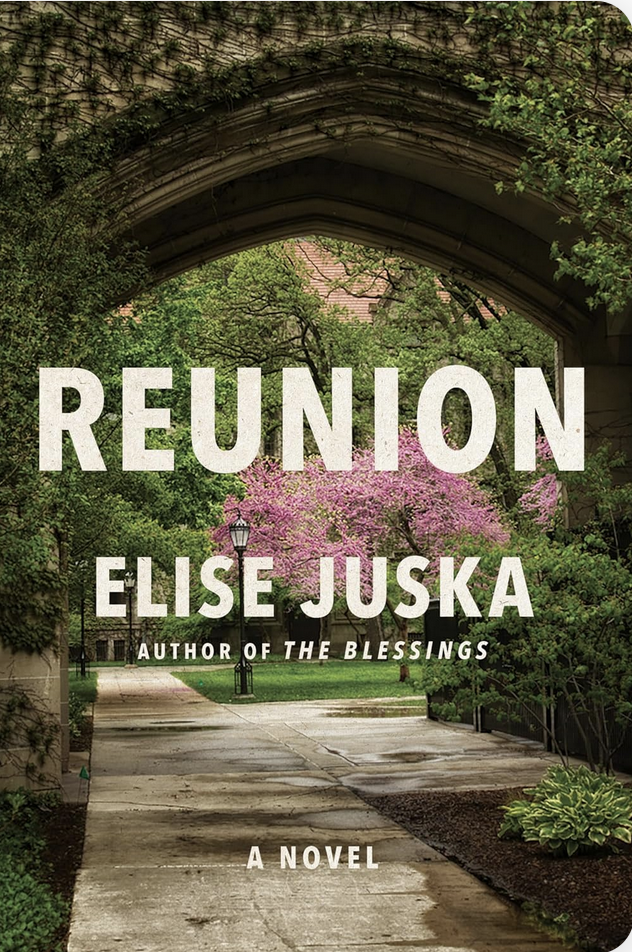
Reunion by Elise Juska (Literary Fiction)

June 2021 — Three friends anticipate a Covid postponed college reunion at the Maine campus. Hope — a stay at home mom with an increasingly distant husband — is desperate to return to what she remembers as her happiest time; Adam looks forward to reconnecting but feels guilt at leaving his perpetually sad wife with the twins in the house that she hasn’t left in a very long time; and NYC based single-mom Polly who doesn’t share her friends fond memories, but is persuaded to attend by her reclusive son who wants to visit a nearby friend.

This character-driven novel explores friendships and personal growth against the backdrop of lock down parenting and recovery alongside some pretty intense environmental anxiety. With every relationship comes inevitable clashes and this story covers quite a few. I particularly “enjoyed” the generational clashes — some familiar and some brand new to me as successive generations bear less and less in common with my own. Well written probes into the evolution of friendships
— what connects people with little in common and what decisions can impact the closeness over time. I really liked that the ending for all of our protagonists had a closure that was more about understanding the nature of their issues, thereby clarifying a path towards closure, rather than any kind of quick solution to the problem itself — because there really are no quick solutions to relationship issues…

One kind of funny (to me) quote as Hope thinks about her teenage daughter Izzy: “Meanwhile, Izzy was skeptical of all things where Hope was concerned. Her Spotify list. Her low-carb bread. Her Facebook posts — too frequent, too obviously curated — why was she even on Facebook? Her overuse of exclamation points. Her leather tote. Sometimes Hope secretly wondered if Izzy had become a vegan primarily to get on her nerves.”

Thank you to Harper and NetGalley for providing an advance copy of this book in exchange for my honest review. The book will be published on May 11th, 2024.