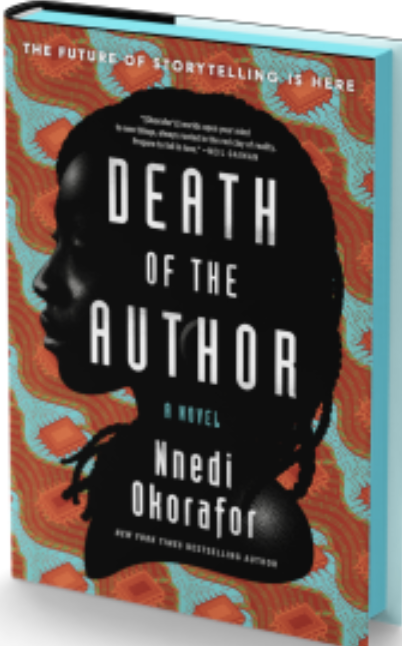
Death of the Author by Nnedi Okorafor (Literary / spectulative fiction)

A captivating book about Zelu — a disabled Nigerian American author (unpublished) and teacher who gets cancelled (and fired) due to her insensitivity (really deeply provoked impatience!) with her more irritating students. It’s also about the new book she writes — Rusted Robots — which becomes an overnight sensation. A post-apocalyptic story where robots and AI are at war over the tattered remains of human civilization, Rusted Robots brings her fame, fortune, some wild, tech-based opportunities, and a whole lot of people who suddenly feel entitled to tell her exactly what to do.

There are so many intellectually interesting and intersecting threads in this story — AI and automation, family, gender roles, African culture, authorial creativity and control, fame, freedom vs safety, disabilities, and the balance between individual and society — but the overarching theme is one of my favorites: the place of narrative and story in human culture. After all, I read fiction because I seek understanding, not just information.

Okorafor manages to blend multiple genres brilliantly, and since I am a fan of both literary and speculative fiction, I was riveted from start to finish. The characters were drawn so deeply — like all of my favorite people, they seemed to be compelling, annoying, loud, supportive, controlling, and caring all at once. I appreciated the fact that while most of the characters were Black (with the exception of the “wealthy white dudes” who keep finding her), there was no antipathy towards white people, just more of a lack of interest.

The big twist at the end absolutely blew me away. And a last little make-me-happy tidbit? She included a call out to one of my favorite (and fairly obscure for the U.S.) books — So Long A Letter by Mariamba Ba.

In my Top Reads of the Year list.

Quotes:
“The rusted robots in the story were a metaphor for wisdom, patina, acceptance, embracing that which was you, scars, pain, malfunctions, needed replacements, mistakes. What you were given. The finite. Rusted robots did not die in the way that humans did, but they celebrated mortality. Oh, she loved this story and how true it felt.”

“The capitalism machine had used her book, her attempt at shouting into the void, to make visual comfort food for drowsy minds.”

“She thought about Rusted Robots and the main character, who understood deep in her circuits that true power was in the harnessing of it, not the possessing of it. And when you were aware of the moment you harnessed power, that was when it was most difficult to navigate.“

“Narrative is one of the key ways automation defines the world. We Humes have always been clear about this fact. Stories are what holds all things together. They make things matter, they make all things be, exist. Our codes are written in a linear fashion. Our protocols are meant to be carried out with beginnings, middles, ends. Look at how I have been built. My operating system is Ankara themed, my body etched with geometric Ankara designs. I’m the embodiment of a human story. But true storytelling has always been one of the few great things humanity could produce that no automation could. Stories were prizes to be collected, shared, protected, and experienced”

Thank you to William Morrow and NetGalley for providing an advance copy of this book in exchange for my honest review. The book will be published on January 14th, 2025.
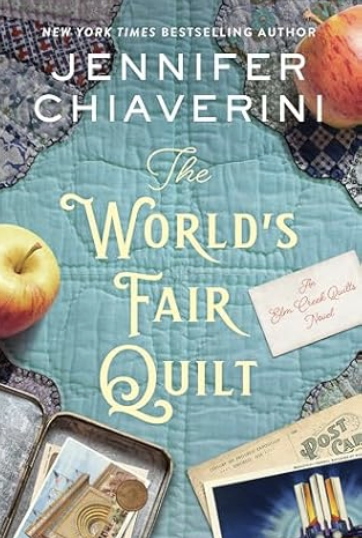
The World’s Fair Quilt by Jennifer Chiaverini (Women’s / Historical Fiction)

Another installment in Chiaverini’s feel good Elm Creek quilts series. While appearing like basic Women’s Fiction (not really my thing), I like this series for two reasons: I like the characters and the way of life they represent, and I love the “every person history” stories of the featured piece of the past.

This book recalled the 1933 nationwide quilting contest sponsored by Sears Roebuck. With a grand prize take of $1,200 in prizes (remember — this was depression era) and the best quilts to be displayed at the Chicago World’s Fair, it garnered over 25,000 entries. In our time, when you can see / experience anything with a tap on the screen, I enjoyed the excitement and wonder the book made me feel along with a couple of expert (but teenaged) quilters entering the contest. Their thoughts (and designs) on the contest’s theme (“A Century of Progress”) was excellent history and told completely within the context of the time period.

I also like the way the characters in these books tackle life — with strength and fortitude, a network of supporters, and a focus on doing the right thing. There is plenty of adversity (this isn’t a fairy tale) but little complaining, little blaming on past events, and little neuroticism. Kind of refreshing 😉

Thank you to William Morrow and NetGalley for providing an advance copy of this book in exchange for my honest review. The book will be published on April 1st, 2025.

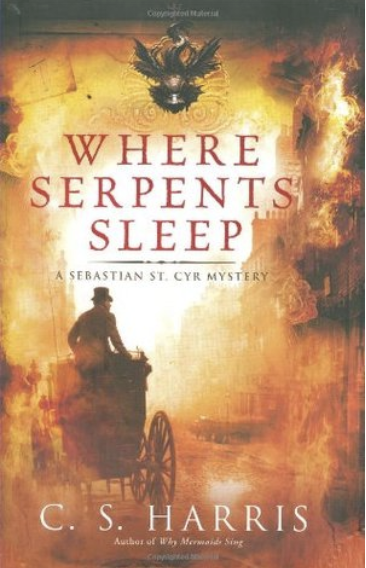
Where Serpents Sleep by C. S. Harris (Historical Mystery — Audio Book)

This is the fourth book in the Sebastian St. Cyr mystery series. I listen to them on audio book because the reader — Davina Porter — is the absolute best, with convincing “voices” for characters of all backgrounds, genders, professions, and place of origin accents. I highly recommend listening to, rather than reading, this series, despite the fact that I am primarily a book reader. The series starts in 1811; this fourth book starts in 1812. The Napoleonic Wars are in full swing and the upstart Americans are giving the British trouble (think “the War of 1812”). This book concerns itself with the killing of eight prostitutes who were sheltering in a Quaker house of refuge.

So why do I love this series so much? The characters — even those who appear in only one book — are fully fleshed out with time and place appropriate personalities. They run the gamut from nobility (both the utterly self obsessed and the more humane) to street urchins, with each novel bringing to light the experiences and behaviors of those in professions we don’t often hear about: for example, the chimney sweep boys or young prostitutes. The historical setting comprises all manner of detail from political power struggles, foreign policy and entanglements, the class system, and quite often the roles allowed or foisted upon women. Some wonderful strong female characters, along with those portraying more negative female stereotypes of the time. And always convoluted plot lines that introduce the reader to more of the time period — (often ridiculous) laws, the constabulary, power machinations, diplomacy, etc.

The main character is Sebastian St. Cyr — heir to an Earl and with a piercing intelligence. At 29, he has already seen quite a bit of military service and is a very impressive fighter as demonstrated through many action oriented scenes, none of which last longer than my low tolerance for extended action scenes allows. While one description called him an anti-hero (I’m guessing because he has no trouble dispatching people who are in the process of trying to kill him), I think he makes the perfect hero, with his strong regard for justice for all people (not just those with a title), and the ability to correct injustices with the combination of rank, privilege, physical prowess, courage, intelligence, and an unbreakable moral code.

While I started reading this series somewhere in the middle, and bounced about for a while, I’m now going back to the beginning and stepping through all the installments that I missed.

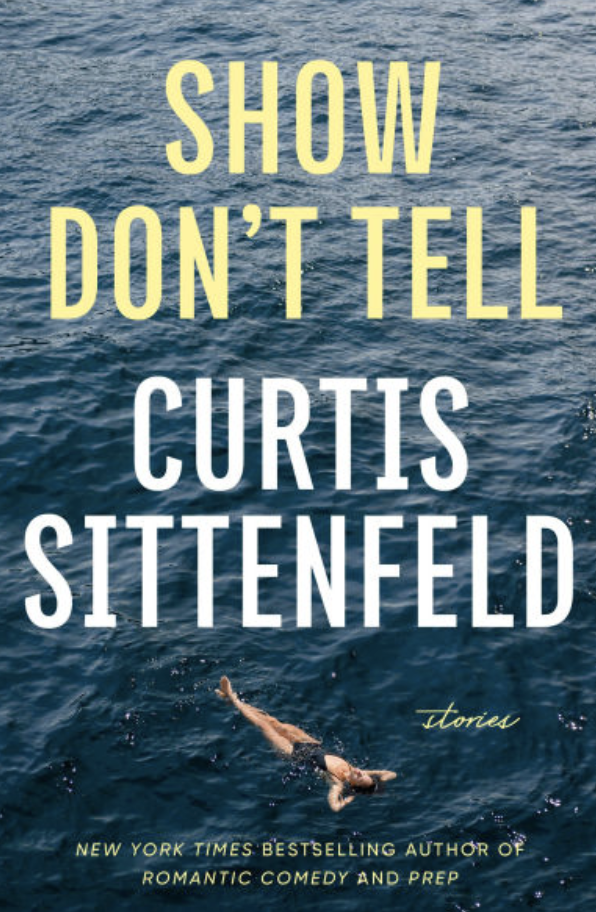
Show Don’t Tell by Curtis Sittenfeld (Literary Stories)

A set of short stories with such thorough character development and such clear, succinct, and essence depicting prose that I read the whole set without once wishing I were reading a novel instead (I tend to get bored with short stories about 1/3 of the way through the collection).

The stories run the gamut of professions, relationship statuses, races, and problematic situations. Just about all of them got me thinking about some little aspect of life that I hadn’t necessarily considered before. While the characters are all different, they do seem to all share an earnestness, a tendency toward reflection, a (shared with us) path to insight, and a focus on whether or not they are, indeed, good people. A few over thinkers (unfortunately, I do identify with this). I loved the exploration of human fitness and honesty within relationships. There is plenty of dramatic tension, but of the “it could happen to me” variety and not the melodrama that so many people seem to crave.

I liked all of the stories but here are a few that tickled my thinking bone: a VP of film production heading to Alabama to convince the religious author of a popular marriage book to allow a gay couple in the movie; a babysitter for a future internet billionaire; a woman researching the “Billy Graham rule” that “if you’re a married man, you don’t spend time alone with another woman;” a covid story that unearths strange behavior patterns in a long time couple.

Quotes:
“He’s the kind of writer, I trust, about whom current students in the program have heated opinions; I’m the kind of writer their mothers read while recovering from knee surgery. To be clear, I’m mocking neither my readers nor myself – it took a long time, but eventually, I stopped seeing women as inherently ridiculous.”

“Even if it takes a month to get through a novel, the ritual still anchors me, the access to lives I’ll never live.”

“Among the gifts Alison had given me years before when she said ‘only white women are afraid of getting old’ was the reminder, at a time when I’d needed it, of just how many cultural narratives were optional rather than compulsory.”

“I hadn’t thought adulation was something I wanted or needed; I had thought companionship sufficed. But I’d failed to anticipate how calamitous the standard erosion of affection over time could be when you started with a modicum as opposed to an abundance.”

“Not for the first time, it occurs to her that perhaps, rather than exploring the customs of married, heterosexual socializing, she is inadvertently demonstrating the isolation of modern life.”

“I’d noticed over time that neither she nor Cheryl insulted themselves in the reflexive, somewhat disingenuous way my white friends did; Allison and Cheryl didn’t use self-criticism as a bid for either praise or bonding.”

Thank you to Random House and NetGalley for providing an advance copy of this book in exchange for my honest review. The book will be published on February 25th, 2025.

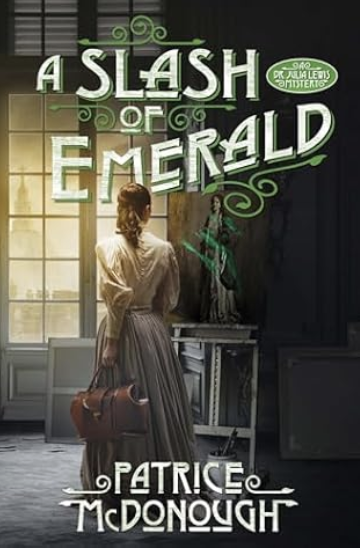
A Slash of Emerald by Patrice Mcdonough (Historical Mystery)

This Victorian London mystery really grew on me with its abundance of female characters pursuing professions and activities still unusual at the time (1867). Julia Lewis is a doctor and medical examiner who is called on to do post-mortems on women and to inspect suspected prostitutes for venereal disease (!) I love the historical note that Julia — trained in the US — is able to practice medicine in Britain (where medical schools do not admit women) though a loophole: Parliament added doctors with foreign degrees to the medical register in 1858 without specifying that they had to be men. Absolutely delightful piece of (real world) trivia! She is paired with the rather open-minded Inspector Tennant in this second installment of the Dr. Julia Lewis Mysteries.

This episode centers on the art world of Victorian England, the narrative flowing between competition for the Royal Academy’s annual exhibition and the frustrations of the female artists who wish to pursue art as a profession, rather than a genteel pastime. I enjoyed the fully fleshed out setting which opened an entire world of models, studios, galleries, technique, and inspiration with just enough well-researched detail. I particularly enjoyed the comment of one artist who pointed out that the best models were actresses who were able to channel the painter’s intention while posing.

Decent writing, strong women characters, and full marks for an historical setting that is detailed, interesting, and accurate. I’m going back to read book number one!

Thank you to Kensington and NetGalley for providing an advance copy of this book in exchange for my honest review. The book will be published on February 25th, 2025.

Rabbit Moon by Jennifer Haigh (Literary Fiction)

Writing: 5/5 Plot: 4/5 Characters: 5/5

When red haired, six-foot tall Lindsey Litvak is slammed by a hit and run driver in Shanghai, her suspension between life and death is a shock for her family and friends, each of whom reflects on how this completely unforeseen point was reached. Her (bitterly) divorced parents — Aaron and Claire — who race across the world in a panic; her ethnically Chinese adopted sister Grace, now stuck in a Quaker summer camp that she hates while her parents abandon their homes; her secretive and stylish gay best friend Johnny, who fades into the background as the Americans march in; and even the apartment building manager who knew more about her situation than he lets on.

Backcasting through time, pieces of history help us to understand how the intersections between lives were set into motion, eventually crashing into the blunt trauma of the accident. The writing is excellent, full of small reflections and insight on the part of each character. Themes around cultural differences, coming-of-age stories, sexual predators, multi-cultural adoption, queerness, and all the various influences that shape a person permeate the novel.

Quotes:

“The Quaker camp, which Grace hates, looks like a penal colony and is priced like a five–star resort.”

“When disaster strikes, Claire can always be counted on to lose her shit, her anguish eclipsing the original crisis in its demands for attention and care. If the house burst into flames, Claire’s distress would demand the firefighters’ full attention. It would be unforgivable, an act of monstrous insensitivity, to put out the fire first.”

“Since earliest childhood, Lindsay has drawn up language like a cut flower and water.”

“Efficient sleeping is Aaron’s superpower. He can fall asleep at will – anytime, anywhere — and wake on time without setting an alarm. His consciousness operates on a toggle switch: the two settings are wide-awake and dead asleep, with nothing in between.”

“In those moments Lindsay was the whole world to him, the center of the known universe. The feeling was intoxicating. She would chase it for the rest of her life.”

“His skepticism was infectious; it made believing sympathetic. Eventually, Claire surrendered to it. Exhibiting a striking lack of foresight, she neglected to cultivate a relationship with God, to pray or fast or do any of the things a person would do if she actually believed. Now, in her hour of need, she feels unable to ask for blessings.”

Thank you to Little, Brown and Company and NetGalley for providing an advance copy of this book in exchange for my honest review. The book will be published on April 8th, 2025.