Artificial Condition by Martha Wells (SciFi — Audio Book)

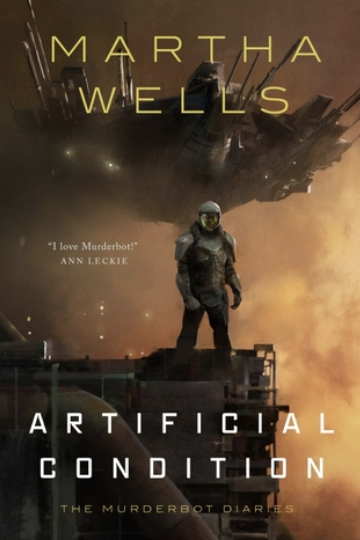
Book two in Martha Well’s MurderBot series following the adventures of a rogue “Sec Unit” (part organic / part inorganic bot uber-designed for security). Just as good as the first one! Our hero is a perfect symbol of what I have recently heard called “Heroic Masculinity” as opposed to “Toxic Masculinity.” Strong, caring, and bent on protection. (In truth, our Sec Bot is an it — I think of it as “male” because the audio book reader was male and the story is told in the first person, but SecBots have no genitals so … “it” it is even though it makes the next paragraph read poorly IMHO.)

I like its funny and acerbic “voice” and its constant search for how to pretend to be human to evade capture but also to understand interactions well — kind of reads like the story of someone with autism struggling both to fit in and to understand what it is it wants to fit into. In this story it (we never get a name!) makes a “friend” and finds that it surprisingly “misses” its team from book one. Its new friend is called ART for Asshole Research Transport — they weren’t friends when the name was coined. ART is a supremely intelligent and advanced bot pilot who helps our hero purely out boredom and excitement at the challenge. Plenty of action but without the dull and pointless extended chase scenes. Lots of exploration of evolving cultural norms as new types of beings are brought into play.

Moving on to book three — there are many and they are short!

The Personal Librarian by Marie Benedict and Victoria Christopher Murray

Writing: 3/5 Characters: 4/5 Plot: 3.5/5

I disliked this book and eventually gave up reading it when I got about 2/3 of the way through. It is the fictionalized history of Belle da Costa Greene — JP Morgan’s personal librarian — but the richly populated details of her personal and inner life seemed far more related to Benedict’s idea of how Greene would feel (or maybe how she imagined her readers would like to think Greene would feel) and not to the way all the available data about Greene would lead one to believe.

The real Belle lived her whole life as white, despite being born to colored parents and having a “C” for colored on her birth certificate. Her secret was only discovered posthumously. She burned all of her personal papers before her death, so the only information on her must be gleaned from her letters to others, her professional papers, and any news coverage of her at the time. She was in her 20s when J.P. Morgan plucked her from her job at Princeton and made her his personal librarian where she managed and grew a multi-million dollar collection. A rare-book and illuminated manuscript expert at a time when the field was almost exclusively men, she was known as stylish, clever, and determined. The early part of the book was very engaging — I loved hearing about the auctions, and the masterpieces, and the collectors she met. But it kind of went downhill (IMHO) from there as she entered into an affair with a married man which launched a set of other events which seemed to impact her heavily.

I haven’t read the personal letters that apparently “hint” at some of these things (they are not available online yet) so I can’t say how on target the fictionalization is, but from everything that I have read about Greene, the novel ascribes far more base emotionality than she possessed. Not every woman is a mass of anxiety and insecurities inside, or ready to liquefy into a puddle when a handsome man tells her he loves her. From all accounts, Greene was a truly extraordinary woman — especially for her time — and I don’t see why we would want to distract from her knowledge and accomplishments with overwrought behavior when there is no evidence at all that she ever felt or behaved that way!

I know a lot of people who absolutely love everything Benedict writes, so this is probably a minority opinion — but it is mine! By the way, the Morgan Library and Museum is opening a Belle da Costa Greene Exhibition in Fall 2024! That I would be interested in seeing.

Welcome to the Hyunam-dong Bookshop by Hwang Bo-reum

I loved this quiet, reflective, and ultimately upbeat book about a young South Korean woman — Yeongju — who drops out of the rat-race to open a bookshop in a quaint residential area of Seoul. This is a far cry from similarly themed American versions with sassy owners or drama gushing from every page. Instead this bookstore slowly grows a community filled with polite and kind people who help each struggle with philosophical questions of life such as: What constitutes success in life? Have we become the person we wanted to be? We meet an array of people, each taking an unusual (especially for South Korea) path through living and hear discussions of the tactics each is employing along with a self-assessment of his or her happiness.

This is a translation of a surprise best-seller from Korea whose popularity spread completely through word of mouth. I enjoyed knowing that I was reading something authentically Korean that had appealed to a non mainstream audience in that way. What I assume was a modern Korean culture permeated the behavior and reflections of each of the characters in a way I found enlightening. I also loved the writing style: Quiet. Observational. Unfiltered. The story was sweet, honest, and real and had many points of resonance for me. I loved the way people communicated with each other with simultaneous insight into each person’s thoughts and assumptions. And of course, I loved all the “action” around reading and books! Yeongju reads. At the start of the book she is reading about people who have left their old lives behind, as that is what she has just done. She reads and discusses the ideas with herself. She learns but also disagrees and in this way furthers the development of her own sense of self and purpose. She makes recommendations but is far from the know-all librarians portrayed in much fiction. My favorite request: a mother whose 18-year old son is already sick of life asks for a book that will “unclog a smothered heart.”

I loved that this book tackled deep issues with neither false cheer nor gloominess. I found it ultimately inspiring while simultaneously grounded in reality. As an aside, I really had to focus on all the Korean names as I don’t have a lot of experience with them and am happy to report that with just that little bit of focused effort, the names felt very familiar to me by the end.

Quotes:
“In The past, she used to live by mantras like passion and willpower, as if by imprinting the words on her mind, they would somehow breathe meaning into her life. It only felt like she was driving herself into a corner. From then on, she resolved never to let those words dictate her life again. Instead, she learned to listen to her body, her feelings, and be in happy places. She would ask herself these questions: does this place make me feel positive? Can I be truly whole and uncompromisingly myself? Do I love and treasure and myself here? For Yeongju, the bookshop checked all the boxes.”

“Yeongju loved such stories. Stories of people going through hard times, taking one step forward at a time as they seek comfort from the flicker of light across the horizon; stories of people determined to live on, despite their sufferings. Stories of hope – not the rash, or innocent kind, but the last glimmer of hope in life.“

“Yeongju’s home felt like an extension of her — somewhat lonely, but a reassuring presence nevertheless.”

“She took care and pride in writing each piece, even though it felt like she had to squeeze out every last bit of her brain juices.”

“Isn’t that what life is about? Foraging forward with the answer you have — stumbling along the way and picking yourself up — only to one day realize that the answer you’ve held onto for a long time is not the right one. When that happens, it’s time to look for the next answer. That’s how ordinary folks, like herself, live. Over our life span, the right answer will keep changing.”

“What counts as a good book? Books by authors who understand life. Those who write about family, mother and child, about themselves, about the human condition. When authors delve deep into their understanding of life to touch the hearts of readers, helping them to navigate life, isn’t that what a good book should be?”

“Small talk could be a considerate gesture, but most of the time, at your own expense. With nothing to say, squeezing the words dry leaving only an empty heart and a desire to escape.”

Thank you to Bloomsbury Publishing and NetGalley for providing an advance copy of this book in exchange for my honest review. The book will be published on February 20th, 2024.

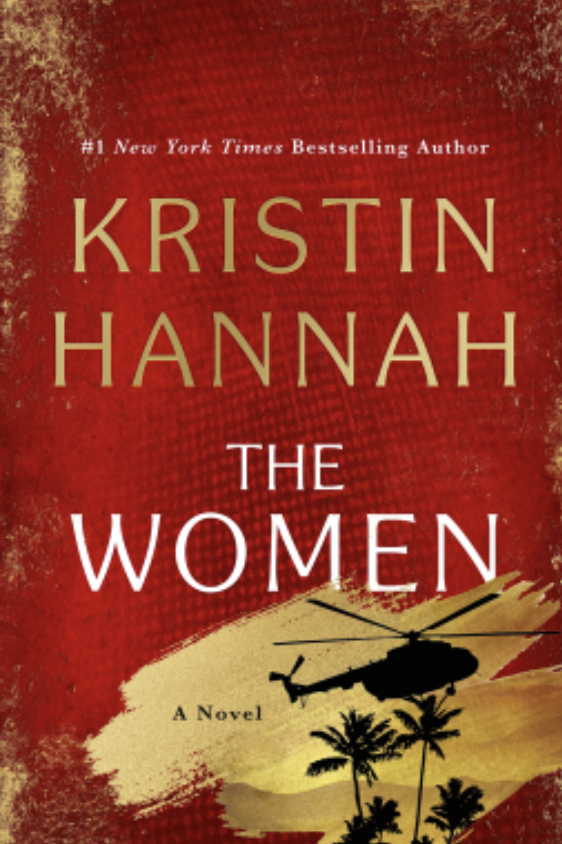
The Women by Kristin Hannah (Historical Fiction)

Writing: 4.5/5 Characters: 5/5 Plot: 4/5

In 1966, freshly minted nurse Frances “Frankie” McGrath joins the Army to be sent to Vietnam in order to be in country with her brother and earn a spot of the family’s “wall of heroes.” The story follows Frankie through nursing on the front lines, returning two years later to a country that (literally) spits on her for her service, and her reliance on alcohol and pills to get through the day. She has a need to be recognized as a veteran when everyone knows there were “no women in Vietnam.” Her life is heavily influenced by the trends of the day: the wide availability of “mother’s little helpers,” the burgeoning awareness of PTSD, and the shocking lies about the War that start coming to light.

The writing is good, and the characters are appealing and have depth. I thought she captured the times and various scenarios well — front line nursing environment (far worse than on MASH!), the reception she received back in Coronado (island community outside San Diego) when she got home, the Veterans administration, and others. I loved the friendships she depicted. Hannah is overly dramatic for my taste — though I think that is exactly why she is such a popular author.   For me the story has plenty of innate drama without loading it down with coincidences and a focus of every possible “bad thing” happening to one person. However, I thought the book did a credible job of explaining exactly how a young, well-off woman could form this track through life and how she could finally turn things around.  I also couldn’t stop reading so the writing was certainly effective!

The author’s stated goal was to bring to light the (whole) story of the women who were in the Vietnam War and she did that admirably. A very good piece of historical fiction with detailed and accurate surroundings and fully embedded characters.

Thank you to St. Martin’s Press and NetGalley for providing an advance copy of this book in exchange for my honest review. The book will be published on February 6th, 2024.

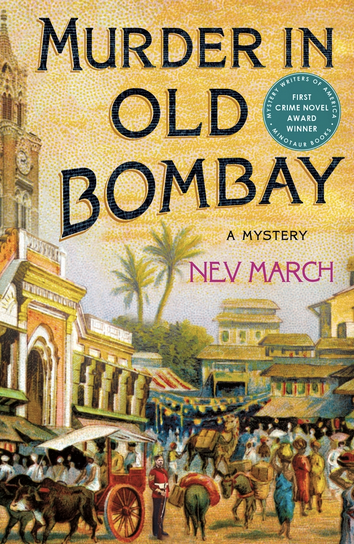
Murder in Old Bombay by Nev March (Mystery –Audio Book)

Writing: 3/5 Characters: 4/5 Plot: 4.5/5

Mixed feelings on this one. This historical mystery takes place in India during the late 1800s. It is full of intrigue and plot twists embedded in little known (to me or to average American readers) parts of Indian history. Captain Jim Agnihotri is recovering from a brain injury resulting from a military skirmish when he reads of the deaths of two Parsi ladies who “fell” from a watchtower to their deaths. Intrigued, he approaches the widower and is hired to investigate. So begins a convoluted plot that incorporates disparate religious and cultural norms, political machinations, and the question of British rule, the princely states, and new bids for Indian independence.

The writing is decent, the characters are appealing, and the historical context was fascinating. On the negative side (for me), there was far too much repetitive anguish on the parts of two characters whose love was forbidden, and too many “impossibly dangerous” situations which Captain Jim — in true heroic style — managed to defuse / rescue / solve without too much trouble. Also, too much unnecessary (to me) hand wringing. In one case, one character killed another — a truly evil person who had had no qualms of committing truly horrific crimes and was about to kill a family member — and still our character was full of pain at the thought of killing someone. Really? That always seemed false to me. I would not relish killing another person, but in those circumstances? I would neither hesitate nor feel any remorse.

I listened to this on audio, and although I very much liked the reader it was so slow that I listened at 1 1/4 speed — something I rarely do. That sped things up but made everything sound even more fraught with tension because of the increased speed! Might have been better to read it so I could skim over the repetitive parts. This is the first book of a series which is now up to number three. The (somewhat tedious) romantic plot was resolved so perhaps the next two books won’t have to go through all that constant angst. Glad I read it and I’m going to try book two in the hopes that she keeps the great plots and drops the romance and the endless heroics. We shall see!

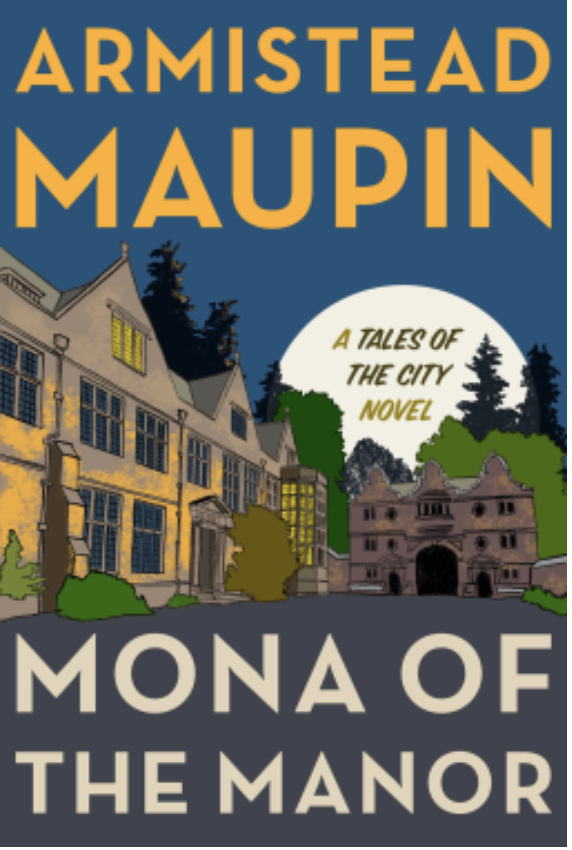
Mona of the Manor by Armistead Maupin

Writing: 4/5 Characters: 4.5/5 Plot: 3/5

I first read Maupin’s Tales of the City books (the first five) back in the early 80s — a lifetime ago. After a long hiatus, Maupin continued producing additional books, but at a slower pace. Mona of the Manor comes ten years after the last book and my memory for any of these past plots is a little challenged! However, reading this novel was like slipping into a comfy blanket — the same easy and intimate writing style, plenty of familiar (and beloved) characters, and a delightful new locale — Mona’s manor house inherited from her late husband — a fun story on its own. Mona will be a familiar character to Maupin fans — she is the woman who (many, many, novels ago) discovered her long lost father in the form of her landlady — the transformed Anna Madrigal.

Although this is the tenth book in a long series, I think there are enough embedded recaps and hints to make it accessible to new readers. Although written in 2024, it seems to take place in the late 90s when the AIDS epidemic was at its height. Interestingly, in this book, AIDS is referred to as a pandemic, which was not the way I remembered it being referred to at the time but which is obviously correct. Although I lived through it, I admit to having largely forgotten about how horrible it was at the time. I found a thorough timeline here: https://www.hiv.gov/hiv-basics/overview/history/hiv-and-aids-timeline/. While AIDS is not the main point of the story, its continuing destruction has a big impact on our characters and their community.

The book does unsurprisingly include a very clear and outspoken sexual / gender agenda, but primarily the characters are all seeking what most of us seek — love, meaning, and a place in life regardless of their sexually diverse backgrounds. Some positive experiences with the Romani — a group that is rarely portrayed in fiction at all, never mind nicely. Well written and enjoyable — not particularly insightful but perfectly paced, easy to read, and always surprising. I enjoyed it thoroughly.

Thank you to Harper and NetGalley for providing an advance copy of this book in exchange for my honest review. The book will be published on March 5th, 2024.

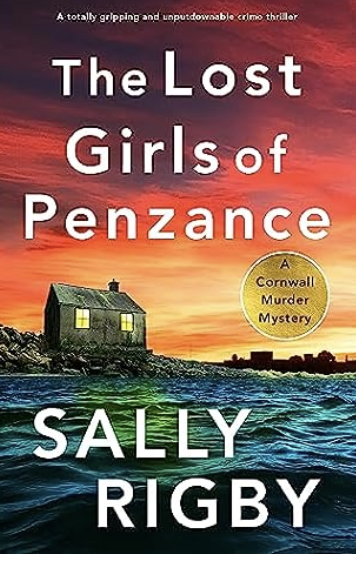
The Lost Girls of Penzance by Sally Rigby Mystery)

Writing: 3/5 Plot: 3.5/5 Characters 4/5

My first Sally Rigby novel. DI Lauren Pengelly is two years into her job on the Penzance police force when bones are discovered on a nearby farm. Not an area with a great deal of crime, Pengelly and crew are taken by surprise when a three year old girl disappears from a local day care center later that same afternoon. And thus begins the mystery novel that is sure to be the first in a series. Pengelly is a female version of the crusty old detective and her brand new sidekick — Matt Price — has an engaging backstory and personality that nicely support her. Vera Stanhope and her (two) trusty sidekicks come to mind.

Parts of the story were a little stressful for me — I don’t like to read about bad things happening to children so I’m going to give a little spoiler here to say that the children are OK by the end without giving away anything else in the plot. This is something I would have liked to know before reading. Plot is a little slow but gets good by the end. I like the characters and I feel like the author left room for future character development.

Thank you to Storm Publishing and NetGalley for providing an advance copy of this book in exchange for my honest review. The book will be published on October 5th, 2023.

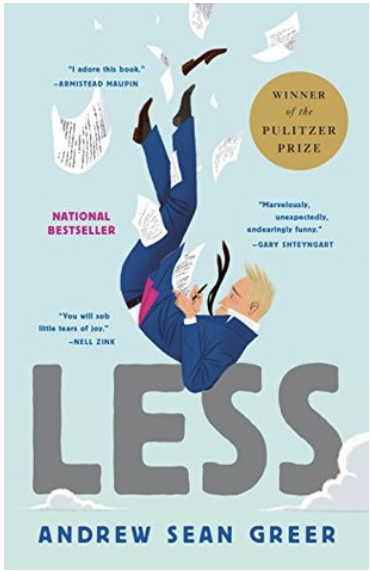
Less by Andrew Scott Greer (Literary Fiction)

Writing; 5/5 Character: 4/5 Plot: 3.5/5

Extremely clever and well-written book about Arthur Less — an aging gay writer (he is almost 50 which doesn’t sound like aging to me!) who embarks on an around-the-world trip to avoid the wedding of his ex-lover and to recover from the rejection of his latest novel. The novel is part memory and part continuous epiphany / humiliation / growth embedded in a personalized travelogue covering visits to Mexico, Italy, Germany, Paris, Morocco, and India. The writing is excellent — pointed, clever, beautiful and without resorting to stupid plot devices. The blurb says it is hilarious and I didn’t find it so at all, which was interesting. It was slow paced and I didn’t care much for the main character but it did grow on me as I continued reading and I found myself pretty happy with the ending. I enjoyed the self-referential bits — Less’ rejected novel is almost exactly what this novel is, with the exception that this novel is what Less (finally) turns his novel into. Some very interesting bits where the book discusses whether or not Less is actually a good gay writer or even a good gay man — according to those who set these rules. It’s very clever and fun to read.

Some quotes which I hope show off the beautiful writing a bit:
“Sad young Arthur Less had become sad old Arthur Less. Stories would be brought out of mothballs for ridicule; new ones would be tested, as well. The thought was unbearable; he could under no circumstances decline. Tricky, tricky, this life.”

“Next morning: the coffee maker in his hotel room is a hungry little mollusk, snapping open its jaws to devour pods and subsequently secreting coffee into a mug.”

“Too wistful. Too poignant. These walk-around-town books, these day-in-the-life stories, I know writers love them. But I think it’s hard to feel bad for this Swift fellow of yours. I mean, he has the best life of anyone I know.”

“Name a day, name an hour, in which Arthur Less was not afraid. Of ordering a cocktail, taking a taxi, teaching a class, writing a book. Afraid of these, and almost everything else in the world. Strange, though; because he’s afraid of everything, nothing is harder than anything else. Taking a trip around the world is no more terrifying than buying a stick of gum. The daily dose of courage.”

His mind, a sloth making its slow way across the forest floor of necessity, is taking in the fact that he is still in Germany.“

“It is our duty to show something beautiful from our world. The gay world. But in your books, you make the characters suffer without reward. If I didn’t know better, I think you were Republican. Kalipso was beautiful. So full of sorrow. But so incredibly self-hating. A man washes ashore on an island and has a gay affair for years. But then he leaves to go find his wife! You have to do better. For us. Inspire us, Arthur. Aim higher. I’m so sorry to talk this way, but it had to be said.“

More likable, make Swift more likable. That’s what everyone’s saying; nobody cares what this character suffers. But how do you do it? It’s like making oneself more likable. And at 50, Less muses drowsily, you’re as likable as you’re going to get.”

“But he can no more feel sorry for Swift — now become a gorgon of Caucasian, male ego, snake headed, pacing through his novel turning each sentence to stone — than Arthur Less can feel sorry for himself.”

But his mind is converging on one point of light. What if it isn’t a poignant, wistful novel at all? What if it isn’t the story of a sad, middle-aged man on a tour of his hometown, remembering the past and fearing the future; a peripateticism of humiliation and regret; the erosion of a single male soul? What if it isn’t even sad? For a moment, his entire novel reveals itself to him like those shimmering castles that appear to men crawling through deserts…“

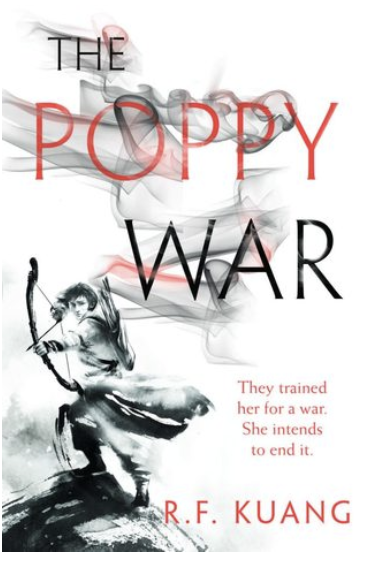
The Poppy Wars by R. F. Kuang (Fantasy)

Writing: 5/5 Characters: 5/5 Plot: 4.5/5

On the surface, this is an epic military fantasy full of politics, vengeance, and war but in R. F. Kuang’s skillful hands (she really is an amazing writer) it’s turned into the most interesting blend of action, philosophy, growth, culture, morals, and ethics. She has a way of creating characters and groups whose beliefs embody all of the complexity and confusion of our modern life without force feeding us the author’s opinions as the obviously right ones. The Poppy Wars was Kuang’s first book, and I’m reading it now after having read (and loved) her last two books: Babel and Yellowface.

The book — the first of a trilogy — follows Rin, a war orphan who claws her way into an elite military academy from a cold and uncaring peasant upbringing. We follow her through her training, a surprising and brutal war, and her growing awareness of the truth behind the stories and assumptions she had been fed since birth. I’m happy to say that all three books of the trilogy are complete and that this one does not end with a cliffhanger (although it’s so good that even without the cliffhanger you’re going to want to read more and right away).

I love her characters — they are neither stereotypes nor simplistic. Each has his/her own innate skills and a preferred mindset, but all have multiple layers of thought and awareness, and all must shift in various ways when bad things — both personal and systemic — happen. Woven into the story is plenty of eastern philosophy and classics references, insightful commentary on religions and how they fit into society, a description of how information is packaged up for the masses, class differences and the implications of cooperating (or not), and what it means to think. I loved this paragraph on thinking: “He made them define concepts they had taken for granted, concepts like advantage and victory and war. He forced them to be precise and accurate in their answers. He rejected responses that were phrased vaguely or could have multiple interpretations. He stretched their minds, shattered their preconceptions of logic, and then pieced them back together.”

Entertaining, thought provoking, and extremely well-written.

A few good quotes:

“Rin recalled the myth of Mai’rinnen Tearza committing suicide for the sake of Speer’s unification with the mainland. Martial arts history seemed to be riddled with people making pointless sacrifices.”

“Youth, Rin thought, was an amplification of beauty. It was a filter; it could mask what one was lacking, enhance even the most average features. But beauty without youth was dangerous. The Empress’s beauty did not require the soft fullness of young lips, the rosy red of young cheeks, the tenderness of young skin. This beauty cut deep, like a sharpened crystal. This beauty was immortal.”

“I believe in the gods as much as the next Nikara does,” she replied. “I believe in gods as a cultural reference. As metaphors. As things we refer to keep us safe because we can’t do anything else, as manifestations of our neuroses. But not as things that I truly trust are real. Not as things that hold actual consequence for the universe.”

“So far she had been pursuing two separate lines of inquiry—the shamans and their abilities; the gods and the nature of the universe. Now, with the introduction of psychedelic plants, Jiang drew these threads into one unified theory, a theory of spiritual connection through psychedelics to the dream world where the gods might reside. The separate concepts in her mind flung connections at one another, like a web suddenly grown overnight. The formative background Jiang had been laying suddenly made total, utter sense.”

“No. In fact, the opposite is true. The creation of empire requires conformity and uniform obedience. It requires teachings that can be mass-produced across the entire country. The Militia is a bureaucratic entity that is purely interested in results. What I teach is impossible to duplicate to a class of fifty, much less a division of thousands. The Militia is composed almost entirely of people like Jun, who think that things matter only if they are getting results immediately, results that can be duplicated and reused. But shamanism is and always has been an imprecise art. How could it be anything else? It is about the most fundamental truths about each and every one of us, how we relate to the phenomenon of existence. Of course it is imprecise. If we understood it completely, then we would be gods.”

“You overestimate the Empire. Think of martial arts. Why were you able to defeat your classmates in the trial? Because they learned a version that is watered down, distilled and packaged for convenience. The same is true of their religion.”

I know why it’s hard for you. You like beating your classmates. You like harboring your old grudges. It feels good to hate, doesn’t it? Up until now you’ve been storing your anger up and using it as fuel. But unless you learn to let it go, you are never going to find your way to the gods.”

Once, the fabric had contained the stories of millions of lives—the lives of every man, woman, and child on the longbow island—civilians who had gone to bed easy, knowing that what their soldiers did across the narrow sea was a far-off dream, fulfilling the promise of their Emperor of some great destiny that they had been conditioned to believe in since birth. In an instant, the script had written their stories to the end.”

No Crying in Baseball –The Inside Story of A League of Their Own: Big Stars, Dugout Drama, and a Home Run for Hollywood by Erin Carlson

A League of Their Own is one of my favorite movies. I’m sure I’ve seen it close to a hundred times. It’s funny, upbeat, and brings to light an easily forgotten piece of history with matter of fact detail that doesn’t slide into heavy handed territory. My daughter loved the movie so much she requested a trip to the Baseball Hall of Fame for her 9th birthday. This book is devoted to telling the “inside story.”

It’s a messy narrative, reading more like a super complete (and utterly engaging) set of IMDB trivia than a cohesive story, but if you loved the movie, you’ll love reading all of it: the incredibly drawn-out, complex, work of casting; Penny Marshall’s very insecure directorial style; her mega-lavish use of film (Kodak threw an expensive party for the cast and they don’t do that for every film!); the detailed history of women’s athletics over time and how that impacted the film, the crew, and the many, many, women who swarmed the tryouts for athletic extras.

I didn’t read through the copious notes at the end of the book, but Carlson basically took each topic and interviewed or studied interviews of cast, crew, friends, family, etc so that the reader gets an extensive set of viewpoints without the author sticking her own oar in too often. Everything from feminism to unaddressed lesbianism to all the hidden elements of making a film — so many personalities and so few of them easy. I found all the various bits of financial and creative control and the way individual contracts stipulated such to be quite fascinating. The in-depth baseball training and the injuries the actresses sustained (a broken foot, a broken nose, and that horrible thigh length bruise Shirley Baker sustained that was NOT makeup(!) really grabbed me.

All the details of making the movie were nested in a complete history of Penny Marshall from birth to death — which I had already read about in Marshall’s memoir but was still interesting (and accurate). I loved this one Penny Marshall quote: “I think my problem is that I have a massive insecurity complex combined with a very huge ego.” Seems to be accurate!

I was surprised by some of the information on women’s sports — I’m not even a little bit sporty so it was all new to me — the public attitude towards women in sports and the various excuses used to push them to softball, for example, when the top athletes were perfectly capable of playing baseball. The idea that women were physically inferior and unable to keep up certainly permeated my thinking growing up in the 60s. Being not sporty (at all) myself, I never challenged any of those assumptions. Add to that the idea that it would emasculate the men if they were included certainly didn’t help anyone. The parallel to this story is the story of women in Hollywood as they vie for a spot in this almost all female and female directed cast.

Very enjoyable reading especially if you loved (or even liked) this movie!

Thank you to Hachette Books and NetGalley for providing an advance copy of this book in exchange for my honest review. The book was published on Sept. 5th, 2023.