Writing: 5/5 Characters: 5/5 Plot: 4.5/5
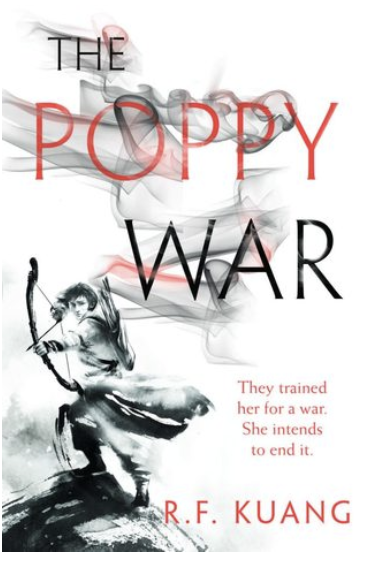
On the surface, this is an epic military fantasy full of politics, vengeance, and war but in R. F. Kuang’s skillful hands (she really is an amazing writer) it’s turned into the most interesting blend of action, philosophy, growth, culture, morals, and ethics. She has a way of creating characters and groups whose beliefs embody all of the complexity and confusion of our modern life without force feeding us the author’s opinions as the obviously right ones. The Poppy Wars was Kuang’s first book, and I’m reading it now after having read (and loved) her last two books: Babel and Yellowface.
The book — the first of a trilogy — follows Rin, a war orphan who claws her way into an elite military academy from a cold and uncaring peasant upbringing. We follow her through her training, a surprising and brutal war, and her growing awareness of the truth behind the stories and assumptions she had been fed since birth. I’m happy to say that all three books of the trilogy are complete and that this one does not end with a cliffhanger (although it’s so good that even without the cliffhanger you’re going to want to read more and right away).
I love her characters — they are neither stereotypes nor simplistic. Each has his/her own innate skills and a preferred mindset, but all have multiple layers of thought and awareness, and all must shift in various ways when bad things — both personal and systemic — happen. Woven into the story is plenty of eastern philosophy and classics references, insightful commentary on religions and how they fit into society, a description of how information is packaged up for the masses, class differences and the implications of cooperating (or not), and what it means to think. I loved this paragraph on thinking: “He made them define concepts they had taken for granted, concepts like advantage and victory and war. He forced them to be precise and accurate in their answers. He rejected responses that were phrased vaguely or could have multiple interpretations. He stretched their minds, shattered their preconceptions of logic, and then pieced them back together.”
Entertaining, thought provoking, and extremely well-written.
A few good quotes:
“Rin recalled the myth of Mai’rinnen Tearza committing suicide for the sake of Speer’s unification with the mainland. Martial arts history seemed to be riddled with people making pointless sacrifices.”
“Youth, Rin thought, was an amplification of beauty. It was a filter; it could mask what one was lacking, enhance even the most average features. But beauty without youth was dangerous. The Empress’s beauty did not require the soft fullness of young lips, the rosy red of young cheeks, the tenderness of young skin. This beauty cut deep, like a sharpened crystal. This beauty was immortal.”
“I believe in the gods as much as the next Nikara does,” she replied. “I believe in gods as a cultural reference. As metaphors. As things we refer to keep us safe because we can’t do anything else, as manifestations of our neuroses. But not as things that I truly trust are real. Not as things that hold actual consequence for the universe.”
“So far she had been pursuing two separate lines of inquiry—the shamans and their abilities; the gods and the nature of the universe. Now, with the introduction of psychedelic plants, Jiang drew these threads into one unified theory, a theory of spiritual connection through psychedelics to the dream world where the gods might reside. The separate concepts in her mind flung connections at one another, like a web suddenly grown overnight. The formative background Jiang had been laying suddenly made total, utter sense.”
“No. In fact, the opposite is true. The creation of empire requires conformity and uniform obedience. It requires teachings that can be mass-produced across the entire country. The Militia is a bureaucratic entity that is purely interested in results. What I teach is impossible to duplicate to a class of fifty, much less a division of thousands. The Militia is composed almost entirely of people like Jun, who think that things matter only if they are getting results immediately, results that can be duplicated and reused. But shamanism is and always has been an imprecise art. How could it be anything else? It is about the most fundamental truths about each and every one of us, how we relate to the phenomenon of existence. Of course it is imprecise. If we understood it completely, then we would be gods.”
“You overestimate the Empire. Think of martial arts. Why were you able to defeat your classmates in the trial? Because they learned a version that is watered down, distilled and packaged for convenience. The same is true of their religion.”
I know why it’s hard for you. You like beating your classmates. You like harboring your old grudges. It feels good to hate, doesn’t it? Up until now you’ve been storing your anger up and using it as fuel. But unless you learn to let it go, you are never going to find your way to the gods.”
Once, the fabric had contained the stories of millions of lives—the lives of every man, woman, and child on the longbow island—civilians who had gone to bed easy, knowing that what their soldiers did across the narrow sea was a far-off dream, fulfilling the promise of their Emperor of some great destiny that they had been conditioned to believe in since birth. In an instant, the script had written their stories to the end.”