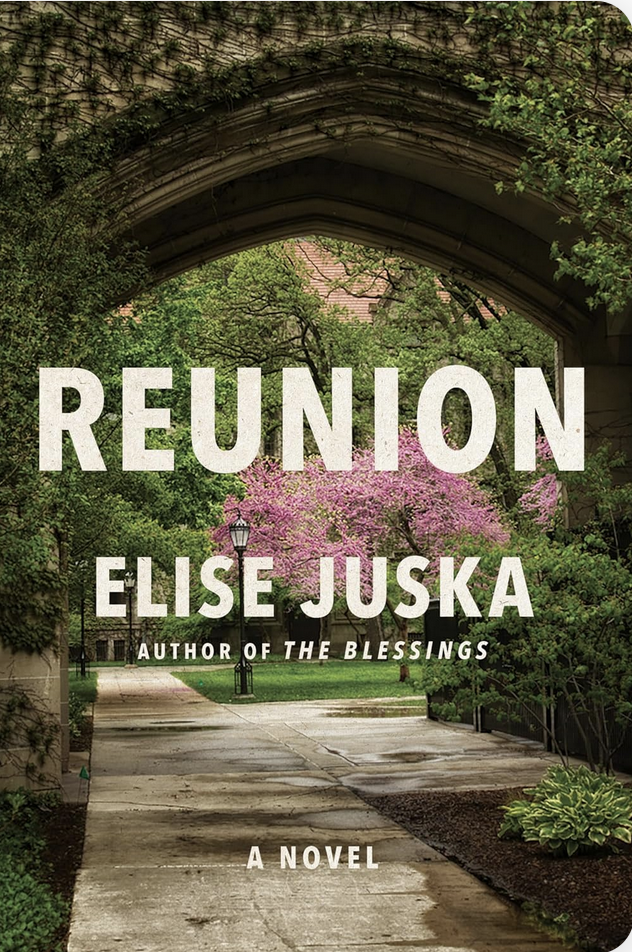
Reunion by Elise Juska (Literary Fiction)

June 2021 — Three friends anticipate a Covid postponed college reunion at the Maine campus. Hope — a stay at home mom with an increasingly distant husband — is desperate to return to what she remembers as her happiest time; Adam looks forward to reconnecting but feels guilt at leaving his perpetually sad wife with the twins in the house that she hasn’t left in a very long time; and NYC based single-mom Polly who doesn’t share her friends fond memories, but is persuaded to attend by her reclusive son who wants to visit a nearby friend.

This character-driven novel explores friendships and personal growth against the backdrop of lock down parenting and recovery alongside some pretty intense environmental anxiety. With every relationship comes inevitable clashes and this story covers quite a few. I particularly “enjoyed” the generational clashes — some familiar and some brand new to me as successive generations bear less and less in common with my own. Well written probes into the evolution of friendships
— what connects people with little in common and what decisions can impact the closeness over time. I really liked that the ending for all of our protagonists had a closure that was more about understanding the nature of their issues, thereby clarifying a path towards closure, rather than any kind of quick solution to the problem itself — because there really are no quick solutions to relationship issues…

One kind of funny (to me) quote as Hope thinks about her teenage daughter Izzy: “Meanwhile, Izzy was skeptical of all things where Hope was concerned. Her Spotify list. Her low-carb bread. Her Facebook posts — too frequent, too obviously curated — why was she even on Facebook? Her overuse of exclamation points. Her leather tote. Sometimes Hope secretly wondered if Izzy had become a vegan primarily to get on her nerves.”

Thank you to Harper and NetGalley for providing an advance copy of this book in exchange for my honest review. The book will be published on May 11th, 2024.

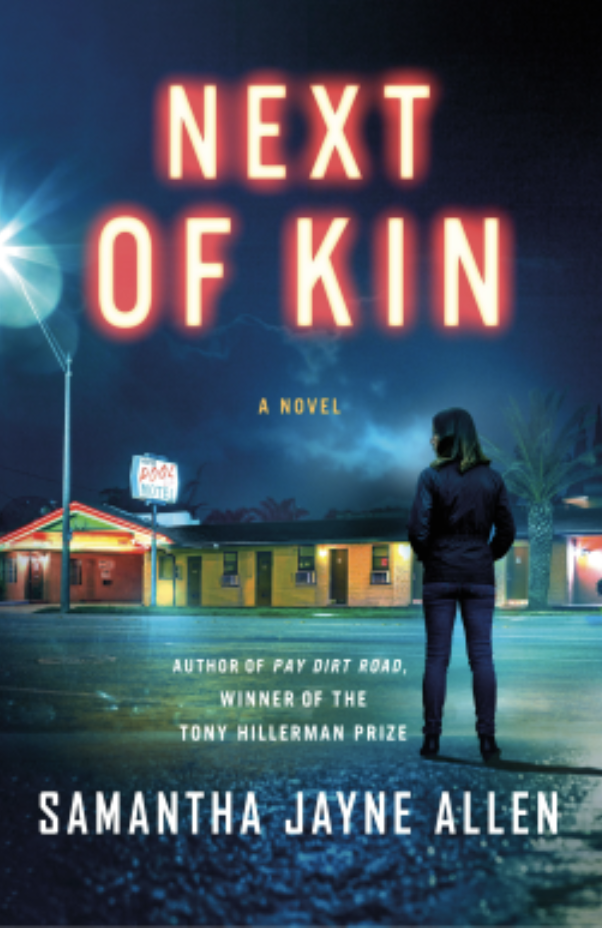
Next of Kin by Samantha Jayne Allen

Number three in Allen’s Annie McIntyre / Garrett, Texas series. Nice and complicated, full of atmosphere, and I really like the way Annie is developing. In my review of the last book, I said, “Annie suffers from occasional bouts of self-doubt which I hope she has less often in the future (I like to see characters grow!)” and guess what? She really has grown into the role, and her bouts of self-doubt have largely disappeared. Made me happy!

This deliciously convoluted plot includes long lost relative discoveries on Ancestry.com with a heavy dose of bad guy blood mixed in. Social services, group homes, drug dealing, bank robbers — they pop up in unexpected places and through it all Annie keeps her cool, pursues justice like a tenacious bulldog, and treats us to her ongoing reflections, many of a philosophical and moral nature (my cup of tea). The regular characters — her 85 year grandfather retired sheriff Leroy, his investigative partner of many years Mary Kate, Annie’s newly married cousin Nikki, and increasingly serious boyfriend Wyatt — all get better and more interesting with each book.

This is the best book so far — tighter plot, better balance of “novel” and “mystery,” and a well-developed (and continuously developing) set of characters.

A couple of quotes:

“He let information sit before speculating, enough time to regulate his own emotions, square them off, and keep them sealed.”

“Though I knew myself to be a believer in redemption, it was hard to overlook the universe’s uneven distribution of such favors.”

Thank you to Minotaur Books and NetGalley for providing an advance copy of this book in exchange for my honest review. The book will be published on April 23rd, 2024.

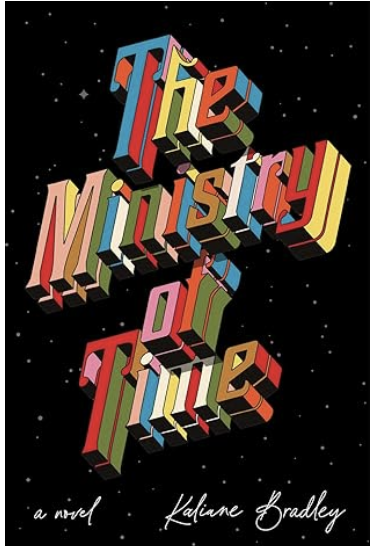
The Ministry of Time by Kaliane Bradley (Speculative Fiction)

Writing: 4.5 / 5 Characters: 5/5 Plot: 4/5

A surprisingly fun ride about the use of time travel to bring historical figures forward in time as part of a (very) complicated plot to ward off a severely climate damaged future. Our narrator (who I now realize is never given a name) is a civil servant who is offered an exciting new job as a “bridge” to one of these “expats from history.” A bridge’s function is to help the refugees from time accommodate to the present.

Our narrator is paired with Graham Gore — a Royal Navy officer and polar explorer from the early 19th century who is brought to the present just before his death as part of the ill fated 1845 Franklin expedition to discover the Northwest Passage. (This is a real historical person and his character and experiences are faithfully drawn from historical records — look him up!). Four other “expats” include the unpleasant Lieutenant Thomas Cardingham from 1645; the lesbian Margaret Kemble from 1665 rescued from the Plague; a woman from Robespierre era Paris (1793); and the closeted homosexual Captain Arthur Reginald-Smythe extracted from the Battle of the Somme in 1916 (he wasn’t going to make it).

The plot is crazy, the characters are well-drawn and time-appropriate. I loved the interactions among all the possible permutations of expats and bridges with what felt like very real reactions and learning curves — most taking to technological advances more easily than the great shifts in social mores and expectations. I found the depth and believability of these interactions and the personal reflections fascinating. Plenty of insight (which I always love) and a great new phrase for me: “ethically sparse” to explain how our narrator felt about certain policies and decisions made by her corporate overlords in the Ministry.

Bradley is an excellent writer — her phrasing and comic overlays are top notch. I found the plot confusing at times — but it feels like this was somewhat intentional as the events were certainly confusing to the people living through them, and we are sharing their experience. Our narrator is part Cambodian, and another bridge is Black. Add to this our historical lesbian and homosexual characters, and there is plenty of opportunity for some pithy and insightful identity issues as well. She even managed to work a theremin (weird musical instrument — look it up) into the plot as well. Impressive!

Some fun Quotes (sorry there are so many but I couldn’t pick):

“I finally had a savings account that looked like it might withstand a life emergency rather than crumple at a dentistry bill.”

“All the emotions I normally watched her puree into professionalism were churning on her face.”

“This was one of my first lessons in how you make the future: moment by moment, you seal the doors of possibility behind you.”

“When Graham got online, as he did not call it, and learned to peck at the keyboard with the elegance and speed of a badly burned amphibian …”

“But my mother never described herself as a refugee. It was a narrative imposition, along with ‘stateless’ and ‘survivor’.”

‘Stop hand-wringing,’ said Simellia, still smiling, though increasingly looking as if the smile was being operated by winches inside her skill. ‘God, Ministry bias training has a lot to answer for,’ she said. ‘I don’t want to drop a piano on your head but believe it or not, I already know I’m Black. You don’t have to roll over and show me your belly about it.’

“It was another dank toothache of a day, barely qualifying in its chromatic dullness for ‘grey‘.”

“Quentin treated me with an impatient familiarity, as if we were both were leaving streaks on one another.”

“We settled back, if ‘settle’ is the right word for the stiff, wary way we offset one another’s weight on the cushions.”

“That night, I slept with unpleasant lightness, my brain balanced on unconsciousness like an insect’s foot on the meniscus of a pond. I didn’t so much wake up as give up on sleep.”

“We separated and spent the fading day bobbing shyly around one another like clots in a lava lamp.”

“I launched into a preplanned speech about class mobility and domestic labor, touching on the minimum wage, the size of an average household, and women in the workforce. I took a full five minutes of talking and by the end I’d moved into the same tremulous liquid register I used to use for pleading with my parents for a curfew extension.”

Thank you to Simon & Schuster and NetGalley for providing an advance copy of this book in exchange for my honest review. The book will be published on May 7th, 2024.

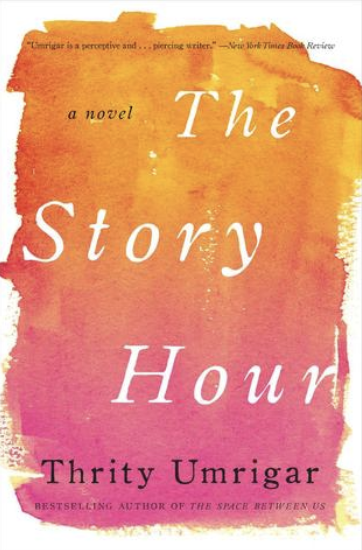
The Story Hour by Thrity Umrigar (Literary Fiction — Audio book)

Writing: 5/5 Characters: 5/5 Plot: 4/5

A beautifully written (with fantastic audio reader) story about an Indian immigrant woman who attempts suicide (in the first chapter — this is not a spoiler) and the black therapist who is assigned her case. Their stories form an interlocking spiral as themes of betrayal, grief, and loneliness play out in both of their lives as the two become more connected than a typical therapeutic relationship warrants.

Lakshmi — the immigrant — is a complex character in a tired body with the loneliness incumbent with an uncaring husband and being cut off from her family home in India. Maggie — the therapist — is a black woman on the verge of an (ill advised) affair, married to a loving and caring Indian professor. Both have complex and well-articulated, deeply considered backstories that have a surprising amount of commonality.

The book is a study in interpersonal engagements of all sorts — the urges, the mistakes, the trust, the quest for redemption, forgiveness and for happiness and intimacy. Incredible breadth and depth. I liked every one of the characters and yet frequently grew angry with them for their all too human errors of judgement. At the very end, there is no specific resolution — highlighting the fact that life is not lived as a novel with a consistent narrative arc and closure.

I was completely engaged and could not stop reading, but there was a lot of pain to share, and I will need something light and happy to read before I venture back into another like it.

The Last Devil To Die by Richard Osman (Literary Mystery)

Number four in Richard Osman’s deservedly popular comic mystery series. Four retirement village pensioners tackle a Romance Fraud, some missing heroin, and the professional looking murder of an elderly antiques dealer who happens to be a friend. A reminder on the four pensioners from my previous reviews: Elizabeth, with the mysterious background and friends in high and low places who all seem to owe her favors; Ibrahim, the retired psychiatrist, who pores over the cases he failed; Ron, the former trade union leader who loves a chance to get back on the stage; and Joyce, who has the often under appreciated skill of bringing everyone together while remaining invisible herself.

While the book has all the hallmarks of Osman’s previous work — tight, content rich prose, laugh out loud moments every few pages, and irreverent mystery solving — this title is different. With one of the regular characters progressing steadily into ever increasing dementia, there is a philosophical turn and one of the most poignant scenes I’ve ever read. I was honestly weeping (correct term) for quite some time. Osman shows a different side of his prodigious writing abilities in blending this very real, and yet unfortunately very ordinary, experience to an otherwise fun, comic, and artfully written romp celebrating friendship and the purposeful embrace of old age.

Some quotes:
“Friendship, and Joyce flirting unsuccessfully with a Welshman who appears to be the subject of a fairly serious international fraud. Elizabeth could think of worse ways to spend the holidays.”

“Mervyn is not one of lifes hand-takers. He lives life at a safe distance.”

“The easiest way to make a small fortune in antiques is to start with a big fortune and lose it.”

“In my business you hear a thing or two about love. I find it easy to replicate. It is largely a willing abandonment of logic.”

“There comes a point when you look at your photograph albums more often than you watch the news.”

“ That’s the thing about Coopers Chase. You’d imagine it was quiet and sedate, like a village pond on a summer day. But in truth, it never stops moving, it’s always in motion. And that motion is aging, and death, and love, and grief, and final snatched moments and opportunities grasped. The urgency of old age. There’s nothing that makes you feel more alive than the certainty of death.”

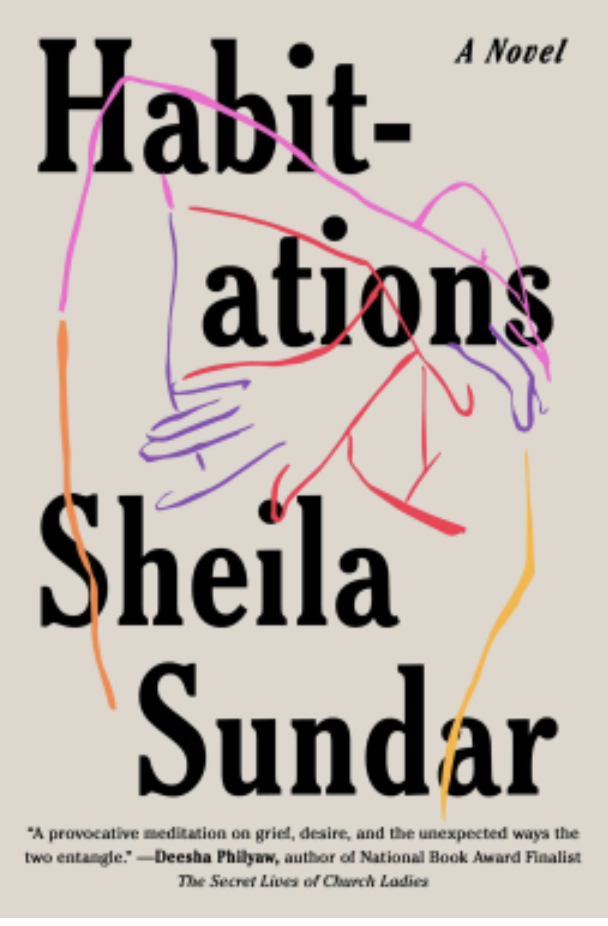
Habitations by Sheila Sundar (Literary Fiction)

Writing: 5/5 Characters: 4.5/5 Plot: 3.5/5

A deeply thoughtful book about Vega Gopalan — an Indian academic (Sociology) who immigrates to the U.S. and shares her introspective take on all her observations of life for herself and the people she meets. Pervading her experiences is the memory of her sister who died at 14 from a disease that would have been easily detectable (and treatable) had she been born in the U.S.

The writing is beautiful, with a talent for capturing complex feelings and thoughts in a few apt phrases. It read like a memoir to me — no foreshadowing, no clearly defined narrative arc — more the development of a life with the actions and events paralleled by Vega’s internal commentary and awareness of self-discovery as it occurs. It was interesting that I didn’t really like Vega — she is not the type of person I would befriend. This is not because she was in any way an unpleasant character, but because she is a deeply interior person who does not always show (or feel?) the empathy and interest in others that I personally like in friends. One of her friends says (appropriately) at one point: “… but sometimes, when we talk, I feel as though I’m interrupting your thoughts.” I usually need to really like a character to enjoy reading about her, but in this case I found myself relating to her intellectually, if not emotionally, so perhaps I would have enjoyed her friendship after all. 🙂

I was impressed by all of the topics discussed in the pages — none with heavy agendas and all with the kind of verbal interactions that show several individuals tackling a topic from multiple personal contexts rather than pulling the latest PC verbiage from a shelf. Vega spends her time in her (American) university keeping company with a wide variety of people — almost all immigrants themselves (from East Africa, Pakistan, Jamaica, etc.). There are a lot of discussions of cultures, advantages, and a realistic depiction of choices that have to be made in order to be allowed to stay or to study. All were treated as facts of life for which you needed to adopt strategies, rather than focussing on the unfairness.

Vega experiences racism at various points but doesn’t let it define her — it’s just more of the expanding context that provides the soundtrack for her developing life. I loved the fact that she was irritated by the “inclusive educational models” at her daughter’s school which featured simplistic math sheets and overly exclamation pointed reading guides, but at the same time had the awareness that if one of her colleagues had written a paper on such models she would have applauded the theories. The book referred to some fascinating academic studies about topics I couldn’t have imagined myself — opening me up to new worlds of thoughts and experiences. Also some lovely references to some of my favorite (and not that well-known) books such as Maya Angelou’s “I Know Why the Caged Bird Sings,” and Tsitsi Dangarembga’s “Nervous Conditions.”

I enjoyed reading the book, but it was one of those books that I found become more interesting the more I thought about it after I finished it. I felt exposed to the multi-faceted reality behind the academic reports, news coverage, and general stereotypes through a stream of social commentary that pertained to individuals in groups, rather than groups as a whole. And lots of stereotype smashing roles — her characters were all influenced by their cultures and backgrounds, but never defined by them. Every time I assumed it would go in a predictable direction it didn’t. Definitely worth reading.

A few good quotes:

“She has long had the sense that there were two types of men: spectacularly bad choices, and interchangeably mediocre ones. She only realized, now, how far she had come from that impression. There was such a thing as a happy marriage. Easy and generous love.”

“She found the veneer of friendship lonelier than being alone.”

“I just grew up with so many people like that. People who lived privileged lives in India, but the moment they travel abroad or talk to foreigners, they want to establish themselves as experts as poverty.”

“There was something broken in her. She knew how to desire a person, but not to care for them.”

Thank you to Simon & Schuster and NetGalley for providing an advance copy of this book in exchange for my honest review. The book will be published on April 12th, 2023.

Real Americans by Rachel Khong (Literary Fiction)

Writing: 4/5 Characters: 4.5/5 Plot: 3.5/5

An exploration of how we become who we are (nature vs nurture and all the permutations) through the stories of three generations of a single family: Lily — raised American (down to the bologna sandwiches she took to school) by her immigrant Chinese parents; her son Nick who looks almost completely like the rich, white father he never met, and not Chinese at all; and Lily’s mother May, who escaped from China during the Cultural Revolution with broken teeth and broken English — and a sharp mind trained in genetic research. Into this mix roam themes of wealth and poverty, racial inequalities, and the ethics of gene editing.

The book held my interest throughout — it’s a plot that thoroughly covers all sorts of interesting times and places from Mao’s cultural revolution to a pharmaceutical empire and across the different stages of an individual’s lifespan. Lily and Nick’s stories felt more real to me. May’s story felt more like a recap of documented history — all true but it didn’t feel like someone’s personal experience to me in the same way the others did (this could be my problem). I liked the depiction of the science, and I thought the descriptions of relationships — with the true intentions, unrealistic expectations, and the heaviness of eventual disappointments — felt genuine. I was sad that these genuine seeming relationships included several people not speaking to others for decades, rather than trying to work through the problems — a sad waste of love. I’m honestly not sure what the overall message of the book was — I get the ethical dilemmas the book (adeptly) portrayed, but I had a hard time understanding what led to individuals literally breaking off all contact with the most important people in their lives. I’m open to someone explaining this to me!

Thank you to Knopf and NetGalley for providing an advance copy of this book in exchange for my honest review. The book will be published on April 30th, 2024.

Chenneville by Paulette Giles (Historical Fiction)

Writing: 5/5 Characters: 4/5 Plot: 3.5/5

A beautifully written book that fits into the same post Civil War world as her News of the World and Simon the Fiddler. Jean-Louis Chenneville — once a successful farmer and gentleman — returns from the war a broken man having spent a year in the hospital in a semi-coma. He awakens to a dark world of ruin — Lincoln had been assassinated, Lee had surrendered, and the Gray Union army had gone home. His body and mind are slowly healing — his memory has wide gaps.

When he does finally get home, he gets worse news — news that sends him off on a long, single-minded journey to right a terrible wrong. Giles excels at bringing a place and time to life — in this case I almost wish she was a little less skilled. It is a depressing time — full of chaos, corruption, and despair. The war is over but things have not returned to any kind of normal — there is little stability in the South, with deep-seated hatreds and little consistent law enforcement.

The story is slow paced with characters — some unpleasant but many good people just trying to make things work again — introduced as part of his heroic journey. Each character had a unique backstory that highlighted all the different people who found themselves in this difficult time and place from a wide variety of starting points. My favorite part had to do with the telegraph operators that he met and the sub community they formed (with details completely and accurately belonging to the time period). There were definitely times that I wished we could have a little less atmosphere and more plot. The book was thick with description and I don’t visualize from textual description very well, which made some of the (albeit exquisitely depicted) passages tedious for me. I was happy with the ending, but until then it was a bit of a depressing read — depressing because of how hard that time really was, not because someone put a bunch of dramatic events to force readers into heavy emotions. I’m very glad I read it, but I wasn’t super cheerful during that week …

Some quotes:
“The clippers ran like teeth over the long scar. John shut his hands together with tense precision as if pain were a mathematical problem, as if he had just solved it and the solution did not include making a noise if he could help it. Sweat ran down his face.”

“The Ohio steamboat was better because the only movement was the unhinged, sliding feel of a vessel with a shallow keel as it moved across the water.”

“He tried to get a grip on himself. This was no way to live, in this messy chaos of despair.”

“People were draining south like wintertime migratory birds.”

“Every word seemed some strange phrase of dejection and unhappiness.”

Thank you to William Morrow and NetGalley for providing an advance copy of this book in exchange for my honest review. The book was published on September 12th, 2023

Welcome to the Hyunam-dong Bookshop by Hwang Bo-reum

I loved this quiet, reflective, and ultimately upbeat book about a young South Korean woman — Yeongju — who drops out of the rat-race to open a bookshop in a quaint residential area of Seoul. This is a far cry from similarly themed American versions with sassy owners or drama gushing from every page. Instead this bookstore slowly grows a community filled with polite and kind people who help each struggle with philosophical questions of life such as: What constitutes success in life? Have we become the person we wanted to be? We meet an array of people, each taking an unusual (especially for South Korea) path through living and hear discussions of the tactics each is employing along with a self-assessment of his or her happiness.

This is a translation of a surprise best-seller from Korea whose popularity spread completely through word of mouth. I enjoyed knowing that I was reading something authentically Korean that had appealed to a non mainstream audience in that way. What I assume was a modern Korean culture permeated the behavior and reflections of each of the characters in a way I found enlightening. I also loved the writing style: Quiet. Observational. Unfiltered. The story was sweet, honest, and real and had many points of resonance for me. I loved the way people communicated with each other with simultaneous insight into each person’s thoughts and assumptions. And of course, I loved all the “action” around reading and books! Yeongju reads. At the start of the book she is reading about people who have left their old lives behind, as that is what she has just done. She reads and discusses the ideas with herself. She learns but also disagrees and in this way furthers the development of her own sense of self and purpose. She makes recommendations but is far from the know-all librarians portrayed in much fiction. My favorite request: a mother whose 18-year old son is already sick of life asks for a book that will “unclog a smothered heart.”

I loved that this book tackled deep issues with neither false cheer nor gloominess. I found it ultimately inspiring while simultaneously grounded in reality. As an aside, I really had to focus on all the Korean names as I don’t have a lot of experience with them and am happy to report that with just that little bit of focused effort, the names felt very familiar to me by the end.

Quotes:
“In The past, she used to live by mantras like passion and willpower, as if by imprinting the words on her mind, they would somehow breathe meaning into her life. It only felt like she was driving herself into a corner. From then on, she resolved never to let those words dictate her life again. Instead, she learned to listen to her body, her feelings, and be in happy places. She would ask herself these questions: does this place make me feel positive? Can I be truly whole and uncompromisingly myself? Do I love and treasure and myself here? For Yeongju, the bookshop checked all the boxes.”

“Yeongju loved such stories. Stories of people going through hard times, taking one step forward at a time as they seek comfort from the flicker of light across the horizon; stories of people determined to live on, despite their sufferings. Stories of hope – not the rash, or innocent kind, but the last glimmer of hope in life.“

“Yeongju’s home felt like an extension of her — somewhat lonely, but a reassuring presence nevertheless.”

“She took care and pride in writing each piece, even though it felt like she had to squeeze out every last bit of her brain juices.”

“Isn’t that what life is about? Foraging forward with the answer you have — stumbling along the way and picking yourself up — only to one day realize that the answer you’ve held onto for a long time is not the right one. When that happens, it’s time to look for the next answer. That’s how ordinary folks, like herself, live. Over our life span, the right answer will keep changing.”

“What counts as a good book? Books by authors who understand life. Those who write about family, mother and child, about themselves, about the human condition. When authors delve deep into their understanding of life to touch the hearts of readers, helping them to navigate life, isn’t that what a good book should be?”

“Small talk could be a considerate gesture, but most of the time, at your own expense. With nothing to say, squeezing the words dry leaving only an empty heart and a desire to escape.”

Thank you to Bloomsbury Publishing and NetGalley for providing an advance copy of this book in exchange for my honest review. The book will be published on February 20th, 2024.

Less by Andrew Scott Greer (Literary Fiction)

Writing; 5/5 Character: 4/5 Plot: 3.5/5

Extremely clever and well-written book about Arthur Less — an aging gay writer (he is almost 50 which doesn’t sound like aging to me!) who embarks on an around-the-world trip to avoid the wedding of his ex-lover and to recover from the rejection of his latest novel. The novel is part memory and part continuous epiphany / humiliation / growth embedded in a personalized travelogue covering visits to Mexico, Italy, Germany, Paris, Morocco, and India. The writing is excellent — pointed, clever, beautiful and without resorting to stupid plot devices. The blurb says it is hilarious and I didn’t find it so at all, which was interesting. It was slow paced and I didn’t care much for the main character but it did grow on me as I continued reading and I found myself pretty happy with the ending. I enjoyed the self-referential bits — Less’ rejected novel is almost exactly what this novel is, with the exception that this novel is what Less (finally) turns his novel into. Some very interesting bits where the book discusses whether or not Less is actually a good gay writer or even a good gay man — according to those who set these rules. It’s very clever and fun to read.

Some quotes which I hope show off the beautiful writing a bit:
“Sad young Arthur Less had become sad old Arthur Less. Stories would be brought out of mothballs for ridicule; new ones would be tested, as well. The thought was unbearable; he could under no circumstances decline. Tricky, tricky, this life.”

“Next morning: the coffee maker in his hotel room is a hungry little mollusk, snapping open its jaws to devour pods and subsequently secreting coffee into a mug.”

“Too wistful. Too poignant. These walk-around-town books, these day-in-the-life stories, I know writers love them. But I think it’s hard to feel bad for this Swift fellow of yours. I mean, he has the best life of anyone I know.”

“Name a day, name an hour, in which Arthur Less was not afraid. Of ordering a cocktail, taking a taxi, teaching a class, writing a book. Afraid of these, and almost everything else in the world. Strange, though; because he’s afraid of everything, nothing is harder than anything else. Taking a trip around the world is no more terrifying than buying a stick of gum. The daily dose of courage.”

His mind, a sloth making its slow way across the forest floor of necessity, is taking in the fact that he is still in Germany.“

“It is our duty to show something beautiful from our world. The gay world. But in your books, you make the characters suffer without reward. If I didn’t know better, I think you were Republican. Kalipso was beautiful. So full of sorrow. But so incredibly self-hating. A man washes ashore on an island and has a gay affair for years. But then he leaves to go find his wife! You have to do better. For us. Inspire us, Arthur. Aim higher. I’m so sorry to talk this way, but it had to be said.“

More likable, make Swift more likable. That’s what everyone’s saying; nobody cares what this character suffers. But how do you do it? It’s like making oneself more likable. And at 50, Less muses drowsily, you’re as likable as you’re going to get.”

“But he can no more feel sorry for Swift — now become a gorgon of Caucasian, male ego, snake headed, pacing through his novel turning each sentence to stone — than Arthur Less can feel sorry for himself.”

But his mind is converging on one point of light. What if it isn’t a poignant, wistful novel at all? What if it isn’t the story of a sad, middle-aged man on a tour of his hometown, remembering the past and fearing the future; a peripateticism of humiliation and regret; the erosion of a single male soul? What if it isn’t even sad? For a moment, his entire novel reveals itself to him like those shimmering castles that appear to men crawling through deserts…“