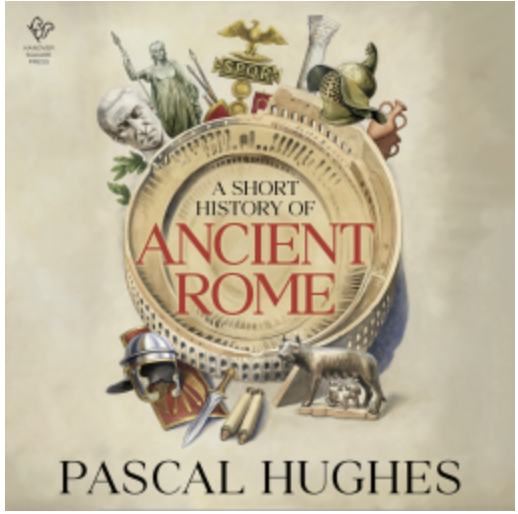
The title doesn’t lie — the book covers about 1,000 years of Roman history (from founding to end) and is only 352 pages (or in my audio book case, about 8 1/2 hours of listening). I don’t read a lot of non-fiction, as I find most of it muddied, tedious with extraneous detail, and overly biased, BUT I found this one to be very well-organized, clear, engaging, and with plenty of reference to the (sometimes competing) sources. It also started with a quip from Monty Python which put me in the right mood!
The book was well-structured, beginning with the stories of Rome’s founding (Romulus and Remus) and traipsing through a set of chronicles garnered from pivotal points in Rome’s history including the “real” stories behind popularized versions of characters like Spartacus, Caesar, Nero, Boudicca, and Attila the Hun. Progressing through the history at a reasonable pace allows the reader to watch the evolution of culture and values, political systems, definitions of personhood, and the technical accomplishments for which the Romans are justly famous. It was a bloody and brutal story from start to finish, to be honest, but it helps put our current issues and ideas of civilization into perspective. I found listening to it (while out on walks) to be useful as I enjoyed breaks from the (mostly unpleasant) “action.” After reading, I find myself marveling at how civilized we actually are in comparison, and also how fragile civilization always is.
Thank you to Harlequin Audio and NetGalley for providing an advance copy of this book in exchange for my honest review. The book was published on November 11th, 2025.
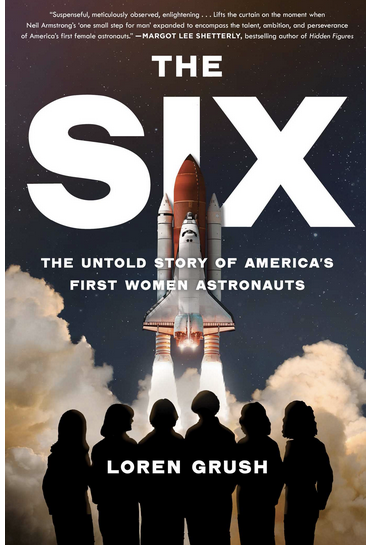
This is the story of the first six women admitted to NASA’s astronaut corps. Drawn from extensive research, interviews, personal papers, etc, it is a blended story that follows each woman from an initial interest (often as children) through to the 1986 Challenger disaster. The narrative focus moved between what it meant for women to (finally) be allowed into the profession, and what it meant to be an astronaut regardless of gender or race. I much preferred the second theme as the level of detail — the (long) training regimen, the detailed prep for each mission, the nightmarish (for some) experience of requisite PR duty, and the actual experience of being in space and on a mission was completely engaging and well documented without a lot of extraneous agenda or overwrought emotion.
The focus on the barriers the women faced and how they were treated as women was actually well done. NASA made a decision to encourage women and minorities to apply to their historic recruitment of Mission Specialists for the new space shuttle program. The focus was completely on the competency of the women under consideration, who were put to the same tests and held to the same expectations as the men. They passed with flying colors — without the need to make changes to the requirements in any way in order to accommodate women. There were a few stories about pranks, teasing, and a Playboy centerfold or two, but nobody got “offended”and everybody simply focussed on doing a great job. The media was irritatingly focussed on asking about “romance in space,” whether the women “weeped” during training, or attacking the morality of a mother for considering such a career, but the women took these questions in stride, answering calmly and rationally and letting the ridiculous questioners look like the fools (IMHO). I was annoyed by the commentary in the prolog and epilog about the need for achieving representation of women and minorities in the astronaut corps — something I disagree with completely. I’m all for equal opportunity, equal pay, and equal recognition — I see no reason for any profession to have its practitioners exactly mirror the gender and racial makeup of the population at large. Get the best! And certainly none of “the six” were turned away from their space dreams by the lack of women role models. So there!
I particularly enjoyed all the details about the space flights — the (multi-year) training routines, the detailed prep for each mission, and the individual experiences on board — both the awe and the practical details on how difficult every day tasks such as movement, eating, and yes, toileting, becomes when one is weightless. I was also intrigued by the medical experiments designed to understand the impact of weightlessness on our internal fluid systems (think blood and a pumping heart). Not something I had considered before. Overall, a clear, engaging description of what it is like to be an astronaut, with personal focus on the journeys of the first six women to take the plunge.
“We hold these truths to be self-evident, that all men are created equal, that they are endowed by their Creator with certain unalienable Rights, that among these are Life, Liberty and the pursuit of Happiness.” This is the sentence — the first in paragraph two of the Declaration of Independence — to which the title refers. Isaacson breaks the sentence down, elaborating on what each word or phrase meant in the context of the times. He follows this up with concluding chapters that remind us that the principles underlying the declaration were based on the need to balance personal opportunityt with the maintenance of “the common good.” He goes on to emphasize one of the main casualties of today’s lack of balance — the American Dream. He blames this near demise on the elite meritocracy that offers opportunity only to those who acquire educational credentials, leaving the other 62% resentful and foundering.
I found the book well written, full of some interesting tidbits, and thought-provoking, but I would have preferred more depth on exactly how we define “the common good,” as that seems to be a point of some contention in our current polarized democracy. I also feel that while the “elite meritocracy” may be a contributor to our economic and cultural woes, it is overly simplistic to assume it is the whole problem — there are so many contributing factors (not to mention the fact that I know quite a few successful people without college degrees and quite a few very well-educated people who find themselves unemployed with few prospects).
I love Isaacson’s biographies — I’ve read his books on Franklin, Doudna, Musk, Jobs, and Da Vinci. Those are full of the kind of intricate details on both the subject’s accomplishments, and the inspiration and drive that powered the journey. I would have been happier had the (very complex) topics in this book had a similar amount of completeness and clarity to them.
Thank you to Simon & Schuster and NetGalley for providing an advance copy of this book in exchange for my honest review. The book will be published on November 18th, 2026.
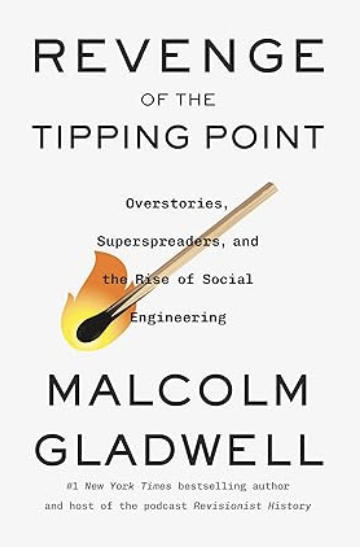
Always an engaging storyteller, Gladwell expands on the Tipping Point theme with an array of anecdotes, research, and social trends to show the impact of tipping points in many important constituents of our society. Ranging from localized bank robbery surges to medical mysteries to social epidemics to group proportions to — my favorite — why Harvard cares so much about arcane sports teams (like girl’s rugby), Gladwell works to understand the evolution of social problems and various bits of social engineering that have or could be applied to nudge things in the right direction. He includes several thought provoking ethical questions regarding these issues — no answers, but I always appreciate the ethical angle.
Some of the book sections that I particularly enjoyed: superspreaders — people who spread germs, pollution, bad behavior — spread orders of magnitude more than “regular” people. Group proportions — the “magic” 1/3 which is the fraction of a group that converts token outsiders into fully fledged members, with both good and bad consequences (think white flight and a truly shocking — to me — story of how Harvard developed its complex admissions process). Small area variation — how monocultures in small areas can lead to radically different behavior when compared to neighbor communities. Think vaccination rates, tonsillectomies, or suicide. The Overstory — how a story can get embedded into a culture without anyone being aware of the shifts. My favorite story here — a connection between the legalization of gay marriage and a long running sitcom starring an openly gay man.
In the last chapter — Conclusion — Gladwell applies the tipping point components developed in the book to the opioid crisis — quoting frequently from the Purdue Pharma (makers of Oxycontin) / Sackler family trial. I don’t completely agree with his conclusions, but was pretty shocked by some of the marketing and sales practices the pharmaceutical company used and how beyond effective (in terms of profit) they were.
Overall this was a thought provoking book, and I enjoyed reading it — with the exception of the first chapter about the LA bank robbery surge which for some reason both bored and upset me. If you feel yourself losing interest as well — just skip the first chapter! I quite enjoyed everything after.
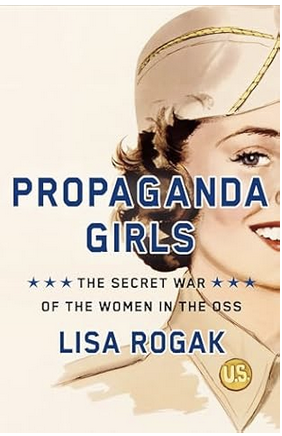
Propaganda Girls follows the lives of four women who worked in WWII’s OSS spinning propaganda webs that demoralized the enemy and helped speed the war to an end. Taking place in the European theater, behind enemy lines in occupied China, and in Washington, D.C., the story follows each of the women from her recruitment, through her placements and work, through her post-war life. The women: Marlene Dietrich — well known German actress who worked non stop for the effort; Betty MacDonald (NOT of Mrs. Piggle Wiggle fame) — the women’s editor in the Oahu paper, one of the first on the ground during Pearl Harbor; Jane Smith-Hutton — wife of a Naval Attache, fluent in Japanese, and held with her family for six months in the Tokyo American embassy after Pearl Harbor; and Barbara (“Zuzka”) Lauwers, a Czech national polyglot married to an American, who worked the European theater.
Each got into the work wanting to do something more for the war — and also wanting to do all that they were capable of doing, rather than living the traditional life available for most women. The story was full of details of life in that time period, the actual strategy and implementation of a propaganda war, and the (often ignored) contributions women made.
So many details were fascinating: The weird training they went through, details on procuring the exact right kind of papers, inks, and using the current language idioms. The arrays of people who had to be recruited with special skills. One story told of an innovative propaganda delivery system — condoms born up and stuffed with a pamphlet that could float across the water. The strategy for determining targets, fake stories, and deployments. How to deal with targets who were not actually literate. Special issues in places like India with hot, ink-melting climates and irregular electricity. But my favorite was a description of the “manual” face lift Marlene Dietrich had to undergo before filming, a kind of elastic pulling of her face, bound back into her hair. Painful and not permanent!
Part personal story, part full program debrief, the book was readable, entertaining, and enlightening.
Thank you to St. Martin’s Press and NetGalley for providing an advance copy of this book in exchange for my honest review. The book was published on March 4th, 2025.
In this ambitious book, Ansary tackles 50,000 years (literally) of history with the thesis that pervasive narrative is the key driver of both cohesion and conflict. Narratives are the glue holding together the social constellations that give rise to culture. From stone age to digital age and beyond the singularity, he traces these narratives through giant hinge points such as the evolution of language, worldviews stemming from religion or ideologies, and methods of conquest and absorption. Why can’t we all get along? Because we are living in different worlds of meaning.
What I gained from reading this book is a much better understanding of the Islamic World, as that, of all the histories, is the one I know least about. Looking through his other books, I now wish I had read “Destiny Disrupted: A history of the world through Islamic Eyes” or “Games Without Rules,” a history of Afghanistan. His primary concept is (to me) not new, and does not really help think of solutions — I think we’ve known for a long time that we need to really understand the other in order to try to find some kind of compromise — and sometimes that is simply impossible. The way he tied global peoples and events across time was pretty interesting, though I found it often very high level.
There were a lot of small surprises (to me). Here are some of them (I have fact-checked some, but not all): • North Americans didn’t develop the wheel because they had no tamable beasts (I don’t completely understand this since 1) a wheeled cart would be helpful to a person and 2) has anyone tried to tame a buffalo? I really don’t know.) • Unlike the Western world, the Chinese had no tradition of jealous gods, demanding exclusive worship, so it was easier to absorb multiple narratives. • Arabs were the (big) slave traders in East Africa, while Europeans became the traders in West Africa. Since Islam forbids enslaving Muslims, many conquered peoples decided to convert. • Rome never fell, but did kind of get taken over by the conquered who had been given a path to citizenship through battle. More of the German tribes (German meant “barbarians who keep bugging us” — his words) ended up in leadership positions shifting things. • Persians were OK with Islam but not with Arab superiority and so found an acceptable path by finding a Persian descendant of the Prophet leading to the Shia split. • History of the development of the Caste system in India and description of why political fragmentation did not lead to cultural fragmentation there. • The main Arab contribution around 800 CE was to catalog everything done elsewhere, e.g. medical knowledge. Their central project was the documentation of Sharia — the complete manual of how to be a Muslim. Meanwhile, the central project of the Western world was Science. • Mongols brought bubonic plague to Europe from the Himalayan foot hills via fleas. In 1345 they lay siege to cities by catapulting diseased warrior corpses into the city. • Movable type could handle the Roman alphabet better than Chinese pictographs. Arab writing also had something about it (he was vague) that made it more difficult. • When Mongols took over China they tried to be Chinese, but their policies came from a different environment (e.g. water shortage in their home on the Steppes led to policies that discourage bathing in China) • Systems based on patronage and relationships (Islamic world) vs commerce (western) and what that led to. • Columbus “discovering” America led to one of the biggest hinges: — some estimates are that 90% (55 million) of people in all the Americas died — mostly of disease — after that “visit.” A catastrophe that dwarfs the Mongol hordes, the Holocaust, the Black Death, and both world wars. • Tools and machines were as seminal as the acquisitions of language. Western social constellations could incorporate machines into their networks of meaning much more easily than the other large empires of the time. • The Muslim narrative with its patronage networks and Sharia law did not have a way of turning inventions into products. The Chinese world with its dream of a socially cohesive centralized state operated by an all pervasive bureaucracy didn’t either. New technology had the potential for disrupting existing social arrangements, and in much of the world preserving existing social arrangements took precedence over building better stuff. • Societies shaped by the progress narrative (ie the West) had an advantage not because of the tools, but because of the improvements and variations they kept building on the first. • The invention explosion was the busy energy of all the entrepreneurial companies and corporations that got excited about making things happen
In summary — it was a long book and the ratio (for my personal background) of new ideas or information to number of pages was lower than I would like. However, the writing was accessible — it didn’t tend to get dragged into too much tedium — and I did learn a lot about the Muslim World. However, at this point I’m more interested in going back and reading the two books I mentioned at this beginning of this review. I did read (in 2007 so I unfortunately do not recall the details) his memoir of growing up in Afghanistan and then coming to the U.S. in high school. That was excellent!
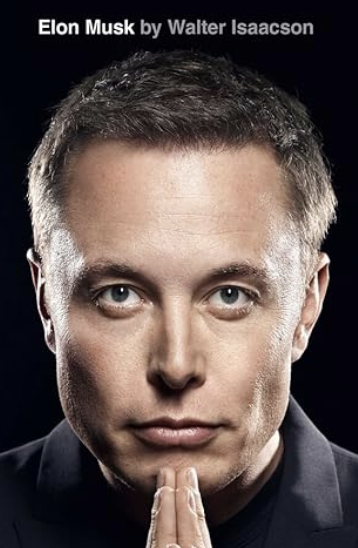
Isaacson does a great job of bringing odd, but clearly brilliant, characters to life. He did it for Steve Jobs, Benjamin Franklin, Leonardo Da Vinci, and now he does it for Elon Musk who makes a great subject for Isaacson’s style of biography — one full of relevant detail along with well-rounded, attributed commentary every step of the way. From childhood to the creation of one industry disrupting business after another (eg Tesla, SpaceX, StarLink) all the way through to the (hostile, messy, and yet full of interesting disclosures) acquisition of Twitter, we get the full story as synthesized from interviews, public records, and the occasional clearly labeled author opinions. The coverage continues through December 2022. What comes through clearly is Musk’s passion, drive, and brilliance, as well as what he is like as a human being. My overall takeaway aligns with this Bill Gates comment: “You can feel whatever you want about Elon’s behavior, but there is no one in our time who has done more to push the bounds of science and innovation than he has.” After reading the book, I am a fan, albeit a fan who has no interest in either befriending (not a likely scenario in any case!) or working for the man
I love that Musk is motivated by pushing humanity forward on the grandest scale: making humans multiplanetary; leveraging renewable energy sources to fight climate change; ensuring that human consciousness survives; and enabling freedom of information through networks and speech platforms. I like that he has the courage to stand by the need for a strict meritocracy in his companies, not subscribing to what he calls the “woke-mind virus.” (I understand that this is a contentious issue but I fall on his side, at least in terms of optimizing for competence when hiring). His “simple” test for the people he hires (or keeps) is that they are “excellent, trustworthy, and driven.” Here excellent means actually excellent as in qualitatively MUCH better than average — not the inflated excellent that is designed to make everyone feel good. Also, his version of driven is intense — he keeps things moving with a “maniacal sense of urgency.” While I’m well beyond the energy levels required to work in such an environment, how exciting would it be to be a part of actually changing the world in such a direct, uncluttered, way? Anyone who has ever worked in a (larger) tech company knows the frustration of trying to get anything done with all of the bureaucracy and frankly mediocre gatekeepers along the way. The issues surrounding Twitter are a completely different kettle of fish. Isaacson says, “He thought of it as a technology company, when in fact it was an advertising medium based on human emotions and relationships.” There is extensive coverage and I’ll let you make up your own mind about it.
The book is full of detailed engineering information (made surprisingly accessible and interesting to readers with varying degrees of background and experience) ranging from the behavior of materials to principles of process design. We’re also treated to Musk’s ongoing verbal annotations at each step as to what he was doing, why he was doing it, how he made it happen, and what he would have done differently (not much, really, but some). I found it all pretty engaging.
So was it a good book? I thought so — it was superbly organized and curated so that topics were introduced at the appropriate time. The book proceeds in date order so you get a real sense as to the number of (giant and complex) balls Musk was keeping in the air at once — each with its own urgencies, engineering issues, political aspects, funding problems, etc. He didn’t take a lot of vacations. Isaacson had access to — and extensively interviewed — almost everyone who had any large part to play in the pages. This included family, friends, colleagues, past employees (both disgruntled and appreciative), reporters, industry luminaries, and, of course, Musk himself. Isaacson’s biographies are never dry reading and his style is blessedly clear and concise (we’re still talking 700+ pages — imagine what the length would have been had it been written by a lover of tangents!).
A League of Their Own is one of my favorite movies. I’m sure I’ve seen it close to a hundred times. It’s funny, upbeat, and brings to light an easily forgotten piece of history with matter of fact detail that doesn’t slide into heavy handed territory. My daughter loved the movie so much she requested a trip to the Baseball Hall of Fame for her 9th birthday. This book is devoted to telling the “inside story.”
It’s a messy narrative, reading more like a super complete (and utterly engaging) set of IMDB trivia than a cohesive story, but if you loved the movie, you’ll love reading all of it: the incredibly drawn-out, complex, work of casting; Penny Marshall’s very insecure directorial style; her mega-lavish use of film (Kodak threw an expensive party for the cast and they don’t do that for every film!); the detailed history of women’s athletics over time and how that impacted the film, the crew, and the many, many, women who swarmed the tryouts for athletic extras.
I didn’t read through the copious notes at the end of the book, but Carlson basically took each topic and interviewed or studied interviews of cast, crew, friends, family, etc so that the reader gets an extensive set of viewpoints without the author sticking her own oar in too often. Everything from feminism to unaddressed lesbianism to all the hidden elements of making a film — so many personalities and so few of them easy. I found all the various bits of financial and creative control and the way individual contracts stipulated such to be quite fascinating. The in-depth baseball training and the injuries the actresses sustained (a broken foot, a broken nose, and that horrible thigh length bruise Shirley Baker sustained that was NOT makeup(!) really grabbed me.
All the details of making the movie were nested in a complete history of Penny Marshall from birth to death — which I had already read about in Marshall’s memoir but was still interesting (and accurate). I loved this one Penny Marshall quote: “I think my problem is that I have a massive insecurity complex combined with a very huge ego.” Seems to be accurate!
I was surprised by some of the information on women’s sports — I’m not even a little bit sporty so it was all new to me — the public attitude towards women in sports and the various excuses used to push them to softball, for example, when the top athletes were perfectly capable of playing baseball. The idea that women were physically inferior and unable to keep up certainly permeated my thinking growing up in the 60s. Being not sporty (at all) myself, I never challenged any of those assumptions. Add to that the idea that it would emasculate the men if they were included certainly didn’t help anyone. The parallel to this story is the story of women in Hollywood as they vie for a spot in this almost all female and female directed cast.
Very enjoyable reading especially if you loved (or even liked) this movie!
Thank you to Hachette Books and NetGalley for providing an advance copy of this book in exchange for my honest review. The book was published on Sept. 5th, 2023.
David Brooks dives into a study of how to really “know” another person in this part academic, part how-to, deeply reflective book. Some parts really appeal to me — I like the funny, tongue-in-cheek, self deprecating style and the curating and restating of academic studies supporting his points. He has several ideas that I resonate with (I, too, was not born with copious social skills and had to work hard to learn the few I developed!), but many that I did not. Honestly, it reads as a journey of self-discovery with an implied (and sometimes boldly stated) assumption that his issues / goals / discoveries are relevant for everyone as in “everyone wants x” and “everyone needs y.” I don’t actually believe anything is true of everyone (except the fact that I assume we all have human DNA). Also, for my taste, he goes a little far in the (IMHO simplistic and kind of old news) “everyone just wants to be heard, valued, and understood,” and I think human interaction is a lot more complicated than that.
In any case, it is an interesting read, with plenty of tools to help each of us understand a little more about how we work and how we interact with others, so I think it is worth reading! Includes an exceptional referenced bibliography featuring philosophers, psychologists, novelists, and poets across the ages.
Thank you to Random House and NetGalley for providing an advance copy of this book in exchange for my honest review. The book will be published on October 24th, 2023.
Random Acts of Medicine is a Malcolm Gladwell style book applied to health care systems. The authors — both physicians and public health researchers at Harvard Medical School — propose to explore the “hidden, but predictable ways in which chance affects our health and our healthcare system” through the use of “Natural Experiments,” that is observational studies that make use of naturally occurring differences in the world and measuring the impact. The two (along with colleagues) have used the approach to explore and answer a number of questions such as: does stress really age you? How does the month of a child’s birth impact their health and life success? What happens when all the cardiologists leave town? How does a marathon impact our health? Does your doctor’s politics affect the care they give? For each question (and there are many, many, more than the ones I have listed), the authors carefully explain the natural experiment, the sources of data, results, and what use can be made of the results (possible policy changes, or greater awareness of our own biases at work).
I found the book got better (more interesting to me) as it went on. The authors are careful not to assume that the reader knows anything about natural experiments, statistics, counterfactuals, etc. and they explain the (possibly new) concepts carefully, but not tediously. Still, if you are already familiar with the concepts it can get a little dull and I enjoyed all the actual experiments (many with surprising results) more than the introduction.
An easy read full of fun “I never thought about that” insights. Plenty of notes and references for those who want to investigate further. I always appreciate the kind of “popularized” topic books when they actually show their work, clearly separating them from the whopping pile of self help books that make claims without an iota of scientific support.
Thank you to Doubleday and NetGalley for providing an advance copy of this book in exchange for my honest review. The book will be published on July 11th, 2023