
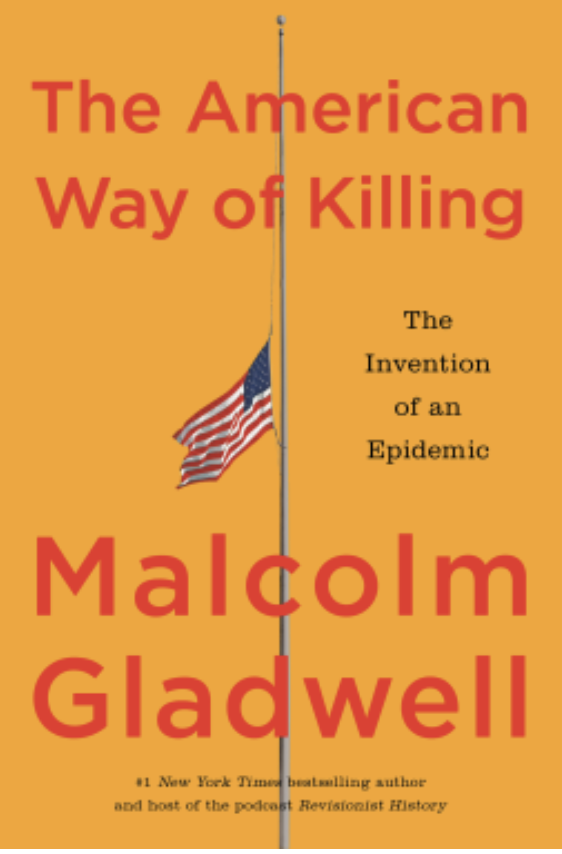
The American Way of Killing by Malcolm Gladwell (Non fiction)

Gladwell’s latest tackles the highly emotional topic of Violence in America — and he tackles it with a shocking amount of anger and aggression aimed at Americans — all 350 million of us. Gladwell’s general approach to his subjects is to (in his words) find interesting anecdotes and interesting research and pair them up. The set of vignettes in this collection do this but in a hostile and often misleading way. Hostile in that he’s clearly angry at Americans (again — all of us) literally and repeatedly calling us stupid, dishonest, “morally reckless,” and pedantic at various points in the narratives. Misleading in that none of his “stories” are comprehensive — some offer partial (but never tested at scale) solutions, many describe efforts and explain why they are a waste of time, a few contradict each other, and several leave out critical aspects of the data that could change the conclusions. I am glad I read this book and I did learn some new and relevant information, but I strongly recommend reading the book critically and doing your own supplemental research to get a fuller picture.

The bits I found interesting: Americans (according to Gladwell) think they are over policed, but in fact we are largely under-policed. A comparison of police forces in L.A. and Berlin (equal populations with L.A. a larger physical area) surprised me. 8,500 police in L.A. vs 18,000 in Berlin. This section included a good description of how a larger police force could prevent more crime and improve community engagement based on interviews with those who had run large police forces (e.g. Boston, L.A.). A dive into a program to teach young men (the victims and perpetrators of the largest segment of gun violence) how to maintain emotional control based on the “realization” that much of gun violence was based on “an exaggerated sense of moral injury leading them to take the law into their on hands.” A few dips into how gun fatality statistics are influenced on the one hand by the amazing abilities of surgeons to save victims who would have died in the past, and on the other hand by the location of trauma centers which are often not close enough to the areas that need them the most. While not productive in any sense, I did learn something from the details of the assault weapons ban — pages and pages of specific weapons banned, an even longer list of those not banned, followed by his point that most homicides were committed with handguns anyway.

The pointless or frustrating bits: Long diatribes about our “absurd” focus on the second amendment and the pedantic nature of the Supreme Court, betraying incomprehension for what the Constitution is and how the Supreme Court is supposed to make decisions (Gladwell is a British-Canadian who has lived in the U.S. since the mid eighties without applying for citizenship so maybe he missed the memo?). Conflating homicides and suicides into single gun violence statistics which give misleading ideas about where the biggest problems are. Some sideways mentions of racism without any cohesive theme — almost as though just throwing it in there.

I’ve read most, if not all, of Gladwell’s books and have enjoyed them. They are called “pop sociology” and I enjoy the surprising tidbits. However, with such a critical topic under discussion, the light-weight nature of the anecdotes coupled with the needlessly hostile tone really didn’t work for me. Read it — but spend some time thinking about what you read and maybe do a little extra research before drawing any conclusions.

There are so many good sources of relevant information out there. Here are a few statistics that I found (and found easily): There is an oft referenced meme on gun friendly states having the highest amount of gun deaths. Using the CDC data at https://www.cdc.gov/nchs/state-stats/deaths/homicide.html, what I found is that by removing the suicides and only looking at homicides, many of the “red” states known to be very gun friendly (Montana, Wyoming, Alaska) jumped down to the middle of the list because almost all (80-90%) of their gun deaths were suicides. In fact, California (very blue!) and Montana (pretty red!) have the exact same number of homicide gun deaths per capita. I also looked up what percentage of firearms in the U.S. were used to cause injury or fatality — according to https://publichealth.jhu.edu/center-for-gun-violence-solutions/data/annual-gun-violence-data, this is 0.003% of all firearms. Lastly, I asked one of the AI engines to give me information on guns used in self-defense and it gave me pointers to several different surveys run by a variety of organizations resulting in a large range (70,000 – 2,500,000) of reported self-defense events, mostly guns used as a deterrant, i.e. without firing a shot. For me this helps to frame why so many people want guns and how few (and concentrated) the use of guns for violence is.

I should mention that I am by no means a “gun nut,” and I’m extremely worried about the level of overall violence in our country — not just inner city gun homicides, but the tendency towards violence with any kind of weapon, the acceptance of politically motivated violence, the excusing of violence committed by the mentally ill, and the violence committed by people who just seem to enjoy it. Some level of gun control is of course required, but it is in no way sufficient. We have a big problem with people and culture — some of Gladwell’s stories point in the right direction, but not nearly enough.

Thank you to Little, Brown and Company and NetGalley for providing an advance copy of this book in exchange for my honest review. The book will be published on September 29th, 2027.
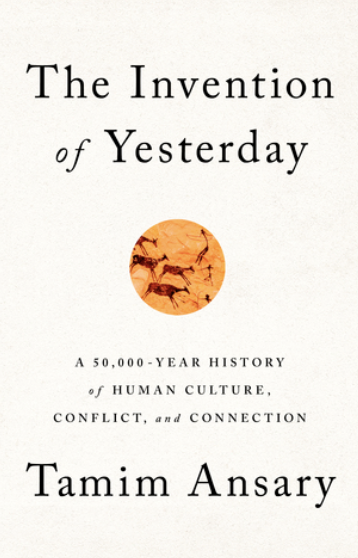
The Invention of Yesterday: A 50,000-Year History of Human Culture, Conflict, and Connection by Tamim Ansary (Non Fiction)

In this ambitious book, Ansary tackles 50,000 years (literally) of history with the thesis that pervasive narrative is the key driver of both cohesion and conflict. Narratives are the glue holding together the social constellations that give rise to culture. From stone age to digital age and beyond the singularity, he traces these narratives through giant hinge points such as the evolution of language, worldviews stemming from religion or ideologies, and methods of conquest and absorption. Why can’t we all get along? Because we are living in different worlds of meaning.

What I gained from reading this book is a much better understanding of the Islamic World, as that, of all the histories, is the one I know least about. Looking through his other books, I now wish I had read “Destiny Disrupted: A history of the world through Islamic Eyes” or “Games Without Rules,” a history of Afghanistan. His primary concept is (to me) not new, and does not really help think of solutions — I think we’ve known for a long time that we need to really understand the other in order to try to find some kind of compromise — and sometimes that is simply impossible. The way he tied global peoples and events across time was pretty interesting, though I found it often very high level.

There were a lot of small surprises (to me). Here are some of them (I have fact-checked some, but not all):
• North Americans didn’t develop the wheel because they had no tamable beasts (I don’t completely understand this since 1) a wheeled cart would be helpful to a person and 2) has anyone tried to tame a buffalo? I really don’t know.)
• Unlike the Western world, the Chinese had no tradition of jealous gods, demanding exclusive worship, so it was easier to absorb multiple narratives.
• Arabs were the (big) slave traders in East Africa, while Europeans became the traders in West Africa. Since Islam forbids enslaving Muslims, many conquered peoples decided to convert.
• Rome never fell, but did kind of get taken over by the conquered who had been given a path to citizenship through battle. More of the German tribes (German meant “barbarians who keep bugging us” — his words) ended up in leadership positions shifting things.
• Persians were OK with Islam but not with Arab superiority and so found an acceptable path by finding a Persian descendant of the Prophet leading to the Shia split.
• History of the development of the Caste system in India and description of why political fragmentation did not lead to cultural fragmentation there.
• The main Arab contribution around 800 CE was to catalog everything done elsewhere, e.g. medical knowledge. Their central project was the documentation of Sharia — the complete manual of how to be a Muslim. Meanwhile, the central project of the Western world was Science.
• Mongols brought bubonic plague to Europe from the Himalayan foot hills via fleas. In 1345 they lay siege to cities by catapulting diseased warrior corpses into the city.
• Movable type could handle the Roman alphabet better than Chinese pictographs. Arab writing also had something about it (he was vague) that made it more difficult.
• When Mongols took over China they tried to be Chinese, but their policies came from a different environment (e.g. water shortage in their home on the Steppes led to policies that discourage bathing in China)
• Systems based on patronage and relationships (Islamic world) vs commerce (western) and what that led to.
• Columbus “discovering” America led to one of the biggest hinges: — some estimates are that 90% (55 million) of people in all the Americas died — mostly of disease — after that “visit.” A catastrophe that dwarfs the Mongol hordes, the Holocaust, the Black Death, and both world wars.
• Tools and machines were as seminal as the acquisitions of language. Western social constellations could incorporate machines into their networks of meaning much more easily than the other large empires of the time.
• The Muslim narrative with its patronage networks and Sharia law did not have a way of turning inventions into products. The Chinese world with its dream of a socially cohesive centralized state operated by an all pervasive bureaucracy didn’t either. New technology had the potential for disrupting existing social arrangements, and in much of the world preserving existing social arrangements took precedence over building better stuff.
• Societies shaped by the progress narrative (ie the West) had an advantage not because of the tools, but because of the improvements and variations they kept building on the first.
• The invention explosion was the busy energy of all the entrepreneurial companies and corporations that got excited about making things happen

In summary — it was a long book and the ratio (for my personal background) of new ideas or information to number of pages was lower than I would like. However, the writing was accessible — it didn’t tend to get dragged into too much tedium — and I did learn a lot about the Muslim World. However, at this point I’m more interested in going back and reading the two books I mentioned at this beginning of this review. I did read (in 2007 so I unfortunately do not recall the details) his memoir of growing up in Afghanistan and then coming to the U.S. in high school. That was excellent!

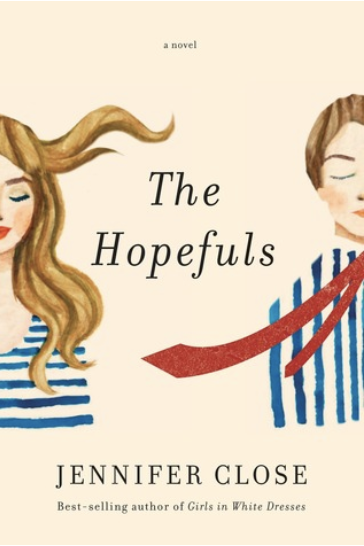
The Hopefuls by Jennifer Close (Literary Fiction — audio book)

Writing:5/5 Plot: 3/5 Characters: 4/5

Matt and Beth are the “Hopefuls.” A young couple — Matt a Harvard trained lawyer eager to run for office and Beth a literary type earning a pittance at various writing / editorial jobs. They move to D.C. shortly after Obama is elected, Matt having worked for the campaign and eager to get into politics full time. When their best friends (Jimmy and Ash) decide to move to Texas to run for the coveted role of Railroad commissioner (hint: apparently has very little to do with railroads!), Matt and Beth go with them, Matt running Jimmy’s campaign. Jimmy is a democrat running against a well funded Republican — in TEXAS — so to say it is hard going is a bit of an understatement.
Beth is the narrator, so the point of view is far more focused on relationships (among all four of them) than on political strategy. She is quite observant, and the unfolding story is full of the kind of nuance and detail that makes people so interesting (and irritating and in this case — a bit whiny for my taste).
The writing is excellent, the story completely believable. My big problem — I did not like any of the characters. None of them were bad people, but they were not people I would have wanted to spend any time with. None of them. Matt was super intelligent and focused but clammed up when he was frustrated, and he was frustrated a lot. Beth didn’t do anything. She was so passive that I wanted to kick her.
Listened to it on audio, and the reader was excellent. The slower pace (I read very fast) really showed off the detail that I might have missed, and the reader really “got” the emotions in the narration. But it also meant a longer time dealing with characters who were irritating me!!