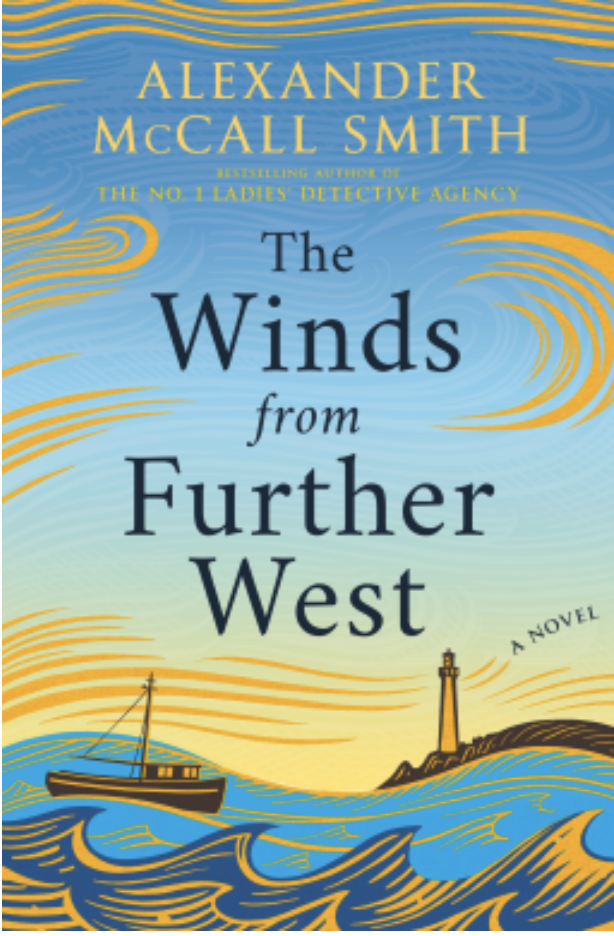
The Winds from Further West by Alexander McCall Smith (Literary Fiction)

In this new, standalone novel, McCall Smith takes on the ethics and responsibilities of those caught up in cancel culture — including the perspectives and calculations of those willing to play along (on either side) for personal gain. We follow Neil, a University of Edinburgh public health lecturer and researcher, as he is accused of making an “insensitive” comment and is asked by an unscrupulous dean to apologize regardless of guilt. I’ll hasten to say that McCall Smith does not allow the book to slide into a Kafkaesque nightmare from which our hero cannot emerge unscathed (I almost stopped reading when I thought it was going in that direction). Instead, he focuses on how people react to “life experiences” such as these and how they can be used to further self (and world-at-large) awareness and growth. I found it insightful and inspiring.

I love that McCall Smith always brings the ethics of big social trends into how they play out in individuals. The book is full of pithy commentary as to the state of the world (or one’s university!) and one’s role within it. His characters are always interesting — one is caught reading a book called “A Brief History of the Smile.” Others contemplate and discuss such random (but IMO engaging) topics such as a recent theory about Neanderthals, people vs. microbes, the use of shaming in society, and as always, a lovely collection of quotations from (mostly Scottish) poets (my favorite is Auden’s line: “If equally affection cannot be, let the more loving one be me.” It made me cry. I also loved the discussion (minor argument?) about the democratization of science — while Neil’s girlfriend feels teachers should be less didactic, Neil points out that Bernoullis equation is not an opinion.

Honestly, I have loved almost all of McCall Smith’s books and really can’t believe he hasn’t run out of philosophical musings and expositions after all this time. Every book seems to cleanly dissect complex problems into clear and concise points to help you thread through them.

Some of my favorite quotes:
“One had to become indifferent to the things you could not do anything about, unless you were prepared to let them hurt you indefinitely.”

“He, and people like him, might do a little to change the basic rules of engagement between human beings and microbes, but here and there, in small corners of the battlefield, they achieve their largely unsung victories. And in the background, their research, sometimes painfully slow and seemingly entirely theoretical, built up the human armory against microbial defeat.”

“People say that the thing about poetry is its power to haunt.“

“The world’s in a sorry mess. People put so much energy into finding fault with others, with attacking them, with calculating personal advantage, with … with all of those things. We’ve broken the bonds that exist between us, with the result that we are all potential enemies of one another, locked in mutual suspicion and distrust. And do you know what? I’ve had enough of it, I can’t bear to be part of that any longer.”

Thank you to Pantheon and NetGalley for providing an advance copy of this audio book in exchange for my honest review. The book will be published on July 29th, 2025.
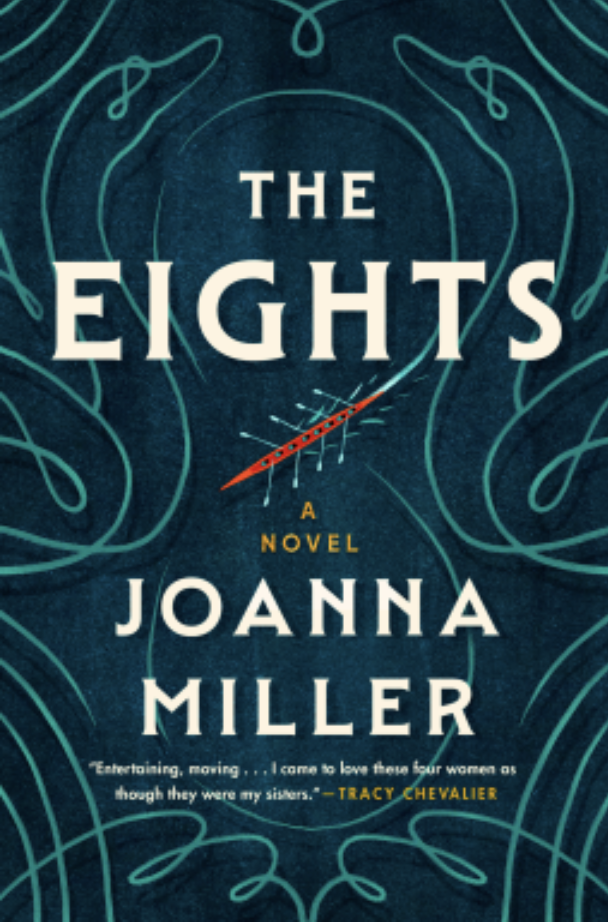
The Eights by Joanna Miller (Historical Fiction)

Historical fiction at its best! Four women are part of the historic 1920 matriculation of women to Oxford — the first in over 1,000 years. Roomed together in “corridor eight,” this is the story of their first year, with several flashbacks to flesh out their personal context. Beatrice Sparks — almost 6 feet tall, daughter of a famous (and vigorous!) suffragette, with an appetite for politics; Marianne Gray — the motherless daughter of an English vicar; Dora Greenwood — beautiful and still grieving for the brother and fiancee who died in the war; and Ottoline Wallace-Kerr — wealthy and at odds with her family’s expectations, who keeps herself calm with mathematics. There are some secrets and some surprises — all quite realistic and perfectly embedded in the well-drawn context of the time. And for the girls, a discovery of unexpected, but deeply felt, friendship.

I say this is historical fiction at its best because it finds the right balance between the extremes of dull, historic, facts and overly sensationalized (and manipulatively emotional) story telling with a minimum of historic accuracy. There are no modern sensibilities sneaking in — but plenty of individual reactions and experiences nestled in the very real context of the day. The country had just emerged from WWI, (some) women had just gotten the vote, and now — Oxford was open to women who wanted to pursue a more intellectual path through life. I loved the many small details that peppered the prose: a new mystery author — Agatha Christie — who was set the challenge to write a novel where it was impossible to guess who did it — and succeeded; the introduction of ouija boards; stories of the Bodlein library and how the rare books were protected during the war; the second wave of influenza; the origin of Chequers (home to Britain’s prime ministers); practice trenches in the countryside; suffragette pennies, etc. A pretty interesting Oxford-style debate on whether or not women should be at Oxford at all. I loved the bits of discussions on various studied subjects. The secondary impact of the war on various people after the war was over was equally interesting — more personal, individualized, and detailed. Philosophical and ethical issues pervaded the experiences because how could they not?

I like historical fiction because, when done well, you learn about what history might have meant to the people who lived through it. The author’s note delineates fact from fiction as well as describes inspirations — with a nice bibliography on relevant sources. Also — there is a glossary at the end that I really wish I had known about before I finished! Plenty of period specific slang was used that I had to constantly look up or guess at. Now you know!

Thank you to G. P. Putnam’s Sons and NetGalley for providing an advance copy of this book in exchange for my honest review. The book will be published on April 15th, 2025.

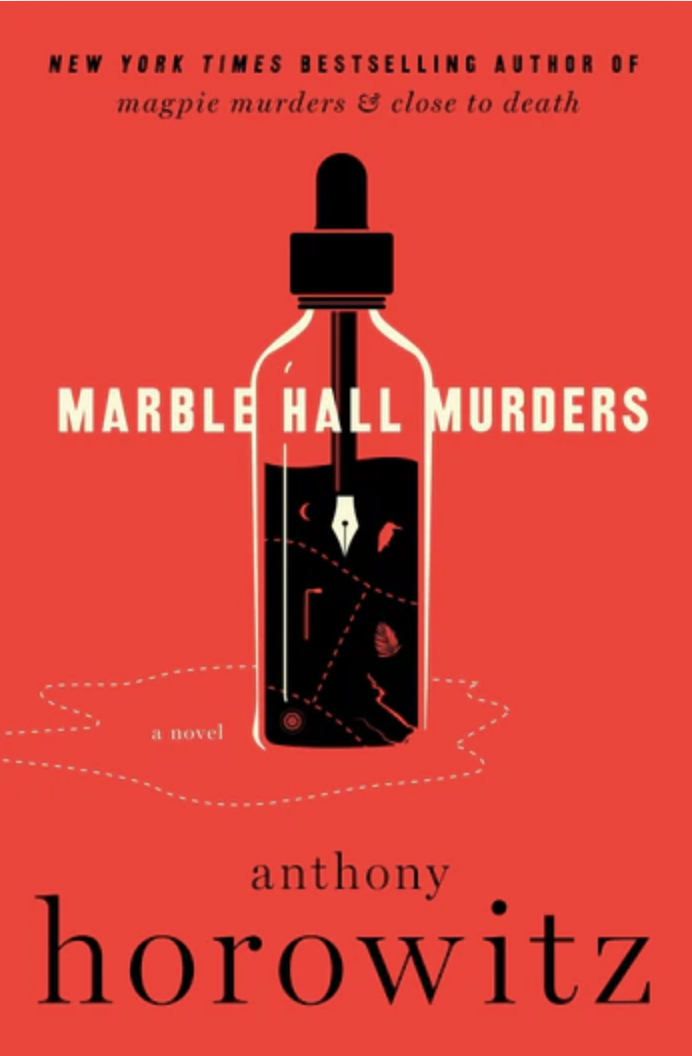
Marble Hall Murders by Anthony Horowitz (Mystery)

Number three in the Susan Ryeland series (after Magpie Murders and Moonflower Murders — both now streaming on Masterpiece). Susan was the editor of the fantastically successful Atticus Pünd detective series — from inception until disastrous events brought the series to an end. You’d think she would have had enough, but dire straights lead her to accept a job editing a continuation novel, written by Eliot Crace — a well-known loose cannon who is nevertheless blessed with a beloved children’s author as a (now deceased) grandmother.

It’s a classic story-within-a-story format — we’re reading the Crace novel as fast as he produces pages while simultaneously reading Ryeland’s story as she keeps sticking her nose into the author and the story, which continues to mirror reality to an uncomfortable extent. The two stories dovetail in weird and twisted ways and I never saw what was coming, though the clues were all there. I love Horowitz’s writing — clear and concise and bringing characters to life with minimal, essential, prose. The mystery (two in parallel really, one fictional and one not) is excellent on its own, but I also loved the meta layer exposure of the literary world — how writers write, the relationship between author and editor, and basic survival tips for the publishing industry. It’s full of anagrams, ethical discussions, and deliciously clever (albeit often evil) moves. I always appreciate a book that has no stupidity — intentional or not — in its pages!

Some facts new to me: According to the Authors, Licensing and Collecting society, the average salary earned by a novelist is a mere 7,000 pounds a year — not a lot (not even a little, really). There are around 200,000 books published in the UK every year ( and as many as 1 million in the USA) and as Horowitz writes: “How many of them do you really think are going to end up on the front table at Waterstones?.” Lastly, I had never heard of the Nazca lines in Peru — giant geoglyphs in a Peruvian desert dated between 500 BC and 500 AD that are so large they can be seen from space (for those who have read it, this reminded me of Vonnegut’s Sirens of Titan.

Easy read, completely engaging, and (IMHO) book clearly better than the Masterpiece series (which itself is very good, but the book is better)

Thank you to Harper and NetGalley for providing an advance copy of this book in exchange for my honest review. The book will be published on May 13th, 2025.

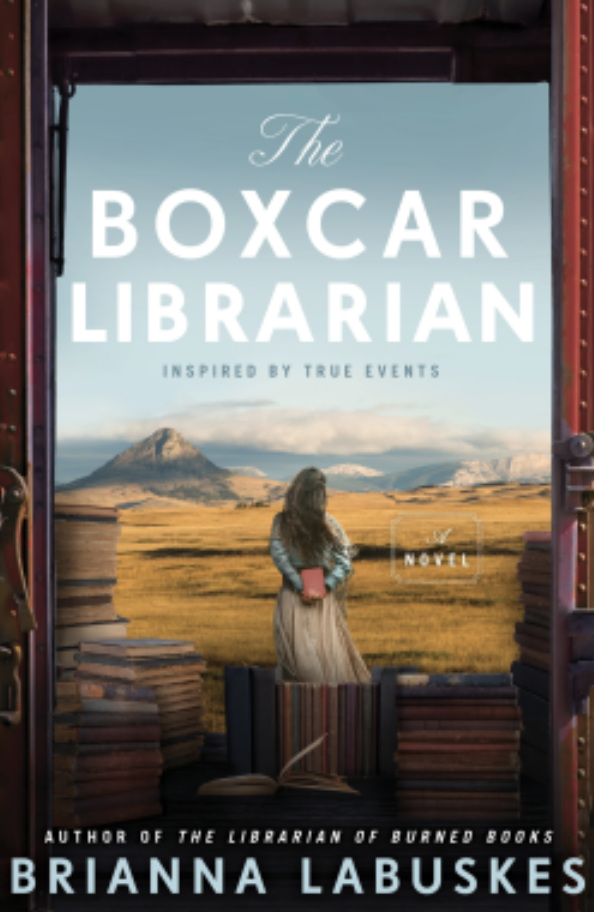
The Boxcar Librarian by Brianna Labuskes (Historical Fiction)

Writing: 4/5 Plot: 5/5 Characters: 5/5

Loved this historical fiction centered in Montana in the early 1900s. Three timelines for three characters that slowly converge: Millie Lang (1936), exiled to Missoula to “fix” the state’s contribution to the depression era American Guide Series, sponsored by the Federal Writers Project of the WPA. Alice Monroe (1924), small town Missoula librarian born to wealth, who works to get more books into more hands via rural visits. Colette Durand (1914), daughter of a Shakespeare loving union organizer for the miners employed by the Anaconda Mining Company.

An excellent cast of supporting characters, lots of action and surprising plot twists, well-researched details of the time period, and plenty of interesting locations (e.g. Glacier National Park, Wild Horse Island in Flathead Lakes, Missoula mining camps) — all vividly brought to life. Lots of literary references, both in terms of very apt quotes and individual books for an assortment of characters and the real impact they had. Really demolished the stereotype of the “lower classes” being uninteresting in learning and mind expansion. She handled themes of vengeance, injustice, and restrictions on and expectations of women adroitly with real reflection on how to know what “doing the right thing” means, and what it might cost. Loved the Boxcar library itself (apparently you can see the Lumberman’s library box car in Fort Missoula — I may take a trip!)

A great read!

Some quotes:

“Everyone had a story, and most people were just trying to get by. They didn’t deserve to become empty vessels to hold other people’s anger and insecurities.“

“So did writers. They saw the extremes in life as appealing – tear courage, fear, and strength, love and hate. They were what made humans human. But Millie didn’t think of herself as a writer. She thought of herself as a journalist. She was there to tell other people’s stories.”

Thank you to William Morrow and NetGalley for providing an advance copy of this book in exchange for my honest review. The book was published on March 4th, 2025.

Typewriter Beach by Meg Waite Clayton (Historical Fiction)

I really warmed up to this book — it started off a little slowly and then became more and more intriguing with every chapter, ending with a lovely last line to cap it all off.

Dual timelines — an isolated set of cottages on the beach at Carmel in 1957. During the darkest times of McCarthy’s blacklists and the slow strangulation of Hollywood, a young starlet on the verge of being the next Grace Kelly is sent to wait in one of these cottages by the studio manager and all around fixer. Told to stay indoors and not be seen, she nevertheless meets her neighbor, the enigmatic Leo — a black listed scriptwriter with a haunted past. In 2018 we follow Gemma, whose beloved grandfather has just died and left her his cottage.

The story slowly unfolds, past to present, and while I often thought I knew what was happening, I was often quite wrong. The writing style is rich with thought provoking commentary and reflections. Hollywood — the deals, the norms, the restrictions, the cheats — is on display with all of the detail that I love — not just a description of events, but a description of the people living through those events and how they are changed, what they do to survive, what decisions they make (and sometimes regret, and often don’t). It’s the full experience and incredibly well-researched. I learned a lot about the different ways people dealt with the blacklist and (of course) the very different ways men and women had to deal with opportunities, threats, and restrictions.

Along with this spectacular depiction of the times and contexts is a lovely and often surprising story of love, family, parenthood, and friendship. I don’t want to give anything away, but there are multiple lovely stories of people finding love and family in a world not inclined to make it easy for them. Plenty of stories of people living in an environment not of their choosing and not in their control — and yet … finding their happiness.

Lots of intriguing details on Carmel and Hollywood — late credits for blacklisted screenwriters, a form of “me too” throughout the ages, morals clauses (for women only). I enjoyed every minute of it.

Thank you to Harper and NetGalley for providing an advance copy of this book in exchange for my honest review. The book was published on July 1st, 2025.

Rental House by Weike Wang (Literary Fiction)

Two vacations five years apart. A married couple from (very) different backgrounds invite their parents to join them for vacation number one.. Keru’s Chinese immigrant parents are post-Covid germaphobes with a suffering-suffused view of life, while Nate’s are outwardly friendly xenophobes from rural Appalachia. On vacation number two, nobody is invited … but some interesting people show up anyway. The whole thing is an incredibly perceptive description of what happens when people of multiple (and often conflicting) worldviews come together.

I read this shortly after reading Tamim Ansary’s “The Invention of Yesterday,” a book blaming most of history on the clashing of misunderstood worldviews (he’s not wrong). Rental House looks at this same problem at the personal level — clashing individual worldviews and the resulting problems and miscommunications. Keru’s observations and incisive analysis gets to the root of how we understand (or don’t) each other — what each person values, perceives, prioritizes and feels entitled to — things people often don’t take the time to understand even about themselves.

I found this to be a remarkably non judgmental book. The clashes developed across the board — political affiliations, race, socioeconomic class, choice of profession, and family expectations — but each person had both different opinions and different levels of investment in those opinions. Did the clash cause mild irritation or offend deeply held principles? Did one person try to understand another, or just get upset at how stubborn the other person was? Keru applied her analytic blade to herself just as often, noting when she may have overreacted to perceived slights, as an example. I appreciated the analytic vs emotional drive for understanding. Reading through someone’s pain allows an empathetic connection for the reader, but doesn’t teach anything about understanding why that someone is in pain, or how he or she (or the reader) might prevent similar pain in the future.

I like Wang’s writing style — clear, insightful, wry, and thought provoking. I also appreciate how thoroughly drawn her characters are — I feel I understand these people in ways that would take years in real life.

Just a few quotes — don’t want to give too many away :
“… An exercise that was like, shoving a square peg into a round hole, but with enough force, and with every neuron dedicated to the problem, he could smash the square peg through.”

“and this led to a heated discussion that characterized the early years of their dating – the aggressive comparison of their worldviews, which ultimately led to clarifications in their basic English vocabularies. Expats left wealthy nations to humble themselves at the altar of the world, immigrants escaped poorer nations to be the workforce of the rich. “

“…because suffering is required. To suffer is to strive and to set a bar so high that one never becomes an obstacle a a complacent. to become complacent is to become lazy and to lose one’s spirit to fight, and to lose one’s spirit to fight is to die. So, to suffer is to live. “

“Then his father chirped back a safe retort, next his mother, and Keru wondered if all white families in public acted like a set of affable birds.”

Thank you to Riverhead Books and NetGalley for providing an advance copy of this book in exchange for my honest review. The book was published on December 3rd, 2024.

The Invention of Yesterday: A 50,000-Year History of Human Culture, Conflict, and Connection by Tamim Ansary (Non Fiction)

In this ambitious book, Ansary tackles 50,000 years (literally) of history with the thesis that pervasive narrative is the key driver of both cohesion and conflict. Narratives are the glue holding together the social constellations that give rise to culture. From stone age to digital age and beyond the singularity, he traces these narratives through giant hinge points such as the evolution of language, worldviews stemming from religion or ideologies, and methods of conquest and absorption. Why can’t we all get along? Because we are living in different worlds of meaning.

What I gained from reading this book is a much better understanding of the Islamic World, as that, of all the histories, is the one I know least about. Looking through his other books, I now wish I had read “Destiny Disrupted: A history of the world through Islamic Eyes” or “Games Without Rules,” a history of Afghanistan. His primary concept is (to me) not new, and does not really help think of solutions — I think we’ve known for a long time that we need to really understand the other in order to try to find some kind of compromise — and sometimes that is simply impossible. The way he tied global peoples and events across time was pretty interesting, though I found it often very high level.

There were a lot of small surprises (to me). Here are some of them (I have fact-checked some, but not all):
• North Americans didn’t develop the wheel because they had no tamable beasts (I don’t completely understand this since 1) a wheeled cart would be helpful to a person and 2) has anyone tried to tame a buffalo? I really don’t know.)
• Unlike the Western world, the Chinese had no tradition of jealous gods, demanding exclusive worship, so it was easier to absorb multiple narratives.
• Arabs were the (big) slave traders in East Africa, while Europeans became the traders in West Africa. Since Islam forbids enslaving Muslims, many conquered peoples decided to convert.
• Rome never fell, but did kind of get taken over by the conquered who had been given a path to citizenship through battle. More of the German tribes (German meant “barbarians who keep bugging us” — his words) ended up in leadership positions shifting things.
• Persians were OK with Islam but not with Arab superiority and so found an acceptable path by finding a Persian descendant of the Prophet leading to the Shia split.
• History of the development of the Caste system in India and description of why political fragmentation did not lead to cultural fragmentation there.
• The main Arab contribution around 800 CE was to catalog everything done elsewhere, e.g. medical knowledge. Their central project was the documentation of Sharia — the complete manual of how to be a Muslim. Meanwhile, the central project of the Western world was Science.
• Mongols brought bubonic plague to Europe from the Himalayan foot hills via fleas. In 1345 they lay siege to cities by catapulting diseased warrior corpses into the city.
• Movable type could handle the Roman alphabet better than Chinese pictographs. Arab writing also had something about it (he was vague) that made it more difficult.
• When Mongols took over China they tried to be Chinese, but their policies came from a different environment (e.g. water shortage in their home on the Steppes led to policies that discourage bathing in China)
• Systems based on patronage and relationships (Islamic world) vs commerce (western) and what that led to.
• Columbus “discovering” America led to one of the biggest hinges: — some estimates are that 90% (55 million) of people in all the Americas died — mostly of disease — after that “visit.” A catastrophe that dwarfs the Mongol hordes, the Holocaust, the Black Death, and both world wars.
• Tools and machines were as seminal as the acquisitions of language. Western social constellations could incorporate machines into their networks of meaning much more easily than the other large empires of the time.
• The Muslim narrative with its patronage networks and Sharia law did not have a way of turning inventions into products. The Chinese world with its dream of a socially cohesive centralized state operated by an all pervasive bureaucracy didn’t either. New technology had the potential for disrupting existing social arrangements, and in much of the world preserving existing social arrangements took precedence over building better stuff.
• Societies shaped by the progress narrative (ie the West) had an advantage not because of the tools, but because of the improvements and variations they kept building on the first.
• The invention explosion was the busy energy of all the entrepreneurial companies and corporations that got excited about making things happen

In summary — it was a long book and the ratio (for my personal background) of new ideas or information to number of pages was lower than I would like. However, the writing was accessible — it didn’t tend to get dragged into too much tedium — and I did learn a lot about the Muslim World. However, at this point I’m more interested in going back and reading the two books I mentioned at this beginning of this review. I did read (in 2007 so I unfortunately do not recall the details) his memoir of growing up in Afghanistan and then coming to the U.S. in high school. That was excellent!

Thus with a Kiss I Die by Christina Dodd (Fiction)

Such a witty, clever, rom-com / adventure story / alternative Shakespearean fan fiction … not sure what to call it but it is thoroughly enjoyable. This is the second book starring Rosaline, the eldest daughter of the very much alive (as explained in book one and reiterated here) Romeo and Juliet. She is a very strong female character — much aware of her expected place in society (the focus on her virtue aka virginity is endlessly irritating), but not terribly affected by it. The Montague home is full of love (and the offspring of love — plenty of children) while Romeo is still one of the best swordsmen in Verona. As the story opens, Rosaline has been tricked into a betrothal with a scarred Prince (don’t let the scarring worry you — he’s a good guy) and while at the castle visiting her betrothed with the whole passel of Montagues, she is treated to a visitation from the Ghost of the murdered King who needs to know the identity of his murderer.

Whip-smart dialog, appealing and saucy characters, a twisted plot, and a pretty decent interleaving of romance, whodunit, and thriller style adventure scenes (featuring parapets!). For those Shakespeare purists who wince at the idea of the mauling of the master, I’ll hasten to say that the Shakespearean characters ring true to their initial depiction, with the only shift being their trickery of death.

Well done and plenty of fun. I look forward to future episodes!

Thank you to A John Scognamiglio Book and NetGalley for providing an advance copy of this book in exchange for my honest review. The book will be published on June 24th, 2025.

The Satisfaction Cafe by Kathy Wang (Fiction)

Joan’s whole life — from Taiwan to California, through relationships and motherhood, to a late-life plunge into a unique business — surprises her. In this life story, told in a blunt manner free from the kind of artifice that filters most of the stories we read and hear (dare I say personal branding?), we follow her as she learns what is important, accepts what she needs to, and continues in her search for satisfaction and meaning. I love her voice and the honesty with which she contemplates the life she is leading — it is remarkably free of hand-wringing, self-flagellation, and other neuroses which seem to plague a lot of modern novels (IMHO).

I enjoyed the variety of ways opportunities (the surprises) arose. Some were serendipitous; some were created by Joan herself, through personal will; some were the roads not taken, which gave rise to regret, but also reflection and growth. In many ways, I felt that this book followed a whole life arc, rather than a narrative one. I really liked the concept behind the Satisfaction Cafe — a place where people go to be heard and understood — and I equally enjoyed the full process that took her there. But mostly, I liked it for the reason specified by the last line of the marketing blurb: “Vivid, comic, and intensely moving, The Satisfaction Café is a novel about found family, the joy and loneliness that come with age, and how we can give ourselves permission to seek satisfaction and connection at any stage of life.”

Thank you to Scribner and NetGalley for providing an advance copy of this book in exchange for my honest review. The book will be published on July 1st, 2025.

The Road to Tender Hearts by Annie Hartnett (Literary Fiction)

I was a big Annie Hartnett fan and after reading this book I am a bigger fan!

The very first line: “Things were falling apart at the nursing home in Pondtown, a small town in the armpit of Massachusetts,” was quickly followed by the introduction of my favorite character — Pancakes the cat — with his affinity for those whose (sometimes surprising) deaths are on the Grim Reaper’s schedule. And that was it — I was hooked.

A cast of characters: PJ, a lottery winner who has succumbed to alcoholism after the death of a daughter; Sophie, his other daughter who has developed a healthy distrust of him as a parental figure; Luna and Ollie, two youngsters suddenly orphaned in not the healthiest way, suddenly dropped in PJ’s lap; and the aforementioned cat. All set off on the world’s weirdest road trip chasing a fantasy paternity prospect and an equally fanciful long lost love prospect. While each character is a little broken, this only tugs the heartstrings in what turns out to be a positive way. Great dialog, wild and wonderful storytelling sprouting from memories and passed down tales, and some atypical (understatement) attitudes toward life and death.

Thank you to Ballantine Books and NetGalley for providing an advance copy of this book in exchange for my honest review. The book will be published on April 29th, 2025.