
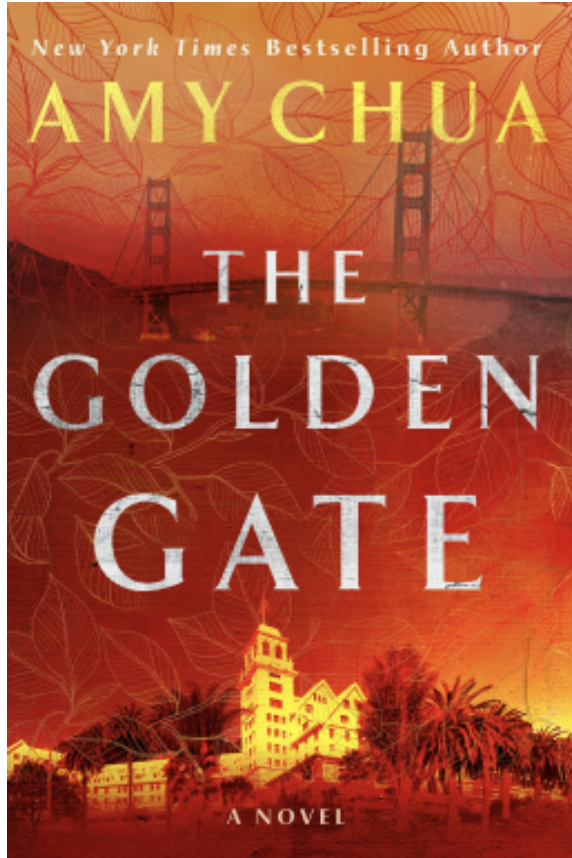
The Golden Gate by Amy Chua (Historical Mystery)

Writing: 4/5 Plot: 4.5/5 Characters: 5/5

An extremely convoluted ( in a delightful way) murder mystery set against an intricately detailed history of the San Francisco Bay Area in the 1930s and 40s. Walker Wilkinson — a rich industrialist and possible presidential candidate — is shot in his room at the Claremont Hotel in Berkeley. Mixed race Detective Al Sullivan lands the case which offers him suspects and witnesses that range from the very rich to the poor and dispossessed — from political figures to steel workers to Chinese / Black / Mexican / Japanese workers. Chua — an historian, this is her first novel — weaves in famous figures such as Madame Chiang Kai Shek, Julia Morgan, Dr. Margaret Chung, and August Vollmer with perfect integrity and context. Background history is delivered in a more or less integrated way ranging from laws and policies to the history of crime labs, the threat of Communism, the opening of the Golden Gate Bridge, the Kaiser shipyards (before it was just a medical plan!), and even the geology of the state. I was aware of some of the historical references — e.g. the Chinese Exclusion Act — but not some of the others such as the Mexican Expulsion of 1931 and the Mann Act (aka the White Slaves act) which was often used against those in interracial marriages. Chua’s non-fiction books focus on “the disparate impact of capitalism on different ethnic and immigrant groups” and that theme is front and center of this well-written and engaging historical mystery.

Some random quotes:
“In California, we have county coroners, and they’re elected, which is not exactly a recipe for competence.“

“That depends on your view of relevance. Yours, Mr. Doogan, appears to be quite cramped.”

“You can’t trust newspapers, but there’s one subject they’re good at — hate. First they whip it up, then they report on it.“

“There’s a suspicion line in every society, Miriam, and you’re either above it or below it. The people above that line, they never even think about it. They walk the streets like they own them. They take for granted that the law is there to protect them because it is.”

Emily Dickinson, but quoted in the book and I love it: “To live is so startling it leaves little time for anything else.”

Thank you to Minotaur Books and NetGalley for providing an advance copy of this book in exchange for my honest review. The book was published on September 19th, 2023

The Swish of the Curtain by Pamela Brown

The last of the three!

I received a complimentary copy of this book from Pushkin Press through NetGalley. Opinions expressed in this review are completely my own. The book will be published on March 12, 2019

An utterly delightful re-publication of a classic children’s series from the 1940s. I’m both embarrassed that I never knew this series existed and happy that I get to discover it now. Originally published in 1941, the author began work on it in 1938 when she was 14 years old — helping to explain why the children all feel so authentic. Maggie Smith says, “I wanted to act before I read this book, and afterwards there was no stopping me.”

This story follows seven children from three families in the town of Fenchester (based on Colchester in the UK) as they found the Blue Door Theater company and forge a future in the dramatic arts. Nigel (15) wants to be a commercial artist and designs and builds all the sets; Vicky (13) is a dancer; Bulldog (13) is a comic and a builder (he does the electric work himself and designs a mechanism to make the curtains “swish”); Jeremy (14) composes music and plays the violin; Lynette (13) is the consummate actress of the group; Sandra (14) sings beautifully and designs and makes all the costumes; and Madeleine (9) acts and works as the group promoter!

What I love about the story is the detail about every aspect of the theater — from converting an abandoned church into an actual theater to writing the pieces to performing them. The children do everything themselves — they create the costumes, they build the sets from abandoned materials, they write the plays and the music and act in them. They learn new skills and use them to create something where nothing had been before. They even make use of one of their mother’s “hair” — the ringlets she cut off and saved ages ago. They also make mistakes and while the story in the book does not revolve around these mistakes, they do lend an air of credibility to the story. Not everything goes perfectly all of the time! I also learned a lot about life in Britain in the 40s: an introduction provides currency translations (12 pence to the shilling; 20 shillings to the pound; 21 shillings to a guinea) and distinct art forms like the English pantomime are introduced. Each performance they give is described in great detail as well — the music, the drama, and the comedy.

This is the first volume of five and I’m happy to find that the publisher intends to release them all. Great for fans of Noel Streitfeld.

The Orphan Band of Springdale by Anne Nesbet

Writing: 5 Characters: 5 Plot: 4
Children’s fiction — middle grade

New (to me) word: hibernaculum — a place in which a creature seeks refuge, such as a bear using a cave to overwinter.

I loved this book — a perfect middle school read!

Gusta Newbronner “loses” her father on the bus ride from NYC to Northern Maine. She will be staying with the grandmother she has never met and living in Grandma Hoopes’ orphan home. The time is 1941 and there is general tension around foreigners. The tension is even higher around Gusta’s father who is not only a foreigner, but a union organizer as well. While Gusta sees her father as brave, courageous, principled, and fighting injustice, others see him simply as a foreign fugitive.

The story is full of real and (to me) lovable characters — her grandmother and aunt, the various children staying in the orphan home, new found cousins, and even the two children who represent opposing sides in “the Dairy Wars” in her classroom. Originally shy and unassuming, Gusta comes into her own as she learns to stand up for what she believes in and to fight injustice in whatever way she can. In the meantime she is making friends, getting to know her family and joining the Honorary Orphan Band (playing the French Horn — she appears to be a bit of a prodigy).

The writing is excellent. In addition to delightful language (see examples below), we are treated to intriguing descriptions of the process of egg cleaning (far more unpleasant than I would have ever guessed), the thrill of playing the French Horn, oculism in the 40s, pigeon photography (as in they are trained to take the photos), and magical stories from Gusta’s great-grandfather, the sea captain. I absolutely loved the description of what it was like for Gusta to see clearly for the first time when she was able to get glasses. Masterfully done.

The novel has that genuine feel of a true story — unsurprising as it is a fictionalized account of the author’s mother’s life, supported with extensive research using the local paper archives. I would add this to any middle grade reading list.

Some of my favorite lines…

“The winter must have been picking at the scabs of that road for months.”

“Gusta’s mother was omnivorous when it came to words”

“For a moment, Gusta stood there, just saving the feeling of having someone in the world who was already glad today about seeing her tomorrow.”

“And the heaviness inside Gusta, where all the secrets festered, thickened and increased.”

“She knew from stories that wishes wriggle and cheat — if they even exist at all.”

“It was like she coated all her meanness with a hard-sugar layer of wholehearted sincerity.”

“Georges made the happy sound of someone who has just become a part of the great unfolding history of pigeon photography.”