
Last House by Jessica Shattuck (Literary Fiction)

Writing: 5/5 Plot: 5/5 Characters: 5/5

This is a brilliant epic of a book. It spans a period of 90 years (~1950 to 2040) via the trajectories of a single family — each member ensconced in his or her own cultural context while engaging with the others who are firmly planted in their own contemporaneous but often dissonant contexts. The story begins with Nick and Bet Taylor — he a junior lawyer attached to an American oil team negotiating deals in the Middle East and she a WWII cryptographer who gave up her dreams of a PhD to become a wife and mother (as women did in the 50s). From this stability and cultural conformity came two children — Katherine and Harry — who grow up in a clash between the middle class values of their parents and the anger and rhetoric of the 60s, complete with Marxist hyperbole and anger-fueled violence in the name of peace and justice. Decades later, by the time the third generation comes of age, their social cohort is beset by the overwhelming angst from the imminent collapse of society from climate change, war, and shifting values.

What impresses me about this book is how well Shattuck captures the feelings of the time(s) from so many different perspectives. Anger, fear, bewilderment, passion. Sometimes it was hard to read because she captured it so well; other times it was chilling to read because the activism of the 60s (the good, the bad, and the ugly) is blatantly mirrored in what is happening today. She must have finished writing this book before the Israel / Hamas war began and yet she captured the mix of intentions, propaganda and stupidity of the current situation perfectly.

I loved that the multiple viewpoints were captured via highly reflective characters — their feelings of joy, frustration, rage, and angst appearing in response to a rapidly shifting cultural landscape. I love that they pondered, each in his or her own way, the responsibilities that are incurred simply by being alive. The pages are full of insight with regard to parenting, political attitudes, alliances, friendship, and familial support.

I was (pleasantly) surprised by the lack of cliche and manipulation in the narrative. If the author has a strong opinion on climate change, greed, politics, democracy, or activism, I couldn’t tell you what it was. She covered several competing thoughts on how a person chooses to live in the world as it is. One of my favorite parts (towards the end) was a 2-3 page summary of an optimistic and pessimistic view of the same world. Perfectly crystalized (IMHO) into personal attitudes and interpretations. This book could have been depressing but came off to me as more wistful — the wistfulness that always accompanies the passage of time, regardless of how sweet that passing is.

Some good quotes:

“That’s what civilization is,” Brent said. “Living with people outside your tribe. All those rules and norms and structures that allow you to coexist. Right? Without those, we’re just – cave dwellers, protecting our own turf. You escape civilization, you escape back into your tribe. “

“The Weather Underground had gone off the deep end. They had aligned themselves with history’s most violent killers, people who thought the righteousness of their cause gave them the right to make decisions about life and death: Hitler, Stalin, Charles Manson. In the name of justice, how could you choose that?”

“Still, Katherine‘s knee jerk cynicism, annoyed him. She had never even been to the Middle East. She knew nothing about Iran. She knew nothing about the oil industry or the complicated politics of resource distribution. She had never even taken an economics class. She did not grasp that she was on the top floor of a great complicated structure with her lofty ideals while he was in the basement, stoking the boiler, making sure she would not freeze to death. Her generation took so much for granted! All the peace and plenty they had grown up with wasn’t given — it was protected by a sheath of young men’s bones strewn across Europe and the Pacific“

“How will it work when everyone is exactly equal?” my mother wanted to know. “Is there enough, really, to go around?” I was appalled by this sentiment, so chauvinist, racist, survivalist. I railed at her about the capitalist racket, the smallness of her Depression-era mindset (“But I don’t have a mindset,” she protested. “I have questions”). She was a good sport about it, really, mild-mannered in the face of my patronizing. But she persisted: Wouldn’t there always be some way people sorted themselves? If it wasn’t race or gender or class, would it be intelligence? Physical strength? Blood type? Weren’t there always bound to be haves and have-nots on account of finite resources? The constraints of weather and geography, for instance? Who got the high ground with fertile soil versus who got the desert?”

“My father wanted calm and safety, not emotion. Everything in their life was set. That was her generation, I guess. Their households clean, tidy, and immobile, built to last. So, too, was their concept of the relationships of the people who populated it: mother, daughter, neighbor, housecleaner — these were static entities. I can see now that for my father, this was vital, the best protection he knew against all that was ugly, tangled, and difficult. My mother, though, longed for something different. She was forty-seven years old, and she’d been living the same life since she was twenty-three.”

“Conflict avoidance is a luxury of the bourgeoisie,” I said as if this were a well-known quote. Maybe it was. My head was awash in edict and directives and liberal platitudes.

“The idea disturbed him. They were raising a daughter who felt free to be unpleasant when she was unhappy? He would have been caned by his father if he’d ever been ‘unpleasant.’ ”

Thank you to William Morrow and NetGalley for providing an advance copy of this book in exchange for my honest review. The book will be published on May 14th, 2024.
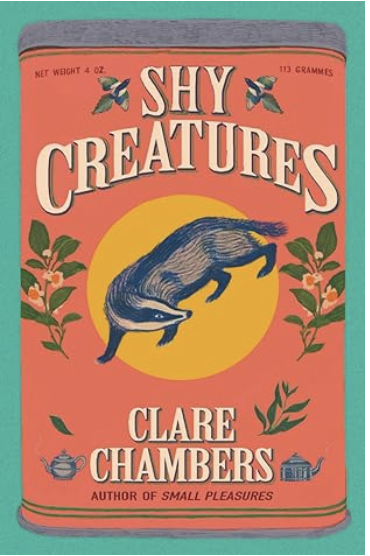
Shy Creatures by Clare Chambers

Writing: 4/5 Characters: 5/5 Plot: 3.5/5

1964. When William — a mute and (very) shaggy man — is found in decrepit conditions in a London suburb, he is taken to a psychiatric clinic for evaluation.  He apparently had not left the house for over ten years.  When William turns out to have a real artistic talent, Helen, the clinic art therapist, feels drawn to the “Hidden Man” and makes him into a special project.  The narrative branches off in two directions.  The first follows Helen as she tries to unravel the mystery of the Hidden Man’s origins while also coming to terms with her increasingly disastrous relationship with the appealing, but definitely married, psychiatrist treating William.  Alternating sections follow William’s story backwards through time — eventually providing the answers in events taking place in 1938.

The story was compelling, and I liked the backwards progression through William’s life slowly explaining how he developed into the man he became.  All of the characters were deftly drawn, and I enjoyed the reflection and details that helped me understand (though not necessarily empathize with!) their various personalities.  I found the psychological tools and thinking of the era fascinating and wished there had been slightly more of that and less day-to-day descriptions.  I found the book a little long winded, but with a little judicious skimming (sorry!) I enjoyed it from beginning to end and appreciated the relatively upbeat ending (will say no more about this!)

I found the writing at the sentence level to be excellent.  Here are a few quotes:

“Helen started to feel the intestinal cramping and queasiness that often accompanied the contemplation of her moral failings.”

“As usual, thoughts of her mother prompted a wave of guilt, swiftly followed by a cancelling backwash of resentment.”

 “The fact that his ire was aimed not at them, but at some nearby object that confounded him didn’t make it any easier to ignore; for quiet people, raised voices are experienced as a kind of aggression even when directed elsewhere.”

Thank you toMariner Books and NetGalley for providing an advance copy of this book in exchange for my honest review.The book will be published on November 12th, 2024.

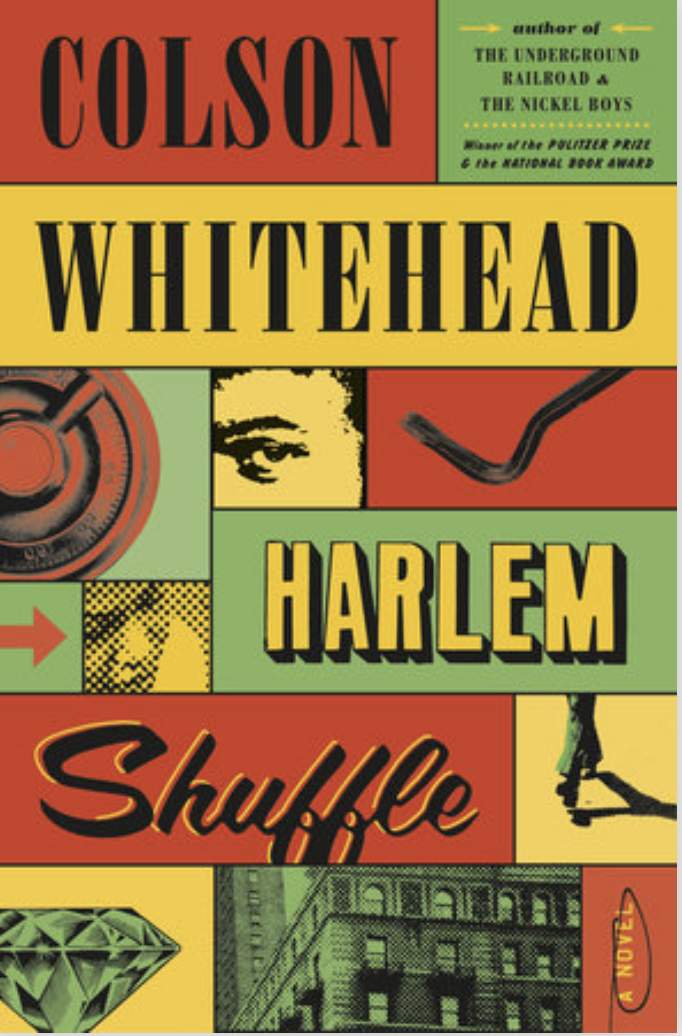
Harlem Shuffle by Colson Whitehead (Literary Fiction)

Writing: 5.5/5 Characters: 5/5 Plot: 4.5/5 (for me)

Colson Whitehead is a master of bringing a place and time to life. Harlem in the 60s — this is the story of a man who came from nothing and relentlessly made something of himself. But it’s not the typical rags to riches story with people “managing” to do this and that. This includes all the details of just what he had to do to make it in the world as it was — the pay offs (to gangsters and the police), the loyalties and trust, the “deals” made, the heists, and the constant jockeying for power, influence, and importance by the big shots while everyone else struggles to get by.

Carney is “only slightly bent when it came to being crooked”. He has principles but suspends them as necessary with full awareness. He runs a furniture store with a secret side line in low level fencing of stolen goods. He primarily manages to stay out of trouble except when his cousin Freddie pops up (Freddie’s most constant refrain — “I didn’t mean to get you in trouble”).

Fantastic scenes in Harlem — The Theresa Hotel, known as the “Waldorf of Harlem,” Striver’s Row for the African-American elite, Black Star Travel agency to help black travelers at the time make their way through parts of the US without getting lynched. Some vivid scenes from the 1964 Harlem riots, resulting from the shooting of an unarmed black teenager by a white policeman. All narrated by Carney with his somewhat cynical (and pretty realistic) worldview.

Whitehead is a fantastic writer — this had a little more focus on unsavory elements for my taste but it was very hard to put down.

A few quotes (out of many):

“Carney took the previous tenants’ busted schemes and failed dreams as a kind of fertilizer that helped his own ambitions prosper, the same way a fallen oak in its decomposition nourishes the acorn.”

“There was a hole in the air where the Ninth Avenue el used to run. That disappeared thing.”

“He reconsidered: The consequences remained, but the reasons had turned spectral, insubstantial. Harlem had rioted — for what? The boy was still dead, the grand jury cleared Lieutenant Gilligan, and black boys and girls continued to fall before the nightsticks and pistols of racist white cops. Freddie and Linus were gone, their heist unwound as if it had never happened, and Van Wyck kept throwing up buildings.”

“Death took Freddie from Carney and mourning returned to him a visitation, an invisible companion who shadowed him everywhere, tugging at his sleeve and interrupting when he least expected: Remember what my smile looked like, Remember when, remember me. Its voice grew quiet and Carney didn’t hear it for a while and then it was loud again: Remember me, This is your job now, Remember me or no one else will.”

Thank you to Doubleday Books and NetGalley for providing an advance copy of this book in exchange for my honest review. The book will be published on Sept. 14, 2021.

The Dearly Beloved by Cara Wall (Historical Fiction)

A slow-paced, deeply interior book about love, marriage, and faith. It follows a linear progression through the lives of four individuals, two marriages, and a forty-year shared ministry.

The real center of the book is the place of God in people’s lives. Each character has his or her own relationship (or lack thereof) with God: Charles knows absolutely that there is a God and that he has a calling to the ministry; his wife Lily is equally certain that there is no God and has no affinity with the tasks expected of a minister’s wife, preferring an academic life. Nan is a minister’s daughter and has never questioned her faith; James is not religious and has doubts about God, but feels the ministry would be a good platform for his drive towards social justice.

As each character grows into his or her life and faces difficulties both large and small, God is at the center of many thoughts and actions and is present on most pages. This was surprisingly non-repetitious, and the arguments, discussions, reflections, and historical references were balanced and intriguing, even to someone like myself who has no interest in religion.

The characters are all very earnest — even in their doubt and questioning, there is no cynicism (or any humor which I’m now realizing is often predicated on cynicism). It was somewhat refreshing and made me realize how very cynical the world feels today and how it wasn’t always that way.

The prose is beautiful, though at times over wrought. It is a philosophical and reflective look at life and marriage and documents the details of a healthy approach to personal growth — listening, discussing, reflecting, and resolution.

I was initially quite put off by the number of references to God and faith — it really isn’t my thing — but I found myself quite taken by the four individuals and their personal quests for understanding and a fulfilling life. I learned quite a bit more than I expected.

Thank you to Simon & Schuster and NetGalley for providing an advance copy of this book in exchange for my honest review. The book will be published on August 13th, 2019.