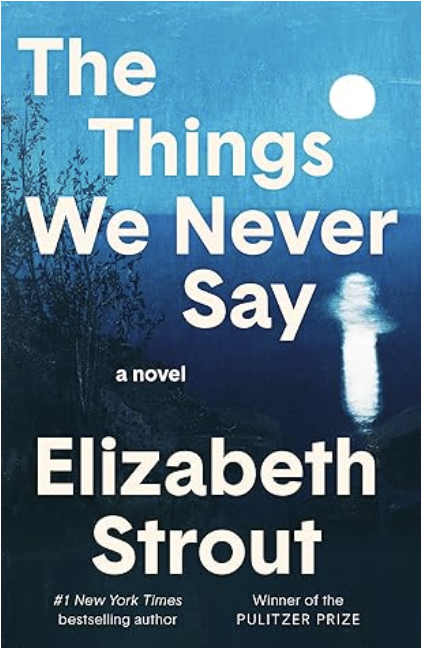
The Things We Never Say by Elizabeth Strout (Literary Fiction)

Writing: 5/5 Characters: 5/5 Plot: 4/5

I was instantly hooked by the epigraph: Loneliness does not come from having no people about one, but from being unable to communicate the things that seem important to oneself, or from holding certain views which others find inadmissible. — Carl Jung

This was the beautifully written, deeply reflective story of Artie Dam — a high school history teacher who spends time considering free will, loneliness, and whether or not anybody can really know anybody else. He watches his own mind a lot — I like that concept. He has been married 34 years, has a grown son who has become more distant, and a deep love for his students who he fears, based on the last election, he is sending out into an unsafe world.

I love the way the author (who is one of my favorites) paints a scene from multiple points of views. We spend a lot of time in Artie’s head, but we also get snapshots of what each of the people in his life think about him simultaneously and why. The elucidation of how we perceive the people around us, how they perceive us, and how we manage to make a connection to them despite this variance is brilliant. I also loved the fluid way Artie reflects on his life — memories precipitated by small events and interactions and the larger social shifting in reaction to the big events — Covid, the 2024 election, and the (ever changing) perceptions of right and wrong.

Political angst is a big piece of the context for Artie and several other key characters. Semi-oblique references to orange hair, cancelled government contracts, ICE “Nazis”, and general loathing for certain personages (you know who they are!) are tossed out without too much discussion. I found this interesting not because I agree or disagree with the view, but because of how having these feelings — justified or not — deeply impacted the characters. I appreciated that the author did include other characters — presented as reasonable and good people — who held either opposing views (they voted for Trump!) or who were simply content to wait and see what actually happened, rather than get too intensely worked up about it. What I loved about this book was that in spite of the angst — both internally and externally induced — the novel was primarily about personal insight and the way that we can have a positive impact on others and work to achieve the contentment and connection that we want. I found this book ultimately uplifting.

Quotes:
“She was unaware — even after their thirty-four years of married life — of the deep pockets of sensitivity that Artie had. And why did she not know? Because she herself did not have those particular sensitivities — and like almost everyone else on this Earth her imagination could not take her fully to another place, even with her husband.”

“So blind we humans are — so blind. To each other and to ourselves, moving through life as though through shadows, putting out a hand in the dark and thinking we have touched someone. And maybe we have, as Artie did with Rhonda Lazarre that day. But mostly we travel through life unsighted, grasping only the smallest details of one another’s selves, including our own. Thinking all the while that we can see.”

“And then she leaned her head against his shoulder, and this is what stabbed Artie now, their innocence, and how badly he wanted — as that elderly woman had — to lean his head against a loving person, to be innocent and incorruptible.”

“And now he knew why. Because to say anything real was to say things that nobody wanted to know. Or if they wanted to know, they would not care in the right way. Or even understand. It was a private thing, to be alive. He understood this now.”

“As he walked slowly up to the bedroom, he thought that now, after all these years, he was finally becoming a grownup. What did he mean by that? That he was finally beginning to understand the multitudinous aspect of people. He was amazed by it, really, now that he thought about it. In his study of history, he had learned about the leaders, and the various groups involved, but he had some how missed this fact about every single person: that they held within themselves a vast, unknowable universe. And he understood that it could make a person lonely; people had to take and give to one another whatever they could. If it was not enough … Well, then it meant one just had to be a grownup.”

Thank you to Random House and NetGalley for providing an advance copy of this book in exchange for my honest review. The book will be published on May 5th, 2026.

Last House by Jessica Shattuck (Literary Fiction)

Writing: 5/5 Plot: 5/5 Characters: 5/5

This is a brilliant epic of a book. It spans a period of 90 years (~1950 to 2040) via the trajectories of a single family — each member ensconced in his or her own cultural context while engaging with the others who are firmly planted in their own contemporaneous but often dissonant contexts. The story begins with Nick and Bet Taylor — he a junior lawyer attached to an American oil team negotiating deals in the Middle East and she a WWII cryptographer who gave up her dreams of a PhD to become a wife and mother (as women did in the 50s). From this stability and cultural conformity came two children — Katherine and Harry — who grow up in a clash between the middle class values of their parents and the anger and rhetoric of the 60s, complete with Marxist hyperbole and anger-fueled violence in the name of peace and justice. Decades later, by the time the third generation comes of age, their social cohort is beset by the overwhelming angst from the imminent collapse of society from climate change, war, and shifting values.

What impresses me about this book is how well Shattuck captures the feelings of the time(s) from so many different perspectives. Anger, fear, bewilderment, passion. Sometimes it was hard to read because she captured it so well; other times it was chilling to read because the activism of the 60s (the good, the bad, and the ugly) is blatantly mirrored in what is happening today. She must have finished writing this book before the Israel / Hamas war began and yet she captured the mix of intentions, propaganda and stupidity of the current situation perfectly.

I loved that the multiple viewpoints were captured via highly reflective characters — their feelings of joy, frustration, rage, and angst appearing in response to a rapidly shifting cultural landscape. I love that they pondered, each in his or her own way, the responsibilities that are incurred simply by being alive. The pages are full of insight with regard to parenting, political attitudes, alliances, friendship, and familial support.

I was (pleasantly) surprised by the lack of cliche and manipulation in the narrative. If the author has a strong opinion on climate change, greed, politics, democracy, or activism, I couldn’t tell you what it was. She covered several competing thoughts on how a person chooses to live in the world as it is. One of my favorite parts (towards the end) was a 2-3 page summary of an optimistic and pessimistic view of the same world. Perfectly crystalized (IMHO) into personal attitudes and interpretations. This book could have been depressing but came off to me as more wistful — the wistfulness that always accompanies the passage of time, regardless of how sweet that passing is.

Some good quotes:

“That’s what civilization is,” Brent said. “Living with people outside your tribe. All those rules and norms and structures that allow you to coexist. Right? Without those, we’re just – cave dwellers, protecting our own turf. You escape civilization, you escape back into your tribe. “

“The Weather Underground had gone off the deep end. They had aligned themselves with history’s most violent killers, people who thought the righteousness of their cause gave them the right to make decisions about life and death: Hitler, Stalin, Charles Manson. In the name of justice, how could you choose that?”

“Still, Katherine‘s knee jerk cynicism, annoyed him. She had never even been to the Middle East. She knew nothing about Iran. She knew nothing about the oil industry or the complicated politics of resource distribution. She had never even taken an economics class. She did not grasp that she was on the top floor of a great complicated structure with her lofty ideals while he was in the basement, stoking the boiler, making sure she would not freeze to death. Her generation took so much for granted! All the peace and plenty they had grown up with wasn’t given — it was protected by a sheath of young men’s bones strewn across Europe and the Pacific“

“How will it work when everyone is exactly equal?” my mother wanted to know. “Is there enough, really, to go around?” I was appalled by this sentiment, so chauvinist, racist, survivalist. I railed at her about the capitalist racket, the smallness of her Depression-era mindset (“But I don’t have a mindset,” she protested. “I have questions”). She was a good sport about it, really, mild-mannered in the face of my patronizing. But she persisted: Wouldn’t there always be some way people sorted themselves? If it wasn’t race or gender or class, would it be intelligence? Physical strength? Blood type? Weren’t there always bound to be haves and have-nots on account of finite resources? The constraints of weather and geography, for instance? Who got the high ground with fertile soil versus who got the desert?”

“My father wanted calm and safety, not emotion. Everything in their life was set. That was her generation, I guess. Their households clean, tidy, and immobile, built to last. So, too, was their concept of the relationships of the people who populated it: mother, daughter, neighbor, housecleaner — these were static entities. I can see now that for my father, this was vital, the best protection he knew against all that was ugly, tangled, and difficult. My mother, though, longed for something different. She was forty-seven years old, and she’d been living the same life since she was twenty-three.”

“Conflict avoidance is a luxury of the bourgeoisie,” I said as if this were a well-known quote. Maybe it was. My head was awash in edict and directives and liberal platitudes.

“The idea disturbed him. They were raising a daughter who felt free to be unpleasant when she was unhappy? He would have been caned by his father if he’d ever been ‘unpleasant.’ ”

Thank you to William Morrow and NetGalley for providing an advance copy of this book in exchange for my honest review. The book will be published on May 14th, 2024.

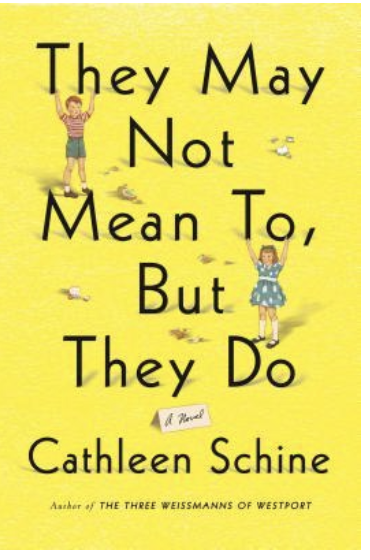
They May Not Mean To, But They Do by Cathleen Schine (Audio Book – Literary Fiction)

Writing: 5+/5 Story: 4.5/5 Characters: 5/5

I love Schine’s books. She is better able to get into the head of wildly different people than almost anyone I can think of. This book is a story about aging and the multiple familial pressures and experiences that are inextricably linked to the process. Joy is the octagenarian matriarch of a New York Jewish family whose husband is ever more rapidly sinking into dementia. When he dies about half way through the book, her children are anxious to solve her loneliness and despair but she is equally anxious to mourn in the way she chooses and to maintain her own life, rather than be absorbed into one of theirs (or, God forbid, be stuffed into an assisted living facility).

I loved so much about this book which was brought to life magnificently by the narrator who has the NY Jewish grandma voice down cold. The ongoing reflection about her own aging; her deep mourning for her far-less-than-perfect husband who she had nevertheless loved completely; her equally deep love for her children coupled with an outrageously growing irritation at their increasing need to boss her around and intrude on her own life plans; the search for belonging when a long term spouse dies — it’s all there and wrapped beautifully in the every day experiences of herself, her children, and her grandchildren. Joy has a wicked sense of humor, a realistic handle on what is happening, and an old flame perking up the picture, so this is by no means a depressing book. Just completely insightful. While the other characters — her two children, her daughter’s wife, all three grandchildren — were fleshed out fully, it was clearly Joy that I resonated with (despite her annoying lack of organizational skills and the fact that I am almost 30 years younger!)

I listened to this on audio so I don’t have captured quotes, but here are some of the concepts I just loved reading about: Joy thinks of her own mother and how she (Joy) could not understand her (the mother) the way she had needed to be understood when she (the mother) was aging. Joy begins to feel there is another person in the apartment and it was she. She had to constantly watch “it” to make sure it took its pills and didn’t fall etc. She doesn’t want to be a burden, but if she is one, she wishes others could carry her with more grace.

One more note — the title comes from the Philip Larkin poem “This Be The Verse.” It’s quite apt.