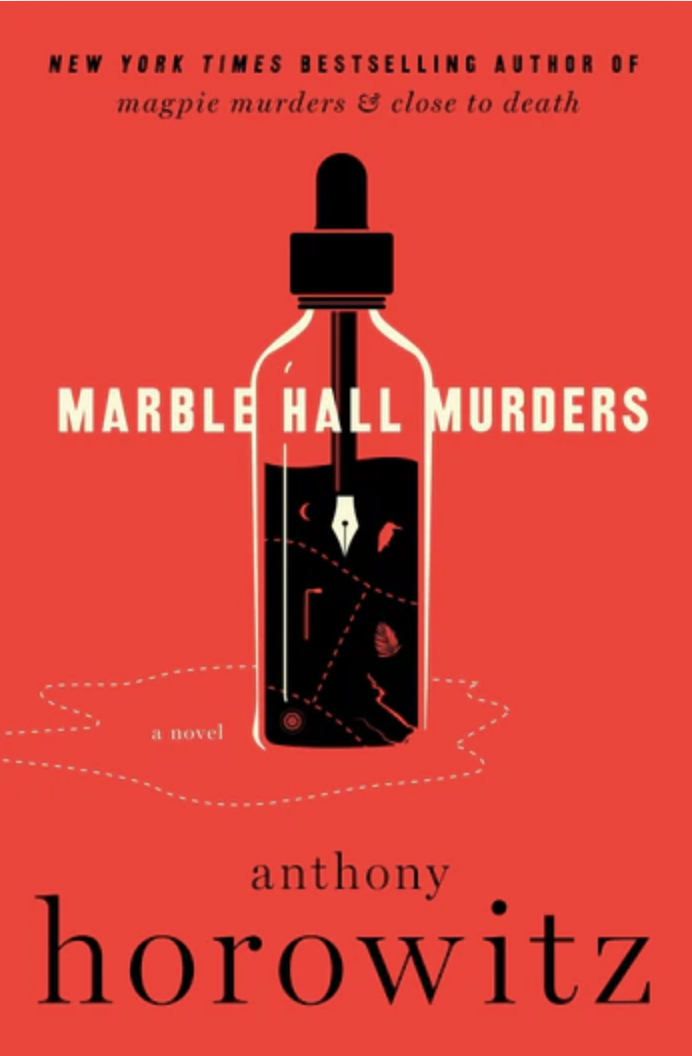
Marble Hall Murders by Anthony Horowitz (Mystery)

Number three in the Susan Ryeland series (after Magpie Murders and Moonflower Murders — both now streaming on Masterpiece). Susan was the editor of the fantastically successful Atticus Pünd detective series — from inception until disastrous events brought the series to an end. You’d think she would have had enough, but dire straights lead her to accept a job editing a continuation novel, written by Eliot Crace — a well-known loose cannon who is nevertheless blessed with a beloved children’s author as a (now deceased) grandmother.

It’s a classic story-within-a-story format — we’re reading the Crace novel as fast as he produces pages while simultaneously reading Ryeland’s story as she keeps sticking her nose into the author and the story, which continues to mirror reality to an uncomfortable extent. The two stories dovetail in weird and twisted ways and I never saw what was coming, though the clues were all there. I love Horowitz’s writing — clear and concise and bringing characters to life with minimal, essential, prose. The mystery (two in parallel really, one fictional and one not) is excellent on its own, but I also loved the meta layer exposure of the literary world — how writers write, the relationship between author and editor, and basic survival tips for the publishing industry. It’s full of anagrams, ethical discussions, and deliciously clever (albeit often evil) moves. I always appreciate a book that has no stupidity — intentional or not — in its pages!

Some facts new to me: According to the Authors, Licensing and Collecting society, the average salary earned by a novelist is a mere 7,000 pounds a year — not a lot (not even a little, really). There are around 200,000 books published in the UK every year ( and as many as 1 million in the USA) and as Horowitz writes: “How many of them do you really think are going to end up on the front table at Waterstones?.” Lastly, I had never heard of the Nazca lines in Peru — giant geoglyphs in a Peruvian desert dated between 500 BC and 500 AD that are so large they can be seen from space (for those who have read it, this reminded me of Vonnegut’s Sirens of Titan.

Easy read, completely engaging, and (IMHO) book clearly better than the Masterpiece series (which itself is very good, but the book is better)

Thank you to Harper and NetGalley for providing an advance copy of this book in exchange for my honest review. The book will be published on May 13th, 2025.

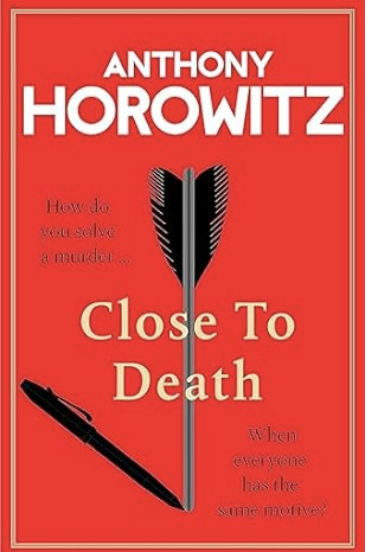
Close to Death by Anthony Horowitz (Mystery)

The fifth in The Hawthorne and Horowitz series (for newbies, the two main characters are the fictional Detective Hawthorne and the author himself. It can get kind of twisted in a brain that holds too firmly to reality). In this episode, Horowitz — under pressure from his agent to produce a fifth book when there are no fresh murders for the duo to solve — decides to write up an old Hawthorne case. He is warned by many — including Hawthorne — not to do it but naturally he does it anyway!

The case: The peace of an idyllic upscale gated community (a close — cul-de-sac to Americans) is shattered when a loud, obnoxious, and inconsiderate family moves into the largest lot. It doesn’t take long for the neighbors to get irate and only a little bit longer for the main irritant to show up with a crossbow bolt through his neck on his doorstep. Enter the curmudgeonly Hawthorne at the grudging request of the local police.

As always, Horowitz draws you in from the first paragraph, introducing each character in a way to arouse your curiosity, and then continually shedding layers until you think you see the truth behind the character. At least in my case, I never quite do figure it out even though Horowitz does not cheat, and all the clues are actually there. And who are these characters? A chess grandmaster, a compassionate dentist with a chronically ill wife, an NHS doctor who wishes he were still in London, two older women who share a house and a business (a cozy mystery shop), and a black barrister whose wife has passed away. The plot twists deliciously and the book itself alternates between the mystery and Anthony’s trouble getting enough information out of a reluctant Hawthorne to build on. And then there is Dudley — Hawthorne’s old “Watson” of whom he speaks positively (certainly in comparison to his thoughts on Horowitz as a replacement!) and yet whom he no longer sees…

Excellent fun.

Thank you to Harper and NetGalley for providing an advance copy of this audio book in exchange for my honest review. The book was published on April 16th, 2024.

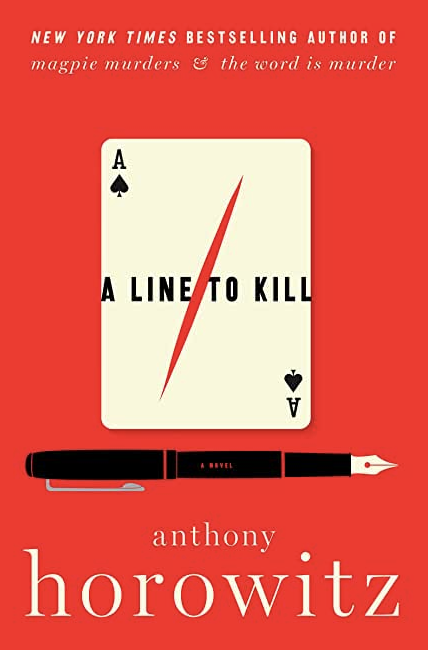
A Line to Kill by Anthony Horowitz (Mystery)

In this third episode of ex-detective Hawthorne and his amanuensis (non other than the author himself), the two have been invited to a (quite small) literary festival in Alderney, one of the Channel islands. There is a murder — Charles le Mesurier — a thoroughly unpleasant, wealthy man who made his fortune in online gambling sites. In an Agatha Christie style locked-room murder, the festival guests — a bestselling children’s author, a blind psychic, a French poet, and a TV chef — are prime suspects.

Unfortunately this was just so-so. Decently entertaining — Horowitz always writes well — but the gimmick of writing himself into the book as a sort of sniveling, bumbling, Watson to Hawthorne’s Holmes has gotten old and somewhat annoying. I’m a big fan of Horowitz’ work, and I believe I would enjoy meeting him in real life but not if he were the person depicted in these pages! Additionally, this is one of those books where the detective just “figures it out” at the end and we only sort of had the clues that might have helped. All in all, I read it quickly. It would make a good beach / plane read, but I’m not sure I’ll bother with the next one.

Moonflower Murders by Anthony Horowitz (Mystery)

Writing: 3/5 Plot: 4/5 Characters: 4/5

Ex-editor / publisher Susan Ryeland is living in a not-so-glorious involuntary retirement in Crete after the events of Horowitz’ Magpie Murders in which her primary author (Alan Conway) was murdered and her publishing company offices burned to the ground. Now she is approached by a pair of distraught parents who want to help find Cecily Treherne, their missing daughter. Why Susan? Because just before she went missing Cecily had called them to say that upon rereading Conway’s Atticus Pund Takes the Case, she realized that the wrong person had been jailed eight years ago for a murder taking place in the Treherne hotel. I love British murder mysteries but I am constantly amazed that anyone is left alive in the country!!

This is a murder mystery steeped in literary detection. Right in the middle of the novel we are treated to the entire text of Atticus Pünd Takes the Case to try to decipher what Cecily read. I didn’t figure it out and neither will you (let me know if I’m wrong — I’d love to hear!). The literary “clues” are deeply embedded in the book and we need the main character to unpack them for us. Luckily there are also a lot of un-literary clues that follow more traditional murder mystery lines.

Lots of fun to read, though I admit to having had a hard time keeping track of the initial characters once the book-within-a-book began (it is not short). Horowitz is an adaptable writer — he does a great job of writing in the style of another (his Sherlock Holmes stories are a case in point). The embedded Atticus Pünd book is in the style of Agatha Christie and Pünd himself is a thinly disguised Poirot (I literally just finished watching the entire David Suchet series so it was easy to spot).

Possibly a little long — especially the embedded book. I like the Horowitz style of writing better than the Agatha Christie-like writing so that also added to the feeling of wanting to get back to the main story a little faster. As always, though, the plot twists were just the right amount of convoluted and surprising. Worth reading.

Thank you to Harper Collins and NetGalley for providing an advance copy of this book in exchange for my honest review. The book will be published on November 10th, 2020.


The Sentence is Death by Anthony Horowitz (Mystery)

The second installment of Horowitz’ self-referential detective series starring himself as the semi-bumbling, self-deprecating sidekick to the enigmatic Detective Daniel Hawthorne. Horowitz writes fantastic mysteries — they are convoluted in the most delightful ways, are full of interesting characters, and progress at the perfect pace (also — I never do figure it out early!) One of the benefits of this particular series is also gaining some insight into other aspects of Horowitz’ writing life — the production issues for Foyles War, the interactions with agents and booksellers, and parts of the Writer’s Process (as experienced by Mr. Horowitz).

I don’t want to give away *anything* in the plot, but it covers a wide range of places, people, time, and professions — divorce lawyers, (very) expensive wine, literary snobs, interior decorators, spelunkers, forensic accountants, muscular dystrophy, and the NHS. Horowitz does an impressive job of applying diversity to characters with no regard to stereotypical expectations. I did find myself struggling to constantly sift out the fact from the fiction, which told me more about myself and my own neuroses than about the book — it doesn’t matter a bit! A fun read.

Great for fans of Robert Galbraith.

Thank you to Harper Collins and NetGalley for providing an advance copy of this book in exchange for my honest review. The book will be published on May 28th, 2019.

The Word is Murder by Anthony Horowitz

Writing: 3/5 Plot: 3/5 Characters

Disappointing! I loved Magpie Murders  and I love Horowitz’ TV work (Midsomer Murder, Foyle’s War) so I was looking forward to this book, which I picked up in London last year and finally got around to reading. But … it did not live up to my expectations.

Horowitz likes to experiment with writing style. In this book, he includes himself as a character who has been asked by real-life detective Daniel Hawthorne to follow him around and write a book about his cases — to be the Watson to his Holmes as it were.

The Horowitz character is annoyed that Hawthorne doesn’t give him any personal background or share his ongoing thoughts or inner procedures on the case (I bet Holmes frustrated Watson in the same way).

While I don’t mind this blurring of fact and fiction, I found the Horowitz character’s issues with his agent, his wife, and trying to out-think the detective (and getting it wrong) just a distraction from the actual murder mystery (that part was well done!). Instead of objectively following a detective and watching him work, we had a whiny author complaining about getting pulled out of an important meeting with Steven Spielberg and Peter Jackson in order to go see the body, or complaining that the detective wouldn’t open up so he had no background to write.

I’m not sure why it didn’t work for me — it was obviously supposed to be playful and funny — but I just found it tedious!