
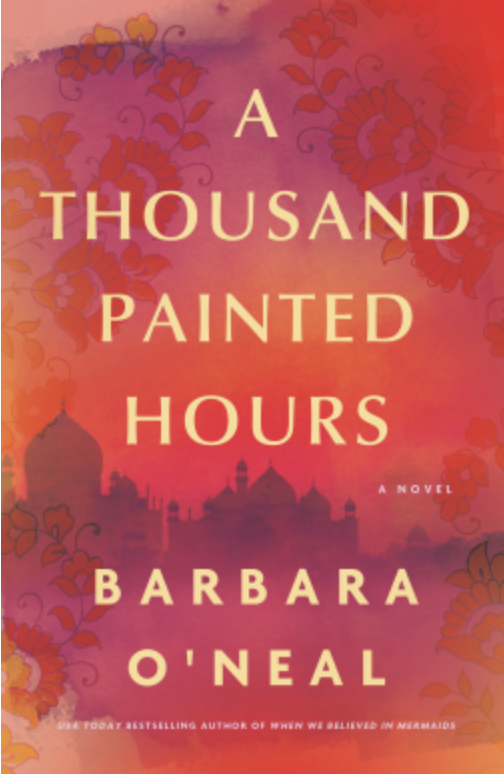
A Thousand Painted Hours by Barbara O’Neal (Historical Fiction)

Excellent historical fiction alternating between London in late 1940, during the Blitz, and the early 1900s in India and England. Elsie has been raised in India, her father in the British civil service. While there she forms a deep friendship with a Sikh prince with strong tendencies towards independence. When her father is called back to England, Elsie is reluctantly sent back as well.

This is a love story that stretches across time, space, class, and political trends, including the recognition of the treatment and consideration of women. It’s quite emotional and there are plenty of scenes I can only describe as “torrid” which is usually not my thing, but the writing was excellent, the situations were quite believable, and I never felt emotionally manipulated. Additionally, the various characters and depiction of life in those times and places were really good — colonial India, war torn England, Cairo after WWI, etc.) . Elsie is an artist struggling to make her way in a world where her responsibilities and the expectations of others don’t always allow her much autonomy. The descriptions of her artistic efforts were very engaging (that’s two books in a row about artistic types that have appealed to me, the unartistic type) and the detailed descriptions of the (completely appropriate to the ages) discussions and interests of the various characters (her Prince, his sister, her own mother, a Bohemian group she connects with, etc) is a marvel. I love the way that the letter exchanges between her and her Sikh Prince always contained “one small beauty” regardless of the deeply disturbing events they were going through.

It was a quick read — a little repetitive (for me) on the love story, but fully compelling from start to finish.

Thank you to Lake Union Publishing and NetGalley for providing an advance copy of this book in exchange for my honest review. The book will be published on August 11th, 2026.
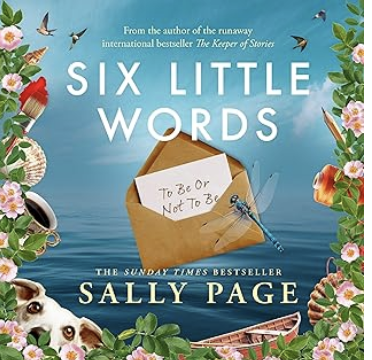
Six Little Words by Sally Page (Fiction — Audiobook)

Lighthearted and uplifting, this is a charming tale of a Norfolk (England) community group that comes together around an amateur competition designed to unlock a person’s creative spark. We alternate between the perspectives of Bardy, a retired English teacher suffering from writer’s block, and Kate, an equally frustrated once-painter, but the others in the group each have equally compelling narratives that slowly surface as the group coalesces into something much greater than originally intended.

This could have been simply another piece of uplifting women’s fiction (and nothing is wrong with that!), but I found a lot to love that went far beyond the expected bromides. Bardy experiences synesthesia and the description of how he saw people as intense and specific colors was fascinating. It was as though his subconscious experiences of people manifested as actual visual portrayals. I also found all the discussions about art — making it, recognizing it, expressing oneself through it (without considering external judgement) incredibly insightful and engaging — even though I have no artistic capabilities or experiences trying to produce it. The array of artistic endeavor was both amusing and absorbing — from oils to poetry to photography to fashion designs (on dogs!) to musical theatre. I was particularly interested in the way that any artistic expression is a window into someone — their interests, the way they see things, the way their brain works — I’m always curious about people and very aware of how differently people “work” from each other. I hadn’t really thought about artistic expression as a channel in that. I liked the reminder also that artistic expression is for the artist, regardless of the opinions and valuations of others. With so much commentary and criticism on all sides, it’s sometimes difficult to remember that you paint or play piano or pretend to take on acting roles because it’s fun and internally satisfying, not because you need the approval from others (unless you’re trying to make a living that way, of course!).

The book had a nice happy ending — full of (realistically IMHO) resolved situations with personal growth required for decent closure. The “Six Little Words” inspiring the title are exposed near the end — and they are perfect! Great for fans of Joanna Trollope. Thoroughly enjoyed it.

The Party Upstairs by Lee Conell (literary fiction)

Thank you to Penguin Press and NetGalley for providing an advance copy of this book in exchange for my honest review. The book will be published on July 7th, 2020.

Plot: 4/5 Characters: 4/5 Writing: 4/5

A single day in an Upper West Side apartment building in New York City: we tag along inside the heads of a father and daughter. Martin is the long time super for the building, snagging the free apartment in the basement as part of his salary. Martin has internalized the building — the tenants, the systems, the various immigrants that continually circle around building infrastructure to keep it all running. Ruby is his daughter — recent Art History graduate plunged into a jobless recession and back living in the basement with her parents. As they churn through a disastrous day amidst plenty of existential angst, they are prodded along by two wildly different characters: Caroline lives in the building’s penthouse and has been Ruby’s friend since childhood; Lily is the now deceased, rent-control, neighbor who serves as a kind of Marxist Greek chorus narrating Martin’s every movement in his head. These narrations are priceless.

As a novel, I very much enjoyed this book about relationships across socioeconomic divides. Clear, insightful writing that absolutely captures the “voice” of the two main characters. Plenty of morally ambiguous action where judgement is left to the reader. On the other hand, the “wealthy” tenants were not painted with much sympathy. While we care about Martin and Ruby and understand (though possibly disagree with) their actions, the tenants are all depicted as hypocrites, rationalizers, or virtue signalers (except for Lily — the last representative of pre-gentrification!). In this book, there is no way for these wealthy tenants to behave that would earn them any appreciation from the “oppressed.” There is no way for them to be sympathetic or “good.” As a description of the way Martin and Ruby saw those people, I can’t argue with the narrative, but I don’t believe all New Yorkers are easily divided into just two categories: rich or exploited.

However — a fun read with plenty of good quotes (see below) and some great descriptions of specific aspects of individual jobs and the way a building works! I’m very interested in reading her previously published “Subcortical” which sounds like it might be right up my alley.

Some fun quotes:
“ ‘It’s not Ruby’s fault the fever dream of free-market capitalism has corrupted the realm of higher education.’ Lily had always tried to cheer Martin up by blaming his parental angst on the free market.”

“He’s got the Manifest Destiny glaze in his eyes.”

“The culture of grievances in this country is an unseemly stain, spreading fast! Wherever you come from, rich or poor, there is suffering. The problem is the way we quantify that suffering, revel in suffering — tired of those pesky self-pity streaks? Try growing a pair.”

“… in a real utopia the super wouldn’t exploit the voice of the dead to think the thoughts that he can’t let himself think on his own because his own voice is too quiet, too soft, too accommodating, he’s so good-natured they all think, not knowing that he’s only that way because if he acted out, if he shouted at Caroline over her little sporks, it would only confirm what they hoped was most true in him, he was a beast, he deserved his position in this world, he deserved to be exploited, I mean, that temper they would say, no wonder he’s …”

“The collar of the shirt under his gray cardigan was half down, half up, which gave him the sartorial look of a friendly dog unable to coordinate the orientation of its ears.”

“The city just operated this way sometimes; you could have a day fueled by coincidences that lined up wearing the mask of fate, trying to fool you into thinking there was some secret order to your life.”


The Clockmaker’s Daughter by Kate Morton

Writing: 3.5 Plot: 3.5 Characters: 4

Richly detailed historical fiction with a convoluted plot pulled from a set of narratives scattered across time but centered on place: Birchwood Manor — a 400 year old house immersed in myth and mystery. Murder, mayhem, stolen heirlooms, and old artifacts form the center of the story, but they exist in a sea of love, loss, and a range of historical settings including Queen Elizabeth and the Catholic persecution of 1586, the (fictional) Magenta Brotherhood artist group of the mid 1800s, the establishment of a school for young women in the late 1800s, London and environs in WWII, and modern day archival work. It’s engrossing but complicated — I found that documenting a timeline as I read was extremely helpful.

The writing is good but a little long winded for my taste. On the other hand, if you love historical dramas you may enjoy the longer opportunity to immerse yourself in the 500 pages of intriguing characters and historically accurate details. Did I mention that one of the narrators is clearly a (compelling) spirit that has been bound to the house for over a century?