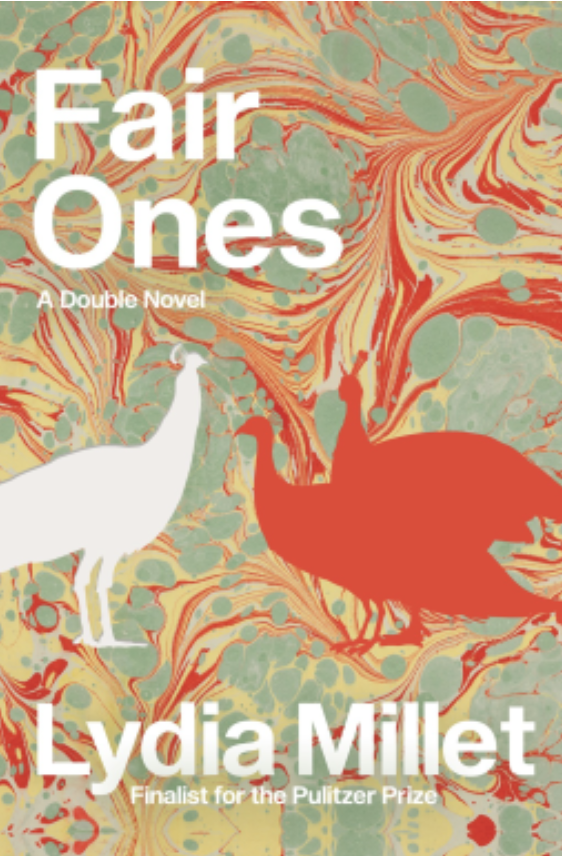
Fair Ones by Lydia Millet (Literary Fiction)

A slow paced (but exquisitely written and perversely engaging) novel rich in insightful discourse and doubly rich in character depth. At the core is a trio of best friends: Mara, Jen, and Claire — single New Yorkers operating at various edges of the wealthy. Claire — a high school guidance counselor and beauty queen; Mara a tutor for prep school students; and Jen the brainy former journalist and culture editor. It’s billed as a double novel — part one is Mara’s story, launched immediately after Claire’s sudden and violent death; part two is Jen’s story, taken up a year later and continuing with the evolving relationships, secrets, and healing.

I loved this book for the very real and thoroughly explored lives in relation to the catastrophic experience and the mad swirl of collateral damage resulting. New friendships, new discoveries, new reactions, new regrets, new hopes. The plot progresses, sometimes in very surprising (but utterly believable) ways. Social commentary throughout in characters’ thoughts, reactions, and evolving sense of self. Plenty of existential considerations as well as political discussions and a sense of societal duty (rather than entitlement). I found so many great quotes. I liked the fact that each character worked hard at understanding what made a “good person” and how they could best achieve that label, while also having the awareness of the layers of hypocrisy that lurk just below the surface. I also liked how well the author painted people from the different perspectives of the other characters through the kind of dialog / discussions we all have.

Quintessentially a New York story, and yet, typical for stories about New Yorkers, the characters are all NY transplants and so we travel from a Jain community in California, to the woods in Maine, to elite boarding schools, to high priced, drug infused Wall Street lofts in discovery of backstories. We consider white collar crime, dementia without financial resources, and the search for meaningful occupation. And we are surprised with a creeping, surreptitious solution to a mystery we didn’t know existed. We “join” in the discussion of a wide variety of topics from multiple perspectives on everything from climate change to the pros and cons of capitalism, to the real meaning of Shel Silverstein’s The Giving Tree (that was a hoot). Millet’s books have a kind of dream like quality for me because I feel like I am occupying so many different heads at once. I loved this book.

Quotes:
“We had our daily routines, inside millions of others, and along the edges of those routines there was always the prospect of the story taking new turns. Because the city contained multitudes. So if the story changed, we’d figured, maybe we’d be excited all over again. Even the pandemic hadn’t driven us away. We’d survived.”

“In more neutral terms, she explained, they were both aware that pleasure and so-called ‘being in love’ are based on neurological novelty. And that the brain can’t be trusted not to take a relationship for granted. If they hung out together for too long a stretch, the dopamine surges would flare out.”

“If I tried to join in, throwing out a quick word of agreement or question, they’d gaze at me anthropologically. Like they were tolerating my naive opinion the way you’d tolerate a well-meaning foreigner who doesn’t speak the language.”

“Still, if you took away words, music lasted for centuries, I thought. A distillation of sadness that never aged. Unlike the person who’d felt it.”

“‘Economically underprivileged,’ was what the school called them, but Claire said poor kids; economically underprivileged was a privileged euphemism.”

“Although, she’d added, they outsourced their misery. Norway, for instance, claimed to be leading on carbon-neutrality but got most of its money from exporting a s***load of fossil fuels. Plus they went around slaughtering whales. Like the Japanese.”

“I never wanted kids. Even back when being gay meant you probably couldn’t have them. For the middle and upper classes, it’s a way of replacing anxiety about society with a fixation on the domestic. So you don’t have to strain your compassion by worrying about anything beyond the home front. Because you’ve already met your daily quota struggling to raise your young You can give up your ideals and your unresolved tension over the existential crisis of the ongoing death of the planet. And be praised for it. Since breeding’s sanctioned as the highest form of love.”

“There’s no such thing as a gift horse, Mara. Richard’s a regular horse. And the deal with horses is, you have to take care of them. You have to feed them. Muck out their stalls, Clean the first and shit from their hooves with a rasp. And ride them on a regular basis.”

“I don’t have a heart at peace, with my ex-wife. With that woman, I have a heart at war.”

“Plus Richard bloviated more if another professional was present. Especially Eli, who he saw as highly intelligent and yet, as a forensic pathologist, not fully conversant with current readings of late-stage capitalism. Richard would shift into enthusiastic lecture mode while Eli, likely exhausted from eight hours poking around in gnarly corpses, nodded politely and endured. I had to break into the lectures to save him.”

“So what did I do, again? With all that was given to me? And the answer would be, I ate. Mara claims social boredom makes me act out. But I don’t act out enough. If I did, I wouldn’t get so bored.”

Thank you to W. W. Norton & Company and NetGalley for providing an advance copy of this book in exchange for my honest review. The book will be published on October 6th, 2026.

Trust by Hernan Diaz (Pulitzer Prize for Fiction 2023)

I did not love this book. It won the Pulitzer — which used to be a guaranteed winner for my taste but that hasn’t been true for the last few years. Much of it was well-written in terms of actual literary sentences, but I found the structure unnecessarily tedious. Four distinct sections — each written by a different (fictional) author but purporting to describe the life of the same (very, very) wealthy man and his wife during the late 1800s / early 1900s. Part 1: a novel about a rich man who had no real passions except for the complexity of the stock market, for which his particular brain was well-suited. Some background on the woman who was to be his wife, completing after her death. I’m trying not to give away any real spoilers here — suffice it to say that the language of this section is precise, clean, somewhat poetic, and with some intriguing bits (I like thinking about how other people’s brains work), but with rather two-dimensional characters that I don’t find in the least believable or (obviously) relatable. Part 2 is the partially completed, partially outlined autobiography written by the “real” man serving as the ill-disguised subject of part 1. This was painful to read because it was (intentionally) poorly written and was basically a diatribe claiming that the man attained his riches by ensuring a good and healthy economy for all. We’re now at 50% of the book and feeling a bit weighed down by slog! Part 3 is the best. Reminiscent in style (to me) of A Tree Grows in Brooklyn — it’s the story of a young woman raised by an anarchist father who somehow gets the job of helping the rich man write his autobiography. This part is full of insight into behavior, relationships, imagination, self-preservation, and literature. Part 4 is the short excerpt from the only one of the rich man’s wife’s extensive diaries to have survived. It’s got a real twist to it and I’ll leave it at that.

It’s interesting to read about how different people perceive the same thing, and it’s always interesting to think about how literature can shape the way we think about something, even though it’s “fiction.” It was also interesting to think about why I “trusted” certain sections more than others. In truth, all of the fictional authors were unreliable — an outside author trying to make money on a best seller; a man trying to show how attaining his wealth was really about helping others; a woman writing her own memoir painting her task to embellish the biography with pure imagination in the best light; and the diary excerpt of a woman who may have been mentally ill, may have been suffering from a variety of physical ailments, or may just be an egoist in her own right — and yet we automatically believe some more than others. Is our choice of what to believe from our own biases or from the skill of the writer? That’s worth a discussion — but as the “truth” is never determined, we’re left with the same kind of confusion we (should) bring to any story, news item, piece of gossip, etc.

I think if part 2 had been left out, or at least greatly diminished, it might have been an enjoyable read, but not Pulitzer worthy. On the other hand, the latest Pulitzer Fiction award was given to a book that comprises a single sentence across 304 pages so I think experimental style may have surpassed character development and beautiful language as the key criterion. Also, some kind of social justice / anti-capitalism push as the Pulitzer page describes this book as a “A riveting novel set in a bygone America that explores family, wealth and ambition through linked narratives rendered in different literary styles, a complex examination of love and power in a country where capitalism is king.” Honestly not how I would have described it.

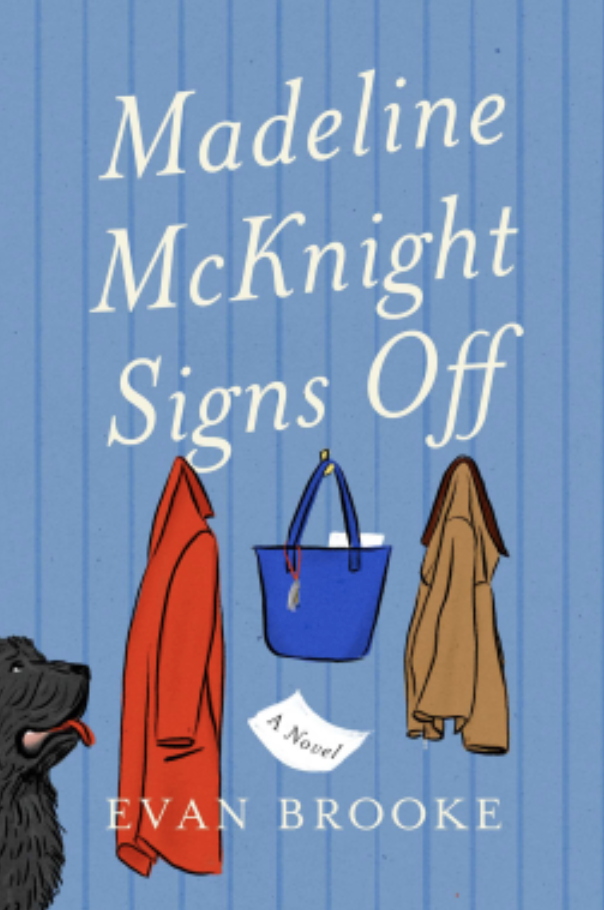
Madeline McKnight Signs Off by Evan Brooke (Literary Fiction)

Madeline McKnight — fierce, determined, a “Wizard of Wall Street”, and … not possessed of too many friends. Fighting against the inevitable resulting from a stage 4 melanoma diagnosis, she is determined to survive it until her museum honoring Hetty Green (1834 – 1916) is opened. She wants people to care about Hetty, and to recognize her brilliance. She sees herself — her accomplishments and her lack of recognition — in Hetty. Hetty was called “the Witch of Wall Street” in her time — Madeline’s epithet rhymes and starts with B. She invites (cajoles, bribes) Bri Davis — struggling nursing student drowning in debt and easily bribable — to help her get to the finish line. The catch? Bri’s mother was Madeline’s best friend until an emotional explosion drove them apart many years ago. Bri’s attitude toward Madeline is ambivalent at best.

Alternating chapters between Madeleine and Bri’s perspectives, the narrative is surprisingly witty, thoughtful, and illuminating. While I shed some tears when the obvious finally occurred, I left feeling more uplifted than down. Excellent writing — clear, humorous at times, and perfectly capturing the internal struggles one faces when considering the parts of one’s life already lived. Themes around money and wealth, atonement, loyalty conflicting with morality, and plenty of thoughtful coverage of how women are treated differently than men — not the heavy handed oppression storyline, but the small ways in which things are harder or more criticized or misunderstood or subject to some doozies of double standards. The latter was particularly interesting because Madeline was forced to acknowledge the complexity of individual human beings. She wanted to make Hetty an unsung hero but the reality of Hetty — known as the “richest woman in America in the Gilded Age” — was more complex. She was a self-made woman with astonishing financial prowess, yet she did nothing to help others, not even supporting women’s suffrage. This led to Madeline’s own soul searching and the recognition and acceptance of her own accomplishments and failures.

Completely engaging.

Thank you to Atria Books and NetGalley for providing an advance copy of this book in exchange for my honest review. The book will be published on November 3rd, 2026.

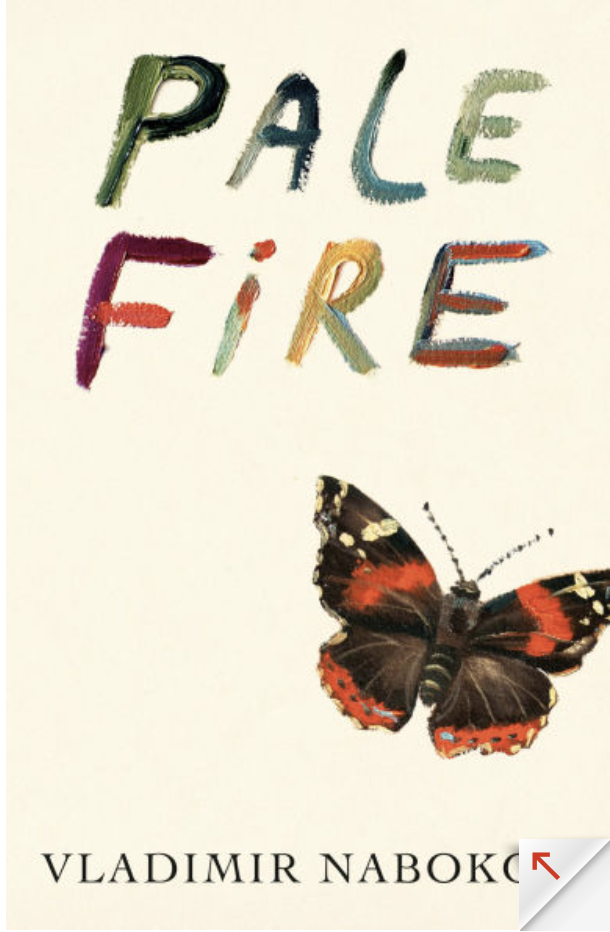
Pale Fire by Vladimir Nabakov (Literary Fiction)

After plowing through this book, reading some online explanations, and having a discussion with other literary fans, I can honestly say that I think this is a masterpiece of literature but not terribly fun to read. The book comprises an introduction, a 999 line poem, and a (very) lengthy, almost line-by-line commentary about the poem.

The poem is written by John Shade, while the introduction and commentary is written by the character Kinbote. Kinbote is the epitome of an unreliable narrator, but that’s OK because what narrative there is is buried in fits and starts within the commentary. While it may seem like “cheating,” I did read a couple of summaries that helped me frame the basic premise my structure craving brain required to make any headway. I won’t include anything here in case you are a firm non-peeker, but know that it can help. Suffice it to say that nothing is what it seems, and the hints to what might be reality are all included but told through the perspective of a madman and only dribbled out in disjoint segments. And yet, it is beautifully done. The writing is incredible (see some quotes below) and the vocabulary … I love words and have (I think) a pretty good vocabulary but the non-native speaker Nabokov blew me away. Just a few of the new (to me) words: Orbicle, Nacreous, Quiddity, Bimanist, stillicide, Ephebe, Pudibundity, Maculation, Architectonically, Trochee, Goetic, Contrapuntal, Perlustration, Selenographer, Versipel, Ament. Life is so much easier when you can look them up on your phone without getting out of the chair!

If you appreciate intricate, highly complex book structure, love beautiful language, and understand that the plot isn’t always the point, this is the book for you!

Quotes:

Alas, my peace of mind was soon to be shattered. The thick venom of envy began squirting at me as soon as academic suburbia realized that John Shade valued my society above that of all other people.

His misshapen body, that gray mop of abundant hair, the yellow nails of his pudgy fingers, the bags under his lusterless eyes, were only intelligible if regarded as the waste products eliminated from his intrinsic self by the same forces of perfection which purified and chiseled his verse. He was his own cancellation.

Nevertheless the urge to find out what he was doing with all the live, glamorous, palpitating, shimmering material I had lavished upon him, the itching desire to see him at work (even if the fruit of his work was denied me), proved to be utterly agonizing and uncontrollable and led me to indulge in an orgy of spying which no considerations of pride could stop.

I notice a whiff of Swift in some of my notes. I too am a desponder in my nature, an uneasy, peevish, and suspicious man, although I have my moments of volatility and fou rire.

And moreover [he said] we, whites, are not white at all, we are mauve at birth, then tea-rose, and later all kinds of repulsive colors.

All the seven deadly sins are peccadilloes but without three of them, Pride, Lust and Sloth, poetry might never have been born.

And let me add here how much I was honored a fortnight later to meet in Washington that limp-looking, absent-minded, shabbily dressed splendid American gentleman whose mind was a library and not a debating hall.

Resemblances are the shadows of differences. Different people see different similarities and similar differences.

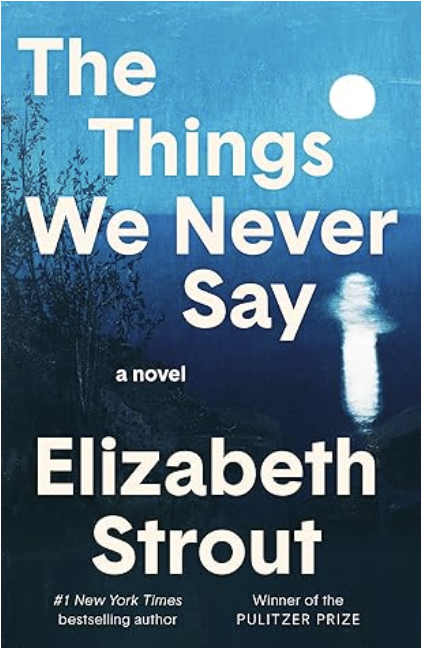
The Things We Never Say by Elizabeth Strout (Literary Fiction)

Writing: 5/5 Characters: 5/5 Plot: 4/5

I was instantly hooked by the epigraph: Loneliness does not come from having no people about one, but from being unable to communicate the things that seem important to oneself, or from holding certain views which others find inadmissible. — Carl Jung

This was the beautifully written, deeply reflective story of Artie Dam — a high school history teacher who spends time considering free will, loneliness, and whether or not anybody can really know anybody else. He watches his own mind a lot — I like that concept. He has been married 34 years, has a grown son who has become more distant, and a deep love for his students who he fears, based on the last election, he is sending out into an unsafe world.

I love the way the author (who is one of my favorites) paints a scene from multiple points of views. We spend a lot of time in Artie’s head, but we also get snapshots of what each of the people in his life think about him simultaneously and why. The elucidation of how we perceive the people around us, how they perceive us, and how we manage to make a connection to them despite this variance is brilliant. I also loved the fluid way Artie reflects on his life — memories precipitated by small events and interactions and the larger social shifting in reaction to the big events — Covid, the 2024 election, and the (ever changing) perceptions of right and wrong.

Political angst is a big piece of the context for Artie and several other key characters. Semi-oblique references to orange hair, cancelled government contracts, ICE “Nazis”, and general loathing for certain personages (you know who they are!) are tossed out without too much discussion. I found this interesting not because I agree or disagree with the view, but because of how having these feelings — justified or not — deeply impacted the characters. I appreciated that the author did include other characters — presented as reasonable and good people — who held either opposing views (they voted for Trump!) or who were simply content to wait and see what actually happened, rather than get too intensely worked up about it. What I loved about this book was that in spite of the angst — both internally and externally induced — the novel was primarily about personal insight and the way that we can have a positive impact on others and work to achieve the contentment and connection that we want. I found this book ultimately uplifting.

Quotes:
“She was unaware — even after their thirty-four years of married life — of the deep pockets of sensitivity that Artie had. And why did she not know? Because she herself did not have those particular sensitivities — and like almost everyone else on this Earth her imagination could not take her fully to another place, even with her husband.”

“So blind we humans are — so blind. To each other and to ourselves, moving through life as though through shadows, putting out a hand in the dark and thinking we have touched someone. And maybe we have, as Artie did with Rhonda Lazarre that day. But mostly we travel through life unsighted, grasping only the smallest details of one another’s selves, including our own. Thinking all the while that we can see.”

“And then she leaned her head against his shoulder, and this is what stabbed Artie now, their innocence, and how badly he wanted — as that elderly woman had — to lean his head against a loving person, to be innocent and incorruptible.”

“And now he knew why. Because to say anything real was to say things that nobody wanted to know. Or if they wanted to know, they would not care in the right way. Or even understand. It was a private thing, to be alive. He understood this now.”

“As he walked slowly up to the bedroom, he thought that now, after all these years, he was finally becoming a grownup. What did he mean by that? That he was finally beginning to understand the multitudinous aspect of people. He was amazed by it, really, now that he thought about it. In his study of history, he had learned about the leaders, and the various groups involved, but he had some how missed this fact about every single person: that they held within themselves a vast, unknowable universe. And he understood that it could make a person lonely; people had to take and give to one another whatever they could. If it was not enough … Well, then it meant one just had to be a grownup.”

Thank you to Random House and NetGalley for providing an advance copy of this book in exchange for my honest review. The book will be published on May 5th, 2026.

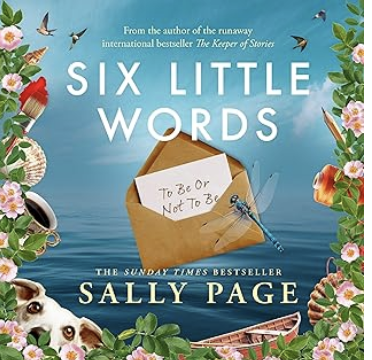
Six Little Words by Sally Page (Fiction — Audiobook)

Lighthearted and uplifting, this is a charming tale of a Norfolk (England) community group that comes together around an amateur competition designed to unlock a person’s creative spark. We alternate between the perspectives of Bardy, a retired English teacher suffering from writer’s block, and Kate, an equally frustrated once-painter, but the others in the group each have equally compelling narratives that slowly surface as the group coalesces into something much greater than originally intended.

This could have been simply another piece of uplifting women’s fiction (and nothing is wrong with that!), but I found a lot to love that went far beyond the expected bromides. Bardy experiences synesthesia and the description of how he saw people as intense and specific colors was fascinating. It was as though his subconscious experiences of people manifested as actual visual portrayals. I also found all the discussions about art — making it, recognizing it, expressing oneself through it (without considering external judgement) incredibly insightful and engaging — even though I have no artistic capabilities or experiences trying to produce it. The array of artistic endeavor was both amusing and absorbing — from oils to poetry to photography to fashion designs (on dogs!) to musical theatre. I was particularly interested in the way that any artistic expression is a window into someone — their interests, the way they see things, the way their brain works — I’m always curious about people and very aware of how differently people “work” from each other. I hadn’t really thought about artistic expression as a channel in that. I liked the reminder also that artistic expression is for the artist, regardless of the opinions and valuations of others. With so much commentary and criticism on all sides, it’s sometimes difficult to remember that you paint or play piano or pretend to take on acting roles because it’s fun and internally satisfying, not because you need the approval from others (unless you’re trying to make a living that way, of course!).

The book had a nice happy ending — full of (realistically IMHO) resolved situations with personal growth required for decent closure. The “Six Little Words” inspiring the title are exposed near the end — and they are perfect! Great for fans of Joanna Trollope. Thoroughly enjoyed it.

When God was a Rabbit by Sarah Winman (Literary Fiction)

Writing: 5+/5 Plot: 4/5 Characters: 5/5

Charming, deep, and full of insight. A coming of age and beyond novel with clear flows from life experiences to the development of a personality, a worldview, and a moral core.

Eleanor Maud is a bit of a loner, with an adored older brother, a best friend from the “other” side of the tracks, an odd collection of adults who provide her with myriad perspectives and experiences, and a pet rabbit she has named God. Introverted and introspective from an early age, we see her develop a sense of self and a unique brand of faith by continually modifying her worldview and her self-understanding in reaction to events both personal and societal (e.g. a suicide, a scary lump, lost memory; 9/11, the massacre at Dunblane, John Lennon getting shot).

I thoroughly enjoyed reading this, being immersed in another’s quirky and slanted, but also rational and considering, mind. Ellie was an easy character for me to “travel with” in this way. I loved the cast of supporting characters who were each unconventional in his or her own way, always through eccentricities well-supported by their outlook and exploits. This is a reprint of the book — it was originally published in 2011 and was the author’s debut. She has since written three additional books.

Some beautiful quotes:

“He had skirted the periphery of my early life like an orbiting moon, held between the alternate pull of curiosity and indifference, and probably would have remained that way, had Destiny not collided with a Tyrolean coach that tragic, pivotal afternoon.”

“He presented a colorful alternative to our mapped-out lives. And every day as I awaited his return from school, my longing became taut, became physical. I never felt complete without him. In truth I never would.”

My father had never met a lesbian before, and it was unfortunate that K. H. should be his first, because his liberal cloak was pulled away to reveal an armory of caricatured prejudice. He could never understand what Nancy saw in her, and all she ever said was that K. H. had amazing inner beauty, which my father said must be extremely hidden, since an archeological dig working round the clock would probably have found it hard to discover.

“I just want my friend back,” I said, tears burning behind my eyes. ‘I’ve become forgettable”

Do I believe in a mystery, the unexplained phenomenon that is life itself? The greater something that illuminates inconsequence in our lives; that gives us something to strive for as well as the humility to brush ourselves down and start all over again? Then yes, I do. It is the source of art, of beauty, of love, and proffers the ultimate goodness to mankind. That to me is God. That to me is life. That is what I believe in.

And she had left nature alone, opting instead to banish vanity like the meddlesome, suffocating weed it was.

His strange presence had uncovered a loneliness of such devouring longing, one that reached cruelly back into the past, and I knew I could no longer be around him.”

And he uncovered in us a curious need: that we each secretly wanted him to remember us the most. It was strange, both vital and flawed, until I realized that maybe the need to be remembered is stronger than the need to remember.

Thank you to G. P. Putnam’s Sons and NetGalley for providing an advance copy of this book in exchange for my honest review. The book will be published on February 24th, 2026.

More than Enough by Anna Quindlen (Literary Fiction)


One of my favorite books of the year — thoughtful, relatable, and delightful, even, in an odd way, the sad parts. This is in large part due to the characters who are all good and wise people in their way, but always with more to learn. I’d like to say there was a jackass or two in the pages, but there really weren’t.

Polly is a high school English teacher at a private Manhattan school where the kids are (mostly) wealthy and privileged but also driven, smart, and with problems of their own. As an aside, I like the fact that people who are not poor, not downtrodden, and not necessarily members of a minority class are allowed to have problems and drives and desires like anyone else. Her appealingly well-adjusted husband is a big animal vet at the Bronx zoo — possibly my favorite character occupation of all time! And she is part of a perfectly balanced four member book club — unique in that its members must buy, but not actually read, the chosen book every month. At the same time, however, her beloved father is losing his mind to dementia, she is struggling with infertility, she is in a perpetually low-grade state of anger with her mother, and a “joke” DNA test gift has resulted in a surprising and uncomfortable disclosure.

The book is a “tag along” to a thoroughly examined life as it progresses, as all lives do, completely out of the control of the one who lives it. All we can do is adjust, appreciate, understand, and settle in for the ride. Beautifully written with a slew of insightful comments (and many apt literary references and quotations — she teaches advanced Literary Honors courses after all!). Full of myriad families and friend groupings, each with their own distinctive cultures and implicit behavior patterns. I loved that the story was a study in non-dysfunctional ways of handling both life’s vicissitudes and pleasures. I found myself disagreeing with Tolstoy — not all “happy families” are alike, because every family, even the happy ones, find their own way of handling all that life throws at them. And lastly, some truly fun and informative scenes with alpacas.

Some quotes both directly from the author and as referenced in the book:

I am out with lanterns looking for myself — Emily Dickinson.

Marriage. Like calculus without the answers.

There’s a kind of equipoise to our group, so that we’ll veer here and there and somehow always come back to center, and peace.

Sometimes I think the human brain is a house, and the lights only come on in mine one room at a time.

Life is a tragedy for those who feel and a comedy for those who think — Moliere

“Daddy Daddy Daddy is running through my head like a piece of music with only two notes, like Philip Glass. I hate Philip Glass.”

“I’d like to disabuse you of the notion that you are the only woman in the world who doesn’t like her mother,” my therapist had said three years before.

The thing about living in New York City is that you feel either perpetually untethered or unwaveringly embedded.

You girls need to allow me my petty grievances.

Beauty is whatever gives joy — Edna St Vincent Millay.

I’m afraid families are a funnel, and ours is running out.

Thank you to Random House and NetGalley for providing an advance copy of this book in exchange for my honest review. The book will be published on February 24th, 2026.

Life: a Love Story by Elizabeth Berg (Literary Fiction)

A beautiful and sweet tale of an elderly woman’s life memories of love in all of its forms. At 94, Flo is still finding new opportunities to connect with people and helping others to spot their own connection opportunities. The story alternates between her “now,” and the (very long) letter she is writing to her heir, the now grown up Ruthie who had befriended her while a child. In this letter is the eponymous love story of Flo’s life, as told through vignettes describing some of the “odd” things Ruthie will find in her house once she is gone. And that will not be too far in the future as Flo has received a terminal diagnosis.

This book was never depressing. It was full of the joys, wonder and sorrows of life. It was full of (sometimes funny, sometimes poignant, sometimes both) origin stories about small, but important, objects (a toothpick dispenser, a handful of rocks). And it was full of the (endless) intricacies of knowing and loving another person. Flo feels compelled to giving advice to those who need it: Ruthie, who is contemplating divorce; her new friend Teresa, who has given up on love completely. And this advice is practical, real, sensical, and insistent in the most positive sense — based on the wisdom that comes from real experience. I loved the mechanism used to depict these experiential bits of wisdom — no bullet points, no logical expositions, just elaborating vignettes sprinkled about with purpose.

I laughed and cried, but the reading of it left me feeling warm, reflective, a bit nostalgic, and more alert to paying attention to the life that I have.

Thank you to Random House and NetGalley for providing an advance copy of this book in exchange for my honest review. The book will be published on March 17th, 2026.

Some Bright Nowhere by Ann Packer (Literary Fiction)

I can’t say this is a happy or uplifting book, but it is a strong, powerful, complex, and very, very real book about a strong marriage and the intricacies of how it weathers the derailers of life. On page two, Eliot and Claire say goodbye to the oncologist who has treated her breast cancer for nine years. The end is near and there is nothing more that he can do. The book takes us from this point until the end, actually, has been reached. But while I think we all feel as though we’ve read this “story” a million times, I found this version quite different.

This story is told from Eliot’s perspective. After a surprising, and somewhat heartbreaking, last request, we see Eliot’s struggle with isolation, communication, understanding, and retrospective introspection. While it is easy to read and make judgements about what people think, say, and do, I don’t think that is really the point. This is life and a marriage and a family and a circle of friends, and there is no “correct” behavior, no hard and fast guidelines to what is right. But it is all exquisitely detailed — the conflicting thoughts, the desires, the dears, the selfishness and simultaneous generosity. I’m not surprised by the quality of the writing (this book could not have been an easy thing to pull off) because it is Ann Packer — I’m pretty sure I’ve read and loved all of her books. Hard to read such a story without having a heavy heart, but it relates to a part of life that we will all experience in one way or another. The depth of insight was worth the trip.

Thank you to Harper and NetGalley for providing an advance copy of this book in exchange for my honest review. The book will be published on January 13th, 2026.