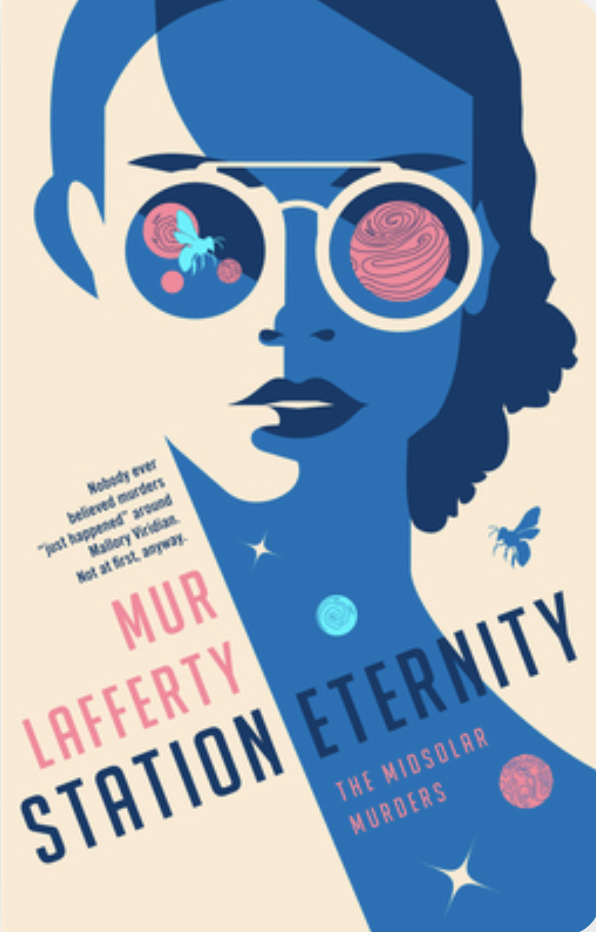
Station Eternity by Mur Lafferty (Science Fiction)

Writing: 4/5 Plot: 5/5 Characters: 4.5/5
Mallory Viridian appears to be cursed. Murders tend to occur whenever she is around. She solves them — quickly and well (much to the irritation of the local police) — but it would be much better if they didn’t happen in the first place! After the latest murder, wanting to be as far from perishable humans as she can get, she makes her way onto Eternity — a sentient space station — where bizarre coincidences tend to happen even more often.

The story is a great mix of action, cultural exploration, and personal growth with an impressive cast of characters (human and not, multi colored, of various sexual proclivities — checks all the right boxes but does not beat the point to death). One step further in the diversity collection — experiments with symbiotic pairings between beings becomes somewhat central to the plot(s). These include sentient hardware, hive minds, giant vegetarian rock people and the “moist races” like humans. Honestly the disgust felt by some of the aliens at the thought of all the “liquid” in humans just cracked me up. The plot often veers at crazy angles with multiple surprises, inducing a pleasurable ADD experience in me (I’m normally more of a linear planner type). Lots of banter and a very cool ending where countless loose end were tied up in highly satisfying ways.

I absolutely loved this book and can’t imagine how I missed it when it first came out. It’s my kind of science fiction — full of aliens, but with fully fleshed out (and imaginative) cultures and individual personalities (alienalities?). No all-hands-on-deck to kill the bug-eyed monsters thread!

Perfect for fans of Ann Leckie or early Becky Chambers (the Monk & Robot series do nothing for me). The best news — book two is coming out shortly (November 7th), and if I’m lucky I’ll get an early copy!

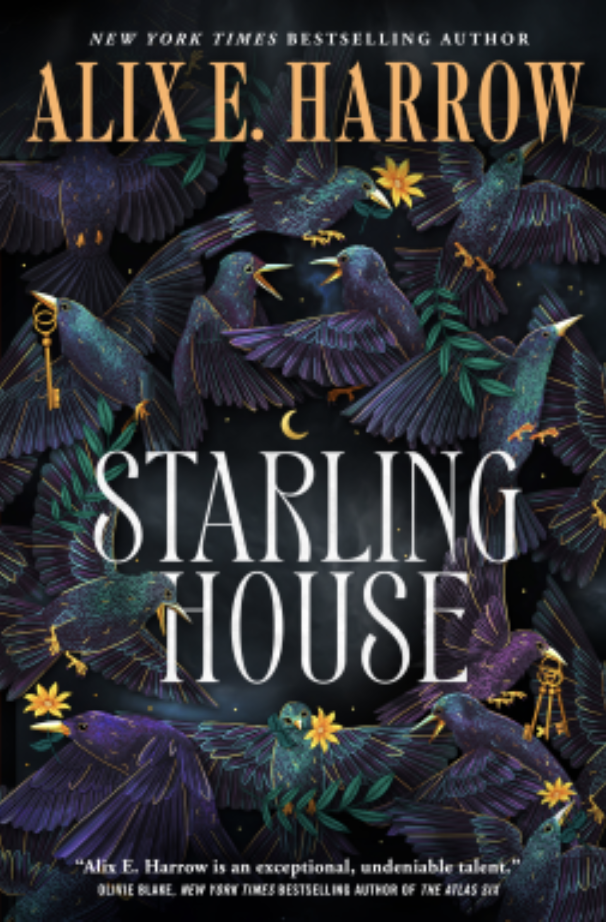
Starling House by Alix E Harrow (Speculative Fiction)

Writing: 4.5/5 Plot: 3/5 Characters: 3/5
A haunted house in a dying town (the inaptly named “Eden”). Somehow bound up with snarly Beasts, the house attracts a new Warden to defend itself (and the town?) through the dreamworld whenever the current Warden dies or disappears. And yet somehow Opal — struggling to keep herself and younger brother going long enough to get out of Eden — finds herself attracted to the house and the strange, gaunt, and equally haunted Warden against her better judgement.
I’ve read and loved (5 star reviews) every Harrow book to date, but I admit to being a bit disappointed in this one. Wonderful writing, as always, and characters that I cared about, but the characters were all stereotypes — nicely drawn stereotypes, but stereotypes nonetheless. And the “bad guys” didn’t even have the depth of a decent stereotype. Additionally, the pace was quite slow and I felt like I had to read a lot of words before the story inched forward. I’m sure the extra prose added deeply depicted ambiance, but I grew impatient. It’s got all the feeling of a nice creepy horror story with a good ending, some recovery-style positive self-discovery, and an odd, but compelling, love story along the way.

Just a couple of quotes:
“It’s just that I had to work eight Entire hours with Lacey Matthews, the human equivalent of unsalted butter.“

“Mr. Cole is a nice man, but he doesn’t know what to do with people raised on the underside of the rules, where the world turns dark and lawless, where only the canny and cruel survive.”

“Even if it’s only a foolish old house with ambitions of sentience.”

Thank you to Tor Books and NetGalley for providing an advance copy of this book in exchange for my honest review. The book will be published on October 31st, 2023

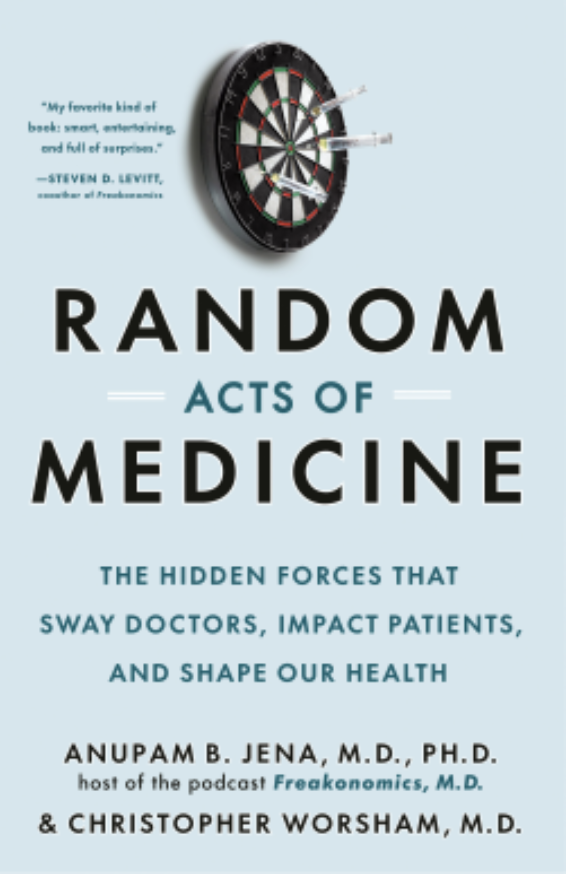
Random Acts of Medicine: The Hidden Forces That Sway Doctors, Impact Patients, and Shape Our Health by Anupam B. Jena; Christopher Worsham

Random Acts of Medicine is a Malcolm Gladwell style book applied to health care systems. The authors — both physicians and public health researchers at Harvard Medical School — propose to explore the “hidden, but predictable ways in which chance affects our health and our healthcare system” through the use of “Natural Experiments,” that is observational studies that make use of naturally occurring differences in the world and measuring the impact. The two (along with colleagues) have used the approach to explore and answer a number of questions such as: does stress really age you? How does the month of a child’s birth impact their health and life success? What happens when all the cardiologists leave town? How does a marathon impact our health? Does your doctor’s politics affect the care they give? For each question (and there are many, many, more than the ones I have listed), the authors carefully explain the natural experiment, the sources of data, results, and what use can be made of the results (possible policy changes, or greater awareness of our own biases at work).

I found the book got better (more interesting to me) as it went on. The authors are careful not to assume that the reader knows anything about natural experiments, statistics, counterfactuals, etc. and they explain the (possibly new) concepts carefully, but not tediously. Still, if you are already familiar with the concepts it can get a little dull and I enjoyed all the actual experiments (many with surprising results) more than the introduction.

An easy read full of fun “I never thought about that” insights. Plenty of notes and references for those who want to investigate further. I always appreciate the kind of “popularized” topic books when they actually show their work, clearly separating them from the whopping pile of self help books that make claims without an iota of scientific support.

Thank you to Doubleday and NetGalley for providing an advance copy of this book in exchange for my honest review. The book will be published on July 11th, 2023

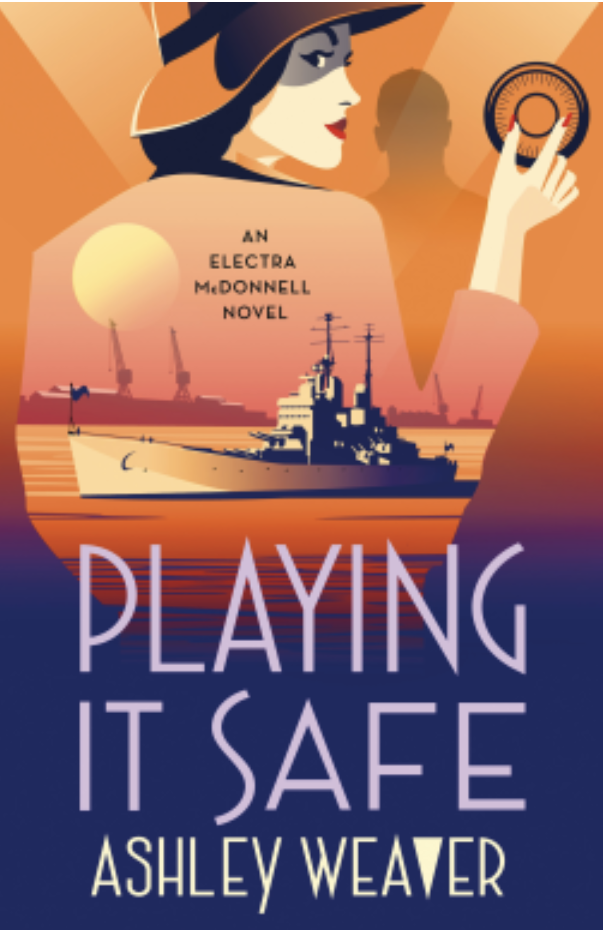
Playing it Safe by Ashley Weaver (Historical Mystery)

A light, historical, cozy with likable characters, this is just what I needed to cleanse the palate from all the dystopic SciFi I’m in the middle of.

Book two in the Electra McDonnell series taking place in England (London and Sunderland in this episode) in late 1940. Electra (Ellie) is the (young, pretty) safe cracker / thief who has turned her skill to serve King and country, working with the tough-as-nails (but also handsome with undertones of patrician) Major Ramsey. A possible Nazi counterfeiting ring, a few unnatural deaths, and a focus on bird watching pepper this episode.

Intelligent, stubborn, and delightfully non-conformist, Ellie is fun to accompany on this adventure. Major Ramsey is a bit of a stereotype, but a very enjoyable one: heroic and competent with “an aristocratic heritage underneath the military bearing.” Weaver includes just the right amount of romancy bits between the two (how could you not?) but doesn’t overdo it (need to leave something for future installments!)

My favorite part: Ellie goes to the movies in chapter one and sees “Bachelor Mother” with Ginger Rogers — one of my favorite movies and not very well-known. I got a real kick out of that. If you’ve never seen it, stream it!

Thank you to Minotaur Books and NetGalley for providing an advance copy of this book in exchange for my honest review. The book was just published on May 9th, 2023

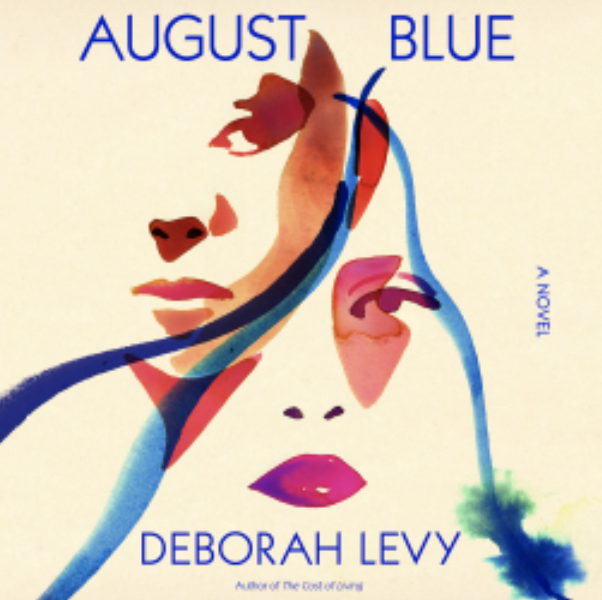
August Blue by Deborah Levy (Literary Fiction – Audio Book)

Writing: 5/5 Characters: 4.5/5 Plot: 4/5

A beautiful book about self-discovery, identity (in the classic sense), and a search for “home” amidst the angst and displacement of Covid. The music and musical themes that lay at the absolute center of the story had wonderful depth and were enlightening, inspiring, and real. I listened to this as an audio book. It was narrated by Alix Dunmore who was so good that I’m seeking out her other narrations because she put a voice to the prose so very well.

Elsa M. Anderson — a former child prodigy — was at the height of her career as a pianist when she walked off the stage in Vienna in the middle of a performance of Rachmaninoff’s second piano concerto. Now there is a pandemic on, her teacher (who adopted her at age six) is dying far away in Sardinia, and Elsa is roaming Europe, teaching a few lessons, playing very little, and allowing herself to go wherever currents take her. She sees a woman in Athens who she feels is her double, and sees her repeatedly throughout the story, serving as a kind of foil that both drives Elsa and causes her to reflect.

The writing is beautiful — poetic, but not to the point of losing content. I would have many quotes if I weren’t listening to it without an opportunity to write them down. I loved the other characters and the interactions that allowed Elsa to learn more about herself with every engagement. I loved the role of music and how it informed the very way she thought. I loved the way she taught music sensitivity to a young and brilliant student with an overbearing parent. I love the interplay between music, life, and emotions that comprises the mind of a true musician. I loved the fact that the ending didn’t really tell you what would happen in the future, but I was left with a sense of where she was going simply from “living her life” with her. In case you can’t tell, I loved this book!

Lastly, while I don’t have an exact quote, I very much liked Elsa’s answer when her friend mocked her (Elsa’s) interest in Isadora Duncan, who he said was “ridiculous.” Elsa retorted that she (Isadora) had to be ridiculous because she was making something new. That made me think.

Thank you to Macmillan Audio and NetGalley for providing an advance copy of this book in exchange for my honest review. The book will be published on June 6th, 2023

Wolfsong by TJ Klune (Speculative Fiction / Romance)

This about-to-be-reissued book is a story about community, self-esteem, and personal growth carefully hidden within a big action story about Werewolves and a special human who manages to join the pack in a surprising way.

The story is interesting and the writing good (I absolutely loved Klune’s “In the Lives of Puppets” which was just released). Wolfsong could be simply summed up as a gay “Twilight,” with more emotional depth. It’s action and gay romance (with a capital R). At first I felt like it was more of a YA book, but about 80% of the way in began some seriously explicit homosexual sex scenes. More explicit than I really needed — frankly I would have liked a little warning! The book was also (for my taste), too long and quite repetitive. On the other hand, if you love action and enjoy a little gay romance / porn, this might be a great book for you!

I did actually love the stereotype busting world of he-men (mechanics, warriors, werewolves) who like to cuddle like puppies in a pack, love ferociously, and explore their feelings — sometimes out loud. I enjoyed the characters a lot — I just wish they had managed to figure out a few pretty obvious things a little earlier.

Thank you to Tor Books and NetGalley for providing an advance copy of this book in exchange for my honest review. The book will be published on July 4th, 2023

Road to Surrender by Evan Thomas (Non-Fiction — History)

Writing: 5/5 Topic Coverage: 5/5 References: 5/5

My favorite kind of non-fiction — all well-referenced facts, with details of people’s thoughts, motivations, and actions as captured at the time through records, diaries, and notes. The book covers the day-to-day (and sometime minute-to-minute) events pertaining to the dropping of two nuclear bombs on Hiroshima and Nagasaki — not the development of the bombs which is well covered elsewhere, but everything to do with the (somewhat chaotic) logistics, strategy, political machinations, and even the evolution of revisionist history to do with the use of the bombs. Drawing heavily from memoirs of several of the key players, including Japanese foreign minister Togo, we are treated to the decision making process with all of the attendant, intermingled motivations and fears of the time.

The writing was superb — clean, clear, and detailed, but never rambling. I don’t tend to read non-fiction unless it’s like this (and very few books are!). The action ranges from March – August 1945, with a well-summarized epilogue that followed some of the main characters (Stimson, Togo, Spaatz) to the end of their lives amidst shifting popular perceptions of the war and the US role in ending it. In many ways, I found this chapter the most interesting — watching the way history gets retold when the stress of an uncontrollable situation is gone and the pontificators get to revise strategy with the benefit of 20-20 hindsight. Towards the end of this period, there is also the scepter of the Russians — allies at the time, but allies who are starting to behave in a not-so-collegial fashion. To trust or not to trust? (I think the answer to this one is now pretty clear).

Of the many character portraits painted, three stood out: Henry Stimson — Secretary of War whose ongoing worry was that “man’s technical capacity to do evil will outrun man’s human capacity to do good;” Carl “Tooey” Spaatz — the Commander of the Strategic Air Forces who insisted on written orders to deploy the bomb(s) and carried the orders around in his pocket; and Shigenori Togo —the only Japanese Cabinet member to oppose the war (and the only one not executed as a War Criminal). I loved the peek into the minds of the men (yes, they were all men) making the decisions — what they worried about, what information they had at their disposal, and how their insights and opinions were informed by their individual backgrounds and levels of idealism and pragmatism.

A significant portion of the book exposed the (wildly different) decision making process in Japan, which resulted in the much delayed surrender. The emperor was largely a prisoner of an increasingly fanatic military and rarely challenged their usually unanimous recommendations. Additionally, the Japanese culture at the time valued consensus and information transmission that is expected to be implicit, rather than explicit, greatly hampering any kind of rapid and rational decision making. Ultimately Emperor Hirohito did issue a proclamation of surrender, but even that was almost quashed through a last minute and desperate coup. Honestly, it reads like absolute insanity, which I’m sure it was.

I honestly couldn’t stop reading. The last paragraph summed it up nicely: “It is hard to imagine the pressure that these men faced in the spring and summer of 1945. The surrender of Japan came at a high cost. Decision makers on both sides engaged in wishful thinking and psychological denial, and peace of mind was hard for the victors to find. But Japan did surrender before hundreds of thousands — possibly millions — more lives were lost. Stimson, Spaatz, and Togo gave mightily of themselves to bring peace, and at last they succeeded.”

Thank you to Random House and NetGalley for providing an advance copy of this book in exchange for my honest review. The book will be published on May 16th, 2023

Orchid Child by Victoria Costello (Literary Fiction)

Writing: 3/5 plot: 4.5/5 characters 3.5/5

Kate is a neuroscientist, on her way to a new position in Ballymore, Ireland having been fired from her prestigious New York City based position after an ill-advised affair with her married boss. Ballymore has an historically high rate of schizophrenia, and she has been hired to work on a new followup study on the descendants of the original 1970 work. She brings along her newly adopted nephew, Teague, who is suffering from schizophrenic symptoms and whose therapeutic care is part of the new job package.

What ensues is a tangled, multi generational story (the narrative follows two timelines — Kate’s story in 2002 and the history of her family from 1920 through 1974). Between the two, we are exposed to Irish folklore, long term feuds based in the Irish “Troubles,” druids, and (most interesting to me) multiple approaches to treating and supporting schizophrenics. These approaches include support from therapists following real (I checked) research results, recommendations from “Mad Pride” activists who avoid medical intervention for mental illness, and the consideration that those who claim to hear the voices of their dead ancestors, really can.

There were enough interesting (and new to me) concepts to keep me reading to the end — I really wanted to know what happened. I thought the writing could use some editing — it was messy with a lot of rambling details and I found the dialog a bit stilted. I liked some of the characters more than others and definitely found the different attitudes towards schizophrenia fascinating. I didn’t personally like the main character, although I know I’m supposed to! Of course, I’ve never walked in her shoes (and the author’s bio suggests that she has), so I can’t really judge. My favorite part was reading about treatment modalities based on new (around the 2002 timeframe) research in neuro-epigenetics and the Orchid Child hypothesis (google it). The focus was primarily on the help people need and mostly avoided any discussion of the very real danger some mentally ill people could be to others when not adequately supervised / managed — I always wish reports and stories could be more balanced in this regard.

Some quotes, which reflect more of the plot than the writing style:

Quotes:
“In the parlance of researchers, they were the orchids, prone to dysfunction. When faced with the stressful choice of which lever to push to get their next drink of syrupy water, orchids sat and trembled with indecision. Their luckier peers, her control group, born with a longer form of the same gene, were hardy like dandelions — a group with which she wholly identified.”

“The Celts called it second sight. In our profession, we throw it all under the label of psychosis. Or we assigned patients different positions on a spectrum of abnormality.”

“You all suffer from the same wound, which festers as each generation fails to face it head on.”

“Let’s say you re-enter your body with the intention of telling the story of what happened to you today in whatever medium you choose. You can be sure that one of your ancestors is seeing and feeling that story in his on time as a powerful premonition.”

Thank you to Between the Lines Publishing and NetGalley for providing an advance copy of this book in exchange for my honest review. The book will be publlished on June 13th, 2023

Dreams of Arcadia by Brian Porter (Literary Fiction)

Writing: 4/4 Characters: 5/5 Plot: 4/4

A gentle book about an East Texas veterinarian who leaves Houston (and the end of a disappointing marriage) for the rural lands of his father’s youth. The main character is very human and very relatable — he is supported by a whole array of well depicted and quite real people from the individuals in the small town to his many relatives, most of whom he hasn’t seen in years (or has never actually met). There is quite a bit of description of the landscape, the real (and brand new to me) day to day big (and small) animal vet cases and procedures, and his own internal thought processes. As he works to solve the little (but critical) every day mysteries that populate his profession and interpersonal engagements, he is able to find a place for himself that feels (finally) like home. I particularly liked the solution to the issue of one family’s ailing cows when no diagnostic test could turn up any problems. I won’t give it away here!

Thank you to Legacy Book Press LLC and NetGalley for providing an advance copy of this book in exchange for my honest review. The book will be published on June 27th, 2023

Harold by Steven Wright (Literary Fiction?)

Writing: 5/5 Plot: 3/5 Characters : 2/5
A deeply interior book with constantly catchy and cerebral writing. The narrative purports to be the thoughts of an obviously gifted and unusual seven-year old boy, primarily while he is sitting in a classroom absolutely not paying attention to the woman in charge. Harold has “tangent festivals in his head” — what a great way to put it! While I’ve read other interior novels, they often seem to focus on neuroses and over thinking, while this one is focussed purely on imagination.

I very much enjoyed the writing and the constant stream of bizarre and connected thoughts — my own brain works that way and it was fun experiencing someone else’s stream. Every thought in Harold’s head presents itself as a well-depicted bird flying through a rectangle in his head. I liked the imagery. However, to be honest, I did get a little bored with the book about half way through — the novelty wore off and I began to notice that Harold’s thoughts were more bitter, superior, and snide than comical (yes, I realize that that is the very definition of comedy for some people, but not me). I also started realizing that there was a fair amount of misogyny — his thoughts on his mother, the young, pretty girl he is obsessed with (Elizabeth), and his teacher are all pretty negative in stereotypical ways. For example, on Elizabeth: “Said the pretty very very smart, blonde girl who years later would send several men to their emotional deaths.”

A couple of good quotes:
“Harold loved living in the circus in his head. He saw his mind as a soup made up of a mixture of what was on the inside of his head and what was on the outside of his head. He considered himself a brain chef.”

“Harold thought that an echo was audio plagiarism.”

Thank you to Simon & Schuster and NetGalley for providing an advance copy of this book in exchange for my honest review. The book will be published on May 16th, 2023