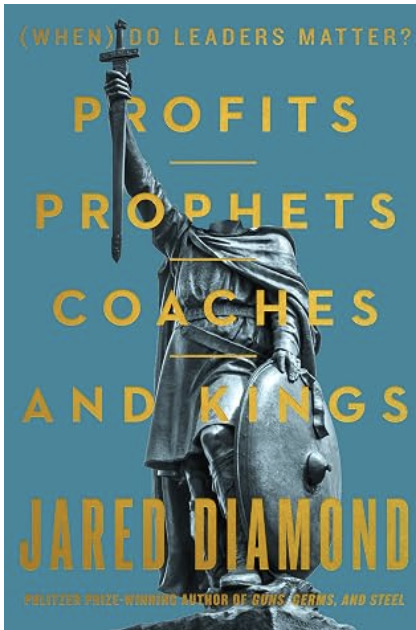
I never read the very popular Guns, Germs, and Steel, so perhaps my expectations for this book were too high, but I did find it disappointing. The subject was ostensibly “When do leaders matter” — is there something uniquely capable about them or are they just in the right place at the right time and someone else would have accomplished the same thing had they not been there. To expand on this “query” Diamond elaborates (at length and in a rambling, unclear, and far too repetitive manner) on the “research” methods used to investigate the question: biography, the “Hamlet test,” and natural experiments (finding experimental situations “in the wild” rather than planned in laboratory).
The book is segmented into four categories: Political, business, sports, and religious leaders. I did enjoy many of the “stories” — mini biographies of “great” figures in each category, and some high level, but interesting analysis of why some religions succeeded while others did not (surprisingly Islam was not mentioned which is a bit of an oversight? Perhaps intentional?). However, I found the depth of investigation to be shallow to the point where I felt some recaps came straight from wikipedia without checking for factual inaccuracies (of which I found several), and conclusions drawn in a sloppy fashion without adequate coverage of contributing factors or even breadth of contributing research.
The writing is (IMHO) simply bad. The narrative rambles, repeats, inserts some personal stories that were strangely ineffective at bonding us to the writer. A large number of pages are devoted to explaining various research techniques but I did not find the writing to have the clarity I look for when explaining potentially complex or unfamiliar subjects. I’m already familiar with these techniques but I wouldn’t have understood them from his verbose and incoherent descriptions. I was also a bit disturbed in some places by his content — asking his readers “do they feel strongly enough about an individual leader’s negative impact that they would sacrifice their own life in order to assassinate him or her?” He was referring to Hitler but too many people today are taking that question seriously and considering “evil” targets that have done little more than disagree with their ideology. Do we want to suggest to people that assassination is a noble endeavor as that question suggests? Similarly, he lumped Margaret Thatcher and Mao Zedong together into a category of leaders with a “mixed legacy.” Mao killed 40 – 80 million of his own people. Does Margaret Thatcher really fall into the same category? Small points but troubling nonetheless.
The book is really a set of vignettes loosely aligned with leadership and impact. I found it entertaining at times, though more difficult to read than it should have been. I didn’t find the main question to be an important one, nor do I think he actually came to any real conclusion, never mind one based on real data extracted from solid research methods. I would categorize this in the popular science / history category along with Mary Roach, Malcolm Gladwell and their ilk, though less entertaining.
Thank you to Mariner Books and NetGalley for providing an advance copy of this book in exchange for my honest review. The book was published on September 1st, 2026.