
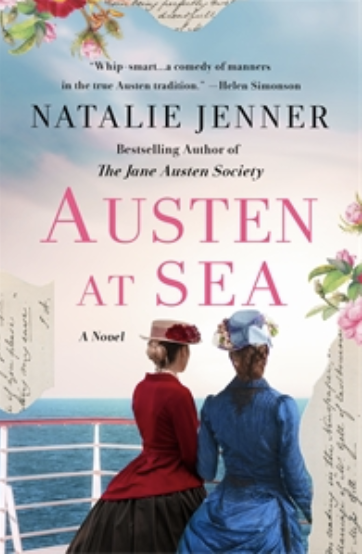
Austen at Sea by Natalie Jenner — Read by Rupert Graves (Historical Fiction)

An enthusiastic five stars for this marvelously fulfilling piece of historical fiction. The story manages to be both intellectually rich and emotionally pleasing. My perfect blend! In 1865, two daughters of the long-widowed Massachusetts Supreme Court Justice pen a daring request to the only surviving brother of their favorite author — Jane Austen. Meanwhile, two Philadelphia book collectors have similarly engaged with Admiral Austen about Austen memorabilia and editions. On the side, the Justices of the Massachusetts Supreme Court have elected to read and discuss the entire Austen oeuvre over the very summer break that sees the four correspondents heading off to England. Their discussions are completely engrossing, putting into dialog multiple well crafted opinions and surprising me with their depth. The story itself takes the reader from Boston, across to the sea to Hampshire, and concludes with a courtroom drama spectacular spanning both countries.

On the surface, this could pleasurably be read as an engaging comedy of manners a la Austen herself, with the delightful development of surprising relationships etc. But under the tip of the romantic iceberg lies the depth, thoroughness, and insight of the literary, political, legal, and economic contexts of the time period. Equality, justice, freedom — these are topics on everyone’s tongues during the post-Civil War recovery period, the still relative newness of the United States, and the current battles in both locations for various forms of women’s rights (including, but not limited to, women’s suffrage). These issues are brought out with a number of different techniques. Those discussing Austen’s works have literary discussions about her characters, their roles, purposes, desires, and life lessons. Women’s rights are addressed (and argued) through a fascinating panoply of laws, Acts, and jurisdictions — exemplified by the situations and experiences of the various characters. It’s obvious to us today (I hope!) that women should have rights equal to those of men, but to hear the completely sensical arguments and rebuttals on both sides of the issue during that time period by people who were not inherently “evil,” was deeply interesting.

I both read and listened to this book. I actually preferred the audio in this case. It slowed me down enough to actually listen to different viewpoints and consider them carefully — I usually read too fast and often miss important details. Rupert Graves is the reader — a wonderful actor with a beautiful reading voice. I learned a lot about Austen’s life and her works (despite the fact that I’ve read each multiple times) and enjoyed a wide array of references from that time period — including Louisa May Alcott who appeared in a delightful cameo role. The cast of characters at the start of the book is quite helpful.

Highly recommended.

Thank you to St. Martin’s Press, Macmillan Audio, and NetGalley for providing an advance copy of this book in exchange for my honest review. The book will be published on May 6th, 2025.

The Woman in the Library by Sulari Gentill (Mystery)

Writing: 4/5 Plot: 5/5 Characters: 4/5

A three-layer nested story merging a murder mystery, the evolution of friendships, and some fascinating insight into a writer’s process.

Australian Hannah Tigon is a writer, and in a semi-epistolary shell to the novel, she writes a chapter which is followed by detailed feedback and comments from an e-colleague living in Boston where her story is set. These comments get stranger and stranger as the book evolves. In the story itself, Winifred Kincaid (Freddie) is also a writer — trying to get some work done in the Boston Library when a bloodcurdling scream is heard. She — and the three others nearby — form a friendship after the scream as they try to figure out what happened. In the third layer of the story, she bases her characters on these three new friends.

Twisted. Engaging. Quite well written in the spare, thoughtful style that I like. The story is told from Freddie’s first person perspective and her internal dialog is clever, colorful and full of insight into a writer’s thoughts. I found it interesting that she presented some un-PC perspectives such as a white author bemoaning the fact that he never got to benefit from white privilege (see quote) and took an interesting perspective on race — never telling us the race of the characters while simultaneously being harangued for same by the man sending her feedback.

A few interesting quotes:

“I open my mouth to explain, to assure him that I’m a writer, not a leering harasser, but of course this is the reading room, and one does not conduct a defense while people are trying to read. I do attempt to let him know I’m just interested in him as the physical catalyst for a character I’m creating, but that’s too complex to convey in mime.”

“But they all smile while they talk — that’s the difference I think, that’s what makes it American. Australians don’t seem to be able to smile and talk at the same time — unless they’re lying, of course.”

“I write her terror gently, allowing what is unsaid to carry the narrative, aware that overt emotion could well move the story into melodrama.”

“The reality is, I suppose, that I am a straight white man with no diversity disadvantage to offer as a salve for the fashionable collective guilt that rules publishing. I understand that popular correctness demands that men like me be denied to compensate for all the years in which we were given too much. I just wish I’d had a chance to enjoy a little of that privilege before it became a liability.”

“I’m not sure if they have more information or if it is simply an inevitable evolution of sensationalism.”

“Cain smiles at me, and the fact that he’s handsome is again very salient.”

“New, but already beloved, wrapped in the excited crush of friendship’s beginning, untarnished by the annoyances, disappointments, and minor betrayals which come with the passing of time.”

Thank you to Poisoned Pen Press and NetGalley for providing an advance copy of this book in exchange for my honest review. The book will be published on June 7th, 2022.

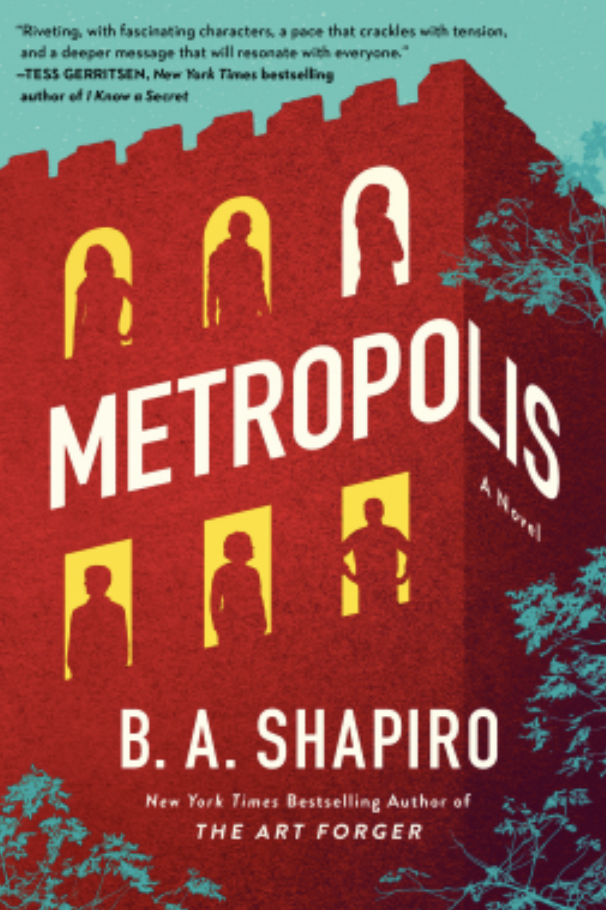
Metropolis by B. A. Shapiro (Literary Fiction)

Plot: 3.5/5 Characters: 4/5 Writing: 4/5
The Metropolis is an old fashioned self-storage unit in Boston — with variable sized units many of which have windows. The best part of this book is the peek into the lives of those who have found themselves in need of excess storage space and the way they use said space. Liddy Haines, wife of the uber wealthy (and not terribly nice) Garrett Haines, keeps her children’s things in the unit when they are shipped off to boarding school courtesy of the not-nice daddy; Jason, the black Harvard educated lawyer who found himself at odds with his corporate employer, houses his office there; Marta, a beautiful Venezuelan on the run from ICE, has moved in, feverishly focussing on her Sociology PhD thesis on how disparities at birth play out in life; and Serge, a brilliant and increasingly mentally disturbed photographer.

The unit is owned by Zach as an effort to go legit and managed by Rose who has her own set of issues. Everything is going along tickety-boo until an “incident” occurs in the unit elevator…

I love the premise of the story — who doesn’t think about all the diverse lives contained in such a collection of rooms with no other commonality? The characters were well-drawn and relatable, though I found their situations were all over-the-top and each was a little tropish. I always love her art commentary, in this case focused on Serge’s extraordinary photographs.

A fun read!

Thank you to Algonquin Books and NetGalley for providing an advance copy of this book in exchange for my honest review. The book will be published on May 17th, 2022.