
Last House by Jessica Shattuck (Literary Fiction)

Writing: 5/5 Plot: 5/5 Characters: 5/5

This is a brilliant epic of a book. It spans a period of 90 years (~1950 to 2040) via the trajectories of a single family — each member ensconced in his or her own cultural context while engaging with the others who are firmly planted in their own contemporaneous but often dissonant contexts. The story begins with Nick and Bet Taylor — he a junior lawyer attached to an American oil team negotiating deals in the Middle East and she a WWII cryptographer who gave up her dreams of a PhD to become a wife and mother (as women did in the 50s). From this stability and cultural conformity came two children — Katherine and Harry — who grow up in a clash between the middle class values of their parents and the anger and rhetoric of the 60s, complete with Marxist hyperbole and anger-fueled violence in the name of peace and justice. Decades later, by the time the third generation comes of age, their social cohort is beset by the overwhelming angst from the imminent collapse of society from climate change, war, and shifting values.

What impresses me about this book is how well Shattuck captures the feelings of the time(s) from so many different perspectives. Anger, fear, bewilderment, passion. Sometimes it was hard to read because she captured it so well; other times it was chilling to read because the activism of the 60s (the good, the bad, and the ugly) is blatantly mirrored in what is happening today. She must have finished writing this book before the Israel / Hamas war began and yet she captured the mix of intentions, propaganda and stupidity of the current situation perfectly.

I loved that the multiple viewpoints were captured via highly reflective characters — their feelings of joy, frustration, rage, and angst appearing in response to a rapidly shifting cultural landscape. I love that they pondered, each in his or her own way, the responsibilities that are incurred simply by being alive. The pages are full of insight with regard to parenting, political attitudes, alliances, friendship, and familial support.

I was (pleasantly) surprised by the lack of cliche and manipulation in the narrative. If the author has a strong opinion on climate change, greed, politics, democracy, or activism, I couldn’t tell you what it was. She covered several competing thoughts on how a person chooses to live in the world as it is. One of my favorite parts (towards the end) was a 2-3 page summary of an optimistic and pessimistic view of the same world. Perfectly crystalized (IMHO) into personal attitudes and interpretations. This book could have been depressing but came off to me as more wistful — the wistfulness that always accompanies the passage of time, regardless of how sweet that passing is.

Some good quotes:

“That’s what civilization is,” Brent said. “Living with people outside your tribe. All those rules and norms and structures that allow you to coexist. Right? Without those, we’re just – cave dwellers, protecting our own turf. You escape civilization, you escape back into your tribe. “

“The Weather Underground had gone off the deep end. They had aligned themselves with history’s most violent killers, people who thought the righteousness of their cause gave them the right to make decisions about life and death: Hitler, Stalin, Charles Manson. In the name of justice, how could you choose that?”

“Still, Katherine‘s knee jerk cynicism, annoyed him. She had never even been to the Middle East. She knew nothing about Iran. She knew nothing about the oil industry or the complicated politics of resource distribution. She had never even taken an economics class. She did not grasp that she was on the top floor of a great complicated structure with her lofty ideals while he was in the basement, stoking the boiler, making sure she would not freeze to death. Her generation took so much for granted! All the peace and plenty they had grown up with wasn’t given — it was protected by a sheath of young men’s bones strewn across Europe and the Pacific“

“How will it work when everyone is exactly equal?” my mother wanted to know. “Is there enough, really, to go around?” I was appalled by this sentiment, so chauvinist, racist, survivalist. I railed at her about the capitalist racket, the smallness of her Depression-era mindset (“But I don’t have a mindset,” she protested. “I have questions”). She was a good sport about it, really, mild-mannered in the face of my patronizing. But she persisted: Wouldn’t there always be some way people sorted themselves? If it wasn’t race or gender or class, would it be intelligence? Physical strength? Blood type? Weren’t there always bound to be haves and have-nots on account of finite resources? The constraints of weather and geography, for instance? Who got the high ground with fertile soil versus who got the desert?”

“My father wanted calm and safety, not emotion. Everything in their life was set. That was her generation, I guess. Their households clean, tidy, and immobile, built to last. So, too, was their concept of the relationships of the people who populated it: mother, daughter, neighbor, housecleaner — these were static entities. I can see now that for my father, this was vital, the best protection he knew against all that was ugly, tangled, and difficult. My mother, though, longed for something different. She was forty-seven years old, and she’d been living the same life since she was twenty-three.”

“Conflict avoidance is a luxury of the bourgeoisie,” I said as if this were a well-known quote. Maybe it was. My head was awash in edict and directives and liberal platitudes.

“The idea disturbed him. They were raising a daughter who felt free to be unpleasant when she was unhappy? He would have been caned by his father if he’d ever been ‘unpleasant.’ ”

Thank you to William Morrow and NetGalley for providing an advance copy of this book in exchange for my honest review. The book will be published on May 14th, 2024.

Lucky by Jane Smiley (Literary Fiction — Audio Book)

Ostensibly the story of a Jodie Rattler — from childhood until her 80s — who achieved moderate fame as a folk/rock singer/composer and, due to some clever investing of the money she had, was able to live her life and create her music without having to make herself a slave of the music industry. I never get the impression that she has any particular plans or goals. Instead she does what she wants to at the time, gathering (and enjoying) experiences that she often embeds into her music. This takes us from her birthplace in St. Louis to England, to recording studios, to tropical beaches, to New York City, and often back home to St. Louis. It takes us through her 25 lovers and their stories. The book is highly reflective with Jodie clearly describing her experiences, her feelings at the time and upon later reflection, and her thoughtful musings on life as a result. It’s really a personal voyage of self-discovery and ongoing development but without the cataclysmic events that often send people into these states. While it sometimes felt a bit slow moving (especially as the audio book reader spoke at a measured pace) I found myself consistently interested. By the end I felt like I knew what it was like to be Jodie. At the same time, I didn’t resonate with her — we are very different kinds of people — which made it even more interesting to be her for the duration.

There is a theme throughout the book where she reflects on how lucky she is every step of the way — chance meetings, being seen by a promoter etc. Hence the title. There is a lot of interesting detail on how she writes her songs, where her ideas come from, how she develops them, and what kind of experimentation she does to get a particular sound — all of which was completely accessible to me as a non-musician. Because the book spans about 80 years (from 1955 – 2030), we also get to watch (through her eyes) the evolution of the music industry, the political scene, and the planet. The worries about climate change and political instability float about the book, settling into something more solid by the end of the book as Jodi ages.

Now — I very much enjoyed listening to this book and thought the end was reasonable. But. I hated the epilog and I would honestly suggest you just don’t read it. It’s short and has a very interesting twist to it (and a tie in to the name of the book), but it has a complete downer of a future prediction that honestly has nothing at all to do with the story and just left me in the worst mood for no good reason! I don’t want to include a spoiler so I’ll say no more except that I really found it both emotionally draining and literarily gratuitous.

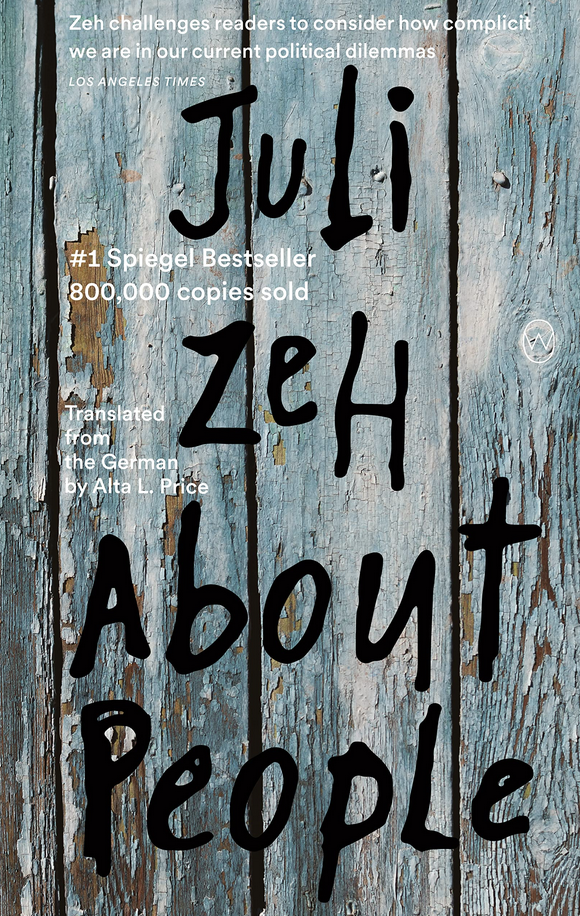
About People by Juli Zeh (Literary Fiction)

Writing: 5/5 Characters: 5/5 Plot: 4.5/5

Dora — a 36-year old advertising creative — thinks a lot. It doesn’t necessarily make her happy, but the stubborn core inside her makes her bristle at any hint of absolute truth, absolute authority, or socially enforced groupthink. Her long-term boyfriend, Robert, has become obsessed with climate change, steadily ramping up his insistence on (her) behavior modification to meet his right-thinking absolutes. When Covid hits, he retargets his laser focus on lockdown adherence and becomes unbearable in close quarters. Dora escapes to a dilapidated house in a small village for a breath of fresh air and finds herself in an AfD (right-wing German populist party) hotbed with the self-proclaimed Village Nazi as a neighbor. Thus begins an unasked for opportunity for a deeply introspective and stubbornly think-for-yourselfer to contemplate existence, humanity, and the nature of moral certitude while the world goes nuts around her.

Had I known anything about the author when I picked this book up, I wouldn’t have been as surprised as I was by how good it was — Zeh is an award winning German author and former judge. I realize that I haven’t kept up with European authors at all in the last decades. The writing / translation is excellent. Through a widely variable set of characters — her rigid climate activist boyfriend, the neo-Nazi next door, her highly confident (veering on the arrogant) neurosurgeon father, advertising colleagues, and a slew of village denizens — Zeh is able to cover a wide range of viewpoints on both specific hot topics (e.g. climate change, covid) as well as general socio-political attitudes towards life.

I loved this mildly satirical look at the way we humans cope with life — “mildly” satirical because it didn’t feel unkind to me. We all have our weaknesses, biases, rationalizations, and expectations and figuring out how to accept that ourselves and others seem like one of the more important problems to tackle. I appreciated Dora’s stubborn insistence on doing her own thinking and doing a lot of it. I loved the way explanation and depth was present in every argument, regardless of the character spouting it. It helped me to (surprisingly) be able to empathize with all of the characters, not just the ones I liked.

There were a lot of great quotes — here are a few:

“She follows the rules and regulations. But her thoughts remain free. Nobody can force her to view the beer drinkers outside the Spatis as treasonous public enemies.”

“What happened to the old certainty that there are no absolute certainties, which is why everything needs to be doubted, debated, and thought about? Dora couldn’t understand how Robert could feel so completely certain his lifestyle was so superior. She just didn’t follow.“

“The era of endless self-pity and constant complaining, JoJo will say. When everyone is always offended, afraid, and feels like they’re in the right. What a combination.”

“Take away the possibility of escape, and every refuge turns into a prison.“

“That sense of superiority is a long-acting poison that devours all humanity from the inside. “

“Then life prescribed her a neighbor. A nazi behind a wall. He was ugly and he stank. If he had been a product, he would’ve gotten only one star in the customer reviews on Amazon.”

“She’s often wondered what, exactly, lies behind this racism-triggered stiffness. Maybe a quandary. A series of impossible either-or decisions: Be a moralizer, or be a coward. Follow your convictions, or society’s expectations — or go for a third option and follow your aversion to conflict.”

“Everyone’s busy being interesting and important. And successful, of course, in both their professional and their personal lives. It’s a rat race of conformists outcompeting one another to come across as something special, someone different.”

“Of course there’s no law stating that neo-Nazis can’t appreciate hydrangeas. But it’s a jarring notion nevertheless. It poses a threat to the life-affirming yet mistaken idea that good and evil can easily be distinguished from one another.”

Thank you to World Editions and NetGalley for providing an advance copy of this book in exchange for my honest review. The book will be published on October 3rd, 2023