
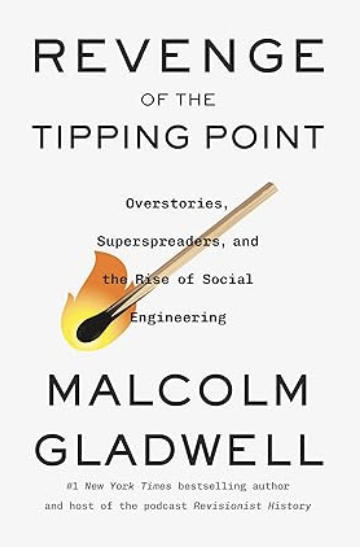
Revenge of the Tipping Point by Malcolm Gladwell (Non-fiction)

Always an engaging storyteller, Gladwell expands on the Tipping Point theme with an array of anecdotes, research, and social trends to show the impact of tipping points in many important constituents of our society. Ranging from localized bank robbery surges to medical mysteries to social epidemics to group proportions to — my favorite — why Harvard cares so much about arcane sports teams (like girl’s rugby), Gladwell works to understand the evolution of social problems and various bits of social engineering that have or could be applied to nudge things in the right direction. He includes several thought provoking ethical questions regarding these issues — no answers, but I always appreciate the ethical angle.

Some of the book sections that I particularly enjoyed: superspreaders — people who spread germs, pollution, bad behavior — spread orders of magnitude more than “regular” people. Group proportions — the “magic” 1/3 which is the fraction of a group that converts token outsiders into fully fledged members, with both good and bad consequences (think white flight and a truly shocking — to me — story of how Harvard developed its complex admissions process). Small area variation — how monocultures in small areas can lead to radically different behavior when compared to neighbor communities. Think vaccination rates, tonsillectomies, or suicide. The Overstory — how a story can get embedded into a culture without anyone being aware of the shifts. My favorite story here — a connection between the legalization of gay marriage and a long running sitcom starring an openly gay man.

In the last chapter — Conclusion — Gladwell applies the tipping point components developed in the book to the opioid crisis — quoting frequently from the Purdue Pharma (makers of Oxycontin) / Sackler family trial. I don’t completely agree with his conclusions, but was pretty shocked by some of the marketing and sales practices the pharmaceutical company used and how beyond effective (in terms of profit) they were.

Overall this was a thought provoking book, and I enjoyed reading it — with the exception of the first chapter about the LA bank robbery surge which for some reason both bored and upset me. If you feel yourself losing interest as well — just skip the first chapter! I quite enjoyed everything after.

The Idiot by Elif Batuman

Writing: 5 Plot: 3 Characters:4

Finalist for the Pulitzer Prize for fiction
Women’s prize for fiction short list

New words (to me):
– Amphibrach – a metrical foot consisting of a stressed syllable between two unstressed syllables or (in Greek and Latin) a long syllable between two short syllables.
– Stomatologist – One who practices oral medicine (at the interface between medicine and dentistry).

Simultaneously poetic and cerebral, this is an extended and (perhaps unintentionally) comic coming-of-age story that follows Selin, the daughter of Turkish immigrants, through her first year as a Harvard student. Her thoughts and experiences are meticulously analyzed and comically documented as she takes classes, meets new people, tutors locals, and goes to Hungary to teach English in a small village over the summer. The text considers the perspectives of several foreign students — for example, her best friend Svetlana is from Belgrade and Selin has a book-long infatuation with Ivan, a mathematician from Hungary. While she takes Russian, we are exposed to Russian culture as perceived via primer texts, and part two of the book is a hilarious travelog of her summer experiences in Paris, Turkey, Budapest, and the Hungarian countryside. Selin’s take on things is fascinating — her observations are honest and get to the root of the experience.

The novel is full of intellectual quirkiness: a class visit to a display of E.O. Wilson’s “favorite” million ants; a discussion of aesthetic vs ethical principles; lots of comparative linguistics such as the similarities between Turkish and Hungarian (both agglutinative, have vowel harmony, no grammatical gender) and the use of the miş suffix in Turkish (something that states the degree of subjectivity in what was said). That is just the tip of the iceberg — I loved her commentary on what she was learning and how it was taught — a far cry from the party oriented “college fiction” I was expecting!

This book documents Selin’s development through the year. She is excessively self-aware and says of herself, “The eternal pauper in the great marketplace of ideas and of the world, I had nothing to teach anyone. I didn’t have anything anyone wanted.” While one reviewer called her “young and stupid,” I think he missed the point completely. She is a social innocent for whom interactions are difficult. She tries to use her intellect to make sense of the irrational word of social discourse and the observations and commentary are hysterical.

The writing is wonderful. Although I wouldn’t bill this as a comedy, I kept laughing out loud. Batuman has this ability to swerve the sentence or phrase half way such that the ending is a jolt that makes you laugh in surprise. This pattern was writ large with the ending (which I will not give away) — similarly abrupt and surprising.

Some favorite lines:

“I said I was easy to entertain. Bojana said it was clear I had never spent five weeks in an Eastern European village.”

“The sky looked like a load of glowing grayish laundry that someone had washed with a red shirt.”

“Is there any way to escape the triviality dungeon of conversations?”

A great read if you’re in the mood for a long ponder (my usual state).