Typewriter Beach by Meg Waite Clayton (Historical Fiction)

I really warmed up to this book — it started off a little slowly and then became more and more intriguing with every chapter, ending with a lovely last line to cap it all off.

Dual timelines — an isolated set of cottages on the beach at Carmel in 1957. During the darkest times of McCarthy’s blacklists and the slow strangulation of Hollywood, a young starlet on the verge of being the next Grace Kelly is sent to wait in one of these cottages by the studio manager and all around fixer. Told to stay indoors and not be seen, she nevertheless meets her neighbor, the enigmatic Leo — a black listed scriptwriter with a haunted past. In 2018 we follow Gemma, whose beloved grandfather has just died and left her his cottage.

The story slowly unfolds, past to present, and while I often thought I knew what was happening, I was often quite wrong. The writing style is rich with thought provoking commentary and reflections. Hollywood — the deals, the norms, the restrictions, the cheats — is on display with all of the detail that I love — not just a description of events, but a description of the people living through those events and how they are changed, what they do to survive, what decisions they make (and sometimes regret, and often don’t). It’s the full experience and incredibly well-researched. I learned a lot about the different ways people dealt with the blacklist and (of course) the very different ways men and women had to deal with opportunities, threats, and restrictions.

Along with this spectacular depiction of the times and contexts is a lovely and often surprising story of love, family, parenthood, and friendship. I don’t want to give anything away, but there are multiple lovely stories of people finding love and family in a world not inclined to make it easy for them. Plenty of stories of people living in an environment not of their choosing and not in their control — and yet … finding their happiness.

Lots of intriguing details on Carmel and Hollywood — late credits for blacklisted screenwriters, a form of “me too” throughout the ages, morals clauses (for women only). I enjoyed every minute of it.

Thank you to Harper and NetGalley for providing an advance copy of this book in exchange for my honest review. The book was published on July 1st, 2025.
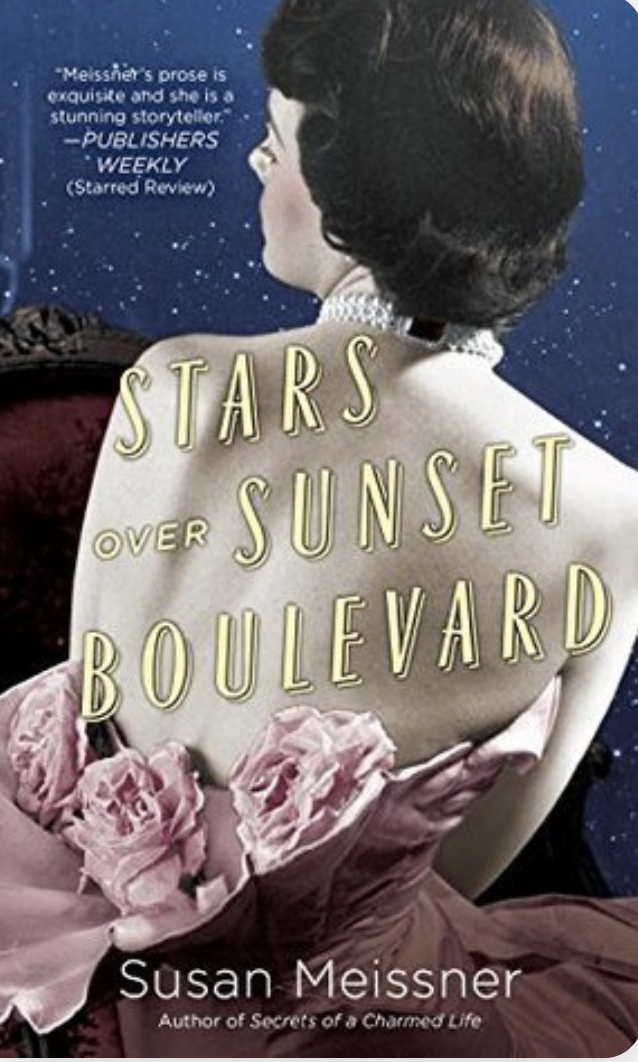
Stars Over Sunset Blvd by Susan Meissner (Historical Fiction)

This is the story of the long friendship between two very different women. Alabama born and bred Violet Mayfield, has fled from the home she loved when her dream of being a wife and mother is dashed. Audrey Duvall is desperate to restart a career that was dashed by the introduction of the talkies. They meet as secretaries on the set of Gone With the Wind in Los Angeles, 1938. The book follows the two of them to the ends of their lives, embedding the complexities of real relationships and the many emotional and moral issues that populate any thinking person’s life: honesty and fear, suspicions and jealousies, loyalty and deep connection. The audiobook reader was fine — a little too slo for my taste.

Susan Meissner is one of my favorite writers. She writes the kind of historical fiction that I love — plumped full of historical detail that awakens fascination — in this case, the movie set of Gone With the Wind. Full of every kind of detail — the technical work, the movie stars, the voice coaching (to make the British actors sound Southern), the filming of epic scenes such as the fall of Atlanta. If you’ve ever seen the movie (and if you haven’t, my goodness!) you’ll be spellbound by all that went into it. At the same time, Meissner writes the kind of human-centered novels that I like — full of thoughtful characters whose interior lives we access as they make their way through a life full of desires, setbacks, regrets, opportunities, and insights. And these are “regular” lives — no giant melodramatic events, but plenty of relatable experiences and thoughts. Her settings often include the kinds of ethical dilemmas we all face, along with the individual choices and the (often predictable and yet somehow surprising) fallout. Because that’s the thing about ethical dilemmas — there are no obviously right answers so some negative fallout is guaranteed.

On a deeper level, I initially felt a lot of judgement about one of the characters — I did not like her. Meissner managed to turn her behavior into something that could be understood (if not applauded), forgiven, and relationship deepening. It’s so easy to immediately judge and so difficult to try to understand. It was inspiring to watch the two continuing their friendship even when one or the other was feeling angry, resentful, or jealous. I was also impressed by some deeply felt and well articulated views on love and why people don’t need reasons to love someone and about recognizing the “brokenness” or maybe “incompleteness” of being young and how you choose to stay close to someone despite irritations, betrayals, and misunderstandings. That understanding, remorse, and a willingness for honesty can mend and make stronger any relationship. Surprisingly insightful.

Looking forward to Meissner’s next book (which I think is due out next March!)

No Crying in Baseball –The Inside Story of A League of Their Own: Big Stars, Dugout Drama, and a Home Run for Hollywood by Erin Carlson

A League of Their Own is one of my favorite movies. I’m sure I’ve seen it close to a hundred times. It’s funny, upbeat, and brings to light an easily forgotten piece of history with matter of fact detail that doesn’t slide into heavy handed territory. My daughter loved the movie so much she requested a trip to the Baseball Hall of Fame for her 9th birthday. This book is devoted to telling the “inside story.”

It’s a messy narrative, reading more like a super complete (and utterly engaging) set of IMDB trivia than a cohesive story, but if you loved the movie, you’ll love reading all of it: the incredibly drawn-out, complex, work of casting; Penny Marshall’s very insecure directorial style; her mega-lavish use of film (Kodak threw an expensive party for the cast and they don’t do that for every film!); the detailed history of women’s athletics over time and how that impacted the film, the crew, and the many, many, women who swarmed the tryouts for athletic extras.

I didn’t read through the copious notes at the end of the book, but Carlson basically took each topic and interviewed or studied interviews of cast, crew, friends, family, etc so that the reader gets an extensive set of viewpoints without the author sticking her own oar in too often. Everything from feminism to unaddressed lesbianism to all the hidden elements of making a film — so many personalities and so few of them easy. I found all the various bits of financial and creative control and the way individual contracts stipulated such to be quite fascinating. The in-depth baseball training and the injuries the actresses sustained (a broken foot, a broken nose, and that horrible thigh length bruise Shirley Baker sustained that was NOT makeup(!) really grabbed me.

All the details of making the movie were nested in a complete history of Penny Marshall from birth to death — which I had already read about in Marshall’s memoir but was still interesting (and accurate). I loved this one Penny Marshall quote: “I think my problem is that I have a massive insecurity complex combined with a very huge ego.” Seems to be accurate!

I was surprised by some of the information on women’s sports — I’m not even a little bit sporty so it was all new to me — the public attitude towards women in sports and the various excuses used to push them to softball, for example, when the top athletes were perfectly capable of playing baseball. The idea that women were physically inferior and unable to keep up certainly permeated my thinking growing up in the 60s. Being not sporty (at all) myself, I never challenged any of those assumptions. Add to that the idea that it would emasculate the men if they were included certainly didn’t help anyone. The parallel to this story is the story of women in Hollywood as they vie for a spot in this almost all female and female directed cast.

Very enjoyable reading especially if you loved (or even liked) this movie!

Thank you to Hachette Books and NetGalley for providing an advance copy of this book in exchange for my honest review. The book was published on Sept. 5th, 2023.

The Devil You Know by PJ Tracy (Mystery)

Book number three in the Margaret Nolan series (I still haven’t gotten around to reading number one but I really liked number two). This one has all the glitz, glamour, and ultimately scumminess of Hollywood. A beloved celebrity is found dead — accident, suicide, or murder unclear — days after a nasty-nasty (but deepfaked) video of him sped out over social media. Nolan and partner Crawford have a more difficult time “reading” the persons of interest as they are all actors and good ones at that.
Very good writing (see a couple of quotes below) and I like the regular characters who have depth and develop with each book. I didn’t love the “bad guy” characters as much as last time — they seemed more shallow and two dimensional — but it’s Hollywood and I expect that comes with the territory!
A fun read, and I’ll be happy to check out book four when it comes!

Thank you to Minotaur Books and NetGalley for providing an advance copy of this book in exchange for my honest review. The book will be published on January 17th, 2023.

The Seven Husbands of Evelyn Hugo by Taylor Jenkins Reid (Fiction)

Writing: 3/5 Plot: 3/5 Characters:2/5

Not sure why this book is so popular — the writing was abrupt and cliched, the plot predictable, and the greatest insight any character came up with was “family is so much more important than wealth and fame.” Well, duh.

OK, that’s a lie. I do know why it’s popular. It’s easy to read, there is plenty of money and glamour and, of course, the real story behind all those husbands! If you like reading People magazine you’re going to love this! There is also a big LGBQT theme serving as a good reminder of what life was like when there were few professions where being “out” wouldn’t result in that profession being yanked away regardless of your talent / merit / success. We still have problems today, but nothing like what people in that community faced before.

For me it was just kind of trash literature without the requisite (IMHO) happy ending and feel good vibes. The big reveal at the end didn’t work for me — too pat, too unbelievable in many ways, and simultaneously too predictable.

I don’t write many negative reviews — maybe 3 in the past 5 years? If I don’t like a book, I simply stop reading it. And this isn’t a fully bad review. The writing is readable, the characters obviously weren’t meant to be deep, and the plot does keep you reading. It’s just disappointing in face of its popularity and not the kind of book I would normally waste my time reading…

Great Circle by Maggie Shipstead (Literary Fiction)

Writing: 5/5 Plot: 4/5 Characters: 5/5

The sweeping story of a daring aviatrix (Marian Graves) who is determined to be the first to fly around the globe longitudinally and the self-destructive actress (Hadley Baxter) who will play her in a movie 60 years later. Their somewhat parallel stories (orphaned young, raised by benignly neglectful uncles) and innate curiosity help Hadley delve into the character more than the screen-writer had.

This book was interesting on so many levels. Stunning descriptions of gorgeous locales — Montana, Alaska, and Antarctica between 1920 and 1950 — spread throughout. In-depth discussions of aviation and art, as well as philosophical dives into isolation, the lure of solitude, the impact of war, and the evolution of personal identity are also ubiquitous. Shipstead really gets inside a subject, presenting it not as a separate entity but through the character’s perception of it. We see Antarctica not as a dry description of mountains and snow, but through Marian’s perspective, and it feels as though her soul is exposed through the beautiful language of what she sees and feels. Similarly, while aviation has no appeal for me, Shipstead describes Marian’s intellectual and emotional engagement with it, and I can feel the (unnatural for me) attraction. It’s a rare author who can transmute a dry topic into fascination through the mind of an obsessed character. Even the Hollywood bits feel real through character insight, rather than splashy opulence and name dropping.

Plenty of historical context is introduced via short tidbits from the news (flights from other aviatrices, difficulties for women in trying to achieve in male-dominated worlds, etc.). As always, I like the fact that the author just wrote the story, with realistic reactions and approaches of her characters and didn’t spend time pontificating on the obvious. Yes, life was much harder for women who wanted to pursue the unorthodox, but this story is about what they did anyhow, not what they were prevented from doing. Her writing style is also not overly dramatic — no heart wrenching prose — though the tale abounds with angsty opportunities.

I’d forgotten that I’d read one of Shipstead’s earlier works — Astonish Me —about ballet dancing and defection. She reminds me of Jennifer Egan a bit (I’m a big Egan fan) in the way she can bring clarity to complex topics in a variety of subjects.

A quick warning — I found the first two chapters a little dry — it gets much, much, better. Highly recommended.

Some good quotes:

“…how best to squeeze Marian’s completely unknowable existence into a neat pellet of entertainment…”

“…and out over the loose northern jigsaw of spring ice that the planet wears like a skullcap, …”

“There should be an Antiques Roadshow for memories, and I would sit behind a desk and explain that while your memory might be lovely and have tremendous sentimental value, it was worth nothing to anyone but you.”

“The landscape is secretive and harsh and impossibly immense, and she borrows some of its inscrutability for herself, its disinterest in human goings-on. Unfriendliness is another form of camouflage.”

“Mountain everywhere: monstrous, ice-choked cousins of the forested peaks that had encircled her as she looped and spun over Missoula.”

“Was this what her father had done after he left Missoula? Slung his skills over his shoulder and set out?”

“Does that mean I wish to die? I don’t think I do. But the pure and absolute solitude in which we leave the world exerts a pull.”

“She thinks he means that no matter what earnest promises of peace are made, what fragments are hauled up and glued back together, the dead will not return. A return to the world as it was is impossible; the only choice is to make a new world. But making a new world seems dreary and exhausting.”

Thank you to Knopf and NetGalley for providing an advance copy of this book in exchange for my honest review. The book will be published on May 4th, 2021.

Set My Heart to Five by Simon Stephenson (Literary / Speculative Fiction)

Writing: 4.5/5 Plot: 4/5 Characters: 5/5

Jared is a bot. Engineered from human DNA, he lives a productive life as a dentist in Ypsilanti, Michigan and is deeply programmed to serve humans. Until one day … he starts to have feelings. Thus begin his simultaneously hilarious and yet poignant adventures as he heads to Hollywood to write a screenplay daring to portray bots as beings deserving humane treatment and not the “killer bots” that comprise the bulk of modern cinema.

The social commentary is priceless as Jared struggles to make rational sense of human behavior. Jared’s “voice” as a developing character is so appealing — his way of expressing surprise, disbelief, and acceptance is incomparable. He refers to himself as a “toaster with a heart.” Bots are the new underclass in this world because after all — they aren’t even human. While the journey is comic (laugh out loud funny much of the time), there are plenty of deep things to think about: What makes us human? What should our relationship with other beings be? What kind of “programming” do we humans have of which we are not explicitly aware?

In some ways this reminded me of Vonnegut — the speculative and humorous extrapolation of today’s social mores — but with a little more depth in terms of human (or bot) experience and how we treat others. As fun additions, there are some great descriptions of classic movies (without titles) that are fun to see through Jared’s eyes (and try to make the identification), some fun screen-writing tips, and all the details of a futuristic road trip adventure.

I won’t give away the ending but I loved the way the author embedded an intricately layered set of foreshadowing and self-referential plot twists.

Thank you to Hanover Square Press and NetGalley for providing an advance copy of this book in exchange for my honest review. The book will be published on September 1st, 2020.

City of Flickering Light by Juliette Fay (Historical Fiction)

Writing: 3/5 Characters: 3.5/5 Plot: 4/5 Historical setting: 5/5

A great story! It grabs you from the first page and won’t allow itself to be put down. It’s a fascinating piece of historical fiction taking place in Hollywood during the Silent Era (1890s – 1920s). The history comes to life through the experiences of our three main characters: Irene Van Beck, Millie Martin, and Henry Weiss. In the opening scene, the three jump off a moving train to escape their current employer — the Burlesque company Chandler’s Follies — and its enforcement goons. They make their way to Hollywood for a chance at a better life.

This is my favorite kind of historical fiction — the author embeds as many of the personages, events, and mechanics of the era into the story as possible: vaudeville, burlesque, and films; jobs within the studios (scenarists, costumes, editing, etc); prohibition and speakeasies; taxi dancing and prostitution; (legal) use of heroin; housing issues (No Jews or actors!); unintended pregnancies; a budding studio Publicity department and the power of the Press to destroy; fancy Hollywood parties; and most interesting — the feel of the small Hollywood enclave within which social mores are relaxed, and many kinds of “forbidden” love are possible (though only with great discretion — hence the budding Publicity department).

In summary — a terrific story with a real feel for what life was like, embedding historical facts and figures without fictionalizing real people (I hate that!). The characters are very likable, with fully fleshed out, historically accurate, backstories (but not the rich interior life that I like). Excellent pacing, decent writing, the story “sticks” with you for a long time…

As an aside, the author lists many sources in the afterward, including a reference to a 13 part documentary called Hollywood: A Celebration of the American Silent Film. All the episodes (listed here: https://en.wikipedia.org/wiki/Hollywood_(1980_TV_series)#Episode_list) are available on YouTube. Start at Episode 1: https://www.youtube.com/watch?v=8mo3Z8IkLnU.

Thank you to Gallery Books and NetGalley for providing an advance copy of this book in exchange for my honest review. The book will be published on April 16th, 2019.

Just the Funny Parts by Nell Scovell

Writing: 5; Importance: 4; Pleasure Factor: 5

Funny, personal, and important – all in one sparkling package!

There’s been a recent spate of celebrity memoirs written by female comedians. I’ve read (or tried to read) them all:  Tina Fey’s Bossypants, Anna Ferris’ Unqualified, Mindy Kaling’s Why Not Me?, etc.  This one is much, much, better — no doubt due to the fact that Nell Scovell is a comedy writer rather than a comedy performer and therefore can really write!

This memoir is part sitcom, part Hollywood wannabe training material, and part exposé on the difficulties of women getting fair treatment (or any treatment at all, really) in the industry. The very first line is her own paraphrase of Nietzsche: “That which doesn’t kill me … allows me to regroup and retaliate” — a great and apt opening!

I love Nell’s writing – it’s well structured and quite personal but never strident nor overly dramatic. Some great quotes, intriguing character profiles, factual depictions of the diversity (or utter lack thereof) in writer rooms, and a real sense of the frustrations in the field. The book is littered with fabulous (and funny) story ideas that went nowhere for no reason.  Her summarized job timeline in the appendix is full of “shot but unaired”, “unshot”, and “unsold” labels, with what feels like a tiny sprinkling of successes.  Such futility!  Any dreams I had of working in Hollywood (luckily I had none) have been thoroughly quashed by reading through this descriptive tour of a Hollywood writing career. At the same time, Nell’s love and passion for the work is obvious, and it is clear she wouldn’t choose to be doing anything else.

Perhaps you know her from Sabrina the Teenage Witch or perhaps from her co-authorship of Lean In with Sheryl Sandberg.  Even if you’ve never heard of her at all, you’ll enjoy this well-documented peregrination through her life as a writer of comedy. FYI I tend to find non-fiction a slog, rarely making it past the 1/3 mark, but I gobbled this book up in two days.