How to Age Disgracefully by Clare Pooley (Fiction)

I loved this book. It was hysterically funny and I found myself laughing out loud on almost every page, multiple times on some. I definitely got some looks on the subway.
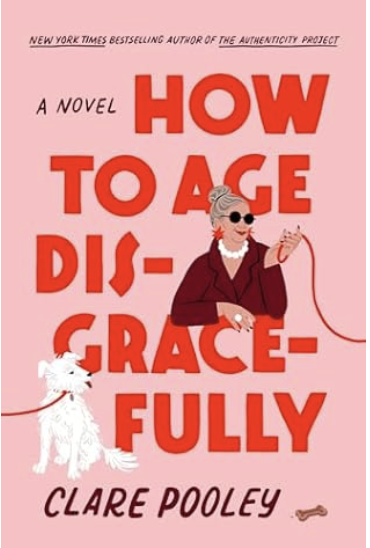
A community center housing a senior citizens social club and a daycare is threatened with closure when the board gets greedy for development money rather than making the effort to fundraise for repairs. But the senior citizens (and one desperate teen father) will do anything to keep that from happening and come up with some pretty interesting long shot ideas. FYI these are not senior citizens living up to society’s (pallid) expectations! We’ve got the larger than life Daphne whose future is bleak but whose past was “extraordinarily colorful;” Art, the actor who specializes in playing dead bodies while managing a small kleptomania problem; Ruby, the Banksy of knitting; Anna, the ex-trucker with quite a number of dead husbands to her credit; and William, the retired Paparazzo who puts his (IMHO sleazy) skills into useful practice. All supposedly organized by the 50 something Lydia, whose life has been drained of purpose but filled by an utter a*hole of a hubby. There is something very appealing about old cranky people getting a new lease on life, and this intensely uplifting book has that in spades.

I loved the characters (a teen father? how often does that happen?), loved the humor and excellent writing, and loved the random thoughts on aging — like how to take advantage of the apparent invisibility of the aged for your personal aging benefit. I loved the author’s note where she claimed she still did not feel like a “grown up” despite her “advanced” age — I so relate to that! Lastly, I loved the reference to the Dylan Thomas poem “Do not go gently into that good night.” How many times have I heard of that poem without ever bothering to actually read it and think about what it means? Here are the first lines:

Do not go gentle into that good night 
Old age should burn and rave at close of day;
Rage, rage against the dying of the light.

There is more — it is good — go read it if you haven’t …

Some great quotes — only a tiny fraction!
“She appeared to have jumped out of the frying pan of sexism and into the fire of ageism. The final frontier of isms.“

“There was nothing better than listening to someone else’s guilty conscience being offloaded.”

“Her comfort zone was exceedingly spacious, but this experience lay well outside of it.”

“She needed to turn over a new leaf. Become an entirely new plant, even.”

“Despite her age, Daphne seemed to have the hearing of an adolescent bat.”

“Why on earth, when there were so many more important things they could be teaching their children, would parents waste their time reading stories about an insect with a dysfunctional relationship with food?” (about the Hungry Caterpillar)

“Daphne wrote texts, he’d discovered, just the way she spoke in proper full sentences and with perfect grammar and an under current of condescension.”

“She leaned forward and gave the man she was with a peck on the cheek, an incidental comma nestling up to a bold exclamation mark.”

“Art had tried to call his new pet Maggie, as instructed by Lydia, but her surname lurked in the ensuing pause like toxic waste.” (pet’s full name was Margaret Thatcher)

Thank you to Pamela Dorman Books and NetGalley for providing an advance copy of this book in exchange for my honest review. The book will be published on June 11th, 2024.

Sandwich by Catherine Newman (Literary Fiction — Humor)

Writing: 5/5 Characters: 5/5 Plot: 4/5 Humor: 5++/5

Ok, this book is just flat out funny. I snorted, giggled, and guffawed my way through it with only occasional pauses. But while it gets top top grades for humor, it has plenty of depth, too. Ostensibly about a week at the beach with an extended (and all adult) family, it’s a study of functional (as opposed to dysfunctional) family dynamics. Many readers seem to want intense drama, with earth shattering impact, but I love these close looks at how real people work and learn and connect. The themes are family, love, and life with plenty of personality, philosophy, and interaction thrown in and a strong focus on parenting, pregnancy, and reproduction. Also the (new to me) phrase “anticipatory grief.” Wow — I should have learned that one a long time ago…

I loved the characters and the way they interacted. Our first person narrator is Rocky (Rachel) — a mother so full of emotion and worry and menopausal heat she is constantly threatening to (metaphorically) explode. I liked the way husband Nick — even as told through her eyes — is depicted so completely and not just a bit player in Rocky’s drama. Without giving anything away, I thought he was masterfully written. I loved the multifaceted views of all of the characters — both as themselves and also as they were in relationship with each other. I also appreciated the way Newman dealt with daughter Willa — the requisite lesbian through whom plenty of social commentary on LGBTQ+ issues was included in a nice relaxed, off key way that both made me laugh and made me think.

I also loved the dialog — it was written the way I wish people would speak — fast, humorous, and with a high signal to noise ratio. General banter and friendly family squabbling throughout but always overlaid on clear, honest, and trusting communication. I could be laughing at the (over-the-top-of the-top menopause complaints and then be tearing up at the essential humanity and love concisely tucked into an honest exchange. Kind of a combination of Nora Ephron (humor), Matthew Norman (human exchange), and Anne Lamott (parenting and reflection).

I will say that the inside of Rocky’s head is a fun, but very tiring place to be and I’m glad I don’t live there permanently.

Quotes:

“Ugh, my voice! You can actually hear the estrogen plummeting inside my larynx.”

“… I say quietly, but my veins are flooded with the lava that’s spewing our of my bad-mood volcano. If menopause were an actual substance, it would be spraying from my eyeballs, searing the word ugh across Nick’s cute face.”

“People who insist that you should be grateful instead of complaining? They maybe don’t understand how much gratitude one might feel about the opportunity to complain.”

“I’m always Sherlock Holmesing around them all with my emotional magnifying glass, trying to figure out if anybody has any actual feelings and what those might be.”

“Also he will get out the innocuous-sounding foam roller that is actually a complex pain device designed by people who hate everybody. I’ve seen enough videos of cats terrorized by cucumbers to know what my face looks like when I suddenly see the foam roller.”

“Nick’s curiosity about feelings and the people who have them is fleeting at best.”

“Forty percent of my waking thoughts were about the children dying — the other sixty about sleep. I was ashamed of this demented pie chart.”

“A conversation like this might be a wolf in clown’s clothing, and he knows it. My rage is like a pen leaking in his pocket, and before long there will be ink on his hands, his lips.”

“I mince down the spiral staircase in my memory-foam slippers, all of my joints clacking like the witch in a marionette performance of Hansel and Gretel.”

“All of the names of everything have oozed out and away from the drainage holes menopause has punched into my memory storage.”

“My ancient father actually swimming in the ocean feels like a bridge too far in terms of what I can handle fretting about.”

Thank you to Harper and NetGalley for providing an advance copy of this book in exchange for my honest review. The book will be published on June 18th, 2024.

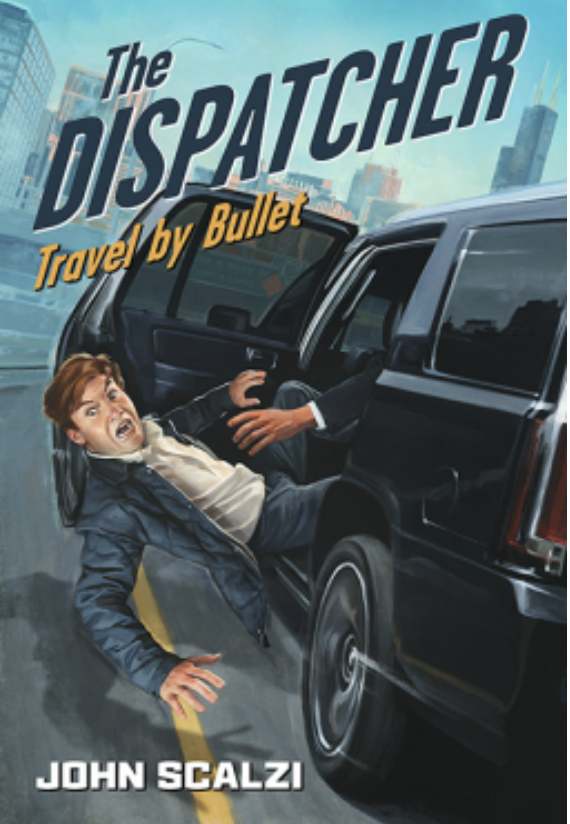
The Dispatcher: Travel By Bullet by John Scalzi (Sci Fi)

Scalzi always has a Big Idea behind each one of his books, which he then wraps with action, humor and some world class banter. His characters are always smart asses — the kind I’d like to hang out with, not the adolescent smirking types that I’m utterly sick of. And he always draws me in with the very first line — in this case: “It was 2:48 PM on a Tuesday, and I was about to do the same thing for the third time since I began work at noon: convince some distraught people that I shouldn’t, in fact, kill their loved one.”

The premise of The Dispatcher: for reasons no one understands, if someone intentionally kills someone else, that person will come back to life 999/1000 times — buck naked and in a place they consider safe, with a body in the state it was in about a day earlier. The new Family Compassion Act gives families the right to request dispatch.

Toss in cryptocurrency, some very rich people with their own twisted philosophy about what makes life worthwhile, and a loner hero with strong ideas about friendship and you have a very entertaining Scalzi ride.

Thank you to Subterranean Press and NetGalley for providing an advance copy of this book in exchange for my honest review. The book was published on April 30th, 2023

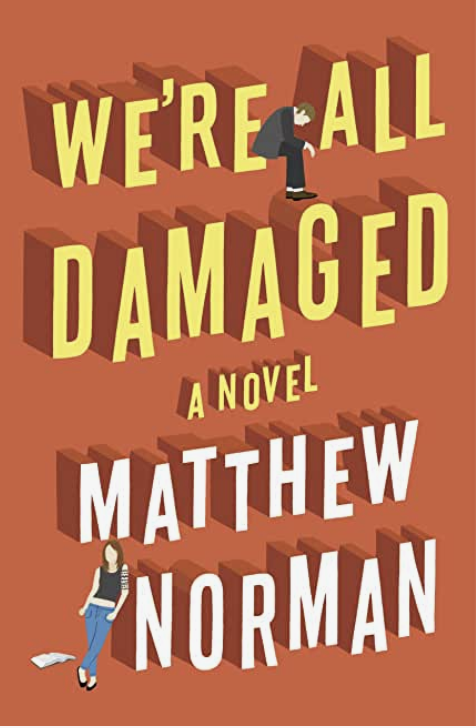
We’re All damaged by Matthew Norman (Literary Fiction)

Broken wrist making reviews hard to type, but I have loved every Matthew Norman book I’ve read, and this is no exception. Humorous (very), yet deep. Wild characters (mom is a Fox News wannabe and his new friend Daisy teaches “vagina fiction” for a start). Draws you in within the first two paragraphs. Kind of a non-Jewish Jonathan Tropper (high praise for me).

Some fun quotes:
“It was our waiter. He was smiling in that maniacal way, that waiters at places, like Applebee’s smile, like they’re all doing methamphetamine back in the kitchen.”

“I’m still not used to living here. I’m not used to the crowds and the constant noise and the weird hours. I’m not sure exactly what it feels like, but it doesn’t feel like home — more like a strange, wildly, expensive Sleep away camp for pseudoadults. I step across the street and I’m nearly run down by a pack of skinny men on bicycles.”

“In all our family portraits growing up, I looked like a short, half-Jewish kid being held captive by a family of Vikings.”

“Jim is the hyper-achiever. You’re the moody one. That’s not a bad thing, by the way. Never trust someone who isn’t miserable at least half of the time. That’s my motto.”

“ ’There’s an entire genre of writing now that’s empowered women to type out their sex fantasies and publish them on the Internet. If you knew how many euphemisms for vagina I endure on a weekly basis, your little heart would break.’ I wasn’t prepared to hear the word vagina this evening. Up front at the register, Gail, apparently wasn’t, either. She clears her throat and gives us a librarian look. That’s the thing about the word vagina: it really carries in a quiet place.”

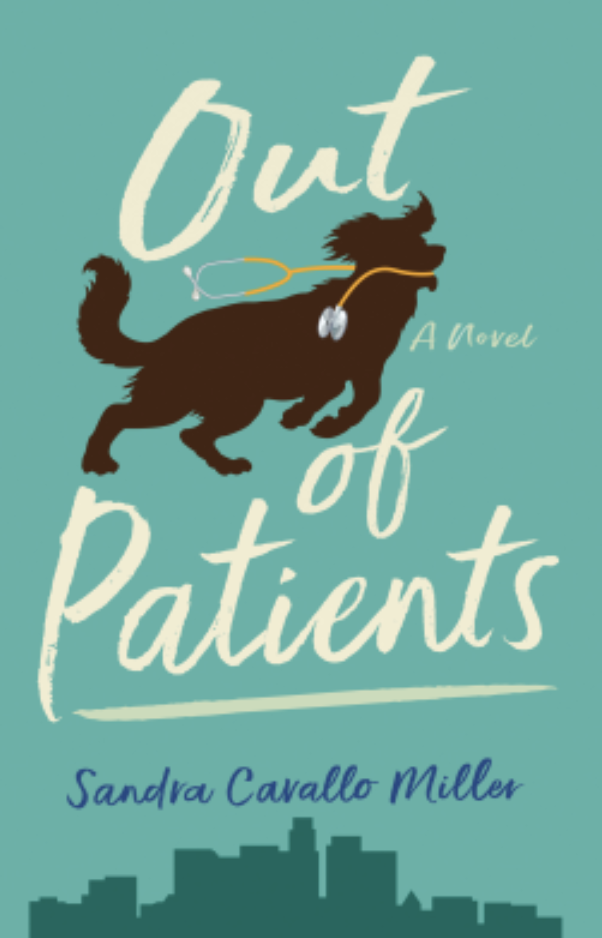
Out of Patients by Sandra Cavallo Miller (Fiction)

Story: 4/5 Characters: 5/5 Writing: 4/5 Enjoyment: 5/5

Norah is the tending-toward-cynical but unfailingly caring and dedicated family practice doctor in the Arizona desert. In her 50s, she thinks of retirement almost every day, but can’t get herself to pull the trigger.

With a jaded but humorous and never bitter tone, Miller brings to life the modern family doctor. Forget Marcus Welby, Norah and her colleagues are beset with endless regulations, condescending specialists, arrogant medical students, health insurance battles, and a plethora of patients who don’t always (ie hardly ever) advance their own cause. On top of this, the practice seems to be losing money despite a full waiting room, and someone is leaving nasty-notes on car windshields. Norah had to kick her do-nothing boyfriend of three years out of the house for … continuing to do nothing, and she has nearly daily calls with (possibly my favorite character) her 86-year old mother who has a crush on the elderly, but well-built mailman and gives detailed instructions on what to do if she doesn’t answer the phone (wait several days to make sure she is dead!). While too grumpy to even consider dating, Norah does come across some potential love interests — an even grumpier vet and a shy radiologist who suffers at her side during endless student admissions committee meetings .

I loved the tone, loved the characters, and appreciated the peek into a real doctor’s life by someone who a) has lived through it themselves and b) translates her knowledge into a highly self-aware and comical story. Some very interesting medical tidbits and asides as well…

Some good quotes:
“To give your life more purpose, for what that’s worth. I’m not sure anyone has ever convincingly proved that human life actually has a purpose. Evolution just does its thing. Sunrise, sunset.”

“I guess when your spirit pales to a washed-out shadow, you grow tentative.”

“Once upon a time we became physicians, but now we also must perform as secretaries and transcriptionists and file clerks and coding authorities and billing experts ad regulations enforcers.”

“And I wondered how anyone can eat baloney, that mash of pig snouts and ears and genitals. You can feel gritty little bits of bone.”

“That made me sad, but why should it? Why should I impose my arduous overdrive, my endless quests, on a quietly contented person?”

“No, apparently my ego needed to analyze and try to fix them. Make a difference in their lives. Maybe I worried that my failure with Grace, a previous student, might repeat itself. I may have mentioned how doctors often obsess about doing things right.”

“Nobody listens. Sometimes I feel like a tiny squeaky voice in a wind tunnel, about to be blown away.”

“And even before I say this next sentence, I’m aware it isn’t fair, because I know tons of great physician men, smart and intuitive, generous and wise. But between Jeremy Newell and Carter Billings, I’d drink my fill of medical males that day.”

“A long afternoon, but mostly rewarding. Nothing easy, nothing cut and dried. Everyone needed to talk. Mostly good patients, all with real problems. No one surly or defiant, no one acting like I owed them good health because they demanded it, no matter how unwilling they might be to earn it. Every now and then those petulant people stayed home and I felt in my element, listening, sorting, treating. Come on, Norah, I told myself, settling in with my charts after everyone had gone.”

“What would fix me would be better healthcare systems, not spending hours grappling with a convoluted computer program. Where I got more than ten minutes with an addict. Consistent medical billing and affordable insulin. Free insulin, Where medical students didn’t lose their glittering idealism in a few short years, while a handful of ego-besotted attending physicians badgered them into despondency. Until some students lost themselves under the crushing demise of their dream. The statistics on physician suicide are dreadful — every day, at least one physician or medical student is lost forever. What an unforgivable waste.”

Thank you to University of Nevada Press and NetGalley for providing an advance copy of this book in exchange for my honest review. The book will be published on August 16th, 2022.

Toil and Trouble by Augusten Burroughs (Memoir/Humor)

Thank you to St. Martin’s Press and NetGalley for providing an advance copy of this book in exchange for my honest review. The book will be published on October 1st, 2019.

It’s hard to believe but this is my first Augusten Burroughs book! I’ve heard of Running With Scissors of course but somehow never managed to get to it. My loss. Burroughs is funny, clever, and writes in a wickedly delicious, entre-nous style. In this segment of his ongoing memoirs, he and husband Christopher make the move out of Manhattan. This includes convincing Christopher that he wants to move, searching for houses, and engaging with the “perfect” home once purchased. The heavy thread running over, under, and through it all (as you might have guessed from the title) are his “magick” and witchcraft skills. Regardless of your opinion on witchcraft, this is a compelling and comprehensive story, comprising personal experience, historical references, an analysis of what witchcraft really is, and lots of lots of laugh-inducing stories. I tossed skepticism aside and just ate it all up.

Reading this book (and probably all of the others), it’s hard not to want to want to befriend the guy (whether he’d want to befriend us back is another story). He manages to turn his (self-reported) “spectrum directed mind” and anxiety (his “default emotion”) into pure entertainment for his readers. I’d really like to have him over for dinner.

Pretty much every line is a quotable quote, but here are a few of my favs:

“Once we pull into the driveway, I know right away: this house is a vampire. It will want all our neck blood and then the blood of our unborn parallel universe children.”

“I’ve always been incredibly socially awkward. Autism runs in the family like detached earlobes. I obviously got sprinkled with enough of it to make me come across as a horrible snob. I wish there were more opportunities to turn this to my advantage, but so far, no luck.”

“I feel off atrocious news stores the way most people today consume kale. Nutrition comes from abductions, electrocutions, capsized boats, and freeway pileups.”

“Every sound of dropping signals water penetration. I wish I could be injected with ape tranquilizers.”

“Being plunged into the colonial era is informative. I learn that my mental health and stability is directly proportionate to the mount of charge on my phone.”

“Back in 1990, the internet was made of paper and it wasn’t called the internet, it was called the Village Voice.”

“It is moving day and we are already an episode of Hoarders.”

Hope and Other Punchlines by Julie Buxbaum (Young Adult)

Writing: 5 Characters: 5 Plot: 4

16-year old Abbi Weinstein is known to the world as “Baby Hope” — she was the one-year old birthday girl clutching a red balloon fleeing the towers in the arms of a day care worker in an iconic (fictional) photograph from 9/11. Noah Stern is obsessed with that photo because he holds the secret hope that one of the background figures is his father, presumed dead. Both hail from Oakdale, New Jersey, a fictional town loosely based on Middletown, New Jersey, with the dubious honor of having the largest number of 9/11 fatalities outside of New York City. Together, they slowly put together the missing pieces from that day, and the ongoing impact ripples on the people affected.

Despite the subject matter, this is an uplifting book. It’s full of humor, friendship, and love as well as a lot of heartfelt and sob inducing stories. It is a way forward from tragedy, not a hopeless and depressing fixation on it. I like YA fiction because somehow the issues are clearer — less muddied by the accreted neuroses and mental sluggishness of age — and I am able to learn more easily from it.

I think Julie Buxbaum is brilliant — I love her characters and her humorous, banter-rich, prose. Each of her books focusses on real and difficult issues — and helps the characters work on making sense of the world and their place in it. This book is easily the best of all — I read it in one sitting. The stories woven together were touching, personal, and inspiring. I sobbed through a lot of it, but finished feeling centered and hopeful.

There are so many great lines in this book — here are a few:
“I think our stories are actually what make us people. We each have a history… Stories are like the … currency of connection. And all your stories woven together might tell some larger story about the history of our country from that moment to now.”

“I was fashionably late to the existential panic party.”

“She’s the one who gave my mom her stoicism. In my mother it takes on a cheery perversion, but my grandma is all strong, clean lines, when it comes to the difficult stuff. She’s stating a fact, true words without any sentimentality.”

“My mother has always liked to outsource our difficult conversations. It was my dad, not her, who sat me down last spring and asked if I’d be interested in going on the pill.”

“Well, the good news is that awkward phases help with long-term personality development.”

“All it takes is a tiny, inexplicable tear in the fabric of the moral universe.”

Abbi’s grandmother is suffering from the beginnings of Alzheimers — this is what she tells Abbi: “You know what I think about sometimes? I think about how all the little bits of me that I’m losing will somehow find their way to you. Like they are … what’s the word … tangible. Like they are tangible things that can crawl from my bedroom to yours and so as I become less me, you will become more you, and I will continue to march on within you when I’m not me anymore. You’re going to keep growing. That’s how it’s supposed to be.”

“Life can really suck, right? So why not make it at least a little bit fun whenever we can? I mean, think about it. There are few things that a well-timed joke can’t solve.”

“Pretty much everything about being in high school is embarrassing. Not only the hours spent jerking off behind locked doors, the days cooped up in windowless classrooms — not to mention the greasiness of it all. I’m talking our very existence. We are a reminder to grown-ups of how far they’ve come and how much further they wish they could go.”

“When you have a kid, it’s like letting your heart walk around outside your body. You never get used to it.”

Goodbye, Vitamin by Rachel Khong

Writing: 4/5 Plot: 4/5 Characters: 4/5 Personal Enjoyment: 5/5

Sweet, touching, and laugh-out-loud funny — and this is a book about Alzheimers. I didn’t think that sentence was even possible!

30-year old Ruth quits her job in San Francisco to move back home (Southern California) to help with father —a prominent history professor father (Howard) who is slowly losing his mind to Alzheimers. Written in a journal style (short, dated, segments over a year), the entries slowly morph into a set of notes addressed to her father describing their days together — a mirror of the delightful notes he had addressed to her about their time together during her childhood.
Ruth, her brother, and her mother all have their own issues to deal with — breakups, infidelity, betrayal — but the focus on helping Howard helps them in unexpected ways: Ruth finds herself more forgiving, and more understanding of the frailties of the people around her. The story abounds in kindnesses, both large and small. Instead of focusing on the loss, they are able to reestablish the love and connections that bind them into a family, with this new (or old) version of their father. A beautiful, and insightful, line: “Sharing things is how things gets started, and not sharing things is how they end.”
Well-written, fun to read, full of odd factoids and observations, and really touching insights into what relationships (of any kind) are really about.
Great for fans of Weike Wang.