
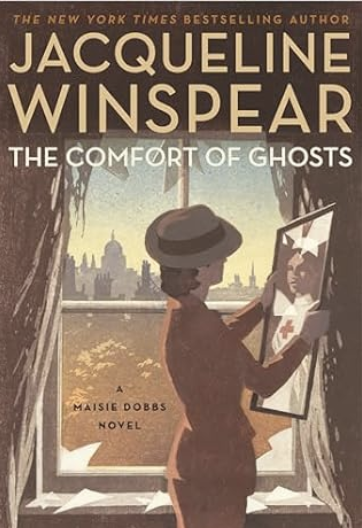
I feel a melancholy knowing that this is the last of the Maisie Dobbs series. I’ve enjoyed the series tremendously — Winspear is one of my favorite historical mystery authors. The series follows Maisie Dobbs from 1910, when she was a 13-year old housemaid in the Compton manor house — through her experiences as nurse, psychologist, and investigator spanning two world wars and their aftermaths. Most involve mysteries, equal amounts mysteries of the spirit as well as of the body(ies). This is the 18th (and final) episode.
The book opens in October, 1945 with an unknown man in a demob suit looking at his reflection in a shop window and thinking to himself: “He couldn’t face home. Not yet. Perhaps not ever. Couldn’t face the wanting in the eyes of others, the wanting for him to be himself again, the man they had known so long ago. But that old self had perished, and now he was looking at the reflection of a wraith that turned out to be him. Alive. Against all odds.” I was hooked (and moved) instantly. This story is focused on recovery — the war is over and people are trying to rebuild lives and there are equal amounts of guilt, relief, worry, and grief. As the last book, we find closure for most of our favorite characters along with some new additions, all going through what it takes to heal from the overwhelming residue of the war. Because after all of the celebrations, England is still struggling with rampant homelessness (think the Blitz), food shortages, missed loved ones, broken bodies and minds, and near financial ruin at the national level. Winspear covers this without melodrama in a way that I rarely see captured in fiction. Full of the reality of individual lives that refuse to be overwhelmed by ubiquitous calamity, yet obviously experience great tears to the soul from the devastation of their homes and families.
I’m going to miss this series. I’ve grown to love the characters, the friendships, and the deep portrayals of individuals coping when faced with the barely surviving wreckage of their civilization. Winspear differs from other historical fiction authors not in her research of the past (which is excellent and thorough) but in her ability to find the depth and impact in “ordinary” lives during extraordinary times. She is a keen observer, diving into personalities and professions ranging from housewife to civic leaders to the aristocracy to Scotland Yard personnel to the many intricate layers of the British Secret Service. I keep reading WWII books, particularly regarding the British home front because I so respect the British spirit that got them through the destruction of two world wars with the attitude of “getting on with it” and “making do” and the strength that comes from real ties of community.
Just a couple of quotes — I love her writing:
“He often wondered why his calculating mind would spin in expanding and contracting circles until he came to the point where a new truth was revealed.“
“She had met a woman, once, who told her she could see the prayers from distressed souls littering the ceiling of every church she had ever entered, as if those heartfelt messages had been inscribed on fine tissue paper and cast up so God could reach down to collect each one.”
 Books to look forward to ...