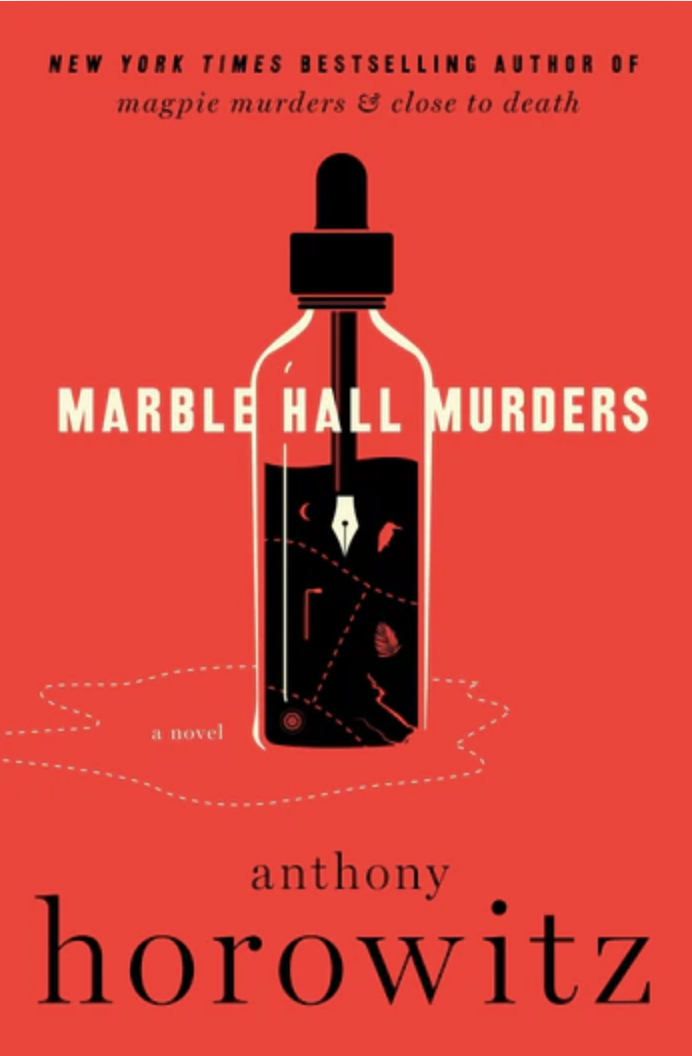
Number three in the Susan Ryeland series (after Magpie Murders and Moonflower Murders — both now streaming on Masterpiece). Susan was the editor of the fantastically successful Atticus Pünd detective series — from inception until disastrous events brought the series to an end. You’d think she would have had enough, but dire straights lead her to accept a job editing a continuation novel, written by Eliot Crace — a well-known loose cannon who is nevertheless blessed with a beloved children’s author as a (now deceased) grandmother.
It’s a classic story-within-a-story format — we’re reading the Crace novel as fast as he produces pages while simultaneously reading Ryeland’s story as she keeps sticking her nose into the author and the story, which continues to mirror reality to an uncomfortable extent. The two stories dovetail in weird and twisted ways and I never saw what was coming, though the clues were all there. I love Horowitz’s writing — clear and concise and bringing characters to life with minimal, essential, prose. The mystery (two in parallel really, one fictional and one not) is excellent on its own, but I also loved the meta layer exposure of the literary world — how writers write, the relationship between author and editor, and basic survival tips for the publishing industry. It’s full of anagrams, ethical discussions, and deliciously clever (albeit often evil) moves. I always appreciate a book that has no stupidity — intentional or not — in its pages!
Some facts new to me: According to the Authors, Licensing and Collecting society, the average salary earned by a novelist is a mere 7,000 pounds a year — not a lot (not even a little, really). There are around 200,000 books published in the UK every year ( and as many as 1 million in the USA) and as Horowitz writes: “How many of them do you really think are going to end up on the front table at Waterstones?.” Lastly, I had never heard of the Nazca lines in Peru — giant geoglyphs in a Peruvian desert dated between 500 BC and 500 AD that are so large they can be seen from space (for those who have read it, this reminded me of Vonnegut’s Sirens of Titan.
Easy read, completely engaging, and (IMHO) book clearly better than the Masterpiece series (which itself is very good, but the book is better)
Thank you to Harper and NetGalley for providing an advance copy of this book in exchange for my honest review. The book will be published on May 13th, 2025.
 Books to look forward to ...