
Behind You Is the Sea by Susan Muaddi Darraj (Literary Fiction)

Writing: 5/5 Characters: 5/5 Plot: 4.5/5

This is a beautifully written novel composed of interlinking stories about characters in a Palestinian-American community in Baltimore. Most are members of three families: the Baladis, Salamehs, and Ammars. The stories move linearly forward in time, while bouncing between different individuals and their points of view. This means that the narrative slowly moves from first generation immigrants to younger family members born in the U.S. Influences from their ethnic heritage and the American culture surrounding them drift downward through the generations, melding uniquely in each individual making for nuanced, discrete characters. This creates a kind of narrative arc through the stories so that it did feel novelistic despite the clear boundaries of the stories.

I enjoyed the diversity of the characters — more akin to the everyday “diversity” of different human beings than to the diversity of skin color or ethnicity since (almost) all the characters were Christian Palestinian-Americans. Some wealthier, some poorer, some professionals, some working class, from real estate moguls to housekeepers. Many stories dealt with some aspect of being a woman within this culture, ranging from pregnancies to divorce to education — basically different ways that women might make decisions that did not align as well with family expectations as some families might expect. However, family reactions were not all the same — sometimes the father would be unhappy (to various extents), sometimes the mother (or the aunt, siblings, etc). Sometimes things escalated badly, and in others acceptance and adaptation was the name of the game. Real people — all in the same “place,” all with different stories. Topics run the gamut include generation conflicts, teenage afflictions, racism (in multiple directions), domestic abuse, cultural misrepresentation, etc. From minor issues to major. Some sweet and uplifting, and some not, but all moving towards understanding and growth.

Beautifully written, wonderful characters, little or no political statements — see some quotes below.

Quotes:
“The day he dies, Baba looks skinny and surprised. When he sucks in the last breath, his mouth opens in an O, like America has shocked him at last, and freezes there. It’s like he finally understood he was never meant to win here.”

“Americans like to talk about everything, I know. They like to share their feelings, like purging old clothing, or dumping clutter. But when you’re like us, you purge nothing. You recycle or repurpose every damn thing. Nothing is clutter.”

“Arabs are ridiculous; even if they live a dream life, they want to star in some tragedy. If there is no tragedy, they imagine one.”

”Sometimes I think that is why I like science. Science doesn’t mind when you make a mistake. Instead, science gets kind of excited.”

“No, with the baby, with Baba fading, with ever-present work stress, now is a time to lie in the weak surface of water, to trust that its fragility could nevertheless keep her afloat. It could even, despite its transparency, carry her great distances.”

“Marcus realized then that, while some people talked about growing up poor, his parents had been a whole different level of poor. Barefoot poor. Starving poor. Babies dying from diarrhea poor, like Mama’s little sister, Amal, who had died before she was a year old. Sleep on rooftops in the summer poor. Go to mass at two different times so your siblings can share the good shoes poor. Boil weeds to make tea poor.”

“Americans like to talk about everything, I know. They like to share their feelings, like purging old clothing, or dumping clutter. But when you’re like us, you purge nothing. You recycle or repurpose every damn thing. Nothing is clutter.”

“Arabs are ridiculous; even if they live a dream life, they want to star in some tragedy. If there is no tragedy, they imagine one.”

”Sometimes I think that is why I like science. Science doesn’t mind when you make a mistake. Instead, science gets kind of excited.”

“No, with the baby, with Baba fading, with ever-present work stress, now is a time to lie in the weak surface of water, to trust that its fragility could nevertheless keep her afloat. It could even, despite its transparency, carry her great distances.”

“Marcus realized then that, while some people talked about growing up poor, his parents had been a whole different level of poor. Barefoot poor. Starving poor. Babies dying from diarrhea poor, like Mama’s little sister, Amal, who had died before she was a year old. Sleep on rooftops in the summer poor. Go to mass at two different times so your siblings can share the good shoes poor. Boil weeds to make tea poor.”

Sandwich by Catherine Newman (Literary Fiction — Humor)

Writing: 5/5 Characters: 5/5 Plot: 4/5 Humor: 5++/5

Ok, this book is just flat out funny. I snorted, giggled, and guffawed my way through it with only occasional pauses. But while it gets top top grades for humor, it has plenty of depth, too. Ostensibly about a week at the beach with an extended (and all adult) family, it’s a study of functional (as opposed to dysfunctional) family dynamics. Many readers seem to want intense drama, with earth shattering impact, but I love these close looks at how real people work and learn and connect. The themes are family, love, and life with plenty of personality, philosophy, and interaction thrown in and a strong focus on parenting, pregnancy, and reproduction. Also the (new to me) phrase “anticipatory grief.” Wow — I should have learned that one a long time ago…

I loved the characters and the way they interacted. Our first person narrator is Rocky (Rachel) — a mother so full of emotion and worry and menopausal heat she is constantly threatening to (metaphorically) explode. I liked the way husband Nick — even as told through her eyes — is depicted so completely and not just a bit player in Rocky’s drama. Without giving anything away, I thought he was masterfully written. I loved the multifaceted views of all of the characters — both as themselves and also as they were in relationship with each other. I also appreciated the way Newman dealt with daughter Willa — the requisite lesbian through whom plenty of social commentary on LGBTQ+ issues was included in a nice relaxed, off key way that both made me laugh and made me think.

I also loved the dialog — it was written the way I wish people would speak — fast, humorous, and with a high signal to noise ratio. General banter and friendly family squabbling throughout but always overlaid on clear, honest, and trusting communication. I could be laughing at the (over-the-top-of the-top menopause complaints and then be tearing up at the essential humanity and love concisely tucked into an honest exchange. Kind of a combination of Nora Ephron (humor), Matthew Norman (human exchange), and Anne Lamott (parenting and reflection).

I will say that the inside of Rocky’s head is a fun, but very tiring place to be and I’m glad I don’t live there permanently.

Quotes:

“Ugh, my voice! You can actually hear the estrogen plummeting inside my larynx.”

“… I say quietly, but my veins are flooded with the lava that’s spewing our of my bad-mood volcano. If menopause were an actual substance, it would be spraying from my eyeballs, searing the word ugh across Nick’s cute face.”

“People who insist that you should be grateful instead of complaining? They maybe don’t understand how much gratitude one might feel about the opportunity to complain.”

“I’m always Sherlock Holmesing around them all with my emotional magnifying glass, trying to figure out if anybody has any actual feelings and what those might be.”

“Also he will get out the innocuous-sounding foam roller that is actually a complex pain device designed by people who hate everybody. I’ve seen enough videos of cats terrorized by cucumbers to know what my face looks like when I suddenly see the foam roller.”

“Nick’s curiosity about feelings and the people who have them is fleeting at best.”

“Forty percent of my waking thoughts were about the children dying — the other sixty about sleep. I was ashamed of this demented pie chart.”

“A conversation like this might be a wolf in clown’s clothing, and he knows it. My rage is like a pen leaking in his pocket, and before long there will be ink on his hands, his lips.”

“I mince down the spiral staircase in my memory-foam slippers, all of my joints clacking like the witch in a marionette performance of Hansel and Gretel.”

“All of the names of everything have oozed out and away from the drainage holes menopause has punched into my memory storage.”

“My ancient father actually swimming in the ocean feels like a bridge too far in terms of what I can handle fretting about.”

Thank you to Harper and NetGalley for providing an advance copy of this book in exchange for my honest review. The book will be published on June 18th, 2024.

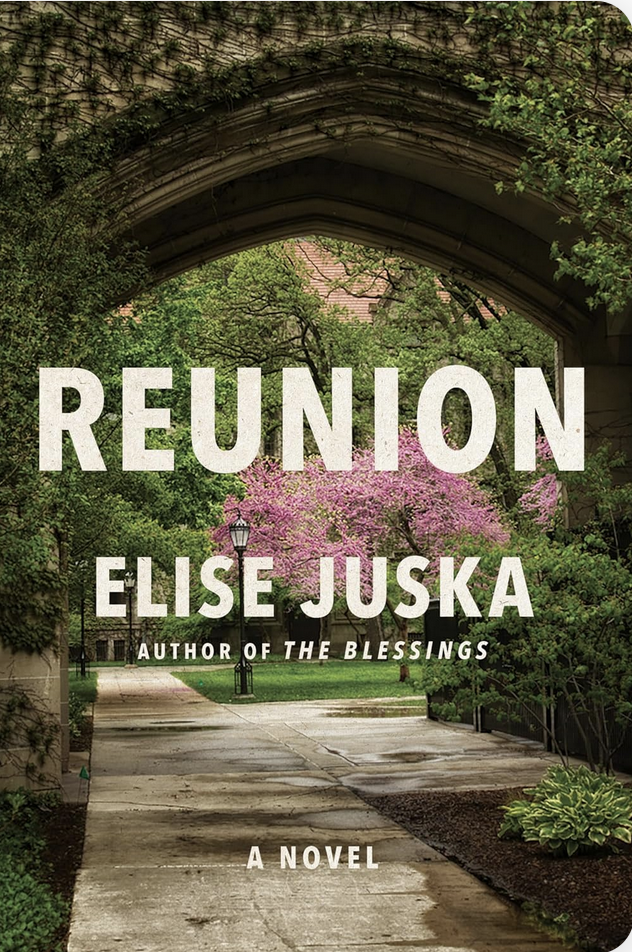
Reunion by Elise Juska (Literary Fiction)

June 2021 — Three friends anticipate a Covid postponed college reunion at the Maine campus. Hope — a stay at home mom with an increasingly distant husband — is desperate to return to what she remembers as her happiest time; Adam looks forward to reconnecting but feels guilt at leaving his perpetually sad wife with the twins in the house that she hasn’t left in a very long time; and NYC based single-mom Polly who doesn’t share her friends fond memories, but is persuaded to attend by her reclusive son who wants to visit a nearby friend.

This character-driven novel explores friendships and personal growth against the backdrop of lock down parenting and recovery alongside some pretty intense environmental anxiety. With every relationship comes inevitable clashes and this story covers quite a few. I particularly “enjoyed” the generational clashes — some familiar and some brand new to me as successive generations bear less and less in common with my own. Well written probes into the evolution of friendships
— what connects people with little in common and what decisions can impact the closeness over time. I really liked that the ending for all of our protagonists had a closure that was more about understanding the nature of their issues, thereby clarifying a path towards closure, rather than any kind of quick solution to the problem itself — because there really are no quick solutions to relationship issues…

One kind of funny (to me) quote as Hope thinks about her teenage daughter Izzy: “Meanwhile, Izzy was skeptical of all things where Hope was concerned. Her Spotify list. Her low-carb bread. Her Facebook posts — too frequent, too obviously curated — why was she even on Facebook? Her overuse of exclamation points. Her leather tote. Sometimes Hope secretly wondered if Izzy had become a vegan primarily to get on her nerves.”

Thank you to Harper and NetGalley for providing an advance copy of this book in exchange for my honest review. The book will be published on May 11th, 2024.