
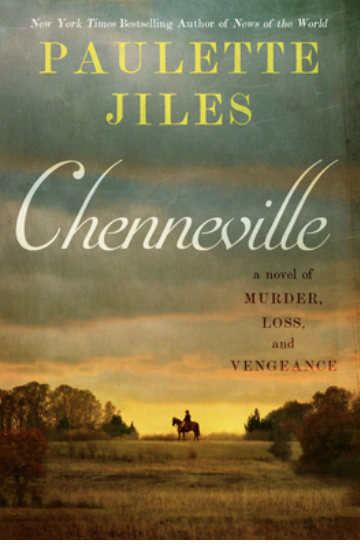
Chenneville by Paulette Giles (Historical Fiction)

Writing: 5/5 Characters: 4/5 Plot: 3.5/5

A beautifully written book that fits into the same post Civil War world as her News of the World and Simon the Fiddler. Jean-Louis Chenneville — once a successful farmer and gentleman — returns from the war a broken man having spent a year in the hospital in a semi-coma. He awakens to a dark world of ruin — Lincoln had been assassinated, Lee had surrendered, and the Gray Union army had gone home. His body and mind are slowly healing — his memory has wide gaps.

When he does finally get home, he gets worse news — news that sends him off on a long, single-minded journey to right a terrible wrong. Giles excels at bringing a place and time to life — in this case I almost wish she was a little less skilled. It is a depressing time — full of chaos, corruption, and despair. The war is over but things have not returned to any kind of normal — there is little stability in the South, with deep-seated hatreds and little consistent law enforcement.

The story is slow paced with characters — some unpleasant but many good people just trying to make things work again — introduced as part of his heroic journey. Each character had a unique backstory that highlighted all the different people who found themselves in this difficult time and place from a wide variety of starting points. My favorite part had to do with the telegraph operators that he met and the sub community they formed (with details completely and accurately belonging to the time period). There were definitely times that I wished we could have a little less atmosphere and more plot. The book was thick with description and I don’t visualize from textual description very well, which made some of the (albeit exquisitely depicted) passages tedious for me. I was happy with the ending, but until then it was a bit of a depressing read — depressing because of how hard that time really was, not because someone put a bunch of dramatic events to force readers into heavy emotions. I’m very glad I read it, but I wasn’t super cheerful during that week …

Some quotes:
“The clippers ran like teeth over the long scar. John shut his hands together with tense precision as if pain were a mathematical problem, as if he had just solved it and the solution did not include making a noise if he could help it. Sweat ran down his face.”

“The Ohio steamboat was better because the only movement was the unhinged, sliding feel of a vessel with a shallow keel as it moved across the water.”

“He tried to get a grip on himself. This was no way to live, in this messy chaos of despair.”

“People were draining south like wintertime migratory birds.”

“Every word seemed some strange phrase of dejection and unhappiness.”

Thank you to William Morrow and NetGalley for providing an advance copy of this book in exchange for my honest review. The book was published on September 12th, 2023
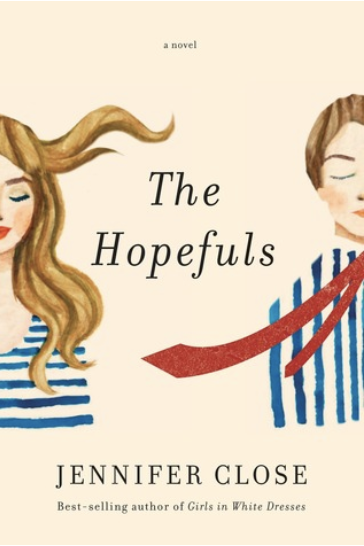
The Hopefuls by Jennifer Close (Literary Fiction — audio book)

Writing:5/5 Plot: 3/5 Characters: 4/5

Matt and Beth are the “Hopefuls.” A young couple — Matt a Harvard trained lawyer eager to run for office and Beth a literary type earning a pittance at various writing / editorial jobs. They move to D.C. shortly after Obama is elected, Matt having worked for the campaign and eager to get into politics full time. When their best friends (Jimmy and Ash) decide to move to Texas to run for the coveted role of Railroad commissioner (hint: apparently has very little to do with railroads!), Matt and Beth go with them, Matt running Jimmy’s campaign. Jimmy is a democrat running against a well funded Republican — in TEXAS — so to say it is hard going is a bit of an understatement.
Beth is the narrator, so the point of view is far more focused on relationships (among all four of them) than on political strategy. She is quite observant, and the unfolding story is full of the kind of nuance and detail that makes people so interesting (and irritating and in this case — a bit whiny for my taste).
The writing is excellent, the story completely believable. My big problem — I did not like any of the characters. None of them were bad people, but they were not people I would have wanted to spend any time with. None of them. Matt was super intelligent and focused but clammed up when he was frustrated, and he was frustrated a lot. Beth didn’t do anything. She was so passive that I wanted to kick her.
Listened to it on audio, and the reader was excellent. The slower pace (I read very fast) really showed off the detail that I might have missed, and the reader really “got” the emotions in the narration. But it also meant a longer time dealing with characters who were irritating me!!

The Field Guide to the North American Teenager by Ben Philippe (YA)

Writing: 4/5 Plot: 4/5 Characters: 4.5/5 Pleasure reading: 5/5

Great YA book! This will be on my top YA book list for the year.

Norris Kaplan, a black French Canadian, born to immigrant Haitian (now divorced) parents, is forced to move to Austin, Texas, so that his mother can follow up on a rare opportunity: a tenure track position at UT Austin as a Creole and Patois scholar. He leaves behind a reasonable (to him) climate, his hockey team, and his best friend. He doesn’t like Texas, or the U.S., or cheerleaders, or football jocks. He doesn’t like the heat, or the constant sweating, or the requisite T-shirt changes. It made sense to him that everything in Texas was bigger: “With this much heat, you needed shadows.” He makes a lot of negative assumptions about everyone he meets, even as he is sure they are making negative assumptions about him.

It’s the classic “Outsider in High School” plot line, but executed beautifully, unconventionally, and laugh-out-loud funny. Norris is grumpy and always expects the worst of everyone. Almost against his will, he makes a friend (Liam — the monk — who Norris admits is “an aggressively chill human being”), helps a cheerleader with her work schedule in exchange for dating tips, and even begins to see the jocks (embodied by Patrick aka “Hairy Armpits”) in a new light.

An hysterical, coming-of-age story, where I liked the protagonist a lot at the beginning, but liked him even more by the end.

Great quotes:
“Texas cheerleaders really are just laboratory-engineered little bags of evil, aren’t they?”

“As he suspected, Original Thought had died in the desert on its way to Texas, baked under the sun for a few miles, and been slaughtered for sustenance when provisions had dwindled.”

“It wasn’t that he didn’t know what to do at parties. He just found them viscerally boring: like getting dressed for a big night out and then spending your evening in an intermission lobby, bumping against people you vaguely recognize and fumbling to align conversation topics for brief windows of validation.”

Maddie (the cheerleader) wants to help him with his dating disasters: “We’re talking about dating here. I’m the genius janitor, there’s a complex equation on the chalkboard after hours … Give me some chalk and let me solve it!”

The News of the World by Paulette Jiles

Writing: 4 Characters: 4 Plot: 3.5

A Wild West story that by no means glorifies the period. Captain Jefferson Kidd — seventy two years old and making his living by reading the “news of the world” to audiences around Texas for a dime a piece — takes on a troubling task: to return a ten-year old white girl to relatives after being kidnapped by the Kiowa four years before. She is not a willing passenger: she has no memory of her original parents and has been thoroughly “Indianized”. She speaks only Kiowa and can’t bear crowds, western clothing, or being indoors.

The time is 1870 — shortly after the end of the Civil War. Texas appears almost lawless with tensions running high between those supporting different candidates and all the men with any law enforcement experience sent away. Kidd reads the news in order to bring the exotic into people’s lives — he avoids controversial topics and prefers to “escort” his audience’s mind “into the lands of the imagination — far places, crisp ice mountains, falling chimney pots, tropical volcanoes.” The news items he reads, and many of the characters he runs into, are historic: Britt Johnson, the Horrell brothers, the Cinncinnati red stockings (the first professional baseball team), Ada Kepley (the first female law graduate), a new bridge from Manhattan to Brooklyn …

It’s a long distance from where he picks up the girl to where she is to be delivered. On the way are multiple opportunities to describe landscape, daily details (broom making machine, meat grinders, US soldiers guarding any assembly), thieves and outlaws, and people trying to muster the courage to be good in a world gone haywire. While the girl grows to trust the Captain, the Captain becomes less happy about what she will face upon delivery. Everything we know about the girl we know from Captain Kidd’s perspective. He is the only person in the story who appears to be able to empathize with her and he does it beautifully. With his age and experience, he is better able to express her experience than she is herself.

A short, fast, read that feels more like catchy journalism than a typical novel (the detail gives it a sense of veracity not often found in historical fiction). Good writing! A few sample lines:

“Captain Kidd could not make himself back down, it was not a thing for which he had any aptitude, nor had he ever, and it was far too late in life to change.”

“Captain Kidd looked up and enviously considered the chickens — so daft, so stupid, so uninformed.”

”He could almost hear the jointed sound as one vertebrae settled on another.”