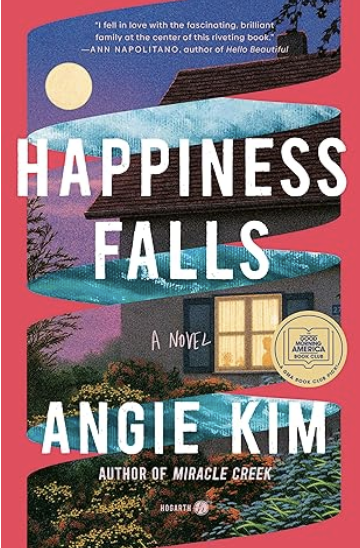
Happiness Falls by Angie Kim (Literary Fiction)

Mia’s family is unusual to say the least. Half Korean, half white, a working mother and a stay-at-home father, wildly different fraternal twins (Mia and John), and a younger brother (Eugene) who has both Autism and Angelman’s Syndrome (also known as the Happiness Syndrome as it is characterized by a happy demeanor). While Mia is hyperlexic (new word for me) and ultra analytic (sinking often into her vortex mode as in “warning, warning you’re sinking into a vortex of over analysis”), her twin John is ADHD, with a heavy emphasis on the H. Their mother is a linguist (who once helped with the libretto of a Vulcan opera) and their father is engaged in some very interesting “Happiness” research while caring full time for the now teenaged Eugene.

One day, the father goes missing and a very distraught Eugene — the only witness — makes it home on his own in a disheveled mess — without the ability to communicate anything about what occurred. What follows is an intricate plot to solve the mysteries of both the missing father and the essence of Eugene, complete with detectives, crowdsourced clues, behavioral specialists, plenty of confusion and misdirection, and some real surprises. The plot is engaging enough to attract most readers on its own, but what intrigued me was the obsessively interesting characters. The inner meanderings of our narrator (Mia — explained in the first pages as her compulsive need to digress) traipsed through philosophy, neurology, linguistics, human perception, music and emotion, modes of communication, and most especially the tools and abilities for understanding oneself and others — especially those others who do not function in the same way as yourself. Lots of research on conditions such as Eugene’s woven seamlessly into the narrative. While none of this would get in the way of a plot-oriented reader finding fulfillment, to me it was a Disneyland of intellectual treats that actually propelled the story forward.

Apropos of nothing, the author had a fantastic working vocabulary — I particularly liked the phrase “titular panache” — tickled me.

Highly recommended!
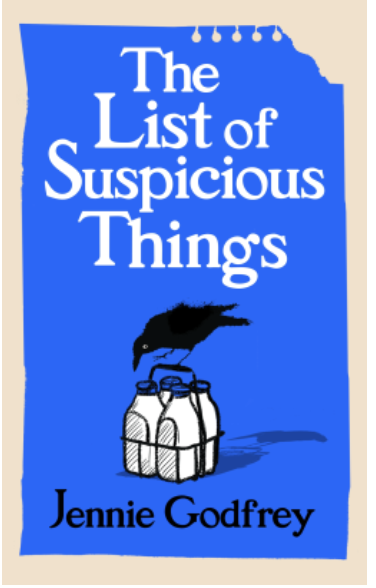
The List of Suspicious Things by Jennie Godfrey (Literary Fiction / Mystery)

A coming-of-age story told by a precocious 12-year old set in the time of the Yorkshire Ripper (late 70s). Miv and her best friend Sharon decide to find the Ripper themselves when their world starts falling apart due to the constant threat. They start by compiling a list of suspicious things about the people around them, and as they pursue investigations on multiple fronts, they learn a great deal about life. The unfolding stories of various people in their community are always instructive — some in bad ways and others in good. Miv learns about bullies, racism, grief, and even domestic abuse, but also about the importance of standing up for yourself and others, doing the right thing, tolerance, curiosity, friendship and love.

I liked the writing a great deal — Miv’s voice is unique, appealing, often humorous, and a good deal more exposed than an actual person might agree to. Never overdone or overly dramatic, but also never, ever vapid. I loved the way we got to know characters who appeared one way but easily morphed into a more complex (and much more likable) person with a little time and exposure. The ending was a real surprise, but well done and thought provoking.

Thank you to Sourcebooks Landmark and NetGalley for providing an advance copy of this book in exchange for my honest review. The book will be published on December 2nd, 2025.

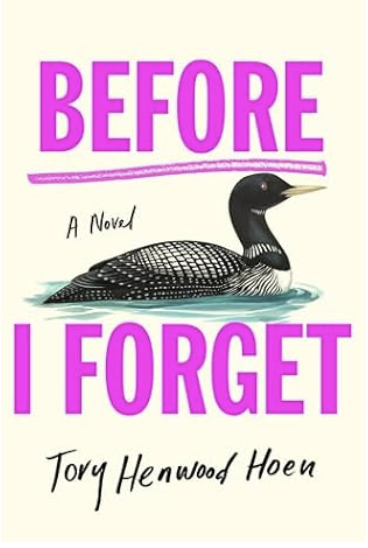
Before I Forget by Tori Henwood Hoen (Literary Fiction)

This is the long-delayed coming-of-age story of a 26-year old going home to care for her Alzheimer-ridden father. And let me immediately reassure you that there is absolutely nothing depressing in any of it. What I began reading with trepidation (I’m not looking for depressing stories!) pulled me forward with increasing amounts of humor, human insight, and beyond touching moments (so yes, I teared up frequently, but from seeing substance, not sadness).

Cricket quits her job as an underutilized gofer for an over-the-top healthcare company that peddles an infinite array of body rejuvenation at very high prices. Instead, she heads to her favorite place (their home in the Adirondacks) and her beloved father — neither of which she has seen since a decade old tragedy left her beyond bereft and thoroughly guilt-ridden. From here the story takes off in unexpected ways with engaging characters, possible connections to the spiritual world, some unexpected business opportunities, and many chances to rethink the past. Throughout all of it, Cricket moves toward self understanding, forgiveness, and a stronger connection to those about her.

The writing is very good — the prose, pacing, and plot elements all perfectly tuned to Cricket’s growth without demeaning the roles of others in her story. I loved the insight and the messaging and the way Cricket always behaved in a principled manner — even when she was confused or afraid. I loved the different out-of-the-box ways dementia was portrayed, without downplaying the difficulty and loss. I loved the way personality traits could be interpreted in opposites: was someone passive or patient? Complacent or content? Insatiable or intrepid?). And I loved the humor applied to the situations and characters — particularly the buffoonish commentary on new age health gurus and products (see some of my favorite quotes below).

One of my favorite books this year.

Some great quotes:
“I am only 26, which means I am essentially a larva. In contemporary America, childhood can last well into one’s 30s, 40s, and even 50s.”

“What if Alzheimers isn’t just a slow death? What if it’s another dimension entirely – an ascension even? Humans are so fixated on our minds that we see their loss as a tragedy. But what if it’s a gift? Maybe the erosion of memory clears space for something truer. Maybe the intellect gets in the way of the heart, until little by little, it doesn’t.”

“My mother once told me I was too passive, but I prefer to think of myself as patient. There are some problems that solve themselves if you simply wait a while.”

“I have a vague feeling that, when it comes to my life, not only am I sitting on the sidelines, but I’m playing the wrong game altogether. As I look around at the leftover mess from the weekend, I think: I’m ready to be something other than young.”

“I was impressed by her confidence and conviction – two things I was lacking. When you are full of questions, you are drawn to people who look like answers.”

“You could spend all day exfoliating, lifting, moisturizing, resurfacing, deep conditioning, buffing, harmonizing, depilating, and rejuvenating your bodily surfaces, but at the end of that day, your soul will still ache for what it really wants: freedom from the consumptive cycle of never feeling or looking quite good enough. We’ve conflated health with vanity. It’s not that I don’t believe in healing; I just don’t believe you can buy it for $78 an ounce.”

Thank you to St. Martin’s Press and NetGalley for providing an advance copy of this book in exchange for my honest review. The book will be published on December 2nd, 2025.

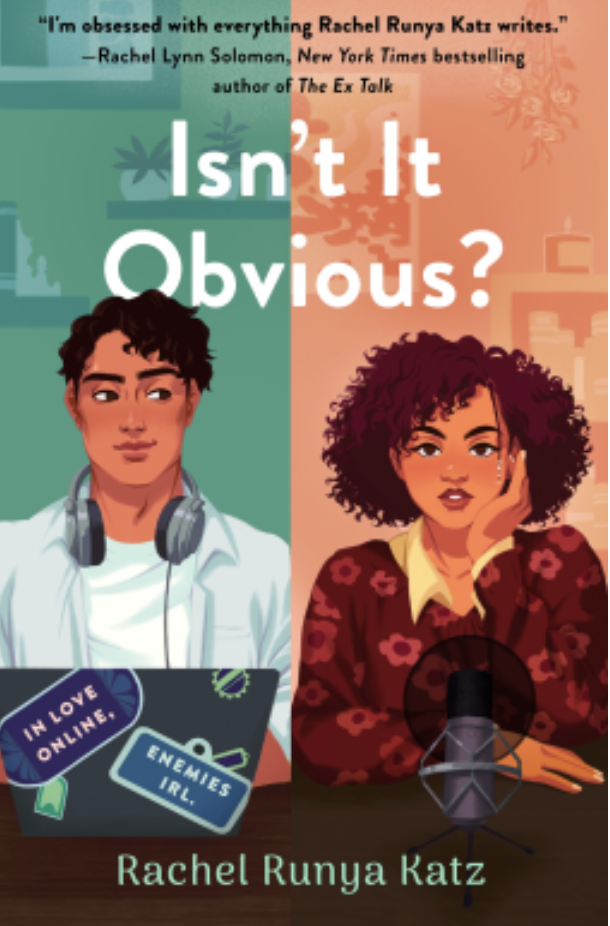
Isn’t it obvious by Rachel Runya Katz (Fiction)

Yael: public school librarian, runs a queer teen book club, podcasts on books that should be banned (she is highly opinionated), searches for the right antipsychotic. Ravi: part-Trinidadian social media designer and tech wizard who uprooted his life to help his brother care for his young daughter. The opening scene in the book? Where the two “sort of” meet? Masterfully done and priceless.

It’s a mix of “you’ve got mail” and “enemies to lover” tropes immersed in a multi-racial, queer, social media saturated situation. Great dialog, fun epistolary (email based) segments that perfectly recreate the excitement of slowly emerging emotions, interesting characters who are both completely foreign to me and surprisingly relatable and likable. I enjoyed getting to know them, though I doubt I would have had any opportunity to do so in real life.

I liked that the book felt like a story, not an agenda. The characters spent more time trying to make things better and not being confrontational and argumentative (although snide comments were obviously both allowed and encouraged). I liked the phrase “competency crush,” which I hadn’t heard before (but which I have a lot of). I generally enjoyed it and picked up several new ways of looking at things.

BUT — some bizarre (to me) nasty asides about a couple of my favorites. Ray Bradbury racist and homophobic? I’ve read everything the man has ever written and can’t think of anything that would earn him those epithets. The author of the Five Love Languages? The ONLY self-help book I’ve found illuminating and helpful? Katz writes: “the guy who wrote the love languages book is actually an intensely conservative Christian, who basically thinks the solution to all marital problems is to conform to gender roles.” I have no idea about Chapman’s background or opinions of gender roles, but there is nothing in the book that suggests Katz’ opinion. For me this smacks of labeling anyone negatively if they don’t completely adhere to your way of thought. Still enjoyed the book, but those barbs hurt and made me wonder at a generation so willing to toss aside a whole person’s work because someone tossed an unpopular label on them.

Thank you to St. Martin’s Griffin and NetGalley for providing an advance copy of this book in exchange for my honest review. The book will be published on October 21st, 2025.